


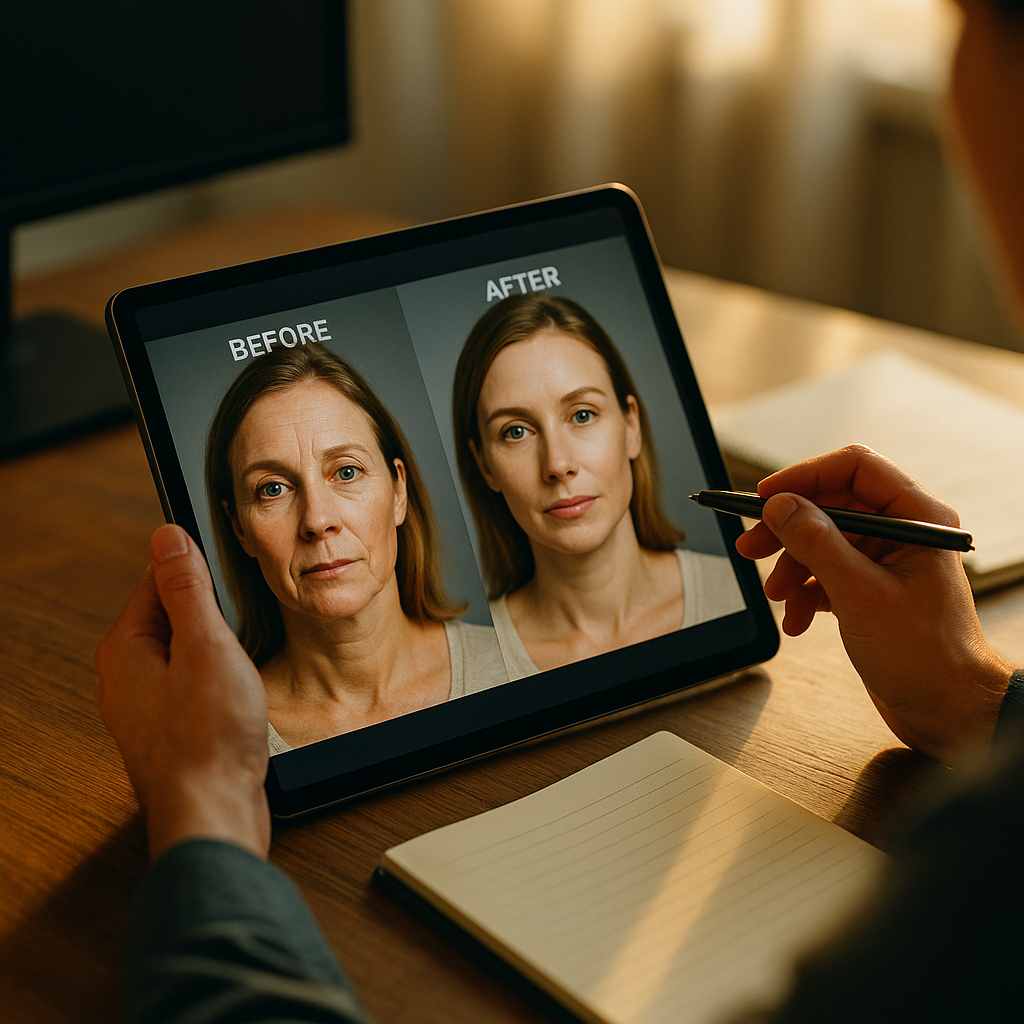
Seventy-one percent of consumers say they’ve encountered a “before-and-after” post they later learned was digitally altered, according to recent Statista consumer trust surveys. Now imagine that same skepticism aimed at your brand, backed by a federal investigator instead of a skeptical scroller. That’s the reality shaping every AI-generated before-and-after claim published under current FTC enforcement priorities, and it’s why substantiation can no longer be an afterthought.
Before-and-after content used to be simple: a photo, a timeframe, maybe a testimonial. Now it’s generative AI smoothing skin, adjusting lighting, or synthesizing an “after” state that never quite happened the way the pixels suggest. Regulators have noticed. Brands that treat this as a creative choice rather than a legal exposure point are the ones getting named in complaints.
Why This Is Suddenly a Front-Burner Issue
The FTC has spent the past several enforcement cycles building a paper trail around deceptive visual claims, and AI-generated content has moved from a niche concern to a primary target. The agency’s guidance under Section 5 of the FTC Act has always prohibited unfair or deceptive practices, but the addition of generative tools into creator workflows introduced a new failure mode: claims that look photographically real but were never captured as real events.
Think about a skincare brand running a 30-day influencer challenge. The creator posts a “before” selfie, then an “after” shot generated or heavily enhanced with AI retouching tools. Even if the underlying product worked, the visual now overstates the result. That gap between what happened and what’s shown is exactly what regulators are trained to catch.
If your legal team can’t produce the raw, unedited source files behind a before-and-after claim within 24 hours of a request, you don’t have substantiation — you have a liability.
This isn’t theoretical. The FTC’s recent enforcement pattern around AI-generated demand gen video ads shows the agency is actively scrutinizing synthetic media across the full funnel, not just top-of-funnel advertising. Creator content sits squarely inside that scope.
What “Substantiation” Actually Means Now
Substantiation isn’t a disclaimer. It’s evidence. The FTC has long required that advertisers possess a “reasonable basis” for objective claims before they’re made, not after a complaint lands. For before-and-after content, that reasonable basis now needs to account for AI’s role in production.
Practically, this means brands and agencies need:
- Unedited source images or video, timestamped and metadata-intact, stored before any AI enhancement occurs.
- A documented enhancement log noting exactly which AI tools touched the asset and what they changed (skin smoothing, color grading, background replacement, etc.).
- Creator attestations confirming the depicted results reflect actual personal experience, not a composite or aspirational render.
- A retained clinical or performance basis for any implied outcome claim (weight loss, skin clarity, muscle gain) that goes beyond cosmetic editing.
Notice that none of this stops brands from using AI. It stops brands from using AI invisibly. The distinction matters enormously to an investigator, and it should matter just as much to your legal team.
The Disclosure Layer Nobody Wants to Add
Here’s the uncomfortable part. Even with airtight documentation, undisclosed AI enhancement in a before-and-after claim can still trigger liability if a reasonable consumer would be misled about what they’re seeing. Documentation protects you in an investigation. Disclosure protects you from the investigation happening in the first place.
The practical fix is a clear, proximate disclosure: “Results digitally enhanced” or “AI-adjusted for lighting/color” placed directly on or adjacent to the image, not buried in a caption’s fifth line or a pinned comment. This mirrors the logic the FTC has applied to other synthetic content categories, including the disclosure standards now expected for AI search-cited creator content, where the agency has made clear that omission itself can be the deceptive act.
Brands running influencer programs at scale should treat this the same way they treat sponsorship disclosure: non-negotiable, templated, and enforced through contract language rather than creator goodwill.
Where Liability Actually Lands
A common misconception: brands assume the creator carries the legal risk because they posted the content. Wrong. The FTC has repeatedly held brands, agencies, and platforms jointly accountable when material connections and substantiation failures occur, especially when the brand supplied the AI tools, the script, or the campaign brief driving the claim.
This liability question gets murkier when editing happens post-capture. If your agency’s editing team runs a creator’s raw footage through an AI enhancement suite before approval, who’s responsible for the resulting claim? The creator who shot it, or the brand that polished it? Recent analysis of script editing and material connection risk suggests the answer increasingly points back to whoever controlled the final edit, not just whoever appeared on camera.
Add another wrinkle: automated approval workflows. If your team uses AI to auto-approve creative at scale without a human substantiation check, you’ve effectively removed your own safety net. The growing body of guidance on AI auto-approved creative liability makes clear that automation doesn’t dilute responsibility. It just delays when you discover the problem.
Automated approval doesn’t remove liability. It just moves the discovery of a compliance gap from your review queue to a regulator’s inbox.
Building an Actual Substantiation File
Legal teams love the word “file” because it implies something concrete exists somewhere. Here’s what that file should contain for every before-and-after asset in a creator campaign:
- Capture metadata: original file, device/camera data, timestamp, and geolocation if available.
- Edit trail: version history showing every AI tool applied, in sequence, with screenshots of settings where possible.
- Creator sign-off: a signed statement that the after-state reflects genuine personal results, distinct from the standard FTC material connection disclosure.
- Substantiation basis: underlying data, study, or performance metric supporting any implied functional claim.
- Disclosure placement proof: screenshot confirming the AI-enhancement disclosure appeared in the published version, not just the draft.
Store this centrally, not in a creator’s personal drive or a scattered Slack thread. Campaigns get audited months, sometimes years, after they run. If your only record is a deleted DM thread, you don’t have a defense.
This is also where brands often underinvest relative to the risk. According to eMarketer data on influencer marketing spend growth, brands are pouring more budget into creator content than ever, yet compliance infrastructure hasn’t scaled proportionally. That mismatch is exactly where enforcement actions originate.
How This Connects to Broader AI Ad Compliance
Before-and-after claims don’t exist in a vacuum. They’re part of a wider tightening around synthetic and AI-assisted content that’s already reshaped adjacent categories. Alcohol brands are facing fresh scrutiny over AI ad compliance risk tied to lifestyle depiction claims. Retailers are being forced to rethink personalized pricing disclosure as AI-driven personalization expands. The common thread across all of it: the FTC’s enforcement posture assumes AI capability implies AI responsibility. If your tools can generate a misleading impression, your compliance program has to assume they eventually will, absent controls.
Brands with mature influencer programs should be running quarterly audits specifically on visual claim categories, not just disclosure language. Pull every before-and-after asset published in the last quarter. Check the file trail. If you can’t reconstruct the substantiation basis in an afternoon, that’s your signal to rebuild the process before regulators force you to.
What a Reasonable Compliance Timeline Looks Like
Legal teams asking “how fast do we need to fix this” should think in three phases:
- Immediate (this quarter): Add mandatory AI-disclosure language to all before-and-after creative templates and creator contracts.
- Near-term (next two quarters): Build a centralized substantiation repository with mandatory metadata capture for every visual claim asset.
- Ongoing: Quarterly audits cross-referencing published creative against the substantiation file, with escalation protocols for gaps.
That escalation piece matters more than most legal teams realize. A documentation gap discovered internally is a fixable process failure. The same gap discovered by an FTC investigator is evidence of willful disregard. Teams building broader escalation frameworks, like those outlined in a compliance escalation matrix for vertical media ads, should extend that same rigor to visual claim substantiation specifically.
The FTC has signaled, through both formal guidance and enforcement patterns, that it views AI-enhanced visual claims as a distinct risk category deserving its own controls, not an extension of existing image-editing norms. Treat it that way internally, and you’ll be ahead of most of your competitive set.
The Bottom Line
Substantiating AI-generated before-and-after claims isn’t about slowing down creative production. It’s about building a documentation habit that survives scrutiny. Start with one campaign, build the file structure, and template it across every creator partnership before your next audit — internal or otherwise — forces the issue.
Frequently Asked Questions
What counts as an “AI-generated” before-and-after claim under current FTC standards?
Any before-and-after visual where generative AI or AI-assisted editing tools altered the depicted result, including skin smoothing, background replacement, color correction that changes perceived outcome, or fully synthesized “after” imagery. The FTC’s standard focuses on whether a reasonable consumer would be misled about what actually occurred, regardless of the specific tool used.
Does a disclaimer alone satisfy FTC substantiation requirements?
No. Disclosure and substantiation are separate obligations. A disclaimer like “results may vary” addresses expectation-setting, but it doesn’t replace the underlying evidence file proving the claim has a reasonable factual basis. Brands need both a clear AI-enhancement disclosure and a documented substantiation trail.
Who is liable if a creator uses AI editing tools without the brand’s knowledge?
Liability can extend to the brand if the brand supplied the campaign brief, approved the final asset, or benefited from the claim, even without directly instructing the AI edit. This is why creator contracts should explicitly require disclosure of any AI enhancement applied before submission for approval.
How long should brands retain before-and-after substantiation files?
Best practice is to retain full substantiation files, including raw source assets, edit logs, and creator attestations, for at least the duration of the campaign plus several years afterward, aligned with your organization’s general advertising records retention policy. Regulatory inquiries can arise well after a campaign has ended.
Can brands still use AI enhancement in creator content at all?
Yes. The FTC isn’t prohibiting AI-assisted editing; it’s requiring transparency and evidence. Brands that disclose AI involvement clearly and maintain a documented substantiation file can continue using these tools without the same level of enforcement exposure.
Frequently Asked Questions
What counts as an “AI-generated” before-and-after claim under current FTC standards?
Any before-and-after visual where generative AI or AI-assisted editing tools altered the depicted result, including skin smoothing, background replacement, color correction that changes perceived outcome, or fully synthesized “after” imagery. The FTC’s standard focuses on whether a reasonable consumer would be misled about what actually occurred, regardless of the specific tool used.
Does a disclaimer alone satisfy FTC substantiation requirements?
No. Disclosure and substantiation are separate obligations. A disclaimer like “results may vary” addresses expectation-setting, but it doesn’t replace the underlying evidence file proving the claim has a reasonable factual basis. Brands need both a clear AI-enhancement disclosure and a documented substantiation trail.
Who is liable if a creator uses AI editing tools without the brand’s knowledge?
Liability can extend to the brand if the brand supplied the campaign brief, approved the final asset, or benefited from the claim, even without directly instructing the AI edit. This is why creator contracts should explicitly require disclosure of any AI enhancement applied before submission for approval.
How long should brands retain before-and-after substantiation files?
Best practice is to retain full substantiation files, including raw source assets, edit logs, and creator attestations, for at least the duration of the campaign plus several years afterward, aligned with your organization’s general advertising records retention policy. Regulatory inquiries can arise well after a campaign has ended.
Can brands still use AI enhancement in creator content at all?
Yes. The FTC isn’t prohibiting AI-assisted editing; it’s requiring transparency and evidence. Brands that disclose AI involvement clearly and maintain a documented substantiation file can continue using these tools without the same level of enforcement exposure.
Top Influencer Marketing Agencies
The leading agencies shaping influencer marketing in 2026
Agencies ranked by campaign performance, client diversity, platform expertise, proven ROI, industry recognition, and client satisfaction. Assessed through verified case studies, reviews, and industry consultations.
Moburst

-
2

The Shelf
Boutique Beauty & Lifestyle Influencer AgencyA data-driven boutique agency specializing exclusively in beauty, wellness, and lifestyle influencer campaigns on Instagram and TikTok. Best for brands already focused on the beauty/personal care space that need curated, aesthetic-driven content.Clients: Pepsi, The Honest Company, Hims, Elf Cosmetics, Pure LeafVisit The Shelf → -
3

Audiencly
Niche Gaming & Esports Influencer AgencyA specialized agency focused exclusively on gaming and esports creators on YouTube, Twitch, and TikTok. Ideal if your campaign is 100% gaming-focused — from game launches to hardware and esports events.Clients: Epic Games, NordVPN, Ubisoft, Wargaming, Tencent GamesVisit Audiencly → -
4

Viral Nation
Global Influencer Marketing & Talent AgencyA dual talent management and marketing agency with proprietary brand safety tools and a global creator network spanning nano-influencers to celebrities across all major platforms.Clients: Meta, Activision Blizzard, Energizer, Aston Martin, WalmartVisit Viral Nation → -
5

The Influencer Marketing Factory
TikTok, Instagram & YouTube CampaignsA full-service agency with strong TikTok expertise, offering end-to-end campaign management from influencer discovery through performance reporting with a focus on platform-native content.Clients: Google, Snapchat, Universal Music, Bumble, YelpVisit TIMF → -
6

NeoReach
Enterprise Analytics & Influencer CampaignsAn enterprise-focused agency combining managed campaigns with a powerful self-service data platform for influencer search, audience analytics, and attribution modeling.Clients: Amazon, Airbnb, Netflix, Honda, The New York TimesVisit NeoReach → -
7

Ubiquitous
Creator-First Marketing PlatformA tech-driven platform combining self-service tools with managed campaign options, emphasizing speed and scalability for brands managing multiple influencer relationships.Clients: Lyft, Disney, Target, American Eagle, NetflixVisit Ubiquitous → -
8

Obviously
Scalable Enterprise Influencer CampaignsA tech-enabled agency built for high-volume campaigns, coordinating hundreds of creators simultaneously with end-to-end logistics, content rights management, and product seeding.Clients: Google, Ulta Beauty, Converse, AmazonVisit Obviously →