


Three regulators, one ad. That’s the math brands are ignoring. A single vertical video running on TikTok Shop or Instagram Reels can simultaneously trip an FTC disclosure violation, a state attorney general consumer-protection statute, and a platform’s own community guidelines — and most legal teams have no idea which one to respond to first. A compliance escalation matrix for vertical media ads isn’t a nice-to-have anymore. It’s the only thing standing between a fixable mistake and a multi-jurisdiction mess.
Why does this keep happening? Because most brands built their compliance workflows for a world where one regulator, one channel, one violation type was the norm. That world is gone.
Why Vertical Video Ads Trigger Overlapping Jurisdiction
Vertical media — TikTok Shop, Reels, Shorts, Spark Ads — collapses the funnel. Discovery, disclosure, and checkout happen in the same fifteen seconds. That compression is exactly why one piece of creative can generate three separate legal exposures at once.
Consider a livestream shopping event with a countdown timer pushing “only 12 left” while an influencer fails to disclose a paid partnership. That’s a potential FTC Section 5 deceptive-practices issue for the missing disclosure, a state-level deceptive scarcity claim under statutes like California’s UCL or New York’s GBL 349, and a platform policy strike for violating branded content rules. Three tracks, three timelines, three sets of remedies. We’ve covered how countdown timers create scarcity law risk in isolation — but the real operational failure is treating these as sequential problems instead of parallel ones.
The average brand compliance workflow assumes one regulator per incident. Vertical commerce ads routinely generate three simultaneous violations — and most escalation paths were never built to run in parallel.
The Core Problem: Silos Don’t Talk to Each Other
Legal, brand safety, and platform relations teams typically operate as separate functions with separate reporting lines. Legal tracks FTC consent decrees. A trust and safety liaison manages platform strikes. Someone in state affairs — if that role exists at all — monitors AG activity. None of them share a dashboard. None of them have agreed on who owns the first 24 hours of a multi-track violation.
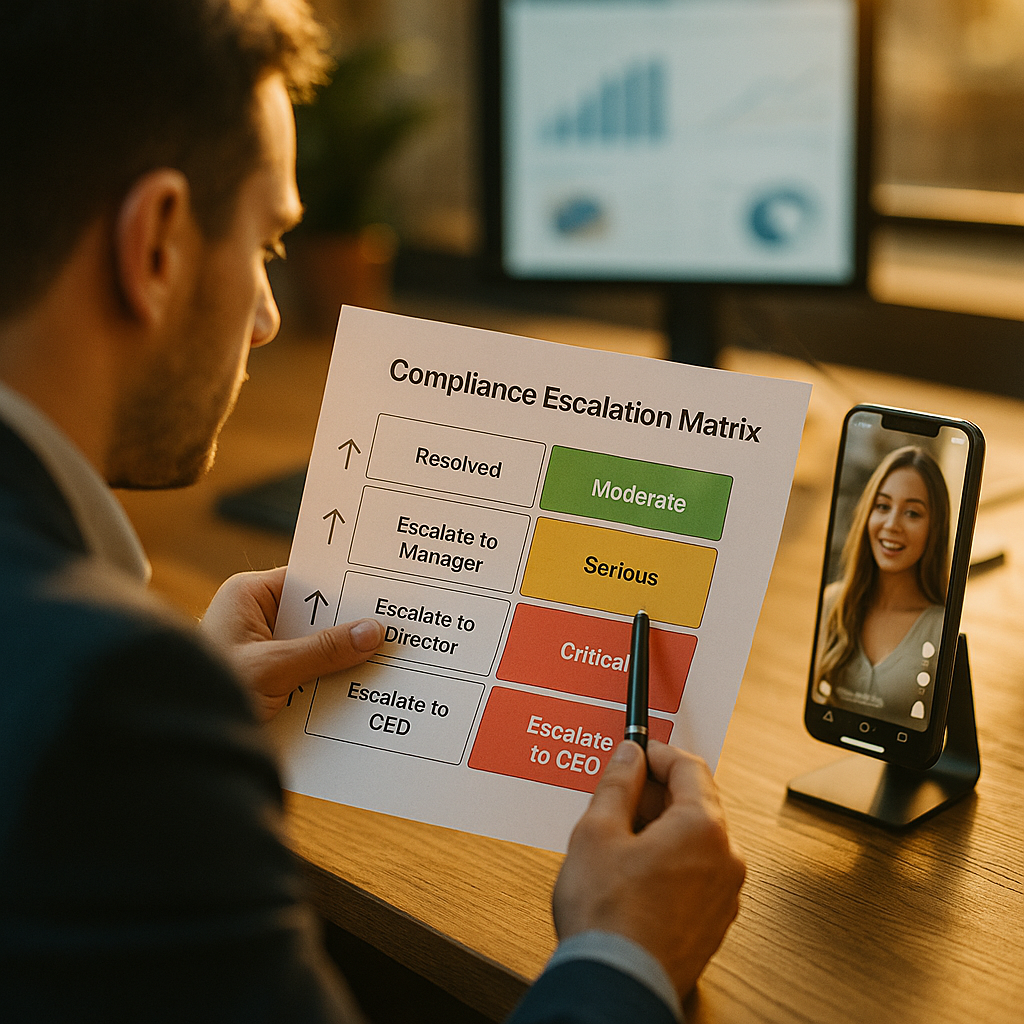
That’s the gap an escalation matrix is designed to close. It’s not a policy document. It’s an operational map that tells every stakeholder, in advance, what happens the moment a violation crosses into a second or third regulatory lane.
Building the Matrix: Four Tracks, One Trigger Point
A working escalation matrix needs to map four distinct tracks against a single triggering event, not four separate incident types. Here’s the structure that holds up under pressure:
- Track 1 — FTC exposure: Material connection disclosures, endorsement guide compliance, and Section 5 deceptive practices. This track owns the fastest clock — the FTC has shown willingness to act on unfair or deceptive ad practices within weeks of a complaint, not months.
- Track 2 — State AG exposure: Consumer protection statutes vary by state, and enforcement priorities shift with each administration. California, New York, Texas, and Washington have all brought influencer-adjacent actions in recent cycles. This track needs its own counsel relationships, not a rerouted federal team.
- Track 3 — Platform policy: TikTok, Meta, and YouTube each maintain independent branded content and commerce policies that don’t map neatly to legal statutes. A platform can suspend shop privileges for a violation that isn’t illegal — just against terms of service.
- Track 4 — Contractual/creator exposure: The creator agreement itself. Who indemnifies whom? Does the contract require creators to carry disclosure liability, or does the brand absorb it by default?
Each track needs its own owner, its own response window, and its own escalation trigger — but all four need to report into a single incident coordinator who decides whether the violation is isolated or compounding.
Who Owns the First Call?
This is where most matrices fall apart in practice. Legal wants to own everything because it’s “legal risk.” But legal teams are rarely fast enough for platform-level takedowns, which can happen in hours. Trust and safety teams move fast but don’t have authority to assess FTC exposure.
The fix: designate a single incident coordinator — not necessarily a lawyer — whose only job is triage. This person’s first move isn’t fixing the problem. It’s classifying it against the matrix: Is this FTC-only? Is this platform-only? Or does it touch all three?
That classification decision should take under two hours. Every hour beyond that is an hour a platform algorithm might be suppressing your content, a state AG office might be logging a complaint, or a competitor might be screenshotting the violation for their own PR purposes.
Severity Tiers Change the Escalation Path
Not every violation deserves the same response. A missing #ad hashtag on a low-reach creator post is not the same emergency as a livestream selling counterfeit-adjacent goods with fabricated urgency claims. Build three severity tiers into the matrix:
- Tier 1 — Correctable: Missing disclosure, minor labeling issue. Fix within 24 hours, document the correction, notify no external party unless platform flags it first.
- Tier 2 — Reportable: Pattern of disclosure failures across a campaign, or a platform strike that threatens shop status. Legal and platform relations coordinate jointly; outside counsel gets looped in for a risk memo.
- Tier 3 — Multi-jurisdictional: Any violation where FTC, state AG, and platform tracks converge — pricing deception paired with disclosure failure paired with a platform ban, for example. This tier activates the full matrix, outside counsel, and executive notification within four hours.
The tiering matters because it prevents the two failure modes brands fall into: over-escalating minor issues (which burns legal budget and credibility) or under-escalating serious ones (which is how a $50,000 fine becomes an eight-figure settlement, as brands learned from Meta’s settlement exposure).
Documentation Is the Whole Game
Regulators and platforms both want the same thing after an incident: proof you had a process before the violation, not just a fix after it. That means every escalation matrix needs a paper trail baked in — timestamped classification decisions, who was notified, what correction was made, and when.
This is where brands running AI-assisted ad approval or creative review need to be especially careful. If an algorithm auto-approved the flagged creative, liability without a human review clause becomes a real question regulators will ask. Your matrix should specify whether AI-flagged content requires human sign-off before publishing, and who signs that log.
Similarly, if your ad involves AI-cited creator content or search-surfaced endorsements, the disclosure requirements are still evolving and the FTC’s disclosure guidance for AI-cited content should sit inside Track 1 documentation, not as a footnote.
State AG Coordination: The Track Everyone Underbuilds
Federal FTC actions get headlines. State AG actions get settlements nobody outside the industry hears about — until they compound. Forty-plus state AG offices each have their own consumer protection statutes, their own enforcement appetite, and their own definitions of deceptive scarcity, personalized pricing, or dark patterns.
Brands running TikTok Shop campaigns with dynamic or personalized pricing need a specific sub-track here. The FTC’s personalized pricing rule creates federal exposure, but several states have parallel statutes that trigger independently. If your matrix doesn’t have a state-specific escalation path — including which states require direct notification versus which allow a standard cure period — you’re relying on federal counsel to improvise state law on a deadline. That rarely goes well. For deeper protocol design here, see how to build a personalized pricing escalation protocol.
Platform Policy Moves Faster Than Law — Plan for It
Platforms update commerce and branded content policies more often than legislatures update statutes. TikTok’s shifting IP verification requirements are a good example — a compliance requirement that didn’t exist eighteen months ago is now a condition of shop eligibility. Your matrix needs a standing review cadence, not a one-time build. Quarterly policy audits against current platform terms should be a calendar fixture, not a reactive exercise triggered by a strike notice.
Brands that skip this end up in the position of being simultaneously compliant with the law and in violation of platform terms — which still gets your shop suspended. Platform policy risk and legal risk are not the same risk, and your matrix should never conflate them.
Building the Matrix Into Vendor and Creator Contracts
An escalation matrix that lives only in a legal team’s internal wiki won’t help you when a creator posts something that trips a violation. Contractual language needs to mirror the matrix: who’s responsible for disclosure compliance, who carries indemnification for state-level claims, and what happens contractually if a platform suspends the creator’s account mid-campaign.
This is especially urgent for brands paying creators via newer rails. Stablecoin payout clauses and OFAC screening requirements add a financial compliance layer that needs its own line in the matrix — because a sanctions violation compounds everything else instantly, with no cure period at all.
According to eMarketer’s ongoing tracking of retail media and influencer spend, brand investment in vertical commerce formats continues to outpace investment in the compliance infrastructure meant to govern it — a gap that widens with every new platform feature launch. Regulatory guidance from the FTC’s official site remains the baseline reference every legal team should monitor directly, not secondhand through platform newsletters.
What a 24-Hour Response Actually Looks Like
Hour zero: violation identified, incident coordinator classifies severity and track. Hour two: relevant track owners notified, initial containment action taken (pause ad, pull livestream, correct disclosure). Hour six: cross-track check — does this touch a second or third jurisdiction? Hour twelve: outside counsel loop-in if Tier 2 or 3. Hour twenty-four: documented resolution memo, whether the fix was a correction, a platform appeal, or a formal legal response.
That’s the target. Most brands without a matrix take three to five days to reach the same point, and by then the platform has already made its own enforcement decision independent of your legal position.
Next Step
Don’t wait for a Tier 3 event to discover your tracks don’t talk to each other. Run a tabletop exercise this quarter: simulate a single vertical ad violation that hits FTC, state AG, and platform policy simultaneously, and time how long it takes your teams to agree on who owns the first call.
Frequently Asked Questions
What is a compliance escalation matrix for vertical media ads?
It’s a structured framework that maps how a brand responds when a single ad or livestream event triggers violations across multiple regulatory or platform tracks simultaneously — typically FTC rules, state attorney general statutes, and individual platform policies. It assigns ownership, response timelines, and documentation requirements for each track.
Why do vertical video ads create overlapping compliance risk more than other formats?
Vertical formats like TikTok Shop and Reels compress discovery, disclosure, and checkout into seconds, meaning a single creative element — like an undisclosed partnership paired with a countdown timer — can violate FTC disclosure rules, state deceptive practices statutes, and platform commerce policies all at once.
Who should own the first response when a violation spans multiple jurisdictions?
A dedicated incident coordinator, not necessarily legal counsel, should own initial triage and classification. Their job is to determine within two hours whether the issue is isolated to one track or compounding across FTC, state, and platform lanes before looping in specialized owners for each.
How does state AG enforcement differ from FTC enforcement for influencer ads?
State attorneys general enforce their own consumer protection statutes, which vary significantly by state and often move independently of federal FTC action. A brand can face a state-level claim even when no FTC action is pending, making state-specific escalation paths essential.
Should creator contracts reference the escalation matrix directly?
Yes. Contracts should mirror the matrix by specifying who owns disclosure compliance, who carries indemnification for state-level claims, and what happens if a platform suspends a creator’s account mid-campaign, so contractual obligations don’t contradict internal escalation procedures.
How often should brands update their escalation matrix?
At minimum quarterly, since platform commerce policies change faster than legislation. A matrix built around last year’s platform terms can leave brands technically legal but still in violation of current platform rules.
Frequently Asked Questions
Top Influencer Marketing Agencies
The leading agencies shaping influencer marketing in 2026
Agencies ranked by campaign performance, client diversity, platform expertise, proven ROI, industry recognition, and client satisfaction. Assessed through verified case studies, reviews, and industry consultations.
Moburst

-
2

The Shelf
Boutique Beauty & Lifestyle Influencer AgencyA data-driven boutique agency specializing exclusively in beauty, wellness, and lifestyle influencer campaigns on Instagram and TikTok. Best for brands already focused on the beauty/personal care space that need curated, aesthetic-driven content.Clients: Pepsi, The Honest Company, Hims, Elf Cosmetics, Pure LeafVisit The Shelf → -
3

Audiencly
Niche Gaming & Esports Influencer AgencyA specialized agency focused exclusively on gaming and esports creators on YouTube, Twitch, and TikTok. Ideal if your campaign is 100% gaming-focused — from game launches to hardware and esports events.Clients: Epic Games, NordVPN, Ubisoft, Wargaming, Tencent GamesVisit Audiencly → -
4

Viral Nation
Global Influencer Marketing & Talent AgencyA dual talent management and marketing agency with proprietary brand safety tools and a global creator network spanning nano-influencers to celebrities across all major platforms.Clients: Meta, Activision Blizzard, Energizer, Aston Martin, WalmartVisit Viral Nation → -
5

The Influencer Marketing Factory
TikTok, Instagram & YouTube CampaignsA full-service agency with strong TikTok expertise, offering end-to-end campaign management from influencer discovery through performance reporting with a focus on platform-native content.Clients: Google, Snapchat, Universal Music, Bumble, YelpVisit TIMF → -
6

NeoReach
Enterprise Analytics & Influencer CampaignsAn enterprise-focused agency combining managed campaigns with a powerful self-service data platform for influencer search, audience analytics, and attribution modeling.Clients: Amazon, Airbnb, Netflix, Honda, The New York TimesVisit NeoReach → -
7

Ubiquitous
Creator-First Marketing PlatformA tech-driven platform combining self-service tools with managed campaign options, emphasizing speed and scalability for brands managing multiple influencer relationships.Clients: Lyft, Disney, Target, American Eagle, NetflixVisit Ubiquitous → -
8

Obviously
Scalable Enterprise Influencer CampaignsA tech-enabled agency built for high-volume campaigns, coordinating hundreds of creators simultaneously with end-to-end logistics, content rights management, and product seeding.Clients: Google, Ulta Beauty, Converse, AmazonVisit Obviously →