


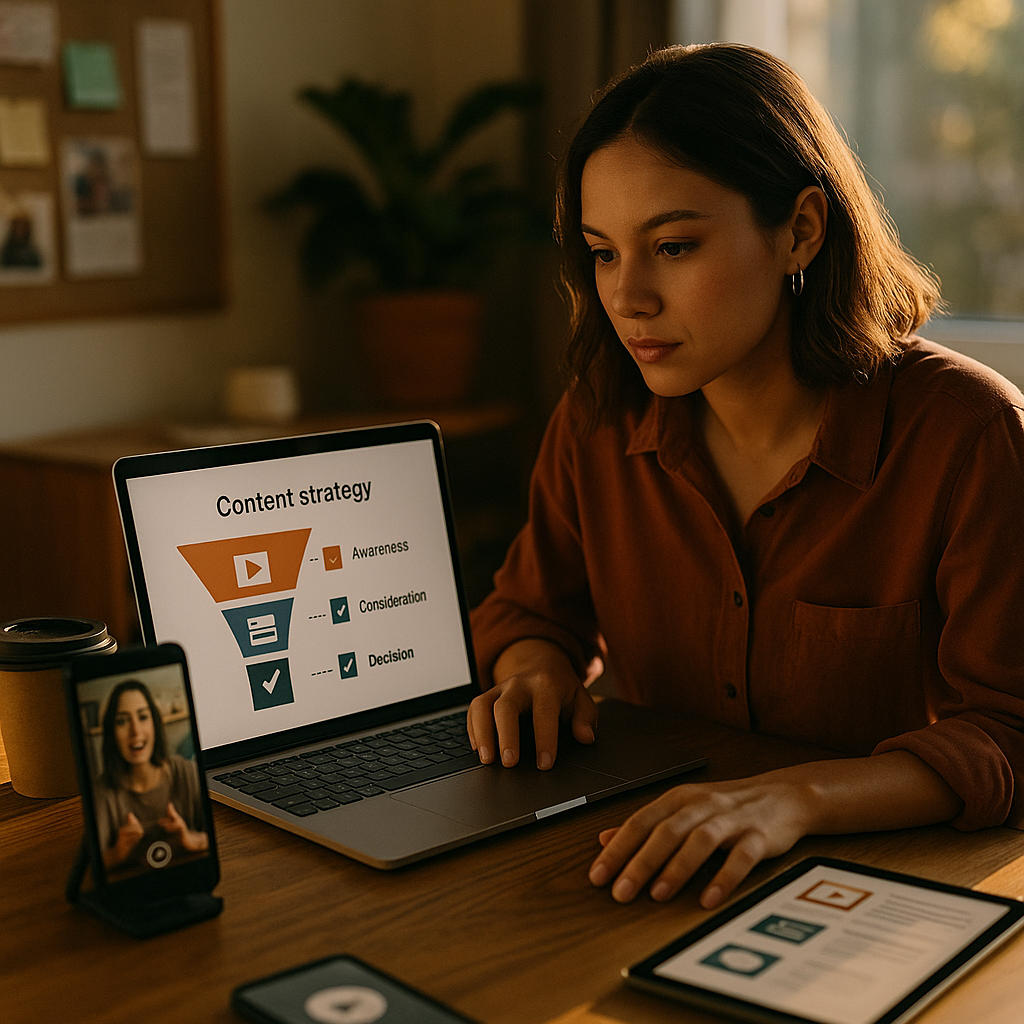
Brands running the same creator brief across TikTok, Twitch, and connected TV are leaving money on the table. A full-funnel creator strategy isn’t about posting everywhere — it’s about matching format to intent. Are you still treating short-form video as a one-size-fits-all solution?
Most influencer programs are stuck in top-of-funnel thinking. Great for a viral moment, terrible for pipeline. The brands winning right now — think Duolingo, Ryanair, or challenger CPG names quietly outspending legacy players — build creator plans the way media planners build linear TV plans: stage by stage, format by format, with distinct KPIs at each step.
Why Funnel Stage Should Dictate Format, Not the Other Way Around
Marketers default to short-form video because it’s cheap and algorithm-friendly. Fair enough for awareness. But short-form clips rarely close a sale for a $40,000 kitchen renovation or a B2B SaaS contract. Live stream shopping events convert browsers into buyers in real time. CTV builds the trust and reach that short-form simply can’t replicate at scale.
The mistake is treating these three formats as interchangeable line items in a media plan. They’re not. Each maps to a different psychological stage of the buyer journey, and each requires its own creative brief, measurement model, and creator selection criteria.
A creator strategy that ignores funnel stage is just content volume dressed up as strategy. Volume without sequencing rarely moves revenue.
Top of Funnel: Short-Form Video for Discovery and Recall
Short-form still dominates awareness budgets, and for good reason. TikTok, Instagram Reels, and YouTube Shorts remain the cheapest way to generate impressions and cultural relevance. eMarketer’s ad spend forecasts continue to show short-form video capturing the largest share of incremental social budget growth.
But discovery isn’t the same as consideration. The job of short-form at this stage is simple: interrupt the scroll, plant a brand cue, and get the algorithm to reward watch time. That’s it.
Brands that overload top-of-funnel short-form with product specs or CTAs waste the format’s strength. This is where UGC as an incremental reach channel earns its keep — it’s disposable, testable, and cheap to produce at volume. Run twenty variations, kill the losers by day three, scale the winners into paid.
Nano and micro creators tend to outperform macro talent here, mostly because their content reads as native rather than branded. Sprout Social’s engagement benchmarks consistently show smaller creators posting higher engagement rates relative to reach — worth checking against your own data via Sprout Social’s platform benchmarks. If you’re building a repeatable system at this tier, the mechanics matter more than the talent roster; see how nano creator programs at scale actually operate.
What KPIs actually matter here?
Forget conversion rate. At top-of-funnel, track view-through rate, completion rate, and brand recall lift. If you’re still reporting EMV as your primary success metric, you’re measuring the wrong thing — read why vanity metrics undersell influencer ROI before your next budget review.
Mid-Funnel: Live Stream Does the Convincing
Here’s where most brands go quiet, and that’s the missed opportunity. Live stream — whether TikTok Shop live, Amazon Live, or Twitch-style Q&A formats — is the closest thing digital marketing has to a trusted salesperson. Viewers ask questions. Creators answer in real time. Objections get handled on camera, not buried in an FAQ page nobody reads.
Live commerce in China proved the model years ago; Western brands are only now catching up. TikTok Shop live sessions in the US routinely outperform static product listings on conversion rate, according to data TikTok has shared through its own TikTok for Business platform.
This is the consideration stage doing double duty as a soft close. A viewer who watched a 15-second Reel yesterday might tune into a 40-minute live stream today because they’re actively comparing options. That’s intent. Treat it accordingly.
Live stream is the only creator format where objection-handling happens in real time, in front of the exact audience you’re trying to convert.
Structurally, live stream needs different contracts than one-off short-form deals. You’re paying for duration, engagement quality, and often a rev-share on sales. If your current agreements don’t account for that, revisit how hybrid creator contracts blend flat fees with performance bonuses — it’s the model most live commerce deals should be using anyway.
Measurement gets messier — plan for it
Live stream metrics don’t sit neatly inside standard dashboards. Platform-reported concurrent viewers rarely match your CRM’s attributed conversions. That gap is exactly why custom measurement models outperform native platform dashboards when you need to prove mid-funnel ROI to a CFO who doesn’t care about “engagement.”
Bottom of Funnel and Beyond: CTV Closes the Trust Gap
Connected TV gets filed under “brand” spend in most budgets, which is a strategic error. CTV creator content — repurposed short-form assets reformatted for the big screen, or purpose-built creator-hosted spots — does something short-form can’t: it borrows the trust signal of television while keeping the authenticity of creator content.
Households watching CTV are, by definition, past the discovery stage. They’re already engaged viewers, often mid-consideration for a category, and primed for a format that feels less like an ad and more like a recommendation. Streaming platforms have leaned into this hard; Roku and Amazon both now support creator-attributed CTV buys natively.
The data backs this up. Creator-produced video run through CTV inventory has shown roughly a 4x view-through rate compared to traditional pre-roll, based on comparative testing covered in creator video vs. pre-roll performance data. That’s not a marginal lift. That’s a format-level advantage brands are still underpricing.
If you’re building creator content specifically for cross-platform reuse across CTV and social, the brief has to account for aspect ratio, pacing, and CTA placement differently than a native TikTok. The CTV social creator brief for cross-platform distribution is worth reviewing before your next shoot — retrofitting vertical content for CTV after the fact rarely looks native.
Retention and Advocacy: The Stage Everyone Forgets
Full-funnel doesn’t stop at purchase. Post-purchase creator content — unboxings, tutorials, “six months later” reviews — does heavy lifting for retention and referral, yet it’s the most underfunded stage in most programs. It also happens to be the cheapest content to produce because you’re not paying for reach; you’re paying for authenticity from customers who already converted.
This is where nano creators and genuine UGC contributors matter most. They’re not influencing a purchase decision anymore. They’re reinforcing one.
Brands that skip this stage tend to over-invest in constant top-of-funnel acquisition instead, which is a more expensive way to solve a retention problem. If your narrative doesn’t extend past the sale, you’re building a funnel with a hole in the bottom. Worth reading how narrative architecture connects creator content across the entire customer lifecycle, not just the acquisition phase.
Building the Actual Media Plan
So how does this look in a real quarterly plan? Roughly:
- 60-65% of budget to short-form for awareness and testing, with rapid creative iteration built into the process.
- 20-25% of budget to live stream during consideration windows, concentrated around launches, restocks, or seasonal demand spikes.
- 10-15% of budget to CTV for households already showing purchase intent through retargeting data or CRM signals.
- A standing (small but permanent) allocation to post-purchase and retention content, funded separately from acquisition budget.
These ratios shift by category. A considered B2B purchase might flip the split, weighting live stream and CTV heavier since the sales cycle is longer and trust matters more than reach. A low-cost DTC impulse product might barely need CTV at all.
The bigger shift is organizational, not budgetary. Funnel-stage planning requires marketing teams to actually talk to sales and CRM teams about where leads stall — information that rarely makes it into a creator brief today. If your quarterly planning framework doesn’t already loop in funnel data before creator briefs go out, that’s the first fix, well before you touch platform mix.
What About Attribution Across Three Different Formats?
This is the part that trips up most teams. Short-form lives in one attribution model, live stream commerce in another, CTV in a third entirely. Stitching them together requires a measurement approach that doesn’t rely purely on platform-native reporting.
Google Marketing Platform has made progress connecting creator campaign data to broader attribution models, particularly for brands running paid amplification alongside organic creator content — see how creator campaign attribution works inside that ecosystem specifically. Pair that with a CMO-level dashboard that blends CPA, incremental lift, and even AI citation tracking, and you get a far more honest read on funnel performance than any single platform will hand you. That’s the model outlined in the CMO dashboard framework, and it’s becoming close to standard practice for brands running six-figure-plus creator programs.
None of this works, though, if creative and measurement live in separate silos. The brief has to specify funnel stage upfront. The measurement plan has to be built before the content, not retrofitted after.
Next step: Audit your last quarter of creator spend by funnel stage, not by platform. If more than 70% landed in top-of-funnel short-form, you’re not running a full-funnel strategy — you’re running an awareness campaign with a bigger budget line.
FAQs
What is a full-funnel creator strategy?
It’s an approach to influencer marketing that assigns specific creator formats — short-form video, live stream, and CTV — to distinct stages of the buyer journey, rather than running the same content type across every channel regardless of intent.
Which creator format works best for driving conversions?
Live stream commerce typically drives the highest direct conversion rates because it allows creators to answer objections and demonstrate products in real time. Short-form drives discovery and CTV builds trust with already-engaged viewers, but neither is optimized purely for closing sales the way live formats are.
How much budget should go to CTV versus short-form?
Most brands allocate the majority of budget (60-65%) to short-form for awareness, with smaller shares to live stream (20-25%) and CTV (10-15%). The exact split depends on sales cycle length and average order value — considered purchases typically need heavier live stream and CTV investment.
Can small brands realistically run a full-funnel creator program?
Yes, though the mix should stay short-form-heavy given budget constraints. Nano and micro creator programs make top-of-funnel and retention content affordable at scale, while a small, targeted live stream or CTV test can be layered in during key sales windows.
How do you measure ROI across three different creator formats?
Platform-native dashboards rarely reconcile cleanly across short-form, live stream, and CTV. Most brands running full-funnel programs build a custom measurement model that blends CPA, view-through rate, and incremental lift data across a unified attribution framework rather than relying on each platform’s separate reporting.
FAQs
What is a full-funnel creator strategy?
It’s an approach to influencer marketing that assigns specific creator formats — short-form video, live stream, and CTV — to distinct stages of the buyer journey, rather than running the same content type across every channel regardless of intent.
Which creator format works best for driving conversions?
Live stream commerce typically drives the highest direct conversion rates because it allows creators to answer objections and demonstrate products in real time. Short-form drives discovery and CTV builds trust with already-engaged viewers, but neither is optimized purely for closing sales the way live formats are.
How much budget should go to CTV versus short-form?
Most brands allocate the majority of budget (60-65%) to short-form for awareness, with smaller shares to live stream (20-25%) and CTV (10-15%). The exact split depends on sales cycle length and average order value — considered purchases typically need heavier live stream and CTV investment.
Can small brands realistically run a full-funnel creator program?
Yes, though the mix should stay short-form-heavy given budget constraints. Nano and micro creator programs make top-of-funnel and retention content affordable at scale, while a small, targeted live stream or CTV test can be layered in during key sales windows.
How do you measure ROI across three different creator formats?
Platform-native dashboards rarely reconcile cleanly across short-form, live stream, and CTV. Most brands running full-funnel programs build a custom measurement model that blends CPA, view-through rate, and incremental lift data across a unified attribution framework rather than relying on each platform’s separate reporting.
Top Influencer Marketing Agencies
The leading agencies shaping influencer marketing in 2026
Agencies ranked by campaign performance, client diversity, platform expertise, proven ROI, industry recognition, and client satisfaction. Assessed through verified case studies, reviews, and industry consultations.
Moburst

-
2

The Shelf
Boutique Beauty & Lifestyle Influencer AgencyA data-driven boutique agency specializing exclusively in beauty, wellness, and lifestyle influencer campaigns on Instagram and TikTok. Best for brands already focused on the beauty/personal care space that need curated, aesthetic-driven content.Clients: Pepsi, The Honest Company, Hims, Elf Cosmetics, Pure LeafVisit The Shelf → -
3

Audiencly
Niche Gaming & Esports Influencer AgencyA specialized agency focused exclusively on gaming and esports creators on YouTube, Twitch, and TikTok. Ideal if your campaign is 100% gaming-focused — from game launches to hardware and esports events.Clients: Epic Games, NordVPN, Ubisoft, Wargaming, Tencent GamesVisit Audiencly → -
4

Viral Nation
Global Influencer Marketing & Talent AgencyA dual talent management and marketing agency with proprietary brand safety tools and a global creator network spanning nano-influencers to celebrities across all major platforms.Clients: Meta, Activision Blizzard, Energizer, Aston Martin, WalmartVisit Viral Nation → -
5

The Influencer Marketing Factory
TikTok, Instagram & YouTube CampaignsA full-service agency with strong TikTok expertise, offering end-to-end campaign management from influencer discovery through performance reporting with a focus on platform-native content.Clients: Google, Snapchat, Universal Music, Bumble, YelpVisit TIMF → -
6

NeoReach
Enterprise Analytics & Influencer CampaignsAn enterprise-focused agency combining managed campaigns with a powerful self-service data platform for influencer search, audience analytics, and attribution modeling.Clients: Amazon, Airbnb, Netflix, Honda, The New York TimesVisit NeoReach → -
7

Ubiquitous
Creator-First Marketing PlatformA tech-driven platform combining self-service tools with managed campaign options, emphasizing speed and scalability for brands managing multiple influencer relationships.Clients: Lyft, Disney, Target, American Eagle, NetflixVisit Ubiquitous → -
8

Obviously
Scalable Enterprise Influencer CampaignsA tech-enabled agency built for high-volume campaigns, coordinating hundreds of creators simultaneously with end-to-end logistics, content rights management, and product seeding.Clients: Google, Ulta Beauty, Converse, AmazonVisit Obviously →