


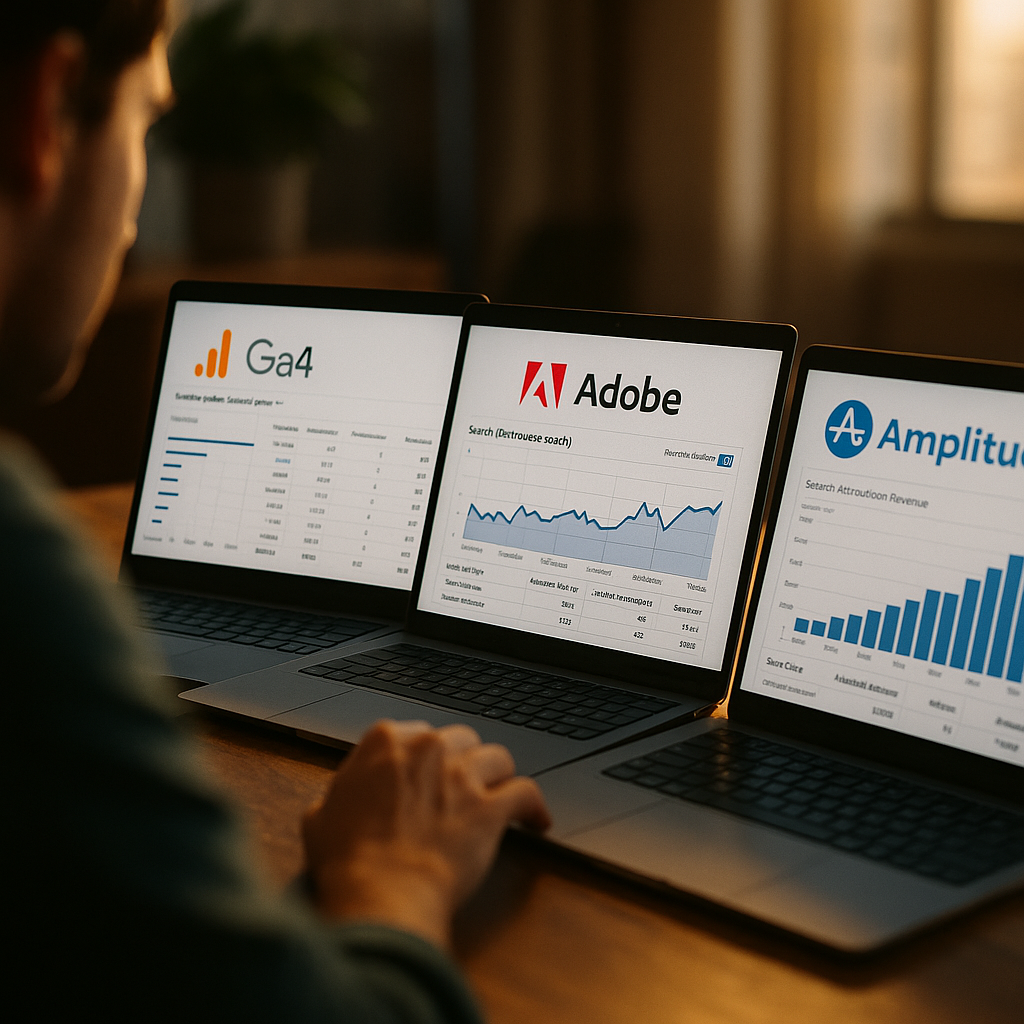
Roughly 13% of Google searches now trigger an AI Overview, and that share keeps climbing. Yet most analytics dashboards still lump those visits into “Organic Search” like it’s 2019. If you’re reporting revenue attribution to leadership without knowing whether your platform can actually isolate generative search referrals, you’re not measuring performance — you’re guessing with better formatting.
This matters more than it sounds. Budget conversations for content, SEO, and creator partnerships increasingly hinge on proving which channels drive pipeline. If ChatGPT, Perplexity, or Google’s AI Overviews are quietly sending high-intent traffic that your stack misclassifies as “Direct” or “Unassigned,” you’re systematically undervaluing a growing acquisition channel. Let’s look at how GA4, Adobe Analytics, and Amplitude actually handle this, and where each one still falls short.
Why Generative Search Referrals Break Traditional Attribution Models
Traditional attribution logic depends on referrer strings and UTM parameters. Generative AI tools break that logic in three ways. First, many AI assistants (think ChatGPT’s browsing mode or Gemini’s in-app answers) don’t pass a clean referrer at all — traffic often lands as “direct” because the click originates from an app shell rather than a standard browser navigation. Second, AI Overviews within Google Search sit inside the same SERP as traditional organic listings, so platforms that bucket by domain (google.com) can’t distinguish an AI Overview click from a classic blue-link click without deeper signal parsing. Third, session stitching gets messy when users bounce between a chat interface, a new tab, and your site across multiple micro-sessions.
None of the three platforms solve this perfectly. But they solve it very differently, and that difference has real revenue-reporting consequences.
If your analytics stack still reports AI Overview clicks under generic “Organic Search,” you’re likely underreporting a channel that’s growing faster than any other referral source this year.
Google Analytics 4: Native Advantage, Shallow Depth
GA4 has an obvious structural advantage: it’s built by the same company running the search engine generating most AI Overviews. In practice, that means GA4 has started surfacing AI Overview referral data through Search Console integration rather than through GA4’s own attribution engine directly. When you cross-reference Google Search Console data with GA4 conversion paths, you can sometimes isolate sessions tagged with search appearance types that include AI Overviews.
The catch? This isn’t automatic revenue attribution. It’s a manual stitching exercise. You’re pulling query-level data from Search Console, matching it against landing pages in GA4, then layering on Enhanced Ecommerce or GA4’s purchase event data to approximate revenue. It works, but it’s brittle. Change your tagging taxonomy or your Search Console property structure, and the whole model breaks.
GA4’s Data API does allow more granular custom reporting than the standard UI, and agencies building attribution dashboards on top of BigQuery exports have had more success isolating AI-driven sessions by combining source/medium anomalies (unusually high direct traffic with unusually short time-to-conversion) as a proxy signal. It’s a workaround, not a native feature. For teams already using structured-data plugins for AI Overview citations, GA4 attribution should be treated as the reconciliation layer, not the source of truth.
What GA4 Gets Right
- Free tier makes it accessible for testing attribution hypotheses without upfront licensing spend
- Tight integration with Search Console gives query-level context unavailable to third-party tools
- BigQuery export enables custom modeling for teams with in-house data engineering support
Where It Falls Short
GA4 doesn’t natively label a session as “arrived via AI Overview” the way it labels “Paid Search” or “Organic Social.” You’re inferring, not attributing. For a CMO asking “how much revenue came from generative search last quarter,” GA4 alone can’t answer that question with confidence — you need supplementary tooling or a data warehouse layer.
Adobe Analytics: More Control, More Configuration Debt
Adobe Analytics takes a different philosophical approach. Instead of relying on Google’s ecosystem signals, Adobe leans on its processing rules and classification engine to let analysts build custom channel definitions. This is genuinely powerful — if you have the implementation resources to use it.
With Adobe, you can define custom traffic classification rules based on referrer domain patterns, then create dedicated “Generative AI Referral” channel groupings that separate ChatGPT, Perplexity, Copilot, and Google AI Overview traffic from standard organic and direct buckets. Adobe’s classification is deterministic and rule-based, not inferred through machine learning, which means it’s more transparent but also more manual to maintain. Every time a new AI search product launches (and in this market, that’s often), someone on your analytics team needs to update the classification rules.
Adobe’s real strength shows up in revenue attribution once the classification is built. Because Adobe Analytics ties directly into Adobe Experience Platform and Customer Journey Analytics, you can build multi-touch attribution models that credit generative search referrals across the full funnel, not just last-click. That’s a meaningful advantage over GA4’s more rigid default models, especially for B2B or considered-purchase brands where the AI Overview click might be a research touchpoint three weeks before conversion.
Adobe’s attribution accuracy for generative search is only as good as your classification rules — and those rules require ongoing maintenance as new AI search tools enter the market.
The tradeoff is cost and complexity. Adobe Analytics implementations routinely run into six figures annually for enterprise licenses, and building custom classification logic typically requires either an in-house analytics engineer or an agency partner. If you’re already running attribution governance frameworks built for audit survival, Adobe’s rule-based transparency is an asset. If you’re a leaner team without dedicated analytics headcount, that same flexibility becomes a maintenance burden.
Amplitude: Built for Product Analytics, Adapted for Attribution
Amplitude wasn’t originally designed as a marketing attribution tool — it’s a product analytics platform first, built around user behavior and event streams. That heritage shows up in how it handles generative search referrals.
Amplitude’s strength is behavioral context after the click, not the referral classification itself. Once a user lands on your site or app from any source, Amplitude excels at tracking what they do next: feature engagement, session depth, conversion events, and revenue tied to specific in-product actions. For attributing generative search referrals specifically, Amplitude relies on custom event properties captured at session start, meaning your engineering team needs to pass referrer and UTM data into Amplitude’s event schema deliberately.
This makes Amplitude less turnkey than GA4 or Adobe for classifying AI Overview traffic out of the box. But it makes Amplitude arguably the best of the three at connecting that traffic to actual downstream revenue behavior, particularly for SaaS and subscription businesses where the “conversion” isn’t a single ecommerce transaction but a multi-step activation funnel.
Amplitude’s revenue attribution models (particularly its Revenue Impact and North Star Metric frameworks) let you see whether generative-search-referred users behave differently than organic search users post-signup. Do they churn faster? Convert to paid at a lower rate? That’s a level of behavioral nuance neither GA4 nor Adobe Analytics offers natively.
Amplitude’s Practical Limitation
You need clean data pipes feeding it. Amplitude doesn’t have Google’s search-engine-level visibility or Adobe’s mature classification rule engine. It depends heavily on your first-party data stack being architected well enough to capture and forward AI referral signals in the first place. Teams without strong data engineering discipline will struggle to get value here.
Side-by-Side: What Actually Differs
Here’s the practical comparison brand teams should care about:
- Native AI Overview detection: GA4 (via Search Console pairing) > Adobe (via manual rules) > Amplitude (requires custom instrumentation)
- Revenue-to-referral accuracy: Adobe > Amplitude > GA4
- Setup cost and speed: GA4 > Amplitude > Adobe
- Multi-touch modeling depth: Adobe > Amplitude > GA4
- Behavioral post-click insight: Amplitude > Adobe > GA4
None of these platforms hand you a clean “Generative Search Revenue” report on day one. All three require some combination of custom configuration, cross-referencing, or supplementary tooling. That’s the uncomfortable truth vendors won’t lead with in a sales demo.
According to eMarketer research on search behavior shifts, AI-assisted search sessions are converting at meaningfully different rates than traditional organic sessions — which makes accurate attribution not just a nice-to-have but a budget-defense necessity. If you can’t prove the channel’s revenue contribution, it’s the first line item cut when budgets tighten.
Building a Realistic Attribution Stack
Most sophisticated marketing teams aren’t choosing just one of these platforms in isolation — they’re stitching signals across tools. A common pattern: GA4 or Adobe for top-of-funnel classification, a CDP layer for identity resolution, and Amplitude or a data warehouse for downstream revenue behavior modeling.
This is where the broader martech stack conversation matters. If your identity resolution layer can’t reliably stitch a generative-search-referred session to a known customer record, none of these analytics platforms can compensate. That’s a data architecture problem, not an analytics tool problem. Teams evaluating this should look closely at how CDP vendors handle agentic AI identity resolution before assuming their analytics platform alone will solve attribution gaps.
It’s also worth stress-testing vendor claims here. Plenty of martech platforms now market “AI-powered attribution” features that amount to marginal improvements on existing models rather than genuine generative-search detection. Before you buy in, it’s worth applying the same scrutiny outlined in frameworks for verifying vendor AI claims — ask for a live demo isolating AI Overview traffic specifically, not a generic “AI-enhanced” dashboard tour.
The platforms aren’t lying about their AI attribution capabilities — they’re just describing a much narrower slice of the problem than most marketers assume.
What This Means for Budget Conversations
If you’re presenting quarterly numbers and someone asks “how much revenue came from ChatGPT or AI Overviews,” the honest answer right now is: it depends on how much manual reconciliation work your analytics team has done. That’s not a satisfying answer in a boardroom, but it’s the accurate one.
The practical move is to build a documented methodology — even an imperfect one — and apply it consistently quarter over quarter. Directional accuracy, applied consistently, beats false precision that shifts every time someone tweaks a dashboard filter. Document your classification rules, note their limitations, and revisit them as new AI search products gain share.
Next step: Audit your current channel classification rules this quarter — specifically checking whether AI Overview and AI assistant referrals are being folded into generic organic or direct buckets — before you present another attribution report to leadership.
Frequently Asked Questions
Can GA4 natively separate AI Overview traffic from regular organic search?
Not automatically. GA4 requires pairing with Search Console data and manual analysis to approximate which sessions originated from AI Overviews, since it doesn’t apply a distinct default channel label for generative search referrals.
Which platform is best for attributing revenue specifically, not just traffic?
Adobe Analytics generally offers the strongest multi-touch revenue attribution once custom classification rules are built, largely because of its integration with Customer Journey Analytics and Experience Platform.
Does Amplitude track AI search referrals out of the box?
No. Amplitude requires custom event instrumentation to capture referrer and UTM data at session start, then applies its behavioral analytics strength to what happens after the click.
Why do AI-referred sessions often show up as “Direct” traffic?
Many AI assistants and chat interfaces don’t pass standard referrer headers, so analytics platforms default to classifying these sessions as direct traffic instead of a distinct referral source.
Is it worth building a custom attribution model instead of relying on native platform features?
For most mid-market and enterprise brands, yes. A documented, consistently applied custom methodology combining Search Console data, CDP identity resolution, and analytics platform exports currently outperforms any single platform’s out-of-the-box reporting.
FAQs
Can GA4 natively separate AI Overview traffic from regular organic search?
Not automatically. GA4 requires pairing with Search Console data and manual analysis to approximate which sessions originated from AI Overviews, since it doesn’t apply a distinct default channel label for generative search referrals.
Which platform is best for attributing revenue specifically, not just traffic?
Adobe Analytics generally offers the strongest multi-touch revenue attribution once custom classification rules are built, largely because of its integration with Customer Journey Analytics and Experience Platform.
Does Amplitude track AI search referrals out of the box?
No. Amplitude requires custom event instrumentation to capture referrer and UTM data at session start, then applies its behavioral analytics strength to what happens after the click.
Why do AI-referred sessions often show up as “Direct” traffic?
Many AI assistants and chat interfaces don’t pass standard referrer headers, so analytics platforms default to classifying these sessions as direct traffic instead of a distinct referral source.
Is it worth building a custom attribution model instead of relying on native platform features?
For most mid-market and enterprise brands, yes. A documented, consistently applied custom methodology combining Search Console data, CDP identity resolution, and analytics platform exports currently outperforms any single platform’s out-of-the-box reporting.
Top Influencer Marketing Agencies
The leading agencies shaping influencer marketing in 2026
Agencies ranked by campaign performance, client diversity, platform expertise, proven ROI, industry recognition, and client satisfaction. Assessed through verified case studies, reviews, and industry consultations.
Moburst

-
2

The Shelf
Boutique Beauty & Lifestyle Influencer AgencyA data-driven boutique agency specializing exclusively in beauty, wellness, and lifestyle influencer campaigns on Instagram and TikTok. Best for brands already focused on the beauty/personal care space that need curated, aesthetic-driven content.Clients: Pepsi, The Honest Company, Hims, Elf Cosmetics, Pure LeafVisit The Shelf → -
3

Audiencly
Niche Gaming & Esports Influencer AgencyA specialized agency focused exclusively on gaming and esports creators on YouTube, Twitch, and TikTok. Ideal if your campaign is 100% gaming-focused — from game launches to hardware and esports events.Clients: Epic Games, NordVPN, Ubisoft, Wargaming, Tencent GamesVisit Audiencly → -
4

Viral Nation
Global Influencer Marketing & Talent AgencyA dual talent management and marketing agency with proprietary brand safety tools and a global creator network spanning nano-influencers to celebrities across all major platforms.Clients: Meta, Activision Blizzard, Energizer, Aston Martin, WalmartVisit Viral Nation → -
5

The Influencer Marketing Factory
TikTok, Instagram & YouTube CampaignsA full-service agency with strong TikTok expertise, offering end-to-end campaign management from influencer discovery through performance reporting with a focus on platform-native content.Clients: Google, Snapchat, Universal Music, Bumble, YelpVisit TIMF → -
6

NeoReach
Enterprise Analytics & Influencer CampaignsAn enterprise-focused agency combining managed campaigns with a powerful self-service data platform for influencer search, audience analytics, and attribution modeling.Clients: Amazon, Airbnb, Netflix, Honda, The New York TimesVisit NeoReach → -
7

Ubiquitous
Creator-First Marketing PlatformA tech-driven platform combining self-service tools with managed campaign options, emphasizing speed and scalability for brands managing multiple influencer relationships.Clients: Lyft, Disney, Target, American Eagle, NetflixVisit Ubiquitous → -
8

Obviously
Scalable Enterprise Influencer CampaignsA tech-enabled agency built for high-volume campaigns, coordinating hundreds of creators simultaneously with end-to-end logistics, content rights management, and product seeding.Clients: Google, Ulta Beauty, Converse, AmazonVisit Obviously →