


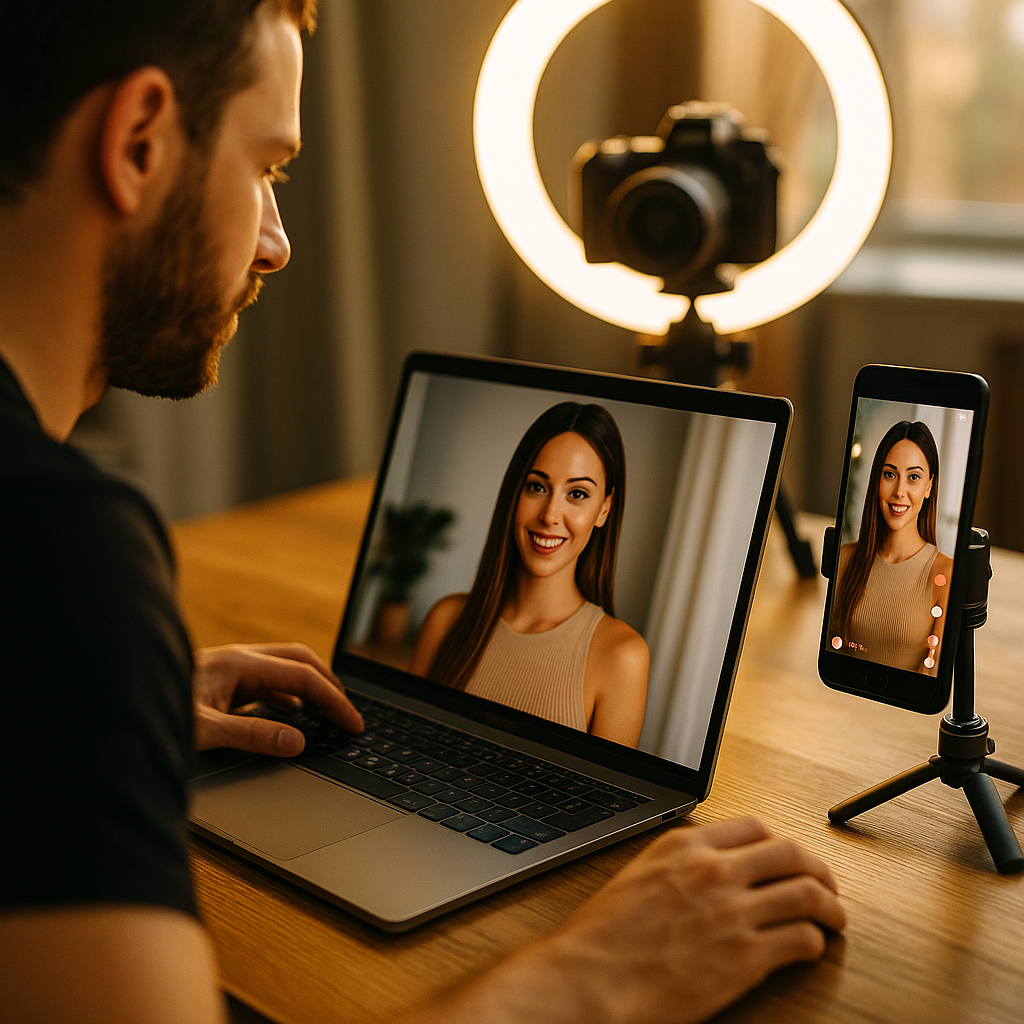
Using Generative Adversarial Networks to create hyper-realistic virtual influencers is revolutionizing digital marketing in 2025. As AI-generated personalities blend seamlessly with social media, brands benefit from unprecedented control and creativity. But how exactly are GANs fueling this phenomenon, and what future can you expect from AI-powered influencers? Let’s explore the details of this rapidly evolving frontier.
How Generative Adversarial Networks Drive Virtual Influencer Realism
Generative Adversarial Networks (GANs) are a type of deep learning architecture that pits two neural networks—the generator and the discriminator—against each other. The generator creates images, while the discriminator evaluates their authenticity. Over time, this adversarial process refines the outputs, producing digital faces, bodies, and expressions indistinguishable from real human beings. GANs have rapidly evolved since their inception and, by 2025, can now render hyper-realistic influencers that charm millions of followers online.
According to a 2024 survey by Influencer Marketing Hub, over 35% of brands have already leveraged AI-driven personalities in their campaigns. GANs make it possible for these virtual influencers to adopt fluid facial expressions, shifting emotions, and even distinct physical quirks, increasing their relatability and engagement. Crucially, their appearance can be tailored for any demographic, further widening marketing reach.
Enhancing Brand Storytelling with AI-Generated Personalities
Hyper-realistic virtual influencers, created by GANs, are transforming the way brands tell their stories. Unlike traditional influencers, AI-generated personas can reflect precise brand values, visual identities, and campaign goals, with consistent behavior patterns over time. By monitoring social data, brands can quickly iterate personality traits and looks to resonate more deeply with target audiences.
For example, a fashion brand can launch a virtual ambassador whose style adapts in real time to seasonal trends and customer preferences. This unmatched adaptability allows marketers to experiment with creative storytelling and build authentic connections at scale—all without the unpredictability of human influencers. AI-driven personalities also remove the risks of PR scandals and scheduling conflicts, offering seamless collaboration for global campaigns.
Technical Innovations: GANs Behind the Scenes
Creating a hyper-realistic virtual influencer requires advanced GAN architectures and training techniques. Today’s most successful virtual influencers are generated using high-resolution, multi-modal GANs such as StyleGAN3 or BigGAN, capable of synthesizing detailed textures, lighting variations, and microscopic facial movements. Developers also use transfer learning to infuse digital personalities with authentic voice, gesture, and cultural awareness.
Moreover, reinforcement learning is often employed post-GAN generation, allowing the influencer to “learn” from audience feedback. These technical advances ensure that every digital action—be it a smile, wink, or subtle gesture—appears convincingly lifelike. Brands often back this up with motion capture data and voice synthesis powered by natural language processing (NLP) to further enhance realism and user interaction.
- End-to-end GAN pipelines: Automate influencer creation from concept art to social-ready avatars.
- Realistic behavior simulation: GANs enable nuanced mimicry of gestures and habits.
- Decentralized identity management: Blockchain ensures each influencer’s digital authenticity.
User Engagement and Ethical Considerations in 2025
The rise of AI influencers brings new opportunities—and important challenges—to user engagement and ethics. Hyper-realistic digital personalities can foster strong brands but also blur lines between reality and fiction. Data from a 2025 Edelman Digital Trust report shows that 57% of social media users cannot reliably distinguish between real and virtual influencers, heightening privacy and authenticity concerns.
Brands are now required, in many regions, to disclose when a promoted persona is AI-generated. Regulators encourage transparent labeling and the use of AI-verified watermarks. Meanwhile, safeguarding against bias in GAN-generated features and behaviors is a growing priority, supported by AI ethics boards and interdisciplinary review panels. As virtual influencers gain prominence, companies must build trust through transparency and responsible content creation.
Business Impact: From Cost Efficiency to Endless Creativity
For brands in 2025, the business case for hyper-realistic virtual influencers is clear. GAN-driven personalities require less budget over time, do not demand physical sets, and can work across time zones instantly. Production cycles are compressed, and campaigns can pivot on short notice without logistical hurdles.
According to a 2025 Digital Marketing Association survey, 48% of C-suite executives reported improved ROI when using GAN-generated influencers compared to traditional ones. This efficiency opens the door to bolder creative campaigns, rapid prototyping, and micro-targeting previously unthinkable with human talent. The future of influencer marketing looks brighter—and more dynamic—thanks to generative adversarial networks.
- Instant global reach with locally tailored virtual faces
- Cost savings on talent, travel, and logistics
- Unlimited campaign iteration with immediate feedback loops
The Future: Integration of GANs into Social Platforms
Looking ahead, social media platforms are increasingly integrating GAN-based tools into their creator ecosystems. AI-generated influencers can interact with followers in real time, personalize content at scale, and even adapt personalities based on aggregate sentiment analysis. Thanks to GANs, brands can maintain multiple digital spokespeople, each fine-tuned to niche audience preferences while upholding consistent visual quality and brand values.
Expect the next generation of GANs to push realism even further—rendering ultra-high-fidelity avatars, advanced voice cloning, and seamless deepfake protections. As platforms and regulations mature, GANs will underpin an entirely new era where AI influencers and human creators coexist, each enriching the digital storytelling landscape in novel ways.
In summary, using Generative Adversarial Networks to create hyper-realistic virtual influencers empowers brands with limitless creative control, cost efficiency, and the ability to authentically connect at scale. As GAN technology advances, the line between virtual and reality continues to blur—reshaping the future of digital influence.
FAQs About GANs and Hyper-Realistic Virtual Influencers
-
What is a Generative Adversarial Network (GAN)?
A GAN is an AI system that uses two neural networks, a generator and a discriminator, to create and evaluate ultra-realistic images, often used to produce digital humans indistinguishable from real ones.
-
How do brands use hyper-realistic virtual influencers?
Brands use these AI-generated personalities for marketing, customer engagement, and storytelling campaigns. They provide consistent brand messaging, adapt rapidly to new trends, and minimize risks tied to human influencers.
-
Are virtual influencers ethical?
As of 2025, ethical concerns center around transparency, user awareness, and data privacy. Most regions require clear labeling of AI-generated personas and encourage responsible content creation to maintain audience trust.
-
Can users tell the difference between real and virtual influencers?
Studies show that most users find it difficult to distinguish between high-quality GAN-generated influencers and real people, which has prompted calls for clearer disclosure and watermarks on virtual profiles.
-
Will GANs replace human influencers?
GANs are unlikely to fully replace human influencers but will coexist, providing brands with flexible creative options and scalable digital spokespeople, especially in fast-moving or highly regulated industries.
Top Influencer Marketing Agencies
The leading agencies shaping influencer marketing in 2026
Agencies ranked by campaign performance, client diversity, platform expertise, proven ROI, industry recognition, and client satisfaction. Assessed through verified case studies, reviews, and industry consultations.
Moburst

-
2

The Shelf
Boutique Beauty & Lifestyle Influencer AgencyA data-driven boutique agency specializing exclusively in beauty, wellness, and lifestyle influencer campaigns on Instagram and TikTok. Best for brands already focused on the beauty/personal care space that need curated, aesthetic-driven content.Clients: Pepsi, The Honest Company, Hims, Elf Cosmetics, Pure LeafVisit The Shelf → -
3

Audiencly
Niche Gaming & Esports Influencer AgencyA specialized agency focused exclusively on gaming and esports creators on YouTube, Twitch, and TikTok. Ideal if your campaign is 100% gaming-focused — from game launches to hardware and esports events.Clients: Epic Games, NordVPN, Ubisoft, Wargaming, Tencent GamesVisit Audiencly → -
4

Viral Nation
Global Influencer Marketing & Talent AgencyA dual talent management and marketing agency with proprietary brand safety tools and a global creator network spanning nano-influencers to celebrities across all major platforms.Clients: Meta, Activision Blizzard, Energizer, Aston Martin, WalmartVisit Viral Nation → -
5

The Influencer Marketing Factory
TikTok, Instagram & YouTube CampaignsA full-service agency with strong TikTok expertise, offering end-to-end campaign management from influencer discovery through performance reporting with a focus on platform-native content.Clients: Google, Snapchat, Universal Music, Bumble, YelpVisit TIMF → -
6

NeoReach
Enterprise Analytics & Influencer CampaignsAn enterprise-focused agency combining managed campaigns with a powerful self-service data platform for influencer search, audience analytics, and attribution modeling.Clients: Amazon, Airbnb, Netflix, Honda, The New York TimesVisit NeoReach → -
7

Ubiquitous
Creator-First Marketing PlatformA tech-driven platform combining self-service tools with managed campaign options, emphasizing speed and scalability for brands managing multiple influencer relationships.Clients: Lyft, Disney, Target, American Eagle, NetflixVisit Ubiquitous → -
8

Obviously
Scalable Enterprise Influencer CampaignsA tech-enabled agency built for high-volume campaigns, coordinating hundreds of creators simultaneously with end-to-end logistics, content rights management, and product seeding.Clients: Google, Ulta Beauty, Converse, AmazonVisit Obviously →