


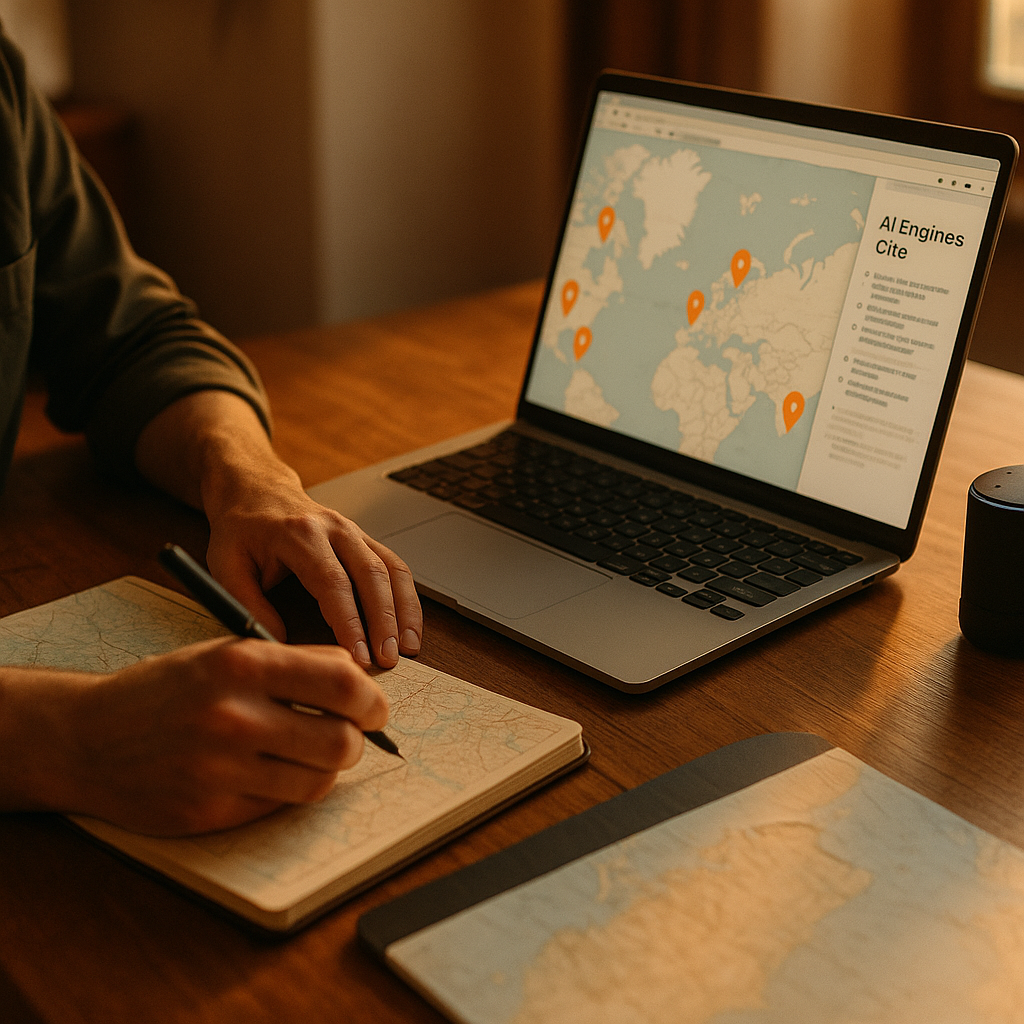
ChatGPT now answers more than 1 billion queries a day, and a growing share of those answers cite a piece of branded content instead of a Wikipedia page. If your creator briefs still optimize for hashtags and hooks instead of citation structure, you’re leaving the fastest-growing discovery channel in marketing untouched. GEO content planning, structuring creator briefs specifically for AI answer engine citation, is quickly becoming the difference between a brand that gets quoted by Perplexity and one that gets ignored.
This isn’t a rebrand of SEO. Answer engines like ChatGPT, Perplexity, Google AI Overviews, and Gemini don’t rank pages the way Google’s blue links did. They extract, synthesize, and cite. That means the unit of value shifts from “did this post rank” to “did this content get pulled into an answer.” And creator content, built on trust, specificity, and firsthand experience, happens to be exactly what these systems are hungry for.
Why Creator Content Is Suddenly an AI Citation Asset
Answer engines are trained and retrieval-augmented on content that demonstrates expertise, direct experience, and clear structure. Generic brand copy rarely qualifies. A creator who actually used the product, tested the claim, or lived the scenario produces exactly the kind of firsthand, verifiable content these models prefer to cite.
Think about how Perplexity handles a query like “best budget-friendly skincare for sensitive skin.” It’s not pulling from a brand’s landing page. It’s pulling from a creator’s comparison post, a review with specific ingredient callouts, or a Reddit-style breakdown with clear pros and cons. The models are optimizing for the same thing readers want: someone who actually tried the thing, explaining it clearly.
Creator content that reads like a genuine answer to a specific question gets cited more often than content written to sound like an ad, because answer engines are explicitly trained to favor experience-based, structured information over promotional copy.
That’s a structural opportunity for brands running creator programs. But only if the brief is built to produce citation-ready content, not just engagement-ready content.
What Makes Content “Citable” to an Answer Engine?
Before rewriting your brief template, it helps to understand what these systems are actually looking for. Based on how retrieval-augmented generation (RAG) systems and answer engines parse content, a few patterns consistently show up in cited material:
- Direct question-answer framing. Content that states a clear question and answers it plainly, ideally in the first sentence or two, gets extracted more easily than content that buries the answer in narrative.
- Specific, checkable claims. “This serum reduced redness in 3 days for my combination skin” is citable. “This product is amazing” is not.
- Structured formatting. Lists, comparisons, numbered steps, and clear headers make it easier for a model to lift a discrete, self-contained chunk of text.
- Demonstrated firsthand experience. Phrases that establish the creator actually used the product, in what context, and for how long, signal the kind of “experience” component search and answer engines increasingly weight.
- Source-friendly attribution. Content that’s easy to attribute (clear author, clear brand mention, clear date) is easier for a model to cite without ambiguity.
None of this requires creators to sound robotic. It just requires the brief to nudge them toward clarity over vibes.
The Brief Template: Building for Extraction, Not Just Engagement
Most creator briefs are still built around campaign goals, brand messaging, and content pillars. Useful, but incomplete for GEO. Here’s what needs to be added, section by section.
1. Lead With the Query, Not the Product
Instead of “talk about our new protein powder,” structure the brief around the actual question a buyer types into ChatGPT: “what’s the best protein powder for lactose intolerance.” Ask the creator to answer that question directly in the first 30 seconds of a video or the first two sentences of a caption. This single change does more for citation odds than any hashtag strategy.
2. Require a Claims and Context Section
Ask creators to state specific, verifiable details: how long they used the product, what alternative they compared it to, what result they measured. This is also where compliance and FTC disclosure requirements intersect with GEO. A clearly disclosed, clearly contextualized review is both more compliant and more citable.
3. Build in Structural Cues
For long-form or written content (blog collabs, YouTube descriptions, LinkedIn posts), require subheadings phrased as questions, short paragraphs, and at least one list or comparison table. These aren’t stylistic preferences anymore. They’re extraction hooks.
4. Add a “Model-Readable Summary” Field
This is the newest addition worth testing: a short, plain-language summary block (2 to 3 sentences) that the creator includes near the top or bottom of the piece, explicitly stating the takeaway. Think of it as a TL;DR built for machines as much as humans. It reads a little unusual to a human audience, but it dramatically increases the odds a model extracts the core claim cleanly.
5. Specify Distribution Surfaces That Feed Answer Engines
Not every platform feeds the same retrieval index. Reddit threads, YouTube transcripts, and long-form blog posts get crawled and cited far more often than ephemeral Stories or Reels captions. If GEO citation is a program goal, the brief needs to specify which formats matter, and that has downstream effects on cross-channel distribution planning and budget allocation.
A creator brief written for engagement optimizes for the algorithm’s attention window. A creator brief written for GEO optimizes for permanence, the twelve months an answer engine might keep referencing that piece of content in response to a query.
Where GEO Briefs Break Down (And How to Fix It)
The most common failure isn’t creative, it’s operational. Brands write one brief and send it to fifty creators with wildly different formats, platforms, and audiences. GEO citation rewards specificity, so a one-size-fits-all brief undercuts the entire strategy.
Second failure: measurement gaps. Most brand tracking still measures reach, engagement, and conversions. Almost none of it tracks whether a piece of creator content actually got cited in an AI answer. That’s a real reporting problem, and it echoes the broader issue brands are already wrestling with in creator program measurement. Until AI citation tracking tools mature (a few are emerging, but none are industry-standard yet), brands should treat citation as a qualitative signal worth monitoring manually: run your target queries through ChatGPT, Perplexity, and Google AI Overviews monthly and check what surfaces.
Third failure: treating GEO as a bolt-on rather than a governance issue. If creators are producing claims that get cited by AI systems as factual answers, brands need the same oversight they’d apply to any public claim. That’s a conversation worth having alongside your existing AI governance process, not a separate silo.
How Do You Brief for Platforms Where AI Retrieval Behaves Differently?
Google’s AI Overviews still lean heavily on traditional Google Search ranking signals, so classic on-page SEO still matters there. Perplexity and ChatGPT’s browsing mode pull more heavily from recent, structured, high-authority sources, including Reddit and niche community content. That means the same creator campaign might need two versions of a brief: one optimized for search-adjacent citation (structured blog content, FAQ schema, clear headers) and one optimized for conversational citation (Reddit-style firsthand accounts, comparison threads, community Q&A formats).
This is also where data quality becomes a hidden dependency. If your brand’s own product data, spec sheets, and claims aren’t structured and accurate, no amount of creator brief optimization will produce citable content, because the creator is often working from your source material. Brands still sitting on messy internal data should treat that as a prerequisite, not a parallel project. It connects directly to the broader problem covered in AI-ready data structuring.
Platforms are moving fast here. Sprout Social’s research and eMarketer’s coverage of AI search behavior both point to the same trend: answer engine traffic is growing, and brands that treat it as a niche experiment now will be playing catch-up within a couple of budget cycles.
Budget and Ownership: Who Actually Runs This?
GEO briefing sits awkwardly between influencer marketing, SEO, and content strategy teams, and most organizations haven’t assigned clear ownership yet. That ambiguity is a risk. Someone needs to own the query research (what are people actually asking AI engines about your category), the brief template updates, and the periodic citation audits.
In practice, this usually lands with whichever team already owns creator program measurement, since GEO citation is fundamentally a new KPI layered onto an existing reporting structure. If your team is already building out flexible KPI frameworks, adding a citation tracking column is a natural extension rather than a new department.
Budget-wise, this doesn’t require new spend so much as reallocated attention. The same creator fee buys either a generic engagement-optimized post or a citation-optimized one. The cost difference is in briefing time and creator education, not media spend.
Next Step
Pick your three highest-value creator campaigns this quarter and rewrite the briefs using the query-first, claims-and-context structure above, then manually check ChatGPT and Perplexity for citation four weeks after publish. That single test will tell you more about your GEO readiness than any framework, including this one.
FAQs
What is GEO content planning in influencer marketing?
GEO (generative engine optimization) content planning is the process of structuring creator briefs and content so that AI answer engines like ChatGPT, Perplexity, and Google AI Overviews can easily extract and cite the material in response to user queries.
How is GEO different from traditional SEO for creator content?
Traditional SEO optimizes for ranking on a search results page. GEO optimizes for being directly quoted or synthesized into an AI-generated answer, which rewards clear question-answer framing, specific claims, and structured formatting over keyword density and backlinks.
Which creator content formats get cited most by AI answer engines?
Long-form, structured formats tend to perform best: blog collaborations, YouTube videos with transcripts, and Reddit-style comparison threads. Ephemeral formats like Stories generally aren’t crawled or cited because they lack persistent, indexable text.
Can brands measure whether creator content is actually being cited by AI models?
Dedicated tracking tools are still emerging and none are industry-standard yet. Most brands currently rely on manual audits, running target queries through ChatGPT, Perplexity, and Google AI Overviews periodically to check what content surfaces.
Does GEO citation require creators to disclose sponsorships differently?
No, standard FTC disclosure rules still apply regardless of whether content is optimized for AI citation. Clear disclosure actually supports GEO goals, since transparent, well-attributed content is easier for answer engines to cite without ambiguity.
FAQs
What is GEO content planning in influencer marketing?
GEO (generative engine optimization) content planning is the process of structuring creator briefs and content so that AI answer engines like ChatGPT, Perplexity, and Google AI Overviews can easily extract and cite the material in response to user queries.
How is GEO different from traditional SEO for creator content?
Traditional SEO optimizes for ranking on a search results page. GEO optimizes for being directly quoted or synthesized into an AI-generated answer, which rewards clear question-answer framing, specific claims, and structured formatting over keyword density and backlinks.
Which creator content formats get cited most by AI answer engines?
Long-form, structured formats tend to perform best: blog collaborations, YouTube videos with transcripts, and Reddit-style comparison threads. Ephemeral formats like Stories generally aren’t crawled or cited because they lack persistent, indexable text.
Can brands measure whether creator content is actually being cited by AI models?
Dedicated tracking tools are still emerging and none are industry-standard yet. Most brands currently rely on manual audits, running target queries through ChatGPT, Perplexity, and Google AI Overviews periodically to check what content surfaces.
Does GEO citation require creators to disclose sponsorships differently?
No, standard FTC disclosure rules still apply regardless of whether content is optimized for AI citation. Clear disclosure actually supports GEO goals, since transparent, well-attributed content is easier for answer engines to cite without ambiguity.
Top Influencer Marketing Agencies
The leading agencies shaping influencer marketing in 2026
Agencies ranked by campaign performance, client diversity, platform expertise, proven ROI, industry recognition, and client satisfaction. Assessed through verified case studies, reviews, and industry consultations.
Moburst

-
2

The Shelf
Boutique Beauty & Lifestyle Influencer AgencyA data-driven boutique agency specializing exclusively in beauty, wellness, and lifestyle influencer campaigns on Instagram and TikTok. Best for brands already focused on the beauty/personal care space that need curated, aesthetic-driven content.Clients: Pepsi, The Honest Company, Hims, Elf Cosmetics, Pure LeafVisit The Shelf → -
3

Audiencly
Niche Gaming & Esports Influencer AgencyA specialized agency focused exclusively on gaming and esports creators on YouTube, Twitch, and TikTok. Ideal if your campaign is 100% gaming-focused — from game launches to hardware and esports events.Clients: Epic Games, NordVPN, Ubisoft, Wargaming, Tencent GamesVisit Audiencly → -
4

Viral Nation
Global Influencer Marketing & Talent AgencyA dual talent management and marketing agency with proprietary brand safety tools and a global creator network spanning nano-influencers to celebrities across all major platforms.Clients: Meta, Activision Blizzard, Energizer, Aston Martin, WalmartVisit Viral Nation → -
5

The Influencer Marketing Factory
TikTok, Instagram & YouTube CampaignsA full-service agency with strong TikTok expertise, offering end-to-end campaign management from influencer discovery through performance reporting with a focus on platform-native content.Clients: Google, Snapchat, Universal Music, Bumble, YelpVisit TIMF → -
6

NeoReach
Enterprise Analytics & Influencer CampaignsAn enterprise-focused agency combining managed campaigns with a powerful self-service data platform for influencer search, audience analytics, and attribution modeling.Clients: Amazon, Airbnb, Netflix, Honda, The New York TimesVisit NeoReach → -
7

Ubiquitous
Creator-First Marketing PlatformA tech-driven platform combining self-service tools with managed campaign options, emphasizing speed and scalability for brands managing multiple influencer relationships.Clients: Lyft, Disney, Target, American Eagle, NetflixVisit Ubiquitous → -
8

Obviously
Scalable Enterprise Influencer CampaignsA tech-enabled agency built for high-volume campaigns, coordinating hundreds of creators simultaneously with end-to-end logistics, content rights management, and product seeding.Clients: Google, Ulta Beauty, Converse, AmazonVisit Obviously →