


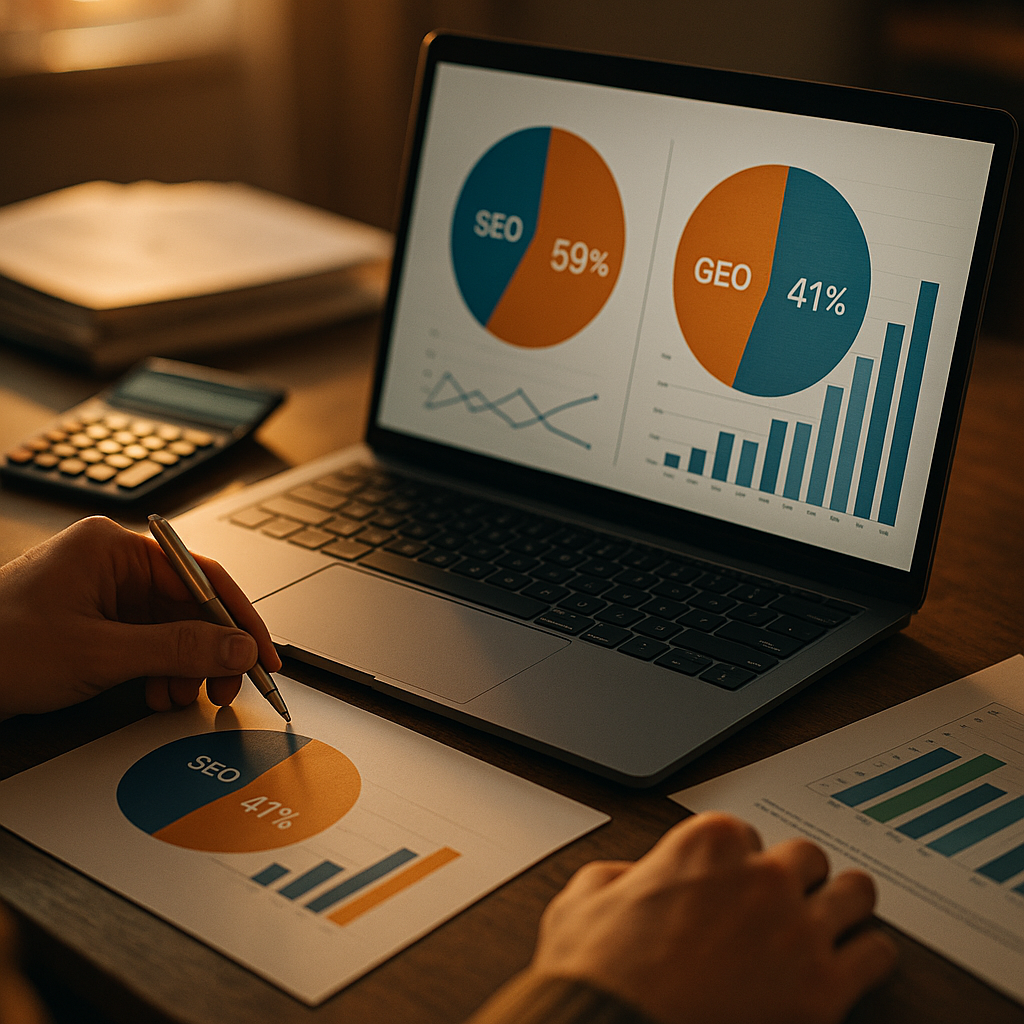
Roughly 60% of Google searches now end without a click, according to eMarketer research on zero-click behavior, and AI answer engines are accelerating that trend. So the question isn’t whether GEO vs SEO matters anymore. It’s how much of next quarter’s content budget you’re willing to bet on each.
Most marketing teams are still allocating spend like it’s 2021: 90% traditional SEO, 10% “whatever GEO thing the agency mentioned in the pitch deck.” That ratio is already outdated. This piece gives you a technical framework for splitting investment correctly, based on query type, funnel stage, and actual citation data rather than gut feel.
Why the Old Split No Longer Works
Traditional SEO optimizes for ranking position on a results page a human scrolls through. GEO (generative engine optimization) optimizes for being cited, quoted, or summarized inside an AI-generated answer where there is no scroll, no page two, and often no click at all. These are different games with different scoring systems.
Google’s ranking algorithm rewards backlinks, dwell time, and keyword architecture built over months. AI citation systems — the retrieval layers behind ChatGPT, Gemini, Perplexity, and Google’s AI Overviews — reward structured clarity, source authority signals, and content that answers a question in a self-contained, extractable chunk. A page can rank #1 on Google and get cited zero times by an LLM. The reverse happens too, more often than SEO teams want to admit.
If your content strategy still treats “getting found” as a single objective, you’re optimizing for a search landscape that no longer exists in isolation.
Our sister analysis on the GEO vs SEO budget split lays out the CMO-level case for this shift. This article goes one layer deeper: the technical mechanics of deciding where each dollar actually goes.
The Framework: Four Variables That Determine the Split
Instead of a flat percentage rule (skip the “70/30 forever” advice you’ve seen elsewhere), score every content initiative against four variables. The output tells you whether it’s an SEO play, a GEO play, or both.
- Query intent shape. Transactional and navigational queries (“best CRM for agencies,” “book a flight to Austin”) still route to traditional search and click-through behavior. Informational and comparative queries (“how does X compare to Y,” “what’s the difference between”) increasingly route through AI answer engines first.
- Funnel stage. Top-of-funnel education content gets synthesized by AI engines constantly. Bottom-of-funnel, high-commercial-intent content (pricing pages, demo requests, product comparisons) still depends heavily on classic SEO because users want to click through and verify before they buy.
- Citation-ability of the content format. Listicles, definitions, data points, and step-by-step frameworks get lifted into AI answers easily. Long-form narrative, opinion pieces, and brand storytelling rarely get quoted verbatim — they still need to rank traditionally to earn visibility.
- Competitive citation share. If competitors already dominate AI citations in your category, playing catch-up in GEO costs more per unit of visibility than defending existing SEO rankings. Sometimes the smarter bet is doubling down where you’re already strong.
Score each planned asset 1-3 on each variable. High scores across the board mean the content is genuinely dual-purpose. Skewed scores tell you where to lean the budget.
A Worked Example
Take a B2B SaaS company writing a “how to choose a martech vendor” guide. Query intent is informational and comparative. Funnel stage is mid-funnel. Format is a listicle with clear criteria. Competitive citation share is currently low for this brand. That’s a near-perfect GEO candidate — structure it for extraction, add clear headers, define terms explicitly, and cite primary data.
Now take a pricing comparison page for that same vendor’s premium tier. Intent is transactional. Funnel stage is bottom. Format is a dense, brand-specific table that AI engines have little reason to quote (and the vendor doesn’t necessarily want quoted out of context, given pricing sensitivity). That page stays an SEO asset — optimize for on-page technical SEO, internal linking, and conversion rate, not citation.
Measuring What You’re Actually Buying
Here’s where most teams get stuck: they can’t measure GEO performance the same way they measure SEO, so they default back to rankings and traffic as the only KPIs. That’s a mistake, and it’s fixable.
Track AI citation share the way you’d track keyword rankings. Tools and methodologies for this are maturing fast — see our guide on tracking AI citation share across ChatGPT, Gemini, and Claude for the mechanics. Pair that with a broader visibility metric some teams now call “share of model” — essentially, what percentage of relevant AI-generated answers in your category mention your brand at all, cited or not. Our Share of Model framework breaks down how to build that baseline, and the companion piece on building a Share of Model dashboard gives you the reporting structure to bring to leadership.
On the traditional side, don’t abandon rank tracking, but recontextualize it. A #3 ranking that used to drive 8% CTR might now drive 3%, because AI Overviews are absorbing clicks above it. Sprout Social and other platforms have documented this CTR compression across informational queries specifically — commercial queries are holding up better.
Attribution gets messier too, since AI referral traffic often shows up misclassified or dark in standard analytics. If you haven’t rebuilt your GA4 setup for this, the piece on tracking AI referral traffic in GA4 is worth the afternoon it takes to implement.
The Technical Side of GEO Nobody Talks About Enough
GEO isn’t just “write clearer content.” There’s real technical infrastructure behind it, and it overlaps heavily with structured data work SEO teams already do — just with higher stakes.
- Schema markup matters more, not less. FAQ schema, HowTo schema, and Article schema give retrieval systems structured signals about what your content actually contains. This isn’t optional anymore.
- Zero-click doesn’t mean zero-value, but it changes what you audit. Our structured data audit framework for zero-click search walks through the technical checklist most teams skip.
- Answer engine optimization is becoming its own discipline. Some organizations are now building dedicated AEO functions that sit between SEO and content strategy. See how answer engine optimization is becoming brand search infrastructure for where that role fits organizationally.
- Buyer journey signals are getting reconstructed, not lost. As fewer users leave a trackable trail, marketers are rebuilding journey mapping using proxy signals and AI search behavior patterns — detailed in our piece on AI search signal reconstruction.
Structured data used to be a nice-to-have for rich snippets. Now it’s the primary language you use to talk to the systems deciding whether your brand gets cited at all.
If you’re outsourcing any of this, vet carefully. A lot of agencies are rebranding basic content services as “GEO” without any real measurement methodology behind it. Our guide to vetting a GEO agency lists the specific questions to ask before signing a retainer, including how they define and report citation share.
Building the Actual Budget Split
So what’s the number? There isn’t one universal ratio, but here’s a starting framework based on content audits we’ve seen work across B2B and B2C brands in the past year.
- Heavy transactional/commercial category (e-commerce, local services): 75% SEO, 25% GEO. Clicks still convert directly; AI engines influence research phase but rarely close the sale yet.
- Informational/educational category (SaaS, B2B services, health, finance): 50% SEO, 50% GEO. This is where AI Overviews and chatbot answers are absorbing the most query volume.
- High-consideration, comparison-heavy category (enterprise software, insurance, complex purchases): 40% SEO, 60% GEO. Buyers are asking AI tools to compare options before they ever hit a search engine.
Revisit this quarterly, not annually. Citation share moves faster than keyword rankings ever did — a Perplexity algorithm update or a new ChatGPT retrieval source can shift your visibility in weeks, not months. Treat the split as a living allocation, reviewed with the same cadence you’d apply to paid media budgets, not a set-it-and-forget-it content calendar decision.
One more thing worth flagging: this isn’t purely a content team problem anymore. Marketing mix modeling teams are already adjusting for the attribution gaps this shift creates — see the broader trend covered in marketing mix modeling’s comeback amid attribution breakage. If your MMM and content teams aren’t talking, that’s a gap to close this quarter.
Next step: Pull your last twenty published assets, score them against the four variables above, and you’ll likely find at least a third are misallocated — ranking-optimized content that should be citation-optimized, or vice versa. Fix that mismatch before you write a single new page.
Frequently Asked Questions
What’s the difference between GEO and SEO in practical terms?
SEO optimizes content to rank on a search results page that a user scrolls through and clicks. GEO optimizes content to be cited, quoted, or summarized directly inside an AI-generated answer, where there’s often no click at all. They require different content structures, different technical signals, and different success metrics.
How do I measure GEO ROI if there’s no click to track?
Track AI citation share (how often your brand is cited in relevant AI-generated answers) and a broader visibility metric like share of model. Combine these with rebuilt GA4 tracking that captures AI referral traffic, since some AI platforms do send click-through traffic even without traditional keyword data attached.
Should small or mid-sized brands invest in GEO at all?
Yes, selectively. Brands with strong topical authority in a niche often see outsized citation gains because AI retrieval systems favor clear, well-structured authority signals over sheer domain size. Start with your highest-intent informational content rather than trying to cover every topic at once.
Does investing in GEO hurt traditional SEO performance?
No, and in most cases the two reinforce each other. Structured, clearly answered content tends to perform well in both traditional rankings and AI citations. The risk is spreading resources too thin trying to optimize every asset for both goals when some content is better served focusing on one.
How often should the GEO vs SEO budget split be reviewed?
Quarterly, at minimum. AI citation share and answer engine behavior shift faster than traditional search rankings, often in response to platform updates you won’t get advance notice about. Treat the split as a flexible allocation reviewed alongside paid media budgets, not a fixed annual decision.
FAQs
What’s the difference between GEO and SEO in practical terms?
SEO optimizes content to rank on a search results page that a user scrolls through and clicks. GEO optimizes content to be cited, quoted, or summarized directly inside an AI-generated answer, where there’s often no click at all. They require different content structures, different technical signals, and different success metrics.
How do I measure GEO ROI if there’s no click to track?
Track AI citation share (how often your brand is cited in relevant AI-generated answers) and a broader visibility metric like share of model. Combine these with rebuilt GA4 tracking that captures AI referral traffic, since some AI platforms do send click-through traffic even without traditional keyword data attached.
Should small or mid-sized brands invest in GEO at all?
Yes, selectively. Brands with strong topical authority in a niche often see outsized citation gains because AI retrieval systems favor clear, well-structured authority signals over sheer domain size. Start with your highest-intent informational content rather than trying to cover every topic at once.
Does investing in GEO hurt traditional SEO performance?
No, and in most cases the two reinforce each other. Structured, clearly answered content tends to perform well in both traditional rankings and AI citations. The risk is spreading resources too thin trying to optimize every asset for both goals when some content is better served focusing on one.
How often should the GEO vs SEO budget split be reviewed?
Quarterly, at minimum. AI citation share and answer engine behavior shift faster than traditional search rankings, often in response to platform updates you won’t get advance notice about. Treat the split as a flexible allocation reviewed alongside paid media budgets, not a fixed annual decision.
Top Influencer Marketing Agencies
The leading agencies shaping influencer marketing in 2026
Agencies ranked by campaign performance, client diversity, platform expertise, proven ROI, industry recognition, and client satisfaction. Assessed through verified case studies, reviews, and industry consultations.
Moburst

-
2

The Shelf
Boutique Beauty & Lifestyle Influencer AgencyA data-driven boutique agency specializing exclusively in beauty, wellness, and lifestyle influencer campaigns on Instagram and TikTok. Best for brands already focused on the beauty/personal care space that need curated, aesthetic-driven content.Clients: Pepsi, The Honest Company, Hims, Elf Cosmetics, Pure LeafVisit The Shelf → -
3

Audiencly
Niche Gaming & Esports Influencer AgencyA specialized agency focused exclusively on gaming and esports creators on YouTube, Twitch, and TikTok. Ideal if your campaign is 100% gaming-focused — from game launches to hardware and esports events.Clients: Epic Games, NordVPN, Ubisoft, Wargaming, Tencent GamesVisit Audiencly → -
4

Viral Nation
Global Influencer Marketing & Talent AgencyA dual talent management and marketing agency with proprietary brand safety tools and a global creator network spanning nano-influencers to celebrities across all major platforms.Clients: Meta, Activision Blizzard, Energizer, Aston Martin, WalmartVisit Viral Nation → -
5

The Influencer Marketing Factory
TikTok, Instagram & YouTube CampaignsA full-service agency with strong TikTok expertise, offering end-to-end campaign management from influencer discovery through performance reporting with a focus on platform-native content.Clients: Google, Snapchat, Universal Music, Bumble, YelpVisit TIMF → -
6

NeoReach
Enterprise Analytics & Influencer CampaignsAn enterprise-focused agency combining managed campaigns with a powerful self-service data platform for influencer search, audience analytics, and attribution modeling.Clients: Amazon, Airbnb, Netflix, Honda, The New York TimesVisit NeoReach → -
7

Ubiquitous
Creator-First Marketing PlatformA tech-driven platform combining self-service tools with managed campaign options, emphasizing speed and scalability for brands managing multiple influencer relationships.Clients: Lyft, Disney, Target, American Eagle, NetflixVisit Ubiquitous → -
8

Obviously
Scalable Enterprise Influencer CampaignsA tech-enabled agency built for high-volume campaigns, coordinating hundreds of creators simultaneously with end-to-end logistics, content rights management, and product seeding.Clients: Google, Ulta Beauty, Converse, AmazonVisit Obviously →