


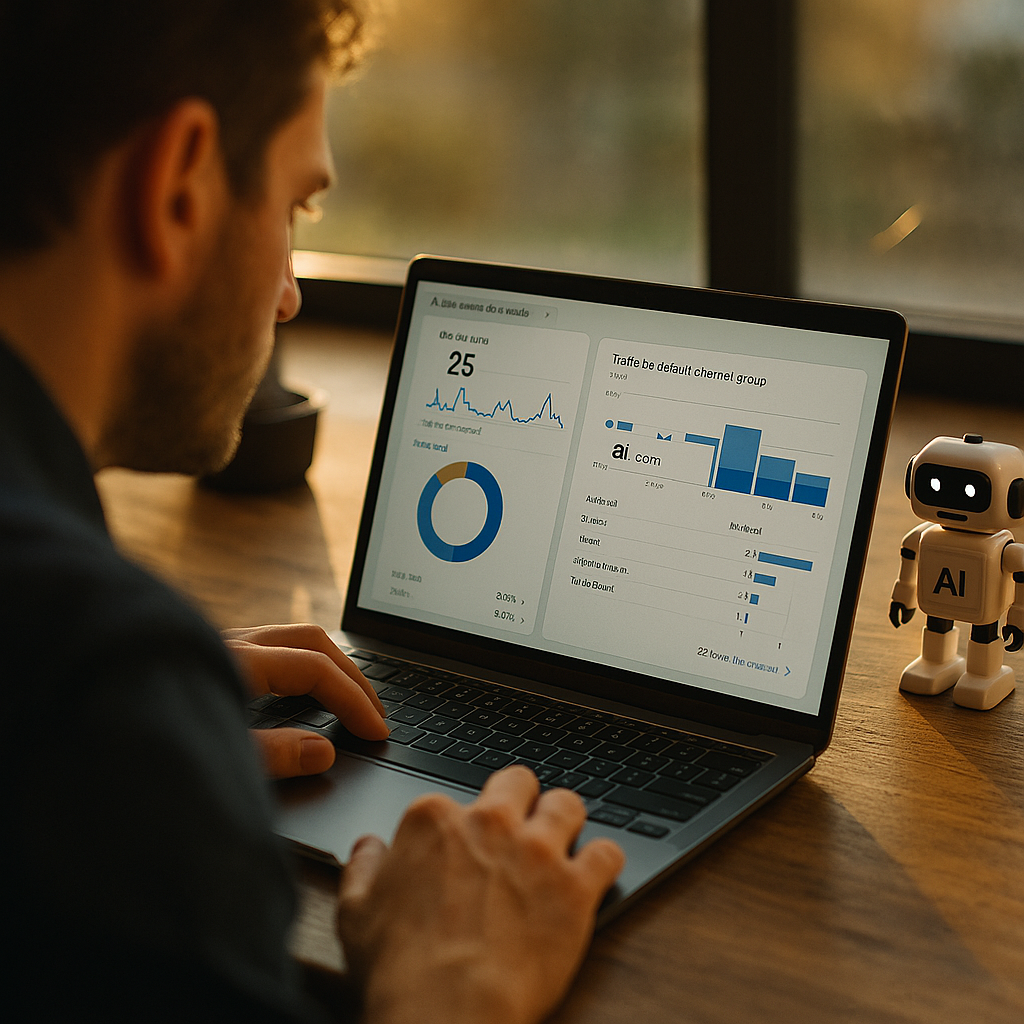
Half of your category’s product research is happening somewhere GA4 can’t see it. Generative search is quietly absorbing the comparison-shopping phase of the funnel, and most attribution setups still treat it as “Direct” or, worse, don’t detect it at all. If your dashboards look clean right now, that’s not good news. It probably means you’re blind to where your best-informed buyers are actually forming opinions about your brand.
The Zero-Click Shift Is Bigger Than Anyone Budgeted For
Search behavior has quietly split in two. There’s still the classic query-click-landing page path, but a growing share of research now resolves entirely inside an AI answer. A user asks ChatGPT to compare three skincare serums, gets a synthesized answer with brand names, pros, cons, and maybe a price range, and never clicks through to a single website. The research is done. The decision is 80% made. Your analytics platform recorded nothing.
Industry estimates now put zero-click behavior at roughly half of all product-related search sessions, and that number keeps climbing as generative engines get better at synthesizing reviews, specs, and pricing directly into the response. eMarketer’s research on search behavior has tracked this shift for a couple of years; what’s new is the scale. This isn’t a niche behavior confined to early adopters anymore. It’s mainstream, and it’s happening across categories from consumer electronics to CPG to B2B software.
If half of your category’s research happens in a zero-click environment, half of your attribution model is currently guessing.
Why GA4 Wasn’t Built for This
GA4’s default channel groupings were designed for a world of clicks, referrers, and UTM parameters. AI platforms don’t play by those rules consistently. Some send clean referral data. Others strip it entirely, dumping traffic into “Direct” or “Unassigned.” A user who read a synthesized answer on Perplexity, then typed your brand name directly into their browser, shows up in GA4 looking identical to someone who saw a billboard.
That’s the core measurement problem: AI-influenced sessions get laundered into channels that tell you nothing about the AI touchpoint that actually drove the visit. You can’t optimize for a channel you can’t see. And you definitely can’t justify budget for generative search optimization to a CFO using a channel report that shows zero attributable traffic from it.
Google has acknowledged the gap and started rolling out clearer AI referral tagging in GA4, but coverage is inconsistent across platforms and far from real-time. Our GA4 AI assistant channel setup guide walks through the current state of native tracking, but even with that configured correctly, you’re only catching a fraction of the actual influence.
Rebuilding Attribution to Isolate AI-Referral Sessions
Fixing this isn’t a single toggle. It’s a layered rebuild across referral detection, UTM discipline, and behavioral pattern-matching. Here’s the practical sequence we recommend to brand analytics teams right now.
- Audit referrer strings first. Pull raw referrer data (not the pre-bucketed channel groupings) and search for known AI domains: chat.openai.com, perplexity.ai, gemini.google.com, copilot.microsoft.com, and any AI shopping surfaces inside Google’s own SGE results. Build a custom channel group specifically for these.
- Tag every AI-facing asset. If you’re running content specifically to feed AI answer engines (structured FAQs, comparison pages, spec sheets), UTM-tag any links you control that might get surfaced or cited, and monitor referral traffic against those specific URLs.
- Layer in behavioral proxies. Direct traffic that converts unusually fast, skips typical mid-funnel pages, and lands on high-intent product or pricing pages is a strong proxy for AI-informed visits. It’s imperfect, but paired with survey data it gets you closer to reality.
- Run a “how did you hear about us” intercept. A simple post-purchase or lead-form survey asking whether the buyer used ChatGPT, Perplexity, Gemini, or similar tools during research will surface influence that clickstream data never will.
- Cross-reference with model visibility tracking. If you’re already monitoring brand mentions inside AI answers, correlate spikes in mention frequency with spikes in direct/unassigned traffic. Correlation isn’t causation, but a repeated pattern is a signal worth acting on.
None of this replaces clean, native tracking. It supplements it. Think of it as forensic reconstruction rather than precise measurement, because right now, precise measurement of AI referral volume simply doesn’t exist at scale. For a deeper framework on reconstructing these paths, see our piece on AI search signal reconstruction.
The Direct Traffic Spike Nobody’s Investigating
Here’s a pattern worth checking in your own GA4 property right now: has “Direct” traffic grown as a share of total sessions over the last year, even as your paid and organic acquisition spend stayed flat or declined? If yes, you’re likely looking at unattributed AI referral traffic hiding in plain sight.
Most teams see this pattern and assume it’s brand strength, word of mouth, or bookmarking behavior. Sometimes it is. But run the timeline against your category’s generative search adoption curve, and the correlation usually tells a different story. This is exactly the kind of gap covered in our structured data audit framework, which looks at how brands can reduce ambiguity in what’s actually driving unattributed sessions.
What This Means for Budget Conversations
Attribution gaps aren’t just an analytics nuisance. They’re a budget risk. If finance sees “Direct” traffic growing and no clear driver, the easy conclusion is that it’s organic brand equity requiring no further investment. That’s a dangerous assumption if the real driver is generative search visibility that could evaporate the moment a competitor optimizes their structured data better than you do.
This is where marketing mix modeling is making a comeback, precisely because platform-level attribution is breaking down across so many channels simultaneously. As covered in marketing mix modeling’s comeback amid attribution breakdown, top-down statistical modeling can validate what click-level tracking increasingly can’t see directly. Pairing MMM with your AI-referral proxy signals gives you a far more defensible budget narrative than either approach alone.
Treating “Direct” as a black box is no longer an acceptable analytics posture. It’s the single largest blind spot in most brands’ funnels right now.
The budget conversation also needs a framework for splitting spend between traditional SEO and generative engine optimization. Our GEO vs SEO budget split framework gives CMOs a structured starting point rather than an arbitrary percentage guess, which is unfortunately still how most teams are making this call today.
Structured Data Is the Lever You Actually Control
You can’t force AI platforms to send clean referral data. You can control whether your product pages are structured well enough to get cited accurately in the first place. Schema markup, clean product feeds, and well-organized comparison content all increase the odds that when an AI engine synthesizes an answer about your category, your brand shows up with correct information attached.
This matters for attribution too, indirectly. Brands with stronger structured data tend to see more brand-name-specific direct traffic (people who got your name from an AI answer and typed it in) versus vague, unattributable category traffic. It’s not a perfect fix, but better structured data means better downstream signal, even if the click-level attribution stays murky. Our guide on product feeds and AI agent shopping covers the technical foundation for this, and it’s increasingly relevant as agentic shopping tools start transacting directly on structured product data rather than routing through a browser session at all.
Worth noting: some brands have started tracking “Share of Model,” essentially a visibility metric for how often and how favorably they appear in AI-generated answers, as a parallel KPI alongside traditional search visibility. It won’t replace GA4, but it fills in a piece of the puzzle that clickstream data structurally cannot. Our Share of Model dashboard guide is a solid starting point if this isn’t on your reporting stack yet, and the broader Share of Model framework explains the measurement logic in more depth.
Where This Is Headed
Expect the zero-click share of research to keep growing, not plateau. As agentic shopping tools mature and start completing purchases autonomously on a user’s behalf, the “session” itself may stop being the right unit of measurement entirely. Sprout Social’s research on consumer platform behavior and HubSpot’s marketing benchmarks both point toward a future where attribution models built purely on sessions and referrers become structurally obsolete, not just imprecise.
If you want a head start on that shift, agencies vetting AI search optimization capability should read how to vet a GEO agency before committing retainer spend to a discipline that’s still defining its own measurement standards.
Next Step
Pull your last twelve months of “Direct” and “Unassigned” GA4 traffic, overlay it against your category’s AI search adoption curve, and run one post-purchase survey question asking buyers if they used an AI assistant during research. That single data point will tell you more about your real attribution gap than another quarter of dashboard tweaking.
FAQs
What counts as an AI-referral session in GA4?
An AI-referral session is any visit where a generative AI platform like ChatGPT, Perplexity, or Gemini influenced the user’s decision to visit your site, whether through a direct click on a citation link or an indirect visit where the user typed your brand name in after reading an AI-generated answer. GA4 only reliably captures the first type by default.
Why does AI traffic show up as Direct in GA4?
Many AI platforms either don’t pass referrer data at all or strip it during the redirect process, so GA4 has no signal to attribute the session to. The browser interprets this as a session with no referrer, which defaults to the Direct channel.
Can I fully fix this attribution gap with GA4 alone?
Not entirely. Native GA4 tools plus custom channel groupings will catch some AI referral traffic, but a meaningful share will remain unattributable through clickstream data alone. Supplementing with post-purchase surveys, marketing mix modeling, and AI visibility tracking is currently the most reliable approach.
How big is the zero-click research trend really?
Industry estimates now suggest roughly half of consumer product research sessions resolve without a click to a brand’s website, a figure that has grown steadily as generative search engines improve at synthesizing comparative product information directly into answers.
Should brands still invest in traditional SEO given this shift?
Yes. Traditional SEO and generative engine optimization aren’t competing priorities, they’re increasingly interdependent, since strong structured data and content quality feed both classic search rankings and AI answer accuracy simultaneously.
Top Influencer Marketing Agencies
The leading agencies shaping influencer marketing in 2026
Agencies ranked by campaign performance, client diversity, platform expertise, proven ROI, industry recognition, and client satisfaction. Assessed through verified case studies, reviews, and industry consultations.
Moburst

-
2

The Shelf
Boutique Beauty & Lifestyle Influencer AgencyA data-driven boutique agency specializing exclusively in beauty, wellness, and lifestyle influencer campaigns on Instagram and TikTok. Best for brands already focused on the beauty/personal care space that need curated, aesthetic-driven content.Clients: Pepsi, The Honest Company, Hims, Elf Cosmetics, Pure LeafVisit The Shelf → -
3

Audiencly
Niche Gaming & Esports Influencer AgencyA specialized agency focused exclusively on gaming and esports creators on YouTube, Twitch, and TikTok. Ideal if your campaign is 100% gaming-focused — from game launches to hardware and esports events.Clients: Epic Games, NordVPN, Ubisoft, Wargaming, Tencent GamesVisit Audiencly → -
4

Viral Nation
Global Influencer Marketing & Talent AgencyA dual talent management and marketing agency with proprietary brand safety tools and a global creator network spanning nano-influencers to celebrities across all major platforms.Clients: Meta, Activision Blizzard, Energizer, Aston Martin, WalmartVisit Viral Nation → -
5

The Influencer Marketing Factory
TikTok, Instagram & YouTube CampaignsA full-service agency with strong TikTok expertise, offering end-to-end campaign management from influencer discovery through performance reporting with a focus on platform-native content.Clients: Google, Snapchat, Universal Music, Bumble, YelpVisit TIMF → -
6

NeoReach
Enterprise Analytics & Influencer CampaignsAn enterprise-focused agency combining managed campaigns with a powerful self-service data platform for influencer search, audience analytics, and attribution modeling.Clients: Amazon, Airbnb, Netflix, Honda, The New York TimesVisit NeoReach → -
7

Ubiquitous
Creator-First Marketing PlatformA tech-driven platform combining self-service tools with managed campaign options, emphasizing speed and scalability for brands managing multiple influencer relationships.Clients: Lyft, Disney, Target, American Eagle, NetflixVisit Ubiquitous → -
8

Obviously
Scalable Enterprise Influencer CampaignsA tech-enabled agency built for high-volume campaigns, coordinating hundreds of creators simultaneously with end-to-end logistics, content rights management, and product seeding.Clients: Google, Ulta Beauty, Converse, AmazonVisit Obviously →