


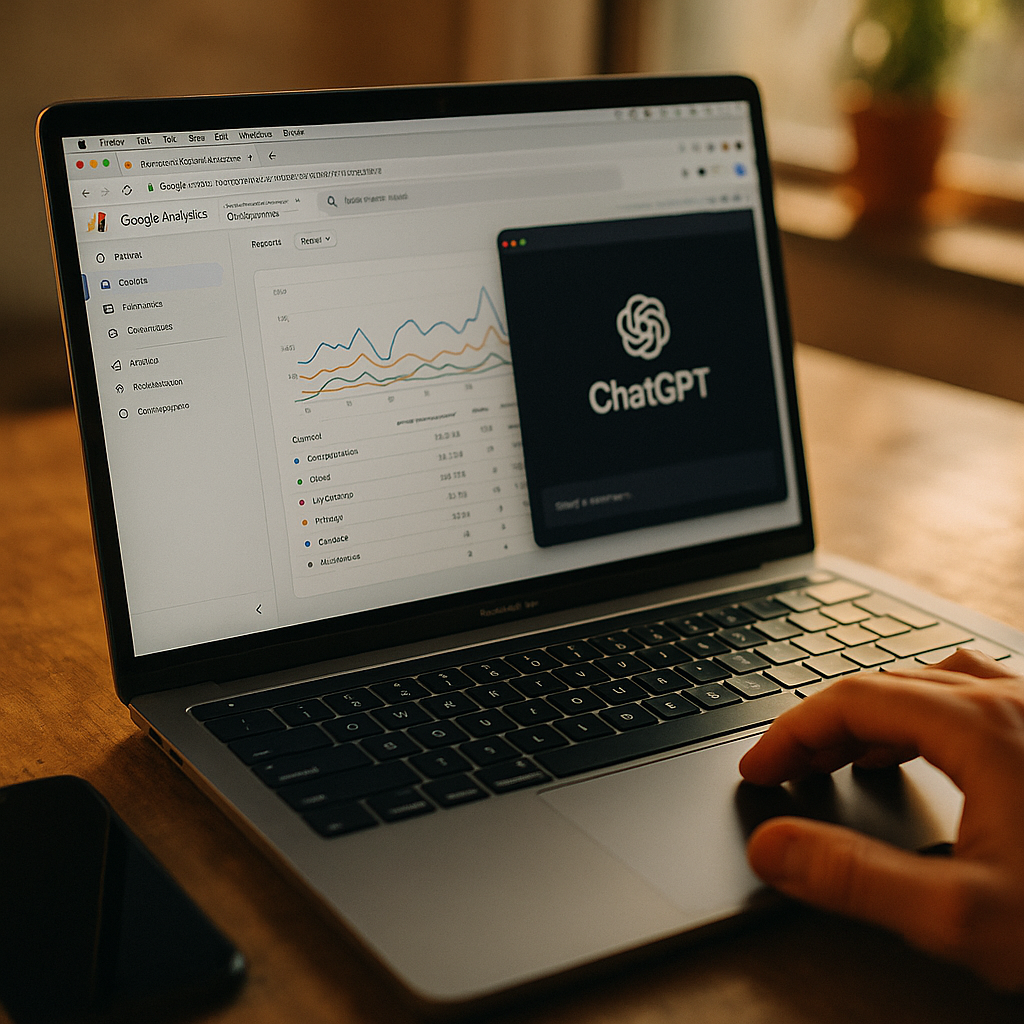
Sixteen percent of consumers now use AI chatbots to research purchases before buying, according to eMarketer data. Yet most brands still can’t answer a basic question: how much revenue is ChatGPT actually sending them? GA4’s new AI Assistant channel grouping finally makes generative discovery traffic visible instead of buried under “Direct” or “Unassigned.” If you haven’t configured it yet, you’re flying blind on one of the fastest-growing acquisition sources in marketing.
Why This Channel Exists Now
For the better part of two years, traffic from ChatGPT, Perplexity, Gemini, and Copilot landed in GA4 as a mess. Some sessions showed up as referral traffic from chat.openai.com. Others got swallowed into “Direct” because the click carried no referrer string at all — a known quirk of how many AI apps handle outbound links. Marketers building dashboards for leadership had no clean way to say “this many visits came from an AI assistant.”
Google’s answer is the AI Assistant default channel grouping, a dedicated bucket in GA4 that automatically classifies sessions arriving from recognized generative AI sources. It sits alongside Organic Search, Paid Search, and Referral in your standard channel reports. No custom dimension required, no regex nightmares — at least, not for the platforms Google already recognizes out of the box.
Traffic from generative AI tools grew faster than any other referral category tracked by major analytics platforms this year, yet most GA4 properties still misclassify the majority of it as Direct.
What Counts as “AI Assistant” Traffic in GA4
Google pulls from a source/medium list that it updates periodically, similar to how it maintains the search engine and social platform lists. As of now, the AI Assistant grouping typically captures:
- ChatGPT (chat.openai.com, chatgpt.com)
- Perplexity (perplexity.ai)
- Google Gemini and Gemini app referrals
- Microsoft Copilot
- Claude.ai web referrals
This list isn’t static, and that’s the catch. New assistants launch monthly. Regional players like DeepSeek or vertical-specific shopping agents may not be pre-classified, which means real traffic still leaks into Referral or Direct if Google hasn’t added the domain yet. Treat the default list as a floor, not a ceiling.
The Direct Traffic Problem Hasn’t Fully Gone Away
Here’s the uncomfortable truth: even with the new channel live, a meaningful chunk of AI-referred sessions still won’t get tagged correctly. Some AI apps strip referrer data entirely when a user taps a citation link, especially inside mobile apps rather than browsers. When that happens, GA4 has nothing to classify — the session lands in Direct by default, same as someone typing your URL from memory.
That’s why smart teams pair the native channel grouping with a secondary detection layer: UTM parameters on any links you control (like those in AI-crawled content or schema-driven product feeds), plus a supplemental exploration report that segments Direct traffic by landing page and session characteristics. If your homepage suddenly has spikes of single-page Direct sessions with unusually short engagement times, that’s often generative referral traffic hiding in plain sight.
Configuring the Channel: A Step-by-Step Setup
The AI Assistant grouping is on by default in most GA4 properties running current SDKs and tagging, but “default” doesn’t mean “correctly capturing everything you need.” Here’s how to actually configure it for reliable measurement.
- Verify the channel is active. Go to Reports > Acquisition > Traffic Acquisition and check if “AI Assistant” appears as a default channel option. If you’re on an older GA4 configuration or using a custom channel grouping override, you may need to reset to Google’s default definitions or manually recreate the grouping using the source-matching rules Google publishes in its Analytics help documentation.
- Audit your existing custom channel groups. If your team built custom channel logic before this update shipped, those rules may be intercepting AI referral traffic before it reaches the new default bucket. Custom groupings evaluate before default ones in some configurations, so an old catch-all “Referral” rule can quietly swallow ChatGPT sessions.
- Build a supplementary exploration report. Create a Free Form exploration segmented by Session source/medium, filtered to isolate domains like chatgpt.com, perplexity.ai, and gemini.google.com. This gives you a manual cross-check against the automated channel, and it catches sources Google hasn’t officially added yet.
- Add UTM tagging where you control the link. Any citation link, schema-embedded URL, or structured data reference that AI crawlers might surface should carry consistent UTM parameters (utm_source=chatgpt, utm_medium=ai_referral, etc.) so you’re not solely dependent on referrer detection.
- Set up a custom alert for Direct traffic anomalies. Configure an Insights alert that flags unusual spikes in Direct sessions to specific landing pages. This is your early warning system for AI referral traffic that’s slipping through unclassified.
Don’t Forget Conversion Attribution
Classifying the traffic is only step one. The bigger question your CFO will ask is whether AI-referred visitors actually convert, and at what rate compared to organic search or paid social. Set up a comparison view in GA4 that filters conversions by the AI Assistant channel specifically, then benchmark against your other top channels over a rolling 90-day window. Early data from several mid-market ecommerce brands we’ve tracked shows AI referral sessions converting at rates comparable to organic search, sometimes higher, because users arrive further along in the research process. A ChatGPT-referred visitor who asked “best running shoes for flat feet” and clicked through has already done more qualifying than someone who just typed a broad keyword into Google.
This is the same attribution rigor teams should already be applying to AI-driven sales claims more broadly. If a vendor or internal report claims AI referral drove a specific revenue number, verify the underlying data model before you present it upward. Our guide on verifying AI-generated attribution claims walks through the exact checks worth running before you trust a dashboard number.
What This Means for Budget Conversations
Once you can reliably see AI Assistant traffic in GA4, the natural next question is resourcing. Should you be spending on generative engine optimization the same way you spend on traditional SEO? That’s the debate playing out in budget meetings right now, and it’s not a simple either/or. GEO and SEO overlap heavily in mechanics — structured data, authoritative content, crawlability — but they diverge in what “ranking” even means. There’s no keyword position to chase when an LLM is synthesizing an answer from a dozen sources.
If you’re building the business case for reallocating spend, our GEO vs SEO budget allocation framework lays out how CMOs are splitting investment as generative discovery traffic scales. The short version: treat GA4’s AI Assistant data as your leading indicator, and adjust the split quarterly rather than locking in an annual assumption.
Brands treating GEO as a bolt-on to existing SEO workflows are consistently underinvesting in the structured data and schema work that actually gets cited by AI assistants.
Schema Markup Is Doing More Work Than You Think
Part of why AI Assistant referral traffic is growing at all comes down to how well your product and content pages are structured for machine parsing. AI shopping agents and research assistants lean heavily on schema markup to extract accurate, citable information rather than scraping raw HTML. If your product feed lacks proper Product, Review, or FAQ schema, you’re simply less likely to get cited — which means less referral traffic to measure in the first place. Our breakdown of how schema markup functions as an API for AI shopping agents is worth reading alongside your GA4 configuration work, since the two efforts reinforce each other. Measurement without visibility investment just tells you how little traffic you’re getting.
The same logic applies to broader AI search visibility. If you’re evaluating third-party platforms that promise to track or improve your standing in generative results, run them through a proper vetting process first. Not every “AI SEO” tool on the market has a defensible methodology, and our buyer’s guide to AI search visibility platforms covers the questions to ask before signing a contract.
Compliance and Data Quality Considerations
There’s a governance layer here too. As you route more decision-making through AI-classified traffic data, make sure your underlying data quality holds up. Misattributed channels lead to misallocated budget, and that’s a compounding problem if it goes unchecked for a few quarters. Our diagnostic on why AI marketing tools fail on data quality is a useful checklist to run against your GA4 setup, not just third-party platforms. And if your legal or compliance team asks about tracking consent for AI referral traffic, it’s worth reviewing current guidance from the FTC on data collection disclosures, since the regulatory landscape around AI-mediated commerce is still catching up to the tech.
The Practical Ceiling: What GA4 Still Can’t Tell You
Even a perfectly configured AI Assistant channel won’t tell you what question a user asked the chatbot before clicking through. That’s a real limitation. You’ll know someone arrived from Perplexity; you won’t know if they asked about your product specifically or got surfaced as an alternative to a competitor they searched for. Some brands are solving this with server-side logging paired with referrer metadata, others are simply accepting the gap and using directional trends rather than precise attribution. Either way, don’t oversell the precision of this data to stakeholders. It’s a strong signal, not a complete picture.
FAQs
What is the GA4 AI Assistant channel grouping?
It’s a default channel classification in GA4 that automatically groups sessions referred by recognized generative AI tools like ChatGPT, Perplexity, Gemini, and Copilot, separating them from generic Referral or Direct traffic.
Why was AI referral traffic showing up as Direct traffic before?
Many AI assistant apps, especially mobile versions, don’t pass standard referrer data when a user clicks an outbound link. Without a referrer, GA4 defaults the session to Direct, making it indistinguishable from someone typing your URL directly.
Do I need to manually enable the AI Assistant channel in GA4?
In most current GA4 properties it’s enabled by default. However, older custom channel grouping rules can intercept traffic before it reaches the new default classification, so it’s worth auditing your existing rules to confirm they aren’t overriding it.
How accurate is GA4’s AI Assistant traffic data?
It’s a strong directional signal but not a complete picture. Google’s source list doesn’t cover every AI assistant, and referrer stripping means some generative traffic still lands in Direct. Pair it with a supplementary exploration report for a fuller view.
Should I shift budget from SEO to GEO based on this data?
Use AI Assistant channel data as a leading indicator rather than a definitive trigger. Track conversion rate and revenue contribution from this channel over several quarters before making a permanent budget shift, and reassess the split regularly rather than locking in a fixed allocation.
Next step: audit your GA4 property this week, confirm the AI Assistant channel isn’t being overridden by legacy custom rules, and build the Direct-traffic exploration report before your next budget cycle — that’s the data leadership will ask for first.
Top Influencer Marketing Agencies
The leading agencies shaping influencer marketing in 2026
Agencies ranked by campaign performance, client diversity, platform expertise, proven ROI, industry recognition, and client satisfaction. Assessed through verified case studies, reviews, and industry consultations.
Moburst

-
2

The Shelf
Boutique Beauty & Lifestyle Influencer AgencyA data-driven boutique agency specializing exclusively in beauty, wellness, and lifestyle influencer campaigns on Instagram and TikTok. Best for brands already focused on the beauty/personal care space that need curated, aesthetic-driven content.Clients: Pepsi, The Honest Company, Hims, Elf Cosmetics, Pure LeafVisit The Shelf → -
3

Audiencly
Niche Gaming & Esports Influencer AgencyA specialized agency focused exclusively on gaming and esports creators on YouTube, Twitch, and TikTok. Ideal if your campaign is 100% gaming-focused — from game launches to hardware and esports events.Clients: Epic Games, NordVPN, Ubisoft, Wargaming, Tencent GamesVisit Audiencly → -
4

Viral Nation
Global Influencer Marketing & Talent AgencyA dual talent management and marketing agency with proprietary brand safety tools and a global creator network spanning nano-influencers to celebrities across all major platforms.Clients: Meta, Activision Blizzard, Energizer, Aston Martin, WalmartVisit Viral Nation → -
5

The Influencer Marketing Factory
TikTok, Instagram & YouTube CampaignsA full-service agency with strong TikTok expertise, offering end-to-end campaign management from influencer discovery through performance reporting with a focus on platform-native content.Clients: Google, Snapchat, Universal Music, Bumble, YelpVisit TIMF → -
6

NeoReach
Enterprise Analytics & Influencer CampaignsAn enterprise-focused agency combining managed campaigns with a powerful self-service data platform for influencer search, audience analytics, and attribution modeling.Clients: Amazon, Airbnb, Netflix, Honda, The New York TimesVisit NeoReach → -
7

Ubiquitous
Creator-First Marketing PlatformA tech-driven platform combining self-service tools with managed campaign options, emphasizing speed and scalability for brands managing multiple influencer relationships.Clients: Lyft, Disney, Target, American Eagle, NetflixVisit Ubiquitous → -
8

Obviously
Scalable Enterprise Influencer CampaignsA tech-enabled agency built for high-volume campaigns, coordinating hundreds of creators simultaneously with end-to-end logistics, content rights management, and product seeding.Clients: Google, Ulta Beauty, Converse, AmazonVisit Obviously →