


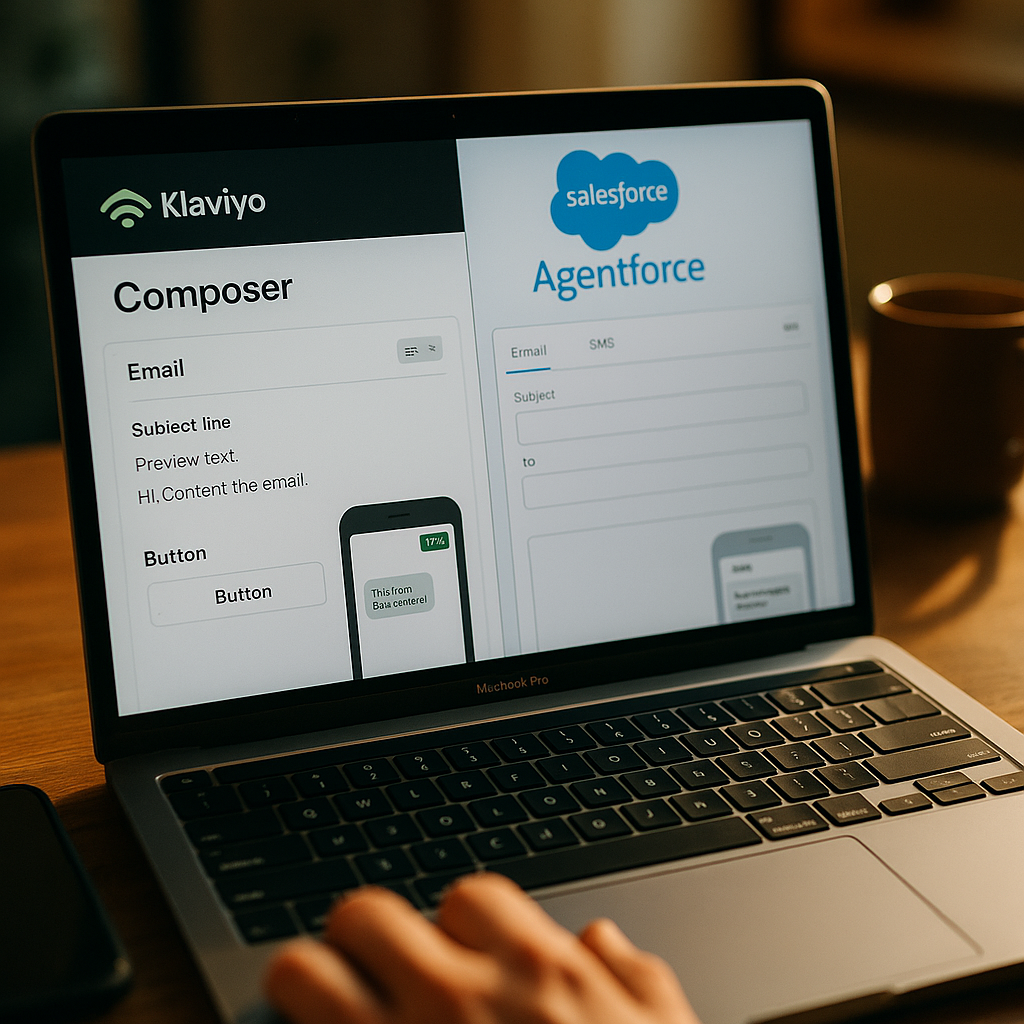
Seventy-one percent of marketers using AI in email say it’s cut campaign build time by half or more, according to HubSpot research. So why are so many e-commerce teams still stuck manually briefing, building, and QA-ing every send? The real question isn’t whether to automate — it’s whether Klaviyo Composer vs Salesforce Agentforce is the better engine for autonomous email and SMS campaign generation. The answer depends on your stack, not your ambitions.
Two Very Different Bets on What “Autonomous” Means
Klaviyo Composer and Salesforce Agentforce both promise to take a brief and produce a send-ready campaign with minimal human hand-holding. But they’re built on fundamentally different assumptions about where marketing intelligence should live.
Composer treats commerce data as the primary input. It’s tuned specifically for e-commerce brands already living inside Klaviyo’s ecosystem — pulling from purchase history, browse behavior, and product catalogs to generate email and SMS content that reflects what a segment actually does, not just who they are demographically. Agentforce takes a broader CRM-first approach. It’s designed to orchestrate campaigns as one function among many — service, sales, commerce — using Salesforce’s Data Cloud as the unifying layer.
That distinction matters more than the marketing decks let on. If your business is DTC-heavy and your customer journey lives almost entirely in transactional and behavioral data, Composer’s narrower focus is a feature. If you’re running a hybrid B2B2C model with sales reps, service tickets, and loyalty programs all touching the same customer, Agentforce’s broader orchestration might be worth the added complexity.
The vendor that wins your RFP isn’t necessarily the one with the flashiest demo — it’s the one whose data model already matches how your customers actually behave.
What Klaviyo Composer Actually Automates
Composer generates full campaign drafts — subject lines, body copy, send-time recommendations, and audience segments — from a short prompt. It’s an extension of Klaviyo’s existing AI features (subject line optimization, predictive analytics, SMS compliance checks) rather than a bolt-on agent layer.
The practical upside: it inherits Klaviyo’s deep e-commerce integrations out of the box. Shopify, WooCommerce, BigCommerce data flows in without middleware. That means product recommendations inside generated emails are pulled from real inventory and pricing, not hallucinated placeholders.
The limitation is scope. Composer is built for email and SMS, full stop. It doesn’t orchestrate loyalty programs, service follow-ups, or paid retargeting the way a broader agentic CRM might. Teams that have already read our breakdown of Klaviyo’s CRM automation shift know this is intentional — Klaviyo is doubling down on being the best tool for commerce messaging, not the best tool for everything.
Where Composer Wins on Speed
- Campaign drafts generated from natural-language prompts in under a minute
- Native access to real-time product and inventory data for dynamic content blocks
- Built-in SMS compliance guardrails tuned to TCPA and carrier filtering rules
- Tight feedback loop between send performance and future generation quality
Agentforce’s Pitch: Campaigns as One Node in a Larger Agent Network
Salesforce Agentforce isn’t primarily an email tool that happens to use AI. It’s an agentic layer that sits across the entire Salesforce ecosystem — meaning a campaign-generation agent can, in theory, hand off to a service agent or a sales agent mid-journey. A customer who abandons a cart could trigger not just a recovery email, but a service agent proactively checking for shipping delays that might explain the abandonment.
That’s a genuinely different value proposition than Composer’s. It’s not about generating better emails faster. It’s about making email one lever among several that an orchestration layer pulls automatically.
The tradeoff is setup complexity and cost. Agentforce campaign generation is only as good as the Data Cloud implementation underneath it. Brands with messy CRM hygiene or fragmented customer records will get mediocre output regardless of how sophisticated the agent framework is. We covered this exact failure mode in our agentic CRM readiness comparison — the agent is only as smart as the data feeding it, and most mid-market teams underestimate the cleanup required before go-live.
Agentforce doesn’t fail because the AI is weak. It fails when brands skip the unglamorous work of unifying customer data first.
Cost and Implementation: The Part Vendors Gloss Over
Klaviyo’s pricing model is contact-based and relatively transparent — you know roughly what you’re paying before you sign anything. Composer functionality is layered into existing plan tiers rather than sold as a separate line item, which keeps procurement simple for teams that just want AI drafting bolted onto a tool they already use.
Agentforce pricing is consumption-based, tied to conversations and actions the agent takes. For high-volume e-commerce sending — think daily promotional cadences plus abandoned cart flows plus post-purchase sequences — those per-action costs can add up fast. Finance teams should model worst-case usage before committing, not best-case.
Implementation timelines diverge just as sharply. Composer, for brands already on Klaviyo, is closer to a feature activation than a deployment. Agentforce campaign generation typically requires Data Cloud configuration, agent training on brand voice and product taxonomy, and integration testing across whichever Salesforce clouds are in play. Expect weeks, not days, for a production-ready rollout — and that’s assuming your data infrastructure is already in decent shape.
Compliance and Brand Risk: The Non-Negotiable Layer
Autonomous generation raises the stakes on compliance. An AI-drafted SMS that skips required opt-out language, or an email agent that pulls outdated pricing from a stale product feed, isn’t a hypothetical risk — it’s a recurring one at scale.
Klaviyo builds SMS compliance checks directly into Composer’s output, flagging carrier-filtering risks and required disclosure language before send. Agentforce leans on Salesforce’s broader trust and governance tooling, which is more mature for enterprise data privacy scenarios (think GDPR data residency, consent management across multiple business units) but less specifically tuned to SMS carrier rules out of the box.
Either way, brands should treat autonomous campaign generation the way they’d treat any new vendor claim: verify before you scale. Our CRM vendor audit framework is a useful starting point for structuring that verification — run a limited pilot, audit output against your compliance checklist, and only then expand volume. The FTC has made clear that AI-generated marketing content doesn’t get a pass on truth-in-advertising rules just because a human didn’t write it.
A Quick Gut-Check Before You Pilot Either Tool
- Is your product catalog and inventory feed clean enough to trust in autonomous content?
- Do you need cross-functional orchestration (service, sales, loyalty) or just better email/SMS drafting?
- What’s your realistic monthly send volume, and how does that map to consumption-based pricing?
- Who reviews AI-drafted campaigns before they go live, and how much time does that review actually save?
Interoperability: The Question Nobody Asks Until It’s Too Late
Here’s the thing most vendor comparisons skip: what happens when you want to swap out a piece of your stack later? If Composer is deeply embedded in Klaviyo and you later add a separate CDP, will the agent still have full context? If Agentforce is orchestrating across five Salesforce clouds, how portable is that setup if you migrate off Salesforce in three years?
These aren’t edge-case concerns anymore. Agent interoperability standards are becoming a genuine procurement criterion, not an afterthought. Our piece on emerging agent interoperability standards lays out why locking into a single vendor’s agent framework carries real switching-cost risk down the line — and why running an interoperability audit before signing a multi-year contract is worth the extra week it takes.
Neither Klaviyo nor Salesforce has fully solved this. Both are building toward more open agent-to-agent communication standards, but neither is there yet. Treat any vendor’s interoperability roadmap claims with the same skepticism you’d apply to their ROI claims.
Which One Should You Actually Pilot?
If your team is e-commerce-first, already runs on Klaviyo, and the pain point is specifically “we can’t produce enough good email and SMS content fast enough,” start with Composer. It’s the lower-friction bet, and the data alignment with commerce platforms means faster time-to-value.
If you’re managing a more complex customer relationship — subscription plus retail, B2B plus B2C, multiple service touchpoints — and campaign generation is one piece of a bigger agentic ambition, Agentforce’s broader orchestration justifies the heavier lift. Just budget for the Data Cloud cleanup first, because that’s where most implementations stall.
Whichever direction you lean, don’t buy on the demo. Run a 30-day pilot against your actual product catalog, actual compliance requirements, and actual send volume. According to eMarketer, AI-generated marketing content adoption is accelerating faster than governance frameworks are keeping pace — which means the brands that win here are the ones auditing output, not just trusting the pitch.
Frequently Asked Questions
Is Klaviyo Composer only available to existing Klaviyo customers?
Yes, Composer is built as a native feature within the Klaviyo platform, so it requires an active Klaviyo account and integration with your commerce data source, such as Shopify or BigCommerce.
Can Salesforce Agentforce generate SMS campaigns, or is it email-only?
Agentforce supports both email and SMS generation, but SMS capabilities depend on which Salesforce Marketing Cloud modules and carrier integrations a brand has configured, so functionality can vary by implementation.
How much technical setup does Agentforce require before it can generate usable campaigns?
Most brands need a functioning Salesforce Data Cloud implementation with clean, unified customer records before Agentforce output is reliable, which often takes several weeks of configuration and testing.
Does autonomous campaign generation eliminate the need for human review?
No. Both platforms recommend a human-in-the-loop review step, particularly for compliance-sensitive content like SMS opt-out language and pricing accuracy pulled from product feeds.
Which platform is cheaper for high-volume e-commerce sending?
Klaviyo’s contact-based pricing tends to be more predictable at high send volumes, while Agentforce’s consumption-based model can become costlier as campaign frequency and agent actions scale up.
Can these tools work together instead of choosing one over the other?
Some brands do run Klaviyo for commerce messaging alongside Salesforce for broader CRM and service orchestration, but that requires careful data syncing to avoid duplicate or conflicting customer records.
Bottom line: pilot both against your real product data and real compliance checklist before committing budget — the vendor with the better demo isn’t always the vendor with the better data model for your business.
Frequently Asked Questions
Is Klaviyo Composer only available to existing Klaviyo customers?
Yes, Composer is built as a native feature within the Klaviyo platform, so it requires an active Klaviyo account and integration with your commerce data source, such as Shopify or BigCommerce.
Can Salesforce Agentforce generate SMS campaigns, or is it email-only?
Agentforce supports both email and SMS generation, but SMS capabilities depend on which Salesforce Marketing Cloud modules and carrier integrations a brand has configured, so functionality can vary by implementation.
How much technical setup does Agentforce require before it can generate usable campaigns?
Most brands need a functioning Salesforce Data Cloud implementation with clean, unified customer records before Agentforce output is reliable, which often takes several weeks of configuration and testing.
Does autonomous campaign generation eliminate the need for human review?
No. Both platforms recommend a human-in-the-loop review step, particularly for compliance-sensitive content like SMS opt-out language and pricing accuracy pulled from product feeds.
Which platform is cheaper for high-volume e-commerce sending?
Klaviyo’s contact-based pricing tends to be more predictable at high send volumes, while Agentforce’s consumption-based model can become costlier as campaign frequency and agent actions scale up.
Can these tools work together instead of choosing one over the other?
Some brands do run Klaviyo for commerce messaging alongside Salesforce for broader CRM and service orchestration, but that requires careful data syncing to avoid duplicate or conflicting customer records.
Top Influencer Marketing Agencies
The leading agencies shaping influencer marketing in 2026
Agencies ranked by campaign performance, client diversity, platform expertise, proven ROI, industry recognition, and client satisfaction. Assessed through verified case studies, reviews, and industry consultations.
Moburst

-
2

The Shelf
Boutique Beauty & Lifestyle Influencer AgencyA data-driven boutique agency specializing exclusively in beauty, wellness, and lifestyle influencer campaigns on Instagram and TikTok. Best for brands already focused on the beauty/personal care space that need curated, aesthetic-driven content.Clients: Pepsi, The Honest Company, Hims, Elf Cosmetics, Pure LeafVisit The Shelf → -
3

Audiencly
Niche Gaming & Esports Influencer AgencyA specialized agency focused exclusively on gaming and esports creators on YouTube, Twitch, and TikTok. Ideal if your campaign is 100% gaming-focused — from game launches to hardware and esports events.Clients: Epic Games, NordVPN, Ubisoft, Wargaming, Tencent GamesVisit Audiencly → -
4

Viral Nation
Global Influencer Marketing & Talent AgencyA dual talent management and marketing agency with proprietary brand safety tools and a global creator network spanning nano-influencers to celebrities across all major platforms.Clients: Meta, Activision Blizzard, Energizer, Aston Martin, WalmartVisit Viral Nation → -
5

The Influencer Marketing Factory
TikTok, Instagram & YouTube CampaignsA full-service agency with strong TikTok expertise, offering end-to-end campaign management from influencer discovery through performance reporting with a focus on platform-native content.Clients: Google, Snapchat, Universal Music, Bumble, YelpVisit TIMF → -
6

NeoReach
Enterprise Analytics & Influencer CampaignsAn enterprise-focused agency combining managed campaigns with a powerful self-service data platform for influencer search, audience analytics, and attribution modeling.Clients: Amazon, Airbnb, Netflix, Honda, The New York TimesVisit NeoReach → -
7

Ubiquitous
Creator-First Marketing PlatformA tech-driven platform combining self-service tools with managed campaign options, emphasizing speed and scalability for brands managing multiple influencer relationships.Clients: Lyft, Disney, Target, American Eagle, NetflixVisit Ubiquitous → -
8

Obviously
Scalable Enterprise Influencer CampaignsA tech-enabled agency built for high-volume campaigns, coordinating hundreds of creators simultaneously with end-to-end logistics, content rights management, and product seeding.Clients: Google, Ulta Beauty, Converse, AmazonVisit Obviously →