


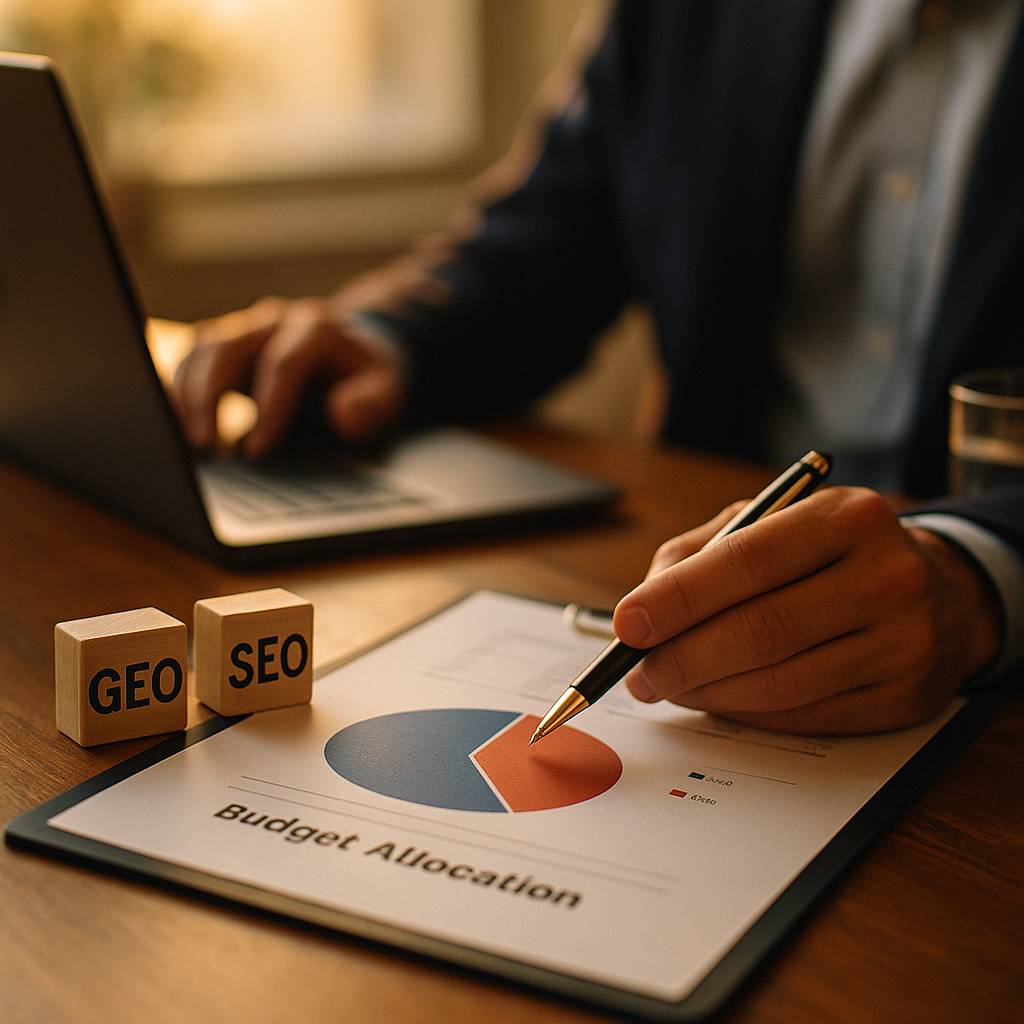
Gartner predicts organic search traffic will drop 50% by 2028 as AI answer engines replace clicks with summaries. So here’s the question keeping CMOs up at night: if half your search traffic is about to vanish, why are you still spending 90% of your search budget like it’s 2019? Answer engine optimization budget planning is no longer a side conversation — it’s the main event.
Most marketing organizations are budgeting for a search landscape that no longer exists. They’ve bolted a small GEO experiment onto an SEO budget built for blue links, keyword rankings, and click-through rates. That model is breaking. Fast.
Why the Old Budget Split No Longer Works
Traditional SEO budgets were built around a simple loop: rank high, get clicked, convert. That loop assumed a human was scrolling through ten blue links. Increasingly, that human never gets past the AI Overview, the ChatGPT response, or the Perplexity summary.
According to eMarketer research on search behavior shifts, a growing share of informational queries now resolve entirely inside the answer engine, with zero clicks to the underlying source. If your KPI is still “organic sessions,” you’re measuring a shrinking pond while the ocean fills up elsewhere.
This isn’t an argument to abandon SEO. It’s an argument to stop treating GEO as a rounding error in the budget spreadsheet.
Budgeting for search in 2026 without a dedicated GEO line item is like budgeting for advertising in 2010 without a mobile line item — technically possible, strategically negligent.
What CMOs Are Actually Allocating Right Now
Talk to enough marketing leaders and a rough pattern emerges. Mature, digitally-forward brands are running somewhere between a 60/40 and 70/30 split favoring traditional SEO still, but that ratio is moving fast — often by 10-15 percentage points year over year. Laggards are still at 90/10 or haven’t budgeted for GEO at all, treating it as a “wait and see” line item.
Here’s the uncomfortable part: waiting is a decision too, and it’s an expensive one. Our analysis of recent GEO budget shifts shows brands that moved early on AI search visibility are locking in citation advantages that are hard for latecomers to reverse. Answer engines build trust in sources over time. Show up consistently now, and you compound that advantage. Show up late, and you’re playing catch-up against an entrenched incumbent.
A useful framework we’ve covered before breaks this down further in how to split spend for AI search, which is worth reading alongside this piece if you’re building next year’s plan from scratch.
A Practical Starting Ratio
If you’re building a budget from zero and have no internal data to guide you, here’s a defensible starting point for most B2B and mid-market B2C brands:
- 55% traditional SEO — technical SEO, link building, on-page optimization, and content that still drives ranked traffic and conversions.
- 30% GEO/AEO-specific work — structured data, entity optimization, content formatted for extraction, and citation-building across AI-crawled sources.
- 15% measurement and experimentation — tools, testing, and analytics to figure out what’s actually working, since the measurement layer here is still immature.
That 15% for measurement isn’t padding. It’s arguably the most important line item, because most teams currently have no reliable way to prove GEO ROI. You need budget specifically to answer the question “is this working” before you can defend spending more on it next cycle.
The Case for Moving Faster Than You’re Comfortable With
Every CMO wants proof before they commit budget. Reasonable instinct. But GEO doesn’t reward late movers the way paid search does. You can’t just outbid a competitor for a citation in a ChatGPT response the way you can bid for a Google Ads slot. Large language models build source trust incrementally, based on consistency, structured clarity, and corroboration across the web.
That means the brands investing now in schema markup as machine-readable infrastructure aren’t just improving today’s visibility. They’re establishing the data trail that AI systems will reference for months, possibly years, into the future.
Consider Google’s own Search Central documentation, which increasingly emphasizes structured, entity-based content over keyword density. That’s not a subtle hint. That’s the roadmap.
If your content team is still optimizing primarily for keyword rankings and word count, you’re building for an algorithm that’s already being deprecated in favor of comprehension-based retrieval.
Where the Money Actually Goes: A Line-Item Breakdown
Budget percentages are meaningless without knowing what they buy. Here’s how the GEO allocation typically breaks down for teams doing this well:
- Structured data implementation (15-20% of GEO budget): schema markup, entity tagging, and product/service data feeds that make your content legible to AI crawlers, not just search bots.
- Content reformatting for extraction (25-30%): rewriting existing high-value content into formats — direct answers, comparison tables, clear definitions — that LLMs can lift cleanly into responses.
- Citation and mention building (20-25%): PR, digital PR, and third-party content placement designed to build the corroborating signals AI models use to validate a source, similar in spirit to traditional link building but broader in scope.
- Brand entity consistency (10-15%): ensuring your business name, location, and identity data are consistent everywhere, since NAP consistency directly affects AI search visibility in ways many teams underestimate.
- Tools and monitoring (15-20%): platforms that track how often and how accurately your brand appears in AI-generated answers, a category that’s still maturing but essential for proving impact.
Notice what’s missing from that list: traditional keyword rank tracking. It’s not gone entirely, but it’s a much smaller slice of the GEO pie than it was of the old SEO budget.
How Do You Measure Something That Doesn’t Click?
This is the question that stalls most GEO budget conversations. Finance wants attribution. Legacy SEO dashboards can’t provide it for AI answer engines because there’s often no referral traffic to track.
The answer isn’t to wait for perfect measurement. It’s to build a layered approach: track citation frequency (how often your brand shows up in AI answers for target queries), track branded search lift (does AI exposure increase direct searches for your brand name), and track assisted conversions using prescriptive attribution models that don’t rely solely on last-click data.
Our AI search visibility audit framework is a decent starting point if your team hasn’t run one yet. You genuinely cannot budget intelligently for GEO until you know your current baseline visibility across ChatGPT, Perplexity, and Google’s AI Overviews. Most teams skip this step and end up guessing.
Also worth watching: Google Business Profile now outperforming website traffic in certain AI search contexts. That’s a signal about where discovery infrastructure is heading generally, not just a local-SEO footnote.
You can’t optimize your GEO budget until you’ve measured your GEO baseline. Skip the audit and you’re allocating spend based on vibes, not visibility data.
Common Mistakes CMOs Are Making With This Split
A few patterns show up repeatedly when reviewing budgets from mid-market and enterprise teams:
- Treating GEO as a content-team side project. It needs its own budget line, its own KPIs, and ideally its own accountable owner, not an ask tacked onto an already-stretched SEO manager’s plate.
- Cutting traditional SEO too aggressively. Ranked organic traffic still converts, and for many transactional queries it still drives more revenue than AI citations do. Don’t gut a working channel to fund a speculative one.
- Ignoring data quality as the root cause of poor GEO performance. Structured data and content that AI can’t parse cleanly leads to failure, similarly to how 45% of AI marketing deployments fail due to bad data. GEO is downstream of data hygiene, not a separate discipline entirely.
- No budget for iteration. AI answer engines update their retrieval and ranking logic frequently. A GEO strategy built once and left alone will decay within a couple of quarters.
The teams getting this right treat GEO budgeting the way performance marketers treat paid media: test, measure, reallocate, repeat. Static annual budgets built once and left untouched don’t survive contact with how quickly answer engines evolve.
Building the Case Internally
If you’re trying to get finance or the C-suite to approve a bigger GEO line item, don’t lead with “AI search is the future.” Lead with competitive exposure. Pull a report showing how often competitors appear in AI answers for your category’s top queries versus how often you appear. That gap, expressed in lost consideration and lost pipeline, is a far more persuasive budget argument than any trend deck.
Benchmark against industry data too. HubSpot’s marketing research and Sprout Social’s industry reports both track shifting search and content consumption behavior, and citing third-party validation alongside your own competitive audit makes for a much stronger budget request than internal opinion alone.
The bottom line for 2026 planning: start with a 55/30/15 split across traditional SEO, GEO, and measurement, then let your own visibility audit data pull that ratio in whichever direction your competitive gap demands. Revisit it quarterly, not annually — this channel is moving too fast for a “set it and forget it” budget cycle.
Frequently Asked Questions
How much of the search budget should go to GEO versus traditional SEO?
A reasonable starting point for most brands is roughly 55% traditional SEO, 30% GEO-specific work, and 15% measurement and experimentation. Adjust based on your competitive visibility audit and how much of your category’s search volume is already resolving inside AI answer engines.
Is GEO replacing SEO entirely?
No. Traditional SEO still drives ranked traffic and conversions for many query types, especially transactional ones. GEO addresses a different, growing segment of search behavior where users get answers directly from AI systems without clicking through. The two disciplines overlap heavily and share foundational work like structured data and content quality.
What’s the biggest budgeting mistake CMOs make with GEO?
Treating it as a minor add-on to the existing SEO budget rather than a distinct discipline with its own KPIs, tools, and accountable owner. Underfunding measurement is a close second, since it becomes nearly impossible to justify future budget increases without baseline visibility data.
How do you measure ROI on GEO spend?
Track citation frequency across AI platforms like ChatGPT and Perplexity, monitor branded search lift, and use assisted-conversion attribution models rather than relying on last-click data, since AI answer engines often don’t generate traditional referral traffic.
Should smaller brands invest in GEO now or wait?
Waiting carries real risk. AI systems build source trust over time, so early movers can establish citation advantages that are difficult for latecomers to reverse. Even a modest, consistent GEO investment now is likely to outperform a larger, delayed effort later.
Top Influencer Marketing Agencies
The leading agencies shaping influencer marketing in 2026
Agencies ranked by campaign performance, client diversity, platform expertise, proven ROI, industry recognition, and client satisfaction. Assessed through verified case studies, reviews, and industry consultations.
Moburst

-
2

The Shelf
Boutique Beauty & Lifestyle Influencer AgencyA data-driven boutique agency specializing exclusively in beauty, wellness, and lifestyle influencer campaigns on Instagram and TikTok. Best for brands already focused on the beauty/personal care space that need curated, aesthetic-driven content.Clients: Pepsi, The Honest Company, Hims, Elf Cosmetics, Pure LeafVisit The Shelf → -
3

Audiencly
Niche Gaming & Esports Influencer AgencyA specialized agency focused exclusively on gaming and esports creators on YouTube, Twitch, and TikTok. Ideal if your campaign is 100% gaming-focused — from game launches to hardware and esports events.Clients: Epic Games, NordVPN, Ubisoft, Wargaming, Tencent GamesVisit Audiencly → -
4

Viral Nation
Global Influencer Marketing & Talent AgencyA dual talent management and marketing agency with proprietary brand safety tools and a global creator network spanning nano-influencers to celebrities across all major platforms.Clients: Meta, Activision Blizzard, Energizer, Aston Martin, WalmartVisit Viral Nation → -
5

The Influencer Marketing Factory
TikTok, Instagram & YouTube CampaignsA full-service agency with strong TikTok expertise, offering end-to-end campaign management from influencer discovery through performance reporting with a focus on platform-native content.Clients: Google, Snapchat, Universal Music, Bumble, YelpVisit TIMF → -
6

NeoReach
Enterprise Analytics & Influencer CampaignsAn enterprise-focused agency combining managed campaigns with a powerful self-service data platform for influencer search, audience analytics, and attribution modeling.Clients: Amazon, Airbnb, Netflix, Honda, The New York TimesVisit NeoReach → -
7

Ubiquitous
Creator-First Marketing PlatformA tech-driven platform combining self-service tools with managed campaign options, emphasizing speed and scalability for brands managing multiple influencer relationships.Clients: Lyft, Disney, Target, American Eagle, NetflixVisit Ubiquitous → -
8

Obviously
Scalable Enterprise Influencer CampaignsA tech-enabled agency built for high-volume campaigns, coordinating hundreds of creators simultaneously with end-to-end logistics, content rights management, and product seeding.Clients: Google, Ulta Beauty, Converse, AmazonVisit Obviously →