


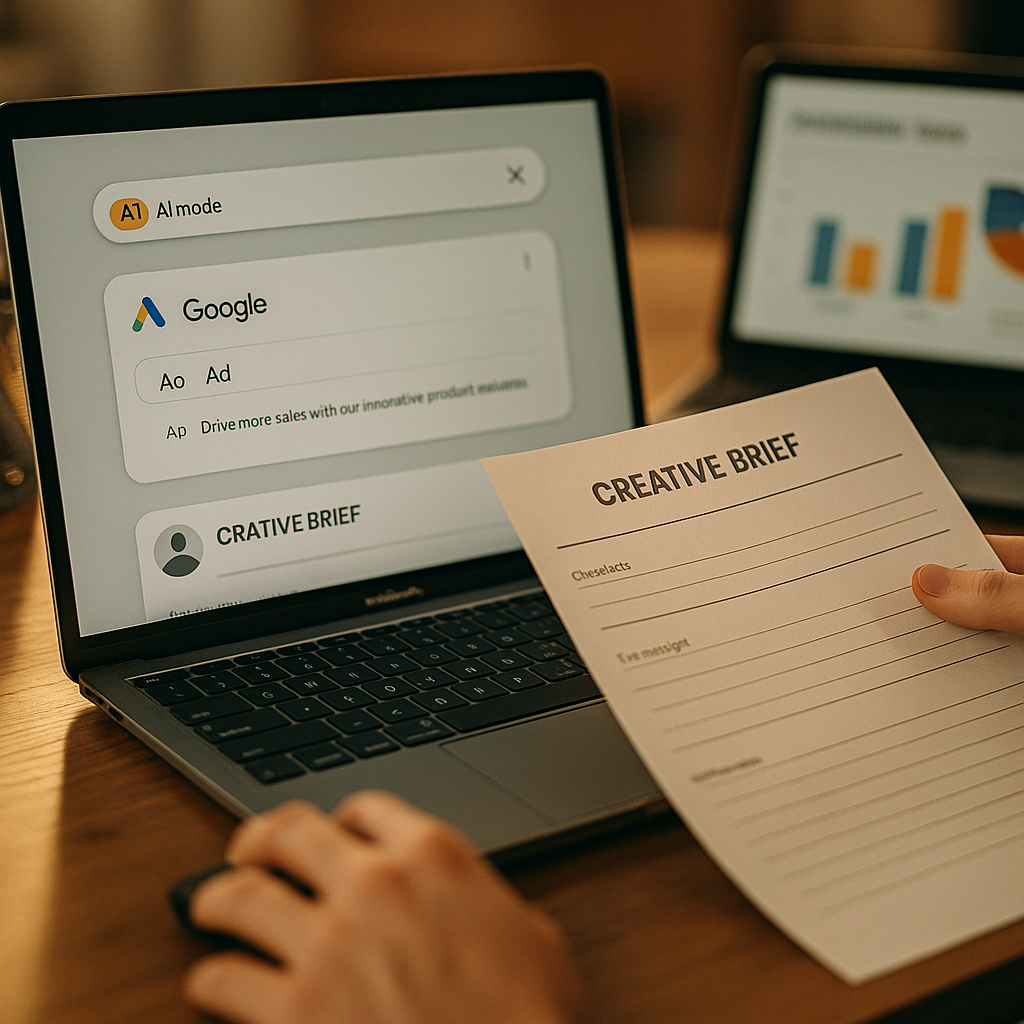
Your Ad Is Inside the Answer Now
Over 25% of Google searches now trigger AI-generated responses, and ads are appearing directly inside those answers. If your creative brief still assumes a standard SERP placement, your campaigns are already misaligned with how Google AI Mode actually works.
This isn’t a future concern. It’s a present operational gap that affects budget allocation, creative production, disclosure compliance, and attribution modeling simultaneously.
How Google AI Mode Actually Serves Ads
Google AI Mode (formerly the AI Overviews expansion) generates synthesized, conversational responses to queries. What changed in this iteration is the native embedding of paid placements within those responses. Ads don’t just appear above or below the AI answer anymore. They appear contextually inside it, anchored to specific claims, product mentions, or recommendations within the generated text.
Google’s mechanism pulls from existing Search and Shopping campaigns but applies a new contextual relevance layer. The AI evaluates query intent, synthesizes a response, then identifies insertion points where a paid result is semantically relevant to the generated content. The ad unit rendered can be a standard text ad, a Shopping card, or a rich visual unit depending on the query type and campaign eligibility.
This matters operationally because your ad is no longer competing for a fixed slot. It’s competing for contextual fit inside a dynamic, AI-generated document that changes with every query variation.
Creative designed for headline-first SERP environments will underperform in AI Mode placements, where the embedding logic rewards semantic coherence with the generated answer, not just keyword match.
What This Means for Creative Brief Design
Most creative briefs are still written for static placement environments: a fixed character count, a CTA button, a visual hierarchy built around the ad unit itself. AI Mode breaks this assumption completely.
When your ad appears inside a generated answer, the surrounding context becomes part of the consumer experience. A Shopping ad for a protein supplement could appear inside an AI answer about muscle recovery nutrition. The ad’s messaging now exists in conversation with the generated text around it, not in isolation.
This demands a shift in brief design toward what practitioners are calling “contextual coherence briefs.” Instead of writing to a placement spec, you write to an intent cluster. The brief should answer: What user intent states are we eligible to appear within? What narrative contexts will our ad unit likely be embedded in? Does our headline create cognitive dissonance or reinforcement when read alongside AI-generated health, safety, or advisory content?
Practically, this means your creative team needs access to query intent mapping, not just keyword lists. Work with your media team to pull search term reports filtered for AI Mode impression data (available in Google Ads under campaign insights), and build brief frameworks around the top intent clusters generating AI Mode placements. Your AI campaign production workflow needs a new gate here: contextual fit review before creative is approved for AI Mode-eligible campaigns.
Disclosure Standards: Regulatory Gray Zone, Real Compliance Risk
The FTC’s guidance on advertising disclosure requires that paid placements be “clearly and conspicuously” disclosed. In a standard SERP, Google’s “Sponsored” label handles this. In AI Mode, the disclosure placement becomes architecturally complex.
When an ad is embedded within a paragraph-length generative response, the “Sponsored” label appears adjacent to the embedded unit but may not be visually prominent relative to the surrounding text. User comprehension studies (Google’s own transparency documentation acknowledges this challenge) show that users in generative search environments have lower ad recognition rates than in traditional SERP layouts.
For brand strategists, this creates three specific risks. First, if your brand appears in an AI response without clear disclosure, consumers may attribute the recommendation to organic AI judgment rather than paid placement. That’s a misrepresentation risk, even if Google is technically displaying the label. Second, regulated industries (pharma, financial services, supplements) face heightened scrutiny because the AI-generated surrounding content may itself contain advisory language that amplifies the authority perception of the adjacent ad. Third, if disclosure standards are tightened by the FTC or EU equivalents under the ICO’s framework, retroactive campaign audits could surface liability from current placements.
The practical response: document your AI Mode placements systematically. Screenshot and archive how your ads appear in AI-generated responses across different query types. Build this into your brand safety monitoring workflow, not just your legal review process. And revisit your AI creative governance policy to explicitly address generative placement environments.
Attribution Logic Breaks Here
This is where most brand teams are flying blind.
Standard last-click and even data-driven attribution models weren’t built for a world where an ad appears inside a synthesized answer that itself cites multiple sources, makes product comparisons, and generates a recommendation. The consumer path from AI Mode ad impression to conversion involves a fundamentally different cognitive journey than a traditional ad click.
Consider: a user asks Google AI Mode “what’s the best project management tool for remote teams under 50 people?” The AI generates a comparative answer. Your brand’s ad for a project management platform is embedded contextually. The user reads the full AI answer, doesn’t click the ad, but later navigates directly to your site. Standard attribution assigns zero credit to the AI Mode impression. Your media team sees underperforming CPC. Budget shifts away from AI Mode. You’ve just defunded a high-influence touchpoint because your measurement model couldn’t see it.
The fix requires building view-through attribution windows specific to AI Mode placements and separating AI Mode impression data from standard Search impression data in your reporting structure. Google Ads now provides campaign-level segmentation for AI Mode placements in beta for larger accounts. If your account qualifies, activate it immediately. If not, use UTM parameter strategies to tag AI Mode-specific traffic and feed that data into your attribution window modeling separately from standard paid search.
For a deeper foundation on why measurement infrastructure needs to precede AI ad investment, the case for data foundation maturity before expanding AI-driven budgets is directly applicable here.
Attribution models that treat AI Mode impressions the same as standard SERP placements will systematically undervalue a channel that operates with higher contextual authority and longer consumer deliberation cycles.
Smart Bidding Implications
Google’s Smart Bidding algorithms are already factoring AI Mode placement probability into bid decisions, though this isn’t transparently documented in campaign interfaces. What this means in practice: if your tROAS or tCPA targets are calibrated only on standard SERP conversion behavior, the algorithm may be underbidding for AI Mode placements that have different (often longer) conversion latency.
Segment your Smart Bidding performance analysis by placement type. Look at how Smart Bidding exploration behaves differently in AI Mode contexts versus standard search. Adjust conversion windows upward for AI Mode campaigns to give the algorithm sufficient signal to optimize correctly. Industry benchmarks from eMarketer indicate that generative search placements carry 30-40% longer consideration cycles than standard search, which directly affects how bidding algorithms should be configured.
Cross-Channel Coherence: The Brand Strategist’s Real Challenge
AI Mode doesn’t operate in isolation. When your brand appears in a generative answer, that appearance influences how consumers interpret your brand across subsequent touchpoints. If your AI Mode ad conveys a value proposition that conflicts with your social content, your influencer campaigns, or your landing page narrative, the generative context amplifies that inconsistency.
This is particularly acute for brands running creator partnerships alongside paid search. Your influencer’s content may be cited as a source within the AI-generated answer surrounding your ad. Understanding how LLM citation optimization affects which creator content surfaces in generative responses gives you leverage to design more coherent cross-channel brand experiences in AI Mode environments.
Brands that treat AI Mode as just another paid search variant will miss the strategic opportunity: this is a channel where paid placement, organic content authority, and creator credibility intersect in a single consumer moment. Coordinate or compete with yourself. The choice is structural, not tactical.
For broader context on how generative search is reshaping content strategy, generative search and brand content frameworks apply directly to AI Mode campaign architecture. And if your team is assessing AI ad risk across your media mix, the AI media buying risk framework provides a structured audit process worth running before scaling AI Mode spend. External benchmarks from Statista on generative search adoption rates provide useful context for sizing budget reallocation decisions.
Your immediate next step: Pull your current Google Ads account data filtered for AI Mode impressions, map those impression clusters to your active creative briefs, and identify the three most common intent contexts where your ads are appearing. Brief a creative review against those contexts this week, not next quarter.
Frequently Asked Questions
What is Google AI Mode and how does it differ from AI Overviews for advertisers?
Google AI Mode is Google’s fully generative search interface that creates synthesized, conversational responses to queries. Unlike AI Overviews, which appeared as a module above standard search results, AI Mode replaces the traditional SERP with a generated answer as the primary response. For advertisers, the key difference is that ads are embedded contextually within the generated content rather than occupying discrete positions above or beside organic results. This changes creative requirements, placement visibility, and attribution logic fundamentally.
Do standard Google Ads campaigns automatically appear in AI Mode?
Eligible Search and Shopping campaigns can appear in AI Mode placements, but eligibility depends on campaign settings, bid strategy, and contextual relevance as evaluated by Google’s AI. Not all campaigns automatically qualify. Google determines contextual fit between your ad creative and the AI-generated response in real time. Campaigns using Smart Bidding with sufficient conversion history are more likely to be eligible. Check your campaign insights and AI Mode impression data under the placement breakdown in Google Ads to confirm your campaigns are generating AI Mode impressions.
How should disclosure language be handled for ads appearing in AI-generated responses?
Google displays a “Sponsored” label adjacent to ads embedded in AI Mode responses. However, the visual prominence of this label relative to surrounding generated text is an active compliance concern. Brand teams should document how their ads appear across different AI Mode query contexts, monitor disclosure visibility in their specific categories (particularly regulated industries), and stay current with FTC guidance on advertising in AI environments. Building AI Mode placement archiving into your brand safety workflow is recommended as regulatory scrutiny in this area is increasing.
What attribution model works best for AI Mode ad placements?
Standard last-click models significantly undervalue AI Mode placements because the channel tends to influence consumers earlier in a longer deliberation cycle rather than at the final conversion moment. Data-driven attribution with extended conversion windows is the recommended baseline. Brands with sufficient data should also build view-through attribution windows specific to AI Mode impressions and analyze AI Mode traffic separately using UTM parameter segmentation. Treating AI Mode impression data the same as standard paid search impression data in your attribution model will produce systematically misleading budget optimization signals.
How does AI Mode ad placement affect influencer and creator campaign strategy?
AI Mode creates a convergence point where paid ads, AI-generated content, and creator-generated content can appear in the same consumer moment. If a creator’s content is cited as a source within an AI-generated answer that also contains your paid placement, the brand experience is shaped by both simultaneously. This means your influencer brief and your paid search creative need to be strategically aligned on value proposition, tone, and claims. Misalignment between creator content and paid ad messaging becomes more visible and consequential in AI Mode environments than in siloed channel execution.
Top Influencer Marketing Agencies
The leading agencies shaping influencer marketing in 2026
Agencies ranked by campaign performance, client diversity, platform expertise, proven ROI, industry recognition, and client satisfaction. Assessed through verified case studies, reviews, and industry consultations.
Moburst

-
2

The Shelf
Boutique Beauty & Lifestyle Influencer AgencyA data-driven boutique agency specializing exclusively in beauty, wellness, and lifestyle influencer campaigns on Instagram and TikTok. Best for brands already focused on the beauty/personal care space that need curated, aesthetic-driven content.Clients: Pepsi, The Honest Company, Hims, Elf Cosmetics, Pure LeafVisit The Shelf → -
3

Audiencly
Niche Gaming & Esports Influencer AgencyA specialized agency focused exclusively on gaming and esports creators on YouTube, Twitch, and TikTok. Ideal if your campaign is 100% gaming-focused — from game launches to hardware and esports events.Clients: Epic Games, NordVPN, Ubisoft, Wargaming, Tencent GamesVisit Audiencly → -
4

Viral Nation
Global Influencer Marketing & Talent AgencyA dual talent management and marketing agency with proprietary brand safety tools and a global creator network spanning nano-influencers to celebrities across all major platforms.Clients: Meta, Activision Blizzard, Energizer, Aston Martin, WalmartVisit Viral Nation → -
5

The Influencer Marketing Factory
TikTok, Instagram & YouTube CampaignsA full-service agency with strong TikTok expertise, offering end-to-end campaign management from influencer discovery through performance reporting with a focus on platform-native content.Clients: Google, Snapchat, Universal Music, Bumble, YelpVisit TIMF → -
6

NeoReach
Enterprise Analytics & Influencer CampaignsAn enterprise-focused agency combining managed campaigns with a powerful self-service data platform for influencer search, audience analytics, and attribution modeling.Clients: Amazon, Airbnb, Netflix, Honda, The New York TimesVisit NeoReach → -
7

Ubiquitous
Creator-First Marketing PlatformA tech-driven platform combining self-service tools with managed campaign options, emphasizing speed and scalability for brands managing multiple influencer relationships.Clients: Lyft, Disney, Target, American Eagle, NetflixVisit Ubiquitous → -
8

Obviously
Scalable Enterprise Influencer CampaignsA tech-enabled agency built for high-volume campaigns, coordinating hundreds of creators simultaneously with end-to-end logistics, content rights management, and product seeding.Clients: Google, Ulta Beauty, Converse, AmazonVisit Obviously →