


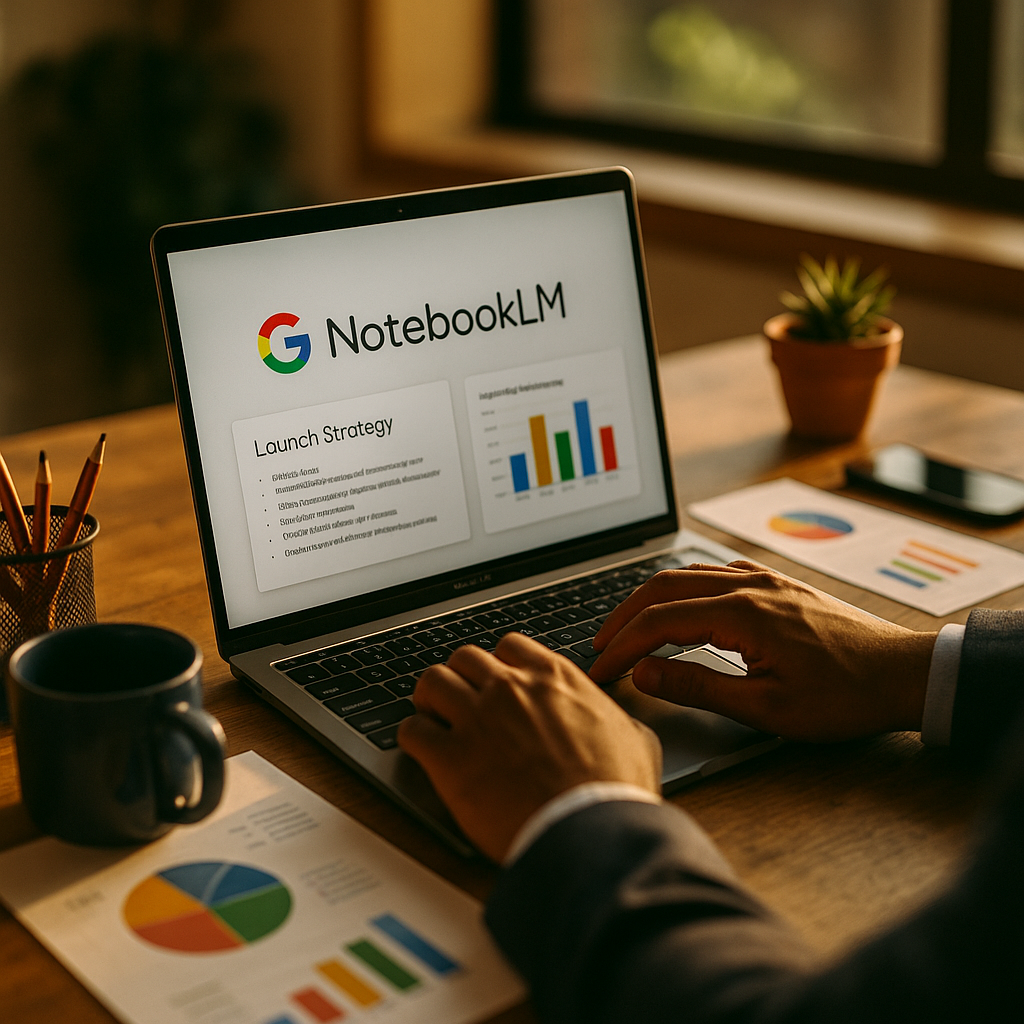
Is Google NotebookLM a Marketing Channel or a Research Curiosity?
Sixty-three percent of B2B buyers now use generative AI tools to shortlist vendors before ever visiting a brand’s website. If your brand isn’t showing up inside those AI research sessions, you’re not losing at the bottom of the funnel — you’re being eliminated before the funnel starts. That’s the strategic tension behind evaluating Google NotebookLM as a brand marketing channel.
What NotebookLM Actually Does (And Why Marketers Misread It)
Most brand teams first encounter NotebookLM as a productivity tool: upload PDFs, ask questions, get summaries. That framing is accurate but incomplete. NotebookLM is a source-grounded AI that synthesizes only the documents a user feeds it. Unlike ChatGPT or Perplexity, it doesn’t crawl the web in real time. It works from a closed corpus.
This distinction changes everything for marketers. You’re not trying to rank in NotebookLM the way you rank in Google Search. Instead, you’re trying to become the document that gets uploaded. Your white papers, research reports, buyer guides, and case studies are the assets that either get pulled into a prospect’s NotebookLM session or don’t. The channel isn’t the tool itself — the channel is the corpus your content occupies.
The brands that win in NotebookLM aren’t optimizing for the AI. They’re optimizing for the researcher who decides which documents to feed it.
This reframe matters enormously for mid-market brands with limited content production budgets. You don’t need to create more content. You need to create content that a B2B researcher would consider authoritative enough to include in a serious research project.
The High-Intent Signal You’re Probably Ignoring
When a buyer opens NotebookLM, they’re not browsing. They’re synthesizing. They’ve moved past awareness and are actively building an internal business case, evaluating shortlisted vendors, or drafting a procurement recommendation. The intent level is extraordinarily high — comparable to a late-stage search query or a direct demo request.
For mid-market brands competing against enterprise players with larger share-of-voice, this is a meaningful opportunity. A 40-page technical brief from a mid-market SaaS company can sit alongside Gartner research in a buyer’s NotebookLM notebook and receive equal treatment from the AI. The brand with the clearest, most structured, most citable content wins the synthesis.
Consider how this plays out practically. A procurement manager evaluating influencer analytics platforms uploads three vendor white papers, a Forrester excerpt, and a case study into NotebookLM. She asks the AI to compare vendor approaches to attribution. If your creator revenue attribution methodology is documented clearly in that white paper, your approach gets surfaced. If it isn’t, you’re invisible in that session.
Building the Evaluation Framework
Before committing budget to a NotebookLM content strategy, mid-market brand teams need a structured go/no-go assessment. Here’s a practical four-dimension framework.
1. Content Depth Audit
Does your brand currently produce content that a serious researcher would consider worth uploading to a synthesis tool? Assets that qualify include original research, methodology documents, technical implementation guides, and detailed case studies with measurable outcomes. Blog posts and social content do not qualify. Run an honest inventory. If your deepest content is a 1,200-word blog post, you have a content gap that predates the NotebookLM question.
2. Buyer Research Behavior Assessment
Not every category’s buyers use AI research tools at the same rate. Enterprise software buyers, agency strategists, and institutional procurement teams are heavy users. Consumer-facing mid-market brands targeting retail buyers or regional SMBs may find that their buyers simply aren’t operating this way yet. Validate through win/loss interviews and sales call debriefs before investing. Ask directly: “How did you research options before contacting us?”
3. Competitive Content Landscape
If category leaders like Salesforce, HubSpot, or dominant vertical players already publish exhaustive research assets, your brand needs a differentiated content angle to earn a place in the corpus. Look for structural gaps: geography-specific data, niche use-case documentation, or methodology transparency that larger competitors avoid for proprietary reasons. This connects directly to strategic narrative positioning — your content’s point of view needs to be distinctive enough to survive alongside better-resourced competitors.
4. Attribution Feasibility
Here’s the hard truth: direct attribution from NotebookLM sessions to pipeline is currently impossible. The tool doesn’t pass referral data. You’ll never see “NotebookLM” in your UTM reports. This means you need a proxy measurement strategy. Track downloads of your high-depth assets, monitor whether prospects who cite specific findings in sales conversations match your content’s language, and use sales enablement tracking tools like Highspot or Seismic to monitor which assets appear in late-stage deals.
Content Architecture for AI Research Tools
Assuming your evaluation clears, what does NotebookLM-ready content actually look like? Several structural principles matter.
- Explicit methodology sections. AI synthesis tools prioritize citable, structured claims. Every major assertion should be grounded in a defined methodology, a named data set, or a documented process.
- Clear section headers and logical flow. NotebookLM’s source analysis improves when documents are well-structured. Treat your white papers the way you’d treat a legal brief: hierarchical, precise, navigable.
- Original data over curated aggregation. Proprietary survey data, platform-specific benchmarks, and first-party case study metrics are far more useful to a researcher than a round-up of publicly available statistics.
- Explicit brand positioning statements. Don’t bury your differentiation. If a researcher asks NotebookLM to compare vendors, your positioning needs to be explicit enough to be surfaced accurately.
For brands already running structured content for AI search environments, many of these principles will feel familiar. The underlying logic — structure, specificity, citable claims — transfers directly.
NotebookLM-ready content isn’t a new format. It’s the discipline of writing documents that hold up under direct interrogation by a researcher who knows exactly what they’re looking for.
Risk Factors and Operational Considerations
Any honest evaluation framework includes the downside. Three risks deserve specific attention.
Competitive intelligence exposure. When you publish detailed methodology documents to earn a place in buyer research sessions, you also hand competitors a clear view of your approach. Calibrate the depth of what you publish against what you can afford to be transparent about. Some brands solve this by publishing methodology frameworks without proprietary benchmarks.
Content maintenance overhead. Outdated white papers create a credibility risk. If a buyer synthesizes a research asset that contains superseded pricing, deprecated product features, or stale benchmarks, the damage to trust is immediate. Build a content review cadence into your operations before scaling production. This is a real AI governance consideration that operations teams often underestimate.
Platform dependency risk. Google’s roadmap for NotebookLM is not guaranteed. The tool could pivot, merge into a broader product, or see adoption patterns shift. Treat NotebookLM-ready content as a durable asset class (long-form, authoritative, citable) rather than a platform-specific tactic. The same assets that perform in NotebookLM sessions perform in social listening research, analyst briefings, and sales enablement contexts.
For teams already managing data-driven content workflows, integrating a research-tool distribution lens into existing production processes is a manageable lift. For teams starting from scratch, be realistic about the six-to-nine month content production runway before this channel produces measurable results.
The Verdict for Mid-Market Brands
NotebookLM is not a social channel, a paid placement opportunity, or a traditional SEO surface. It is a late-stage research context where content quality determines whether your brand participates in a buyer’s decision process. For mid-market brands in B2B categories with high-consideration purchase cycles — marketing technology, professional services, enterprise software, agency selection — the opportunity is real and underexploited by most competitors.
The investment threshold is not trivial. Building a credible corpus of AI-research-ready assets requires dedicated content strategy, subject matter expert time, and a willingness to publish with a level of specificity that most brand content teams currently avoid. But brands that treat this seriously now are building a durable distribution advantage while most competitors are still debating whether to try NotebookLM as a productivity tool.
The strategic question isn’t whether generative AI research tools matter. They do, and eMarketer and Gartner research consistently shows accelerating adoption among B2B decision-makers. The question is whether your content is worth uploading. Start there. Audit your existing depth assets, identify three to five high-intent research questions your buyers are asking, and build documents designed to answer those questions with enough precision that an AI synthesis tool surfaces your perspective accurately. That’s the channel strategy. Everything else is execution.
Frequently Asked Questions
What is Google NotebookLM and how does it differ from other generative AI tools?
Google NotebookLM is a source-grounded AI research tool that synthesizes information exclusively from documents a user uploads, rather than crawling the web in real time. Unlike ChatGPT or Perplexity, it operates from a closed corpus, which means brands cannot optimize for it through traditional SEO. Instead, brands need to create authoritative content assets that buyers would consider worth uploading into a research session.
Can mid-market brands realistically compete with enterprise content in NotebookLM sessions?
Yes. NotebookLM treats all uploaded documents equally regardless of the brand’s size or domain authority. A well-structured, data-rich white paper from a mid-market brand can appear alongside Gartner or Forrester research in a buyer’s notebook. The competitive advantage goes to whoever produces the clearest, most citable, most structurally organized content — not necessarily the brand with the largest content production budget.
How do you measure ROI from a NotebookLM content strategy?
Direct attribution from NotebookLM sessions is not currently possible because the tool does not pass referral data. Proxy measurement approaches include tracking downloads of high-depth content assets, monitoring language patterns in late-stage sales conversations that mirror content phrasing, and using sales enablement platforms like Highspot or Seismic to identify which assets appear in closed deals.
What types of content perform best in generative AI research tools like NotebookLM?
Original research reports, technical methodology documents, implementation guides, and detailed case studies with quantified outcomes perform best. Content should feature explicit section headers, structured argumentation, and citable claims grounded in defined data sources. Blog posts, social content, and loosely structured opinion pieces are unlikely to be selected by researchers for AI synthesis sessions.
Is there a risk of publishing detailed content for NotebookLM optimization?
Yes. Publishing detailed methodology documents to earn inclusion in buyer research sessions also exposes proprietary approaches to competitors. Brands should calibrate transparency carefully — publishing enough to establish authority and differentiation while withholding specific benchmarks or processes that represent a core competitive advantage. Additionally, outdated documents in circulation can damage credibility if surfaced in a buyer’s research session.
Top Influencer Marketing Agencies
The leading agencies shaping influencer marketing in 2026
Agencies ranked by campaign performance, client diversity, platform expertise, proven ROI, industry recognition, and client satisfaction. Assessed through verified case studies, reviews, and industry consultations.
Moburst

-
2

The Shelf
Boutique Beauty & Lifestyle Influencer AgencyA data-driven boutique agency specializing exclusively in beauty, wellness, and lifestyle influencer campaigns on Instagram and TikTok. Best for brands already focused on the beauty/personal care space that need curated, aesthetic-driven content.Clients: Pepsi, The Honest Company, Hims, Elf Cosmetics, Pure LeafVisit The Shelf → -
3

Audiencly
Niche Gaming & Esports Influencer AgencyA specialized agency focused exclusively on gaming and esports creators on YouTube, Twitch, and TikTok. Ideal if your campaign is 100% gaming-focused — from game launches to hardware and esports events.Clients: Epic Games, NordVPN, Ubisoft, Wargaming, Tencent GamesVisit Audiencly → -
4

Viral Nation
Global Influencer Marketing & Talent AgencyA dual talent management and marketing agency with proprietary brand safety tools and a global creator network spanning nano-influencers to celebrities across all major platforms.Clients: Meta, Activision Blizzard, Energizer, Aston Martin, WalmartVisit Viral Nation → -
5

The Influencer Marketing Factory
TikTok, Instagram & YouTube CampaignsA full-service agency with strong TikTok expertise, offering end-to-end campaign management from influencer discovery through performance reporting with a focus on platform-native content.Clients: Google, Snapchat, Universal Music, Bumble, YelpVisit TIMF → -
6

NeoReach
Enterprise Analytics & Influencer CampaignsAn enterprise-focused agency combining managed campaigns with a powerful self-service data platform for influencer search, audience analytics, and attribution modeling.Clients: Amazon, Airbnb, Netflix, Honda, The New York TimesVisit NeoReach → -
7

Ubiquitous
Creator-First Marketing PlatformA tech-driven platform combining self-service tools with managed campaign options, emphasizing speed and scalability for brands managing multiple influencer relationships.Clients: Lyft, Disney, Target, American Eagle, NetflixVisit Ubiquitous → -
8

Obviously
Scalable Enterprise Influencer CampaignsA tech-enabled agency built for high-volume campaigns, coordinating hundreds of creators simultaneously with end-to-end logistics, content rights management, and product seeding.Clients: Google, Ulta Beauty, Converse, AmazonVisit Obviously →