


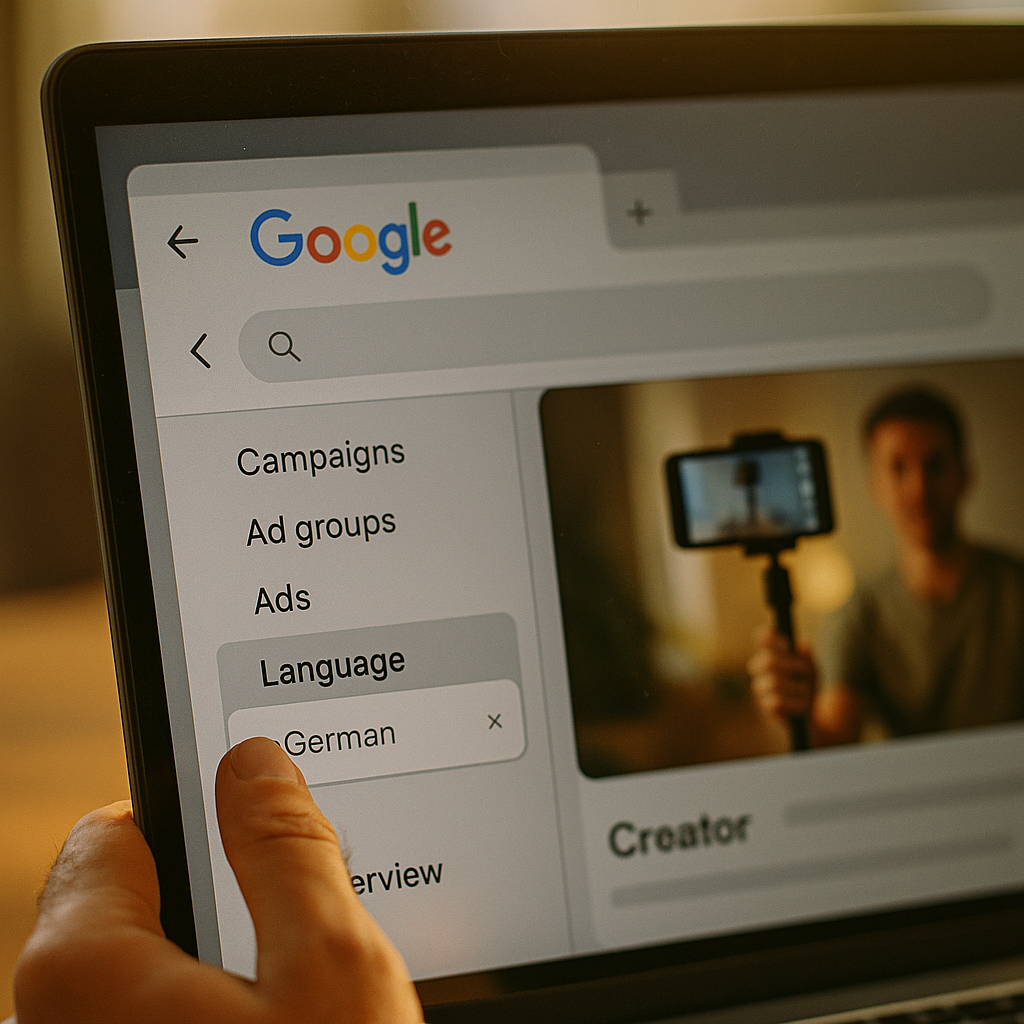
Google just quietly ended an era of granular language control in advertising, and most creator marketing teams haven’t caught up. As of this rollout, Google retires manual language targeting across key campaign types, folding it into automated systems that decide, on their own, which audience speaks which language. If your influencer program runs paid amplification across borders, this isn’t a footnote. It’s a structural shift.
What Actually Changed
For years, advertisers picked language targeting manually inside Google Ads: select English, select Spanish, done. That lever is being phased out in favor of automated language detection tied to Google’s broader push toward machine-learning-driven audience matching. The company frames it as an efficiency gain, fewer settings, smarter delivery. But for brands running multilingual creator campaigns, especially those boosting creator content through Google’s ad network or syndicating influencer video across YouTube in multiple markets, the manual dial is gone.
Google’s own support documentation has historically warned that automated language targeting relies on a mix of browser settings, search history, and content signals rather than a user’s stated preference. That distinction matters more now than ever, because the system is making judgment calls that used to belong to a human media buyer.
When Google automates language targeting, it’s not translating your ad. It’s guessing who should see it, and that guess is now the only option on the table.
Why This Hits Multilingual Creator Campaigns Harder Than Standard Ads
Standard search or display campaigns tend to run in a single language, single market. Creator campaigns rarely do. A beauty brand might commission one creator in Mexico City, another in Miami, and a third in Madrid, all producing content in Spanish, but for audiences with different cultural context, slang, and purchase intent. Manual language targeting let media buyers separate those audiences with precision. Automated detection lumps them together based on signals Google controls, not signals the brand chose.
That’s a real risk for brand safety and message accuracy. A creator ad written for Castilian Spanish landing in front of a Puerto Rican audience isn’t a catastrophe, but it dents relevance, and relevance is the entire value proposition of influencer marketing. Consumers already scrutinize sponsored content harder than organic; a tonal or dialect mismatch is one more reason to scroll past.
There’s also a compliance angle. Regions with strict advertising disclosure rules (see guidance from the FTC and the ICO) expect brands to know exactly who their ads reach and in what context. If automated targeting misfires and pushes a disclosure-compliant ad in English toward a French-only audience segment, the disclosure itself may become functionally invisible. That’s a compliance gap most legal teams haven’t priced in yet.
The Data Problem Nobody’s Talking About
Automated language detection depends on signals: browser locale, device settings, on-platform behavior. It does not depend on the actual language spoken in the creator’s video. That gap is the crux of the issue. A brand running a multilingual creator program needs targeting logic tied to content, not just user metadata. Google’s system doesn’t do that natively for creator-sourced video the way it might for a search ad written in a specific language.
This mirrors a pattern seen across the industry as AI systems take over decisions that used to be manual and inspectable. Our coverage of agentic ad platforms bidding autonomously found the same tension: automation improves speed but strips out the checkpoints marketers relied on to catch errors before spend went live. Language targeting removal is just the latest example of that trade-off playing out inside creator budgets specifically.
What Brands and Agencies Should Do Right Now
This isn’t a wait-and-see moment. Teams running multilingual creator programs need to audit their current setup before the automated system becomes the only path.
- Segment by market first, language second. Instead of relying on Google’s language detection, build audience segments around geography and platform behavior, then layer creator content on top. It’s a workaround, not a perfect fix, but it restores some control.
- Push metadata discipline upstream. Make sure creator briefs specify language and dialect explicitly, and that video metadata, captions, and on-platform tags reflect that. Automated systems lean on available signals; give them better signals to work with.
- Rebuild your QA checkpoint. Someone on the team needs to manually spot-check delivery data weekly to catch mismatches early, because the platform won’t flag them for you.
- Loop in legal and compliance. If your creator disclosures depend on language-matched delivery, get compliance teams reviewing sample impressions, not just campaign briefs.
None of this is glamorous work. But it’s the difference between a multilingual creator strategy that scales cleanly and one that quietly burns budget on mismatched impressions nobody notices until the quarterly report.
Is This Part of a Bigger Pattern?
Yes, and it’s worth naming directly. Google isn’t alone in shifting decision-making away from manual advertiser control and toward automated, AI-driven systems. Meta’s Advantage+ suite, TikTok’s Smart+ campaigns, they all follow the same trajectory: fewer manual levers, more machine judgment, framed as “efficiency.” eMarketer has tracked this shift across ad platforms for several years, and the consistent finding is that automation improves average performance while increasing variance, meaning more wins, but also more expensive misses that go undetected without proper measurement.
For creator marketing specifically, that variance is dangerous because attribution is already messy. Our analysis of dark funnel spend found that a meaningful share of creator-driven budget already operates with weak visibility into where impressions actually land. Add automated language targeting into that mix, and brands lose another layer of insight into who’s actually seeing their sponsored content, and in what language they’re seeing it.
Every platform automating a manual control removes a checkpoint marketers used to catch errors before they became expensive. Language targeting is the newest checkpoint to disappear.
Measurement Gets Harder, Not Easier
Marketing teams already struggle to prove creator program ROI even under ideal conditions. Our reporting on why most teams can’t prove creator ROI despite near-universal AI tool adoption points to a persistent gap between activity and measurable outcomes. Language targeting removal widens that gap. If a brand can’t confirm which audience segment actually received a creator ad in the intended language, attribution models built on regional performance data become less reliable. Marketing mix modeling, which several teams have returned to as platform-level attribution trust erodes (see our piece on MMM’s comeback), may need to account for language mismatch as a new variable entirely.
Agencies managing multi-market creator rosters should also revisit vendor conversations. If your MarTech stack includes attribution or clean data tooling, this is the moment to ask vendors directly how they handle language-level segmentation now that Google controls it algorithmically. Clean first-party data practices, covered in our piece on first-party data and agentic recommendations, become even more valuable when platform-level targeting signals get less transparent.
The Practical Bottom Line for Budget Owners
Nobody’s suggesting multilingual creator campaigns are dead. They’re not. But the operational cost of running them well just went up. Media buyers need better briefs, tighter QA loops, and honest conversations with clients about what “targeted delivery” actually means under an automated system. Budget owners should expect a short adjustment period where performance data looks slightly noisier than usual, that’s the system recalibrating, not a sign the strategy failed.
The brands that adapt fastest will be the ones treating this as a data and process problem, not a platform problem. Google isn’t going to reverse this decision. The only lever left is how well your team compensates for the control it took away.
Frequently Asked Questions
FAQs
What does it mean that Google retires manual language targeting?
It means advertisers can no longer manually select which language audience their ads target inside certain Google Ads campaign types. Instead, Google’s automated systems detect language based on signals like browser locale and user behavior, then decide delivery without direct advertiser input.
Does this affect all Google Ads campaign types?
The rollout primarily affects campaign types where language targeting was previously a manual setting. Search, display, and video campaigns tied to creator content amplification are among those impacted. Advertisers should check their specific campaign dashboards for current targeting options, since availability can vary by account and region.
How does this impact multilingual influencer campaigns specifically?
Multilingual creator campaigns often rely on precise language and dialect targeting to match content with the right audience. Automated detection doesn’t account for the actual language spoken in creator video content, only for user-side signals, which increases the risk of mismatched delivery and reduced ad relevance.
Can brands still control audience language another way?
Not directly through Google’s manual targeting tool anymore. Brands can approximate control by segmenting audiences geographically, tightening creator brief specifications around language and dialect, and improving video metadata and captioning so automated systems have stronger signals to work with.
Does this create compliance risks for sponsored content disclosures?
It can. If an ad’s disclosure language doesn’t match the audience’s actual language due to a targeting mismatch, the disclosure may become functionally ineffective, which raises concerns under regulatory guidance from bodies like the FTC and the ICO. Compliance teams should review sample delivery data regularly.
Should agencies change how they measure campaign performance because of this change?
Yes. Attribution models that rely on regional or language-segmented performance data may need adjustment, since delivery is now less transparent. Many teams are leaning more heavily on marketing mix modeling and first-party data validation to compensate for reduced platform-level visibility.
Top Influencer Marketing Agencies
The leading agencies shaping influencer marketing in 2026
Agencies ranked by campaign performance, client diversity, platform expertise, proven ROI, industry recognition, and client satisfaction. Assessed through verified case studies, reviews, and industry consultations.
Moburst

-
2

The Shelf
Boutique Beauty & Lifestyle Influencer AgencyA data-driven boutique agency specializing exclusively in beauty, wellness, and lifestyle influencer campaigns on Instagram and TikTok. Best for brands already focused on the beauty/personal care space that need curated, aesthetic-driven content.Clients: Pepsi, The Honest Company, Hims, Elf Cosmetics, Pure LeafVisit The Shelf → -
3

Audiencly
Niche Gaming & Esports Influencer AgencyA specialized agency focused exclusively on gaming and esports creators on YouTube, Twitch, and TikTok. Ideal if your campaign is 100% gaming-focused — from game launches to hardware and esports events.Clients: Epic Games, NordVPN, Ubisoft, Wargaming, Tencent GamesVisit Audiencly → -
4

Viral Nation
Global Influencer Marketing & Talent AgencyA dual talent management and marketing agency with proprietary brand safety tools and a global creator network spanning nano-influencers to celebrities across all major platforms.Clients: Meta, Activision Blizzard, Energizer, Aston Martin, WalmartVisit Viral Nation → -
5

The Influencer Marketing Factory
TikTok, Instagram & YouTube CampaignsA full-service agency with strong TikTok expertise, offering end-to-end campaign management from influencer discovery through performance reporting with a focus on platform-native content.Clients: Google, Snapchat, Universal Music, Bumble, YelpVisit TIMF → -
6

NeoReach
Enterprise Analytics & Influencer CampaignsAn enterprise-focused agency combining managed campaigns with a powerful self-service data platform for influencer search, audience analytics, and attribution modeling.Clients: Amazon, Airbnb, Netflix, Honda, The New York TimesVisit NeoReach → -
7

Ubiquitous
Creator-First Marketing PlatformA tech-driven platform combining self-service tools with managed campaign options, emphasizing speed and scalability for brands managing multiple influencer relationships.Clients: Lyft, Disney, Target, American Eagle, NetflixVisit Ubiquitous → -
8

Obviously
Scalable Enterprise Influencer CampaignsA tech-enabled agency built for high-volume campaigns, coordinating hundreds of creators simultaneously with end-to-end logistics, content rights management, and product seeding.Clients: Google, Ulta Beauty, Converse, AmazonVisit Obviously →