


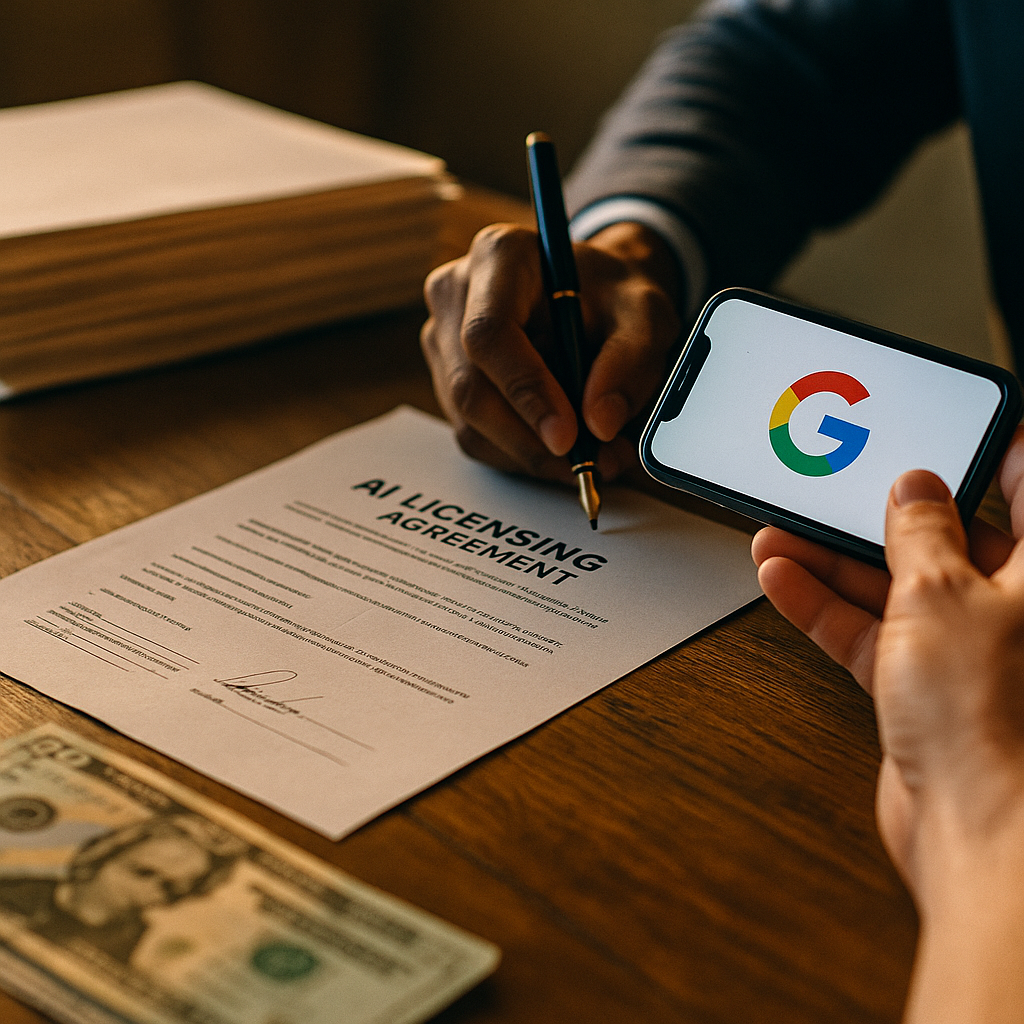
Every piece of branded content a creator posts could soon carry a second price tag: one for the human audience, another for the AI models that scrape, summarize, and resell it. Google’s pay-per-use AI licensing program is the clearest signal yet that content monetization is splitting into two markets. For brands running influencer programs, that split changes how content deals get written, priced, and audited, starting now.
What Google’s Pay-Per-Use AI Licensing Program Actually Does
Strip away the press release language and the mechanics are simple. Google is building infrastructure that lets publishers, and increasingly creators, set terms for how their content gets used to train or ground AI models. Instead of a blanket “opt in or get scraped” arrangement, rights holders can charge per use: per training run, per retrieval, per citation inside an AI Overview or Gemini response.
It’s a direct response to years of publisher complaints that AI companies were harvesting content without compensation. Search traffic has been declining for content-heavy sites as AI answers replace clicks, a trend we’ve already covered in zero-click search behavior. Google’s licensing move is partly a peace offering to publishers threatening lawsuits, and partly a hedge against regulatory pressure.
But here’s the part that should make brand marketers sit up: this framework doesn’t stop at news publishers and blogs. Branded influencer content, product reviews, unboxing videos, and sponsored posts are exactly the kind of high-intent, product-specific material AI models want to train on. If a creator’s TikTok review of your skincare line becomes training data for a shopping assistant, who gets paid for that? Right now, the honest answer is: it depends on a contract clause most brands haven’t written yet.
If your influencer contracts don’t address AI training rights, you’re leaving a monetization stream on the table, and a liability exposure wide open.
Why Brand Content Deals Are Suddenly a Licensing Problem
Traditional influencer contracts were built around a simple exchange: usage rights for a set period, on defined channels, in exchange for a flat fee or commission. Whitelisting rights, paid amplification, and exclusivity clauses got added over time, but the underlying assumption stayed the same. Content lives on a platform, humans see it, campaign ends.
AI licensing breaks that assumption. Content doesn’t just get seen anymore, it gets ingested, indexed, and repurposed by systems that never expire. A sponsored post from eighteen months ago could still be feeding an AI model’s understanding of your product category today. That’s a fundamentally different value exchange, and most brand-creator agreements are silent on it.
This matters more than it sounds, because the money is real. Publishers negotiating with AI companies have reportedly secured licensing deals worth millions annually, according to reporting tracked by Statista’s media industry data. If that same economic logic extends to creator content, and Google’s program suggests it will, brands need to decide upfront whether they’re licensing that value themselves, splitting it with creators, or ceding it entirely.
Three Questions Every Brand Legal Team Should Be Asking
- Does our current creator contract grant AI training rights, explicitly or by vague omission?
- If a creator’s content gets licensed to an AI platform independently, does that violate our exclusivity or category-lock clauses?
- Who owns the downstream revenue if branded content becomes a cited source in an AI shopping assistant?
None of these have industry-standard answers yet. That’s the risk and the opportunity.
The Compliance Gap Nobody’s Talking About
Disclosure rules already struggle to keep pace with how influencer content spreads. The FTC’s endorsement guidelines assume a human audience reading a caption with a #ad tag. They say nothing about an AI model summarizing that same content into a “recommended products” answer with no disclosure attached at all.
Picture this: a shopper asks an AI assistant which serum is best for sensitive skin. The assistant, trained partly on a creator’s sponsored review, recommends your product, no #ad, no FTC disclosure, no indication the original content was paid. That’s not a hypothetical edge case anymore. It’s the default behavior of how generative answers get constructed.
Brands relying on influencer content for lower-funnel conversion need to think about this now, not after a regulator does. The UK’s ICO guidance on AI data use is already signaling that data provenance and consent will be scrutinized more aggressively as AI training becomes commercial. Expect similar movement stateside.
This is also why brands investing in generative visibility need to treat it as a governance issue, not just a growth channel. We’ve written about how generative engine optimization turns citations into sales, but citation without disclosure is a compliance time bomb, not a win.
How This Reshapes Creator Rate Cards
Expect rate cards to fragment further. Right now most creators price by platform, format, and usage window. Add AI licensing to the mix and you get a fourth axis: training rights, retrieval rights, and citation rights, each potentially priced separately.
Some agencies are already testing tiered structures: base rate for the post, a smaller add-on fee if the brand wants whitelisting, and a new line item, still being negotiated case by case, for AI training consent. It’s messy. Nobody has settled pricing benchmarks yet, which means brands negotiating now have leverage they won’t have once norms solidify.
Larger creator management platforms are watching this closely because it directly affects how they structure multi-brand deals. Tools like multi-brand creator deal orchestration platforms will need to bake AI licensing terms into their contract templates, or brands will end up negotiating this clause by clause, deal by deal, which doesn’t scale.
There’s also a budget allocation question. If AI licensing becomes a real revenue stream for creators, does that change how agentic tools handle spend? We’ve already seen agentic AI reallocate creator budgets based on performance signals in near real time. Add AI licensing value into that equation and budget models get more complex fast.
What Brands Should Actually Do This Quarter
Waiting for industry standards to emerge is a losing strategy. Standards follow disputes, and disputes follow money. Here’s what forward-leaning brand teams are doing right now.
- Audit existing contracts. Pull every active influencer agreement and check whether AI training, retrieval, or citation rights are addressed. Most won’t be. Flag them for renewal.
- Add explicit AI licensing language to new deals. Specify whether the brand retains, shares, or waives rights to license branded content for AI training. Silence isn’t neutral, it’s a liability.
- Loop in legal before creative. This isn’t a creative brief issue, it’s a rights issue. Legal teams need visibility into which creators’ content is being used for AI-adjacent purposes like AI virtual product placement, where compliance already lags behind capability.
- Reassess vendor contracts too. If you’re using AI matching or discovery tools, understand whether the creator content surfaced through platforms doing agentic creator matchmaking comes with clean AI licensing provenance.
- Track disclosure downstream. If your content is likely to get cited in AI answers, build a monitoring process. You can’t manage what you can’t see.
The brands that write AI licensing terms into contracts now will negotiate from a position of clarity later. The ones that wait will negotiate from a position of exposure.
None of this means panic. It means treating AI licensing the way smart brands already treat usage rights and whitelisting: as a negotiable asset, not an afterthought. Google formalizing a pay-per-use structure gives the market a reference point. Use it.
Frequently Asked Questions
Does Google’s pay-per-use AI licensing program apply to influencer content specifically?
Not exclusively, but the framework is built broadly enough to extend to any content Google’s AI systems train on or cite, including branded influencer posts. Whether individual creators or brands can access these licensing terms directly is still being clarified, but the precedent applies.
Should brands add AI licensing clauses to influencer contracts right now?
Yes. Even before industry-wide standards settle, adding explicit language about AI training, retrieval, and citation rights protects brands from ambiguity later. Silence in a contract typically defaults to the platform’s terms of service, not the brand’s interest.
Who owns the value if a creator’s sponsored post gets used to train an AI model?
It depends entirely on contract language and platform terms of service, both of which vary widely right now. This is exactly why legal review of existing creator agreements has become urgent rather than optional.
Does FTC disclosure still apply if content is repurposed inside an AI-generated answer?
The FTC’s current guidelines were written for human-facing disclosures and don’t explicitly address AI-summarized content. That gap is a real compliance risk, and brands should assume regulatory scrutiny will eventually catch up to it.
How will AI licensing affect creator rate cards?
Expect a new pricing axis alongside platform and usage rights: separate fees for AI training consent, retrieval rights, and citation permissions. Standard pricing benchmarks don’t exist yet, which gives early-negotiating brands more leverage.
Start with the audit, not the strategy deck. Pull your top ten active influencer contracts this week and check whether AI licensing rights are addressed at all, because the gap you find there is the risk you’re currently carrying unpriced.
Top Influencer Marketing Agencies
The leading agencies shaping influencer marketing in 2026
Agencies ranked by campaign performance, client diversity, platform expertise, proven ROI, industry recognition, and client satisfaction. Assessed through verified case studies, reviews, and industry consultations.
Moburst

-
2

The Shelf
Boutique Beauty & Lifestyle Influencer AgencyA data-driven boutique agency specializing exclusively in beauty, wellness, and lifestyle influencer campaigns on Instagram and TikTok. Best for brands already focused on the beauty/personal care space that need curated, aesthetic-driven content.Clients: Pepsi, The Honest Company, Hims, Elf Cosmetics, Pure LeafVisit The Shelf → -
3

Audiencly
Niche Gaming & Esports Influencer AgencyA specialized agency focused exclusively on gaming and esports creators on YouTube, Twitch, and TikTok. Ideal if your campaign is 100% gaming-focused — from game launches to hardware and esports events.Clients: Epic Games, NordVPN, Ubisoft, Wargaming, Tencent GamesVisit Audiencly → -
4

Viral Nation
Global Influencer Marketing & Talent AgencyA dual talent management and marketing agency with proprietary brand safety tools and a global creator network spanning nano-influencers to celebrities across all major platforms.Clients: Meta, Activision Blizzard, Energizer, Aston Martin, WalmartVisit Viral Nation → -
5

The Influencer Marketing Factory
TikTok, Instagram & YouTube CampaignsA full-service agency with strong TikTok expertise, offering end-to-end campaign management from influencer discovery through performance reporting with a focus on platform-native content.Clients: Google, Snapchat, Universal Music, Bumble, YelpVisit TIMF → -
6

NeoReach
Enterprise Analytics & Influencer CampaignsAn enterprise-focused agency combining managed campaigns with a powerful self-service data platform for influencer search, audience analytics, and attribution modeling.Clients: Amazon, Airbnb, Netflix, Honda, The New York TimesVisit NeoReach → -
7

Ubiquitous
Creator-First Marketing PlatformA tech-driven platform combining self-service tools with managed campaign options, emphasizing speed and scalability for brands managing multiple influencer relationships.Clients: Lyft, Disney, Target, American Eagle, NetflixVisit Ubiquitous → -
8

Obviously
Scalable Enterprise Influencer CampaignsA tech-enabled agency built for high-volume campaigns, coordinating hundreds of creators simultaneously with end-to-end logistics, content rights management, and product seeding.Clients: Google, Ulta Beauty, Converse, AmazonVisit Obviously →