


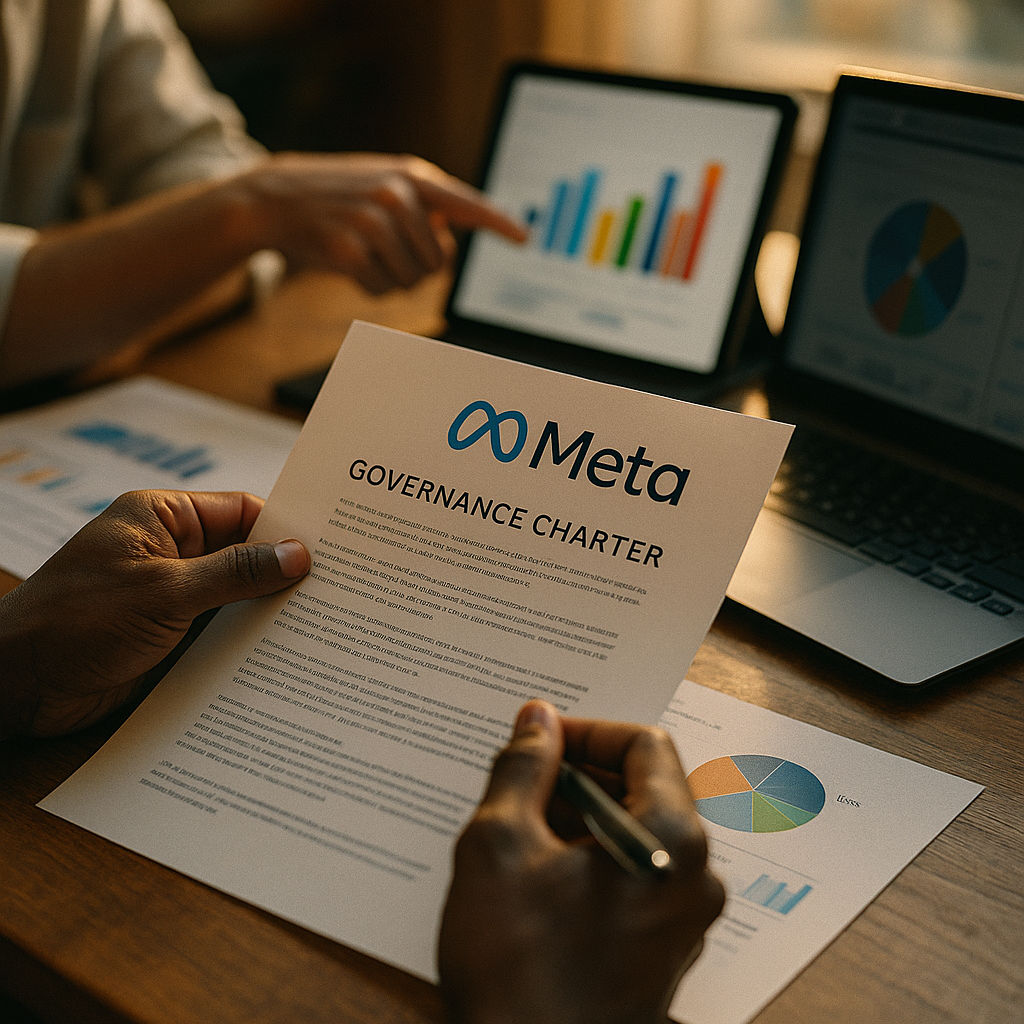
Meta’s AI now suggests budget shifts inside Advantage+ campaigns every few hours. Left unchecked, that “suggestion” becomes an autonomous decision the moment nobody’s watching. A governance charter for Meta’s AI-powered Creator Studio is the difference between an optimization engine and an unsupervised spender with your P&L card.
Marketing teams love to talk about AI adoption. Fewer talk about what happens when the AI is wrong at 2 a.m. and nobody’s logged in to catch it.
Why “Set It and Forget It” Is a Budget Risk, Not a Time-Saver
Meta’s Creator Studio and Advantage+ suite have quietly shifted from suggestion tools to semi-autonomous decision engines. Real-time bid adjustments, audience expansion, creative rotation, even reallocation across campaigns — the AI does it fast, and it does it without waiting for a human to bless the move. That’s the pitch: speed and efficiency at a scale no media buyer could match manually.
The problem is that speed cuts both ways. An algorithm that can reallocate $50,000 across ad sets in an afternoon can also drain a quarter’s budget into an underperforming creator partnership before anyone notices the pattern. Meta’s own advertising resources describe these tools as designed to “reduce manual work,” which is true. It’s also a polite way of saying decisions are happening with less human review than most finance teams would sign off on if they understood the mechanics.
The question isn’t whether Meta’s AI can optimize a budget faster than a human. It’s whether your organization has defined what happens in the thirty seconds after it makes a decision you’d disagree with.
This isn’t hypothetical. Agencies running six and seven-figure influencer-linked ad budgets on Meta have already reported instances where automated bid strategies chased short-term engagement spikes — often from bot-adjacent or low-quality traffic — at the expense of the creator partnerships actually driving conversions. Nobody caught it for days because nobody was assigned to catch it.
Governance isn’t about slowing AI down. It’s about deciding, in advance, where the guardrails sit.
What a Governance Charter Actually Covers
A governance charter is a written, internally binding document that defines how much authority Meta’s AI systems have over live budgets, who reviews what, and what triggers a human override. It’s not a compliance PDF nobody reads. Done right, it’s a working reference your media buyers, brand managers, and finance stakeholders actually use.
At minimum, the charter should define:
- Decision thresholds — dollar amounts or percentage shifts that require human sign-off before execution, not after.
- Escalation paths — who gets pinged when the AI recommends something outside normal parameters, and how fast they must respond.
- Audit cadence — how often someone reviews AI-driven spend decisions retroactively, even the ones that performed well.
- Data inputs — what signals the AI is allowed to weight (engagement, conversion, creator-specific performance) and which are excluded.
- Override authority — the specific role, not just “marketing,” that can pause or reverse an automated decision.
Most brands have none of this written down. They have a Slack channel where someone eventually notices the anomaly. That’s not governance. That’s hoping.
Setting Thresholds: The Part Everyone Skips
Here’s where most teams get lazy. Setting a blanket rule — “AI can move up to $5,000 without approval” — feels efficient but ignores context. A $5,000 shift on a $20,000 monthly budget is a big deal. The same shift on a $2 million enterprise campaign is rounding error.
Better practice: tie thresholds to percentage of total campaign spend, not flat dollar amounts, and tier them by campaign risk profile. A campaign tied to a creator partnership with active FTC disclosure obligations should have tighter human-in-the-loop requirements than a straightforward product catalog ad. This matters more than most teams realize — automated reallocation can inadvertently shift spend toward creative that hasn’t gone through the same disclosure review, a risk covered in depth in our piece on fast-testing ad compliance.
Some brands are experimenting with dynamic thresholds that tighten automatically during high-risk windows — product launches, regulatory scrutiny periods, or when a partnered creator is involved in active controversy. That’s a smart layer to build into version two of your charter, once the basics are working.
Who Actually Owns the Override Button?
This is the question that exposes whether a brand’s AI governance is real or theater. Ask five people on a marketing team who can pause an AI-driven budget reallocation, and you’ll often get five different answers. That ambiguity is the risk.
The charter needs a named role, not a department. Whether that’s a senior media buyer, a marketing operations lead, or a designated “AI oversight” function reporting into brand strategy, someone specific needs override authority and the technical access to exercise it inside Meta’s Business Manager. If that person is on vacation, there needs to be a documented backup. This sounds obvious. It’s astonishing how often it isn’t documented anywhere.
Some agencies have started formalizing this as a rotating on-call function, similar to how engineering teams handle production incidents. If Meta’s AI can move budget at 11 p.m. on a Saturday, someone needs to be reachable at 11 p.m. on a Saturday. Otherwise the “human in the loop” is fictional.
The Compliance Layer Nobody’s Pricing In
Budget governance and legal exposure are more connected than most marketing leads assume. When Meta’s AI reallocates spend toward a creator or creative variant automatically, it can trigger disclosure, data handling, and attribution issues that weren’t part of the original campaign approval.
Consider a scenario: the AI shifts budget toward a creator whose content includes a discount code tied to personalized pricing. If that shift happens without a compliance check, you’ve potentially got a live ad spending real money against creative that doesn’t meet current disclosure standards — a scenario closely related to the risks outlined in our personalized pricing disclosure guide.
Data inputs matter here too. If the AI’s optimization model is pulling in audience or performance data that touches personal information, your governance charter needs to intersect with your existing data processing agreements. Brands that have already mapped this for other platforms should extend the same rigor to Meta’s AI systems — see our breakdown of data processing addendums for AI decision engines for the contractual language that should already exist with your ad tech vendors.
An optimization engine doesn’t know the difference between a high-performing ad and a legally exposed one. That distinction is still a human job.
Building the Audit Trail Before You Need It
Nobody wants to build an audit process. It feels like busywork until the day a client, a regulator, or your own CFO asks “why did we spend $80,000 on this creator in four days?” and nobody can answer.
The audit layer of your governance charter should capture, at minimum, a timestamped log of every AI-driven decision above your defined threshold, the human who reviewed or approved it (or the fact that no review occurred), and the performance outcome measured against the counterfactual — what would have happened without the shift.
This isn’t just defensive documentation. Audit trails are how you actually improve the thresholds over time. Six months of logged decisions tells you where the AI is reliably right and where it needs tighter human review. Without the trail, you’re guessing every quarter instead of learning.
Training the Humans, Not Just the Model
A charter is only as good as the people executing it. Media buyers and brand managers need actual training on what Meta’s AI is optimizing for, not just how to click “approve.” Most teams underestimate how opaque these systems have become — eMarketer’s research on AI adoption in advertising has repeatedly flagged the gap between marketers using AI tools and marketers who understand the underlying optimization logic well enough to catch errors.
Run quarterly scenario training: show the team a real (or simulated) instance of the AI making a questionable call, and walk through the escalation path live. It’s the advertising equivalent of a fire drill. Nobody enjoys it until the day it matters.
This also connects to broader hiring and staffing decisions. Teams under pressure to hit aggressive CAC/LTV targets sometimes lean harder on automation to hit numbers faster, without updating the human oversight layer to match — a tension explored in our piece on CAC/LTV hiring mandates. Governance charters need to scale with performance pressure, not get quietly deprioritized by it.
A Realistic Rollout, Not a Perfect One
Don’t try to build the exhaustive, twenty-page governance document on the first pass. Start with three things: dollar thresholds, a named override authority, and a weekly audit review. Ship that in draft form, run it for a month, and refine based on what actually breaks.
Brands that wait for a “complete” charter before implementing anything tend to never implement anything. The AI keeps optimizing in the meantime, unsupervised, because the perfect policy document is still in legal review. A rough governance framework live today beats a polished one stuck in committee for two quarters.
Cross-functional buy-in matters more than document quality. Get finance, legal, and brand strategy in the same room before finalizing thresholds. According to HubSpot’s marketing operations research, cross-functional alignment is consistently cited as the biggest predictor of whether AI marketing tools actually deliver measurable ROI versus becoming shelfware or, worse, a liability nobody flagged in time.
FAQs
Frequently Asked Questions
What is a governance charter for Meta’s AI-powered Creator Studio?
It’s an internal document that defines the boundaries of Meta’s AI decision-making over live ad budgets, including spend thresholds requiring human approval, named override authority, escalation paths, and audit requirements. It turns AI oversight from an assumption into a documented, enforceable process.
Why can’t we just let Meta’s AI optimize budgets automatically?
Automated optimization can chase short-term signals like engagement spikes without accounting for compliance risk, creator contract terms, or brand safety concerns. Without human checkpoints, a well-performing metric can mask a legally or strategically risky decision until it’s already cost real budget.
Who should have override authority over AI-driven budget decisions?
A specific named role, not a department. Typically a senior media buyer or marketing operations lead with both the authority and the technical access inside Meta Business Manager to pause or reverse automated changes, plus a documented backup for coverage gaps.
How often should AI-driven budget decisions be audited?
At minimum, weekly reviews of any decision above your defined threshold, with a timestamped log of what changed, who approved it (if anyone), and the measured outcome. This creates a record for compliance purposes and helps refine thresholds over time.
Does AI budget governance intersect with FTC compliance?
Yes. Automated budget shifts can push spend toward creative or creators that haven’t cleared current disclosure standards, particularly around personalized pricing or influencer endorsement rules. Governance charters should include a compliance checkpoint, not just a financial one.
Start small: pick your three highest-spend Meta campaigns, define a dollar threshold and a named approver for each by end of week, and build outward from there. Governance that exists on three campaigns today beats a comprehensive policy that’s still in draft next quarter.
Top Influencer Marketing Agencies
The leading agencies shaping influencer marketing in 2026
Agencies ranked by campaign performance, client diversity, platform expertise, proven ROI, industry recognition, and client satisfaction. Assessed through verified case studies, reviews, and industry consultations.
Moburst

-
2

The Shelf
Boutique Beauty & Lifestyle Influencer AgencyA data-driven boutique agency specializing exclusively in beauty, wellness, and lifestyle influencer campaigns on Instagram and TikTok. Best for brands already focused on the beauty/personal care space that need curated, aesthetic-driven content.Clients: Pepsi, The Honest Company, Hims, Elf Cosmetics, Pure LeafVisit The Shelf → -
3

Audiencly
Niche Gaming & Esports Influencer AgencyA specialized agency focused exclusively on gaming and esports creators on YouTube, Twitch, and TikTok. Ideal if your campaign is 100% gaming-focused — from game launches to hardware and esports events.Clients: Epic Games, NordVPN, Ubisoft, Wargaming, Tencent GamesVisit Audiencly → -
4

Viral Nation
Global Influencer Marketing & Talent AgencyA dual talent management and marketing agency with proprietary brand safety tools and a global creator network spanning nano-influencers to celebrities across all major platforms.Clients: Meta, Activision Blizzard, Energizer, Aston Martin, WalmartVisit Viral Nation → -
5

The Influencer Marketing Factory
TikTok, Instagram & YouTube CampaignsA full-service agency with strong TikTok expertise, offering end-to-end campaign management from influencer discovery through performance reporting with a focus on platform-native content.Clients: Google, Snapchat, Universal Music, Bumble, YelpVisit TIMF → -
6

NeoReach
Enterprise Analytics & Influencer CampaignsAn enterprise-focused agency combining managed campaigns with a powerful self-service data platform for influencer search, audience analytics, and attribution modeling.Clients: Amazon, Airbnb, Netflix, Honda, The New York TimesVisit NeoReach → -
7

Ubiquitous
Creator-First Marketing PlatformA tech-driven platform combining self-service tools with managed campaign options, emphasizing speed and scalability for brands managing multiple influencer relationships.Clients: Lyft, Disney, Target, American Eagle, NetflixVisit Ubiquitous → -
8

Obviously
Scalable Enterprise Influencer CampaignsA tech-enabled agency built for high-volume campaigns, coordinating hundreds of creators simultaneously with end-to-end logistics, content rights management, and product seeding.Clients: Google, Ulta Beauty, Converse, AmazonVisit Obviously →