


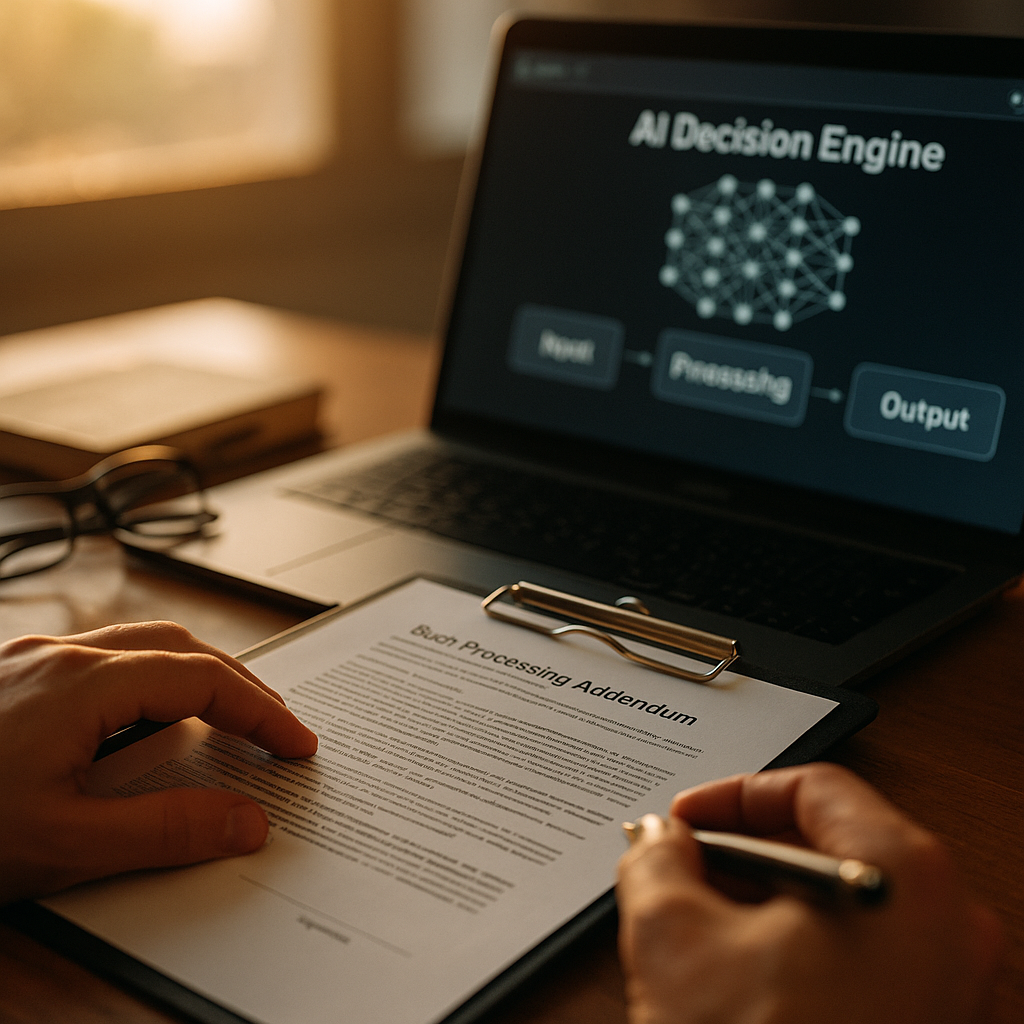
If your AI decision engine can launch a paid social campaign, adjust creator payouts, and push retargeting audiences across three platforms before a human ever sees a dashboard, your standard data processing addendum is already obsolete. Most brands are running AI-driven martech stacks on DPAs written for the era of manual data exports. That gap is where regulators, and plaintiffs’ attorneys, are increasingly looking.
Autonomous execution isn’t a future scenario. It’s the default setting on a growing share of enterprise marketing platforms. And the legal paperwork hasn’t caught up.
Why the Old DPA Template Doesn’t Work Anymore
A traditional data processing addendum assumes a linear relationship: a controller (the brand) instructs a processor (the vendor) to do something specific with personal data, and the processor does it, then stops. Simple. Auditable. Predictable.
AI decision engines break that assumption in three ways. First, they make thousands of micro-decisions per hour without documented human instruction for each one. Second, they often pull data from multiple sources simultaneously — CRM records, loyalty data, browsing behavior, creator campaign performance — to make a single execution call. Third, they push outputs (ad creative, bid adjustments, audience segments) across channels in real time, meaning the “processing” doesn’t happen once; it happens continuously, and it happens downstream in systems you may not directly control.
This is the same structural problem we flagged when covering API-level data sharing agreements for platform integrations. AI decision engines just add a layer of autonomous judgment on top of the data flow, which means your addendum needs to govern behavior, not just data categories.
An AI decision engine that auto-executes campaigns isn’t a data processor in the traditional sense — it’s a decision-maker acting on your behalf without a human sign-off loop, and your DPA needs to say so explicitly.
What Regulators Actually Expect From Automated Decisioning
Neither the FTC nor most state privacy laws have issued AI-decisioning-specific DPA templates. But the underlying expectations are consistent across enforcement actions and guidance documents: transparency about what the system does, a documented basis for automated decisions, and the ability to explain or reverse an action after the fact.
The FTC has been explicit that “the algorithm did it” is not a liability shield. If your AI engine auto-executes a campaign that violates FTC endorsement guidance, targets a minor in violation of COPPA, or triggers a state-level biometric consent issue, the brand is still the responsible party. The processor’s DPA obligations matter for indemnification, but they don’t erase your exposure.
This mirrors what we’ve seen play out with AI shopping agents and endorsement liability — the technology executes, but accountability stays with the brand deploying it. A well-built DPA is one of the few tools that lets you push some of that risk contractually onto the vendor, provided the contract actually anticipates autonomous behavior.
The Core Gaps in Most Current Agreements
- No definition of “autonomous execution” — most DPAs still describe processing as instruction-based, with no clause covering machine-initiated actions taken without per-instance approval.
- Missing multi-channel data flow mapping — the addendum covers the primary platform but says nothing about where the AI engine pushes data next (a DSP, a creator payment platform, a CRM sync).
- No real-time audit trail requirement — if the AI runs 200 campaign variants overnight, can the vendor produce a log of what data informed each decision? Most current contracts don’t require this.
- Undefined rollback obligations — what happens when the engine executes something non-compliant? Few DPAs specify how fast the vendor must halt execution and remediate.
- Vague sub-processor disclosure — AI decision engines often route through additional model providers or data enrichment layers that aren’t named in the original agreement.
Building the Addendum: Clause by Clause
Think of this less as a legal template exercise and more as an operational risk map. You’re not just protecting data categories — you’re constraining what an autonomous system is allowed to do with them, and forcing the vendor to prove it stayed inside the lines.
Define the automated decision scope explicitly
Spell out what “decisions” the AI engine is authorized to make without human review: budget reallocation within X%, creative variant selection, audience expansion up to defined thresholds, channel-switching logic. Anything outside that scope should require a human checkpoint. This single clause does more to limit downstream liability than almost anything else in the document.
Map every downstream data flow, not just the primary integration
If the engine auto-executes across TikTok, Meta, and a DSP simultaneously, the DPA needs a data flow diagram as an attached exhibit (this is becoming standard practice, and it’s genuinely useful in an audit). Each channel that receives processed data needs its own data handling terms referenced or incorporated, similar to the layered approach outlined in our TikTok Shop data residency guide.
Require machine-readable audit logs, on demand
A written promise to “maintain records” isn’t enough anymore. Require the vendor to produce, within a defined SLA (48-72 hours is common), a log showing which data inputs triggered which automated actions, timestamped, and tied to specific campaign IDs. Without this, you cannot reconstruct what happened if a regulator or a creator’s attorney comes asking.
If your vendor can’t produce a decision-level audit trail within 72 hours, you don’t actually have oversight of your AI engine — you have a black box with a service agreement attached.
Build in a kill-switch clause with defined response times
Specify exactly how fast the vendor must halt autonomous execution once notified of a compliance concern — not “promptly,” but a number: 1 hour, 4 hours, whatever your risk tolerance supports. Tie this to financial penalties for missed windows. This clause alone has become a negotiating flashpoint with major ad tech vendors, because it forces them to build the technical capability to actually pause mid-execution across channels, which not all platforms currently support.
Address sub-processors and model providers by name
Many AI decision engines license underlying models from third parties (OpenAI, Anthropic, Google) or route enrichment through separate data brokers. Your DPA needs current disclosure of every sub-processor touching personal data, with a notification requirement before new ones are added. This isn’t paranoia — it’s the same standard ICO guidance applies to any multi-party processing chain.
Set data minimization defaults for the decisioning layer
AI models perform better with more data, which creates a structural incentive to over-collect. Your DPA should require the vendor to justify each data category feeding the decision engine against a specific business purpose, echoing the framework we detailed in lifecycle optimization and data minimization risk. If the engine doesn’t need zip-code-level location data to pick an ad variant, it shouldn’t have access to it.
Multi-Channel Complicates Everything
Here’s the part legal teams underestimate: a DPA that works for a single-platform AI tool often falls apart the moment the same engine orchestrates spend across five channels simultaneously. Each platform has its own data handling terms, its own API rate limits, its own definition of what counts as “processing.”
According to eMarketer research on marketing automation adoption, a majority of enterprise marketers now run campaigns through platforms with some degree of autonomous optimization enabled, and that share is climbing every quarter. Yet Statista-tracked surveys on marketing compliance readiness consistently show legal and data governance teams lagging well behind adoption speed. That gap is exactly where DPA gaps turn into breach notifications.
When one AI engine touches TikTok Shop commerce data, Meta ad accounts, and a CRM system in the same execution cycle, you’re not managing one processing relationship — you’re managing an orchestration layer sitting on top of several. Your addendum needs a clause requiring the vendor to flag, in real time, which specific downstream platform each data element is being sent to, and under what legal basis. Without that, you can’t respond credibly if you’re asked, under something like the multi-state breach notification timelines now in effect, which system actually held the exposed data.
Where This Gets Tested First
Expect the first real enforcement pressure to come from state attorneys general, not the FTC directly, particularly in states with active biometric and automated-decision-making statutes. Illinois, Colorado, and California all have frameworks that touch automated profiling in ways that overlap directly with AI decision engines running ad targeting. If your engine’s outputs affect pricing, eligibility, or personalized offers, you’re also brushing up against issues covered in our personalized pricing disclosure guide — a different regulatory angle, but the same root cause: automated systems making consequential decisions without adequate documentation.
None of this means AI-driven campaign execution is too risky to run. It means the contract has to catch up to what the technology already does. Brands that treat the DPA as a checkbox exercise, rather than an operational control document, are the ones that will struggle to explain themselves when something goes wrong at 2am with nobody watching the dashboard.
Next Step
Pull your current DPA for any AI-enabled martech vendor and check for one thing: does it name a specific human-review threshold before the system acts autonomously? If not, that’s the first clause to renegotiate, before your next campaign cycle, not after an incident forces the conversation.
Frequently Asked Questions
What makes a DPA different for AI decision engines versus standard martech tools?
Standard DPAs govern instruction-based processing — a human tells the system what to do, and it does that one thing. AI decision engines require clauses covering autonomous, machine-initiated actions taken without per-instance human approval, including scope limits, audit logging, and kill-switch obligations.
Who is liable if an AI decision engine auto-executes a non-compliant campaign?
The brand remains primarily liable in most regulatory frameworks, including FTC enforcement. A well-drafted DPA can shift financial responsibility and indemnification obligations to the vendor, but it doesn’t eliminate the brand’s underlying compliance duty.
Does the DPA need to cover every platform the AI engine touches?
Yes. If the engine pushes data or executes actions across multiple channels, each downstream data flow needs to be mapped and addressed, either directly in the DPA or through an incorporated data flow exhibit.
How fast should a vendor be required to halt autonomous execution?
There’s no universal legal standard, but leading brands are negotiating specific response windows — often between one and four hours — with financial penalties attached for missed deadlines, rather than vague language like “promptly.”
Are sub-processors and third-party AI models covered under a standard DPA?
Not automatically. Many AI decision engines rely on third-party model providers or data enrichment services that must be explicitly disclosed as sub-processors, with a notification requirement before new ones are added.
How often should brands review their AI-related DPAs?
At minimum annually, but ideally whenever the vendor updates the model, adds a new data source, or expands the engine’s autonomous decision scope, since any of those changes can quietly widen the brand’s risk exposure.
Top Influencer Marketing Agencies
The leading agencies shaping influencer marketing in 2026
Agencies ranked by campaign performance, client diversity, platform expertise, proven ROI, industry recognition, and client satisfaction. Assessed through verified case studies, reviews, and industry consultations.
Moburst

-
2

The Shelf
Boutique Beauty & Lifestyle Influencer AgencyA data-driven boutique agency specializing exclusively in beauty, wellness, and lifestyle influencer campaigns on Instagram and TikTok. Best for brands already focused on the beauty/personal care space that need curated, aesthetic-driven content.Clients: Pepsi, The Honest Company, Hims, Elf Cosmetics, Pure LeafVisit The Shelf → -
3

Audiencly
Niche Gaming & Esports Influencer AgencyA specialized agency focused exclusively on gaming and esports creators on YouTube, Twitch, and TikTok. Ideal if your campaign is 100% gaming-focused — from game launches to hardware and esports events.Clients: Epic Games, NordVPN, Ubisoft, Wargaming, Tencent GamesVisit Audiencly → -
4

Viral Nation
Global Influencer Marketing & Talent AgencyA dual talent management and marketing agency with proprietary brand safety tools and a global creator network spanning nano-influencers to celebrities across all major platforms.Clients: Meta, Activision Blizzard, Energizer, Aston Martin, WalmartVisit Viral Nation → -
5

The Influencer Marketing Factory
TikTok, Instagram & YouTube CampaignsA full-service agency with strong TikTok expertise, offering end-to-end campaign management from influencer discovery through performance reporting with a focus on platform-native content.Clients: Google, Snapchat, Universal Music, Bumble, YelpVisit TIMF → -
6

NeoReach
Enterprise Analytics & Influencer CampaignsAn enterprise-focused agency combining managed campaigns with a powerful self-service data platform for influencer search, audience analytics, and attribution modeling.Clients: Amazon, Airbnb, Netflix, Honda, The New York TimesVisit NeoReach → -
7

Ubiquitous
Creator-First Marketing PlatformA tech-driven platform combining self-service tools with managed campaign options, emphasizing speed and scalability for brands managing multiple influencer relationships.Clients: Lyft, Disney, Target, American Eagle, NetflixVisit Ubiquitous → -
8

Obviously
Scalable Enterprise Influencer CampaignsA tech-enabled agency built for high-volume campaigns, coordinating hundreds of creators simultaneously with end-to-end logistics, content rights management, and product seeding.Clients: Google, Ulta Beauty, Converse, AmazonVisit Obviously →