


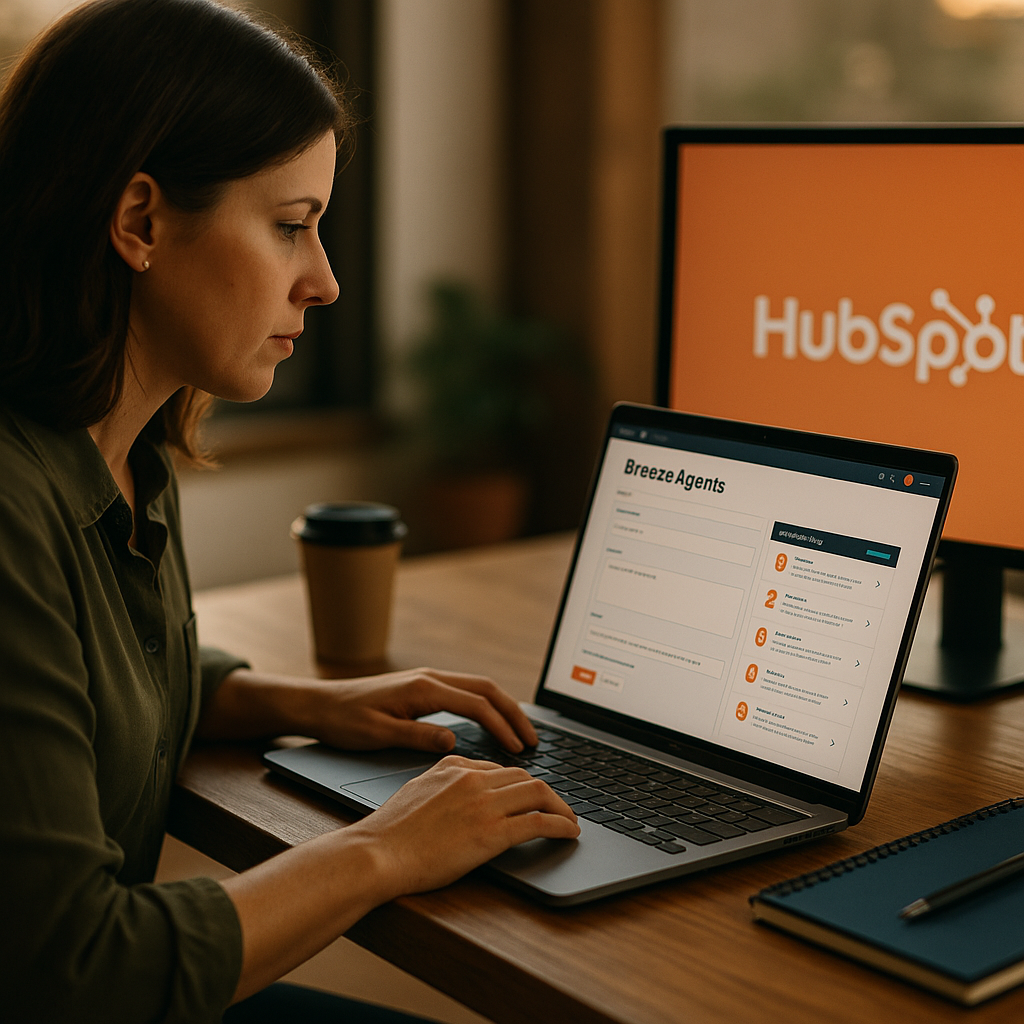
Gartner predicts that by the end of the decade, most B2B marketing orgs will run at least one autonomous agent inside their core systems of record. HubSpot didn’t wait for that forecast to play out. With Breeze, agentic campaign building is already live inside the CRM, and it’s forcing marketing ops teams to rethink what “automation” even means. This isn’t workflow logic anymore. It’s software making judgment calls with your customer data.
That distinction matters more than HubSpot’s marketing wants you to think about. Let’s get into the mechanics.
From Workflow Rules to Agentic Decisions
Traditional HubSpot automation ran on if-this-then-that logic. Contact fills out a form, gets tagged, enters a sequence, receives an email three days later. Predictable. Auditable. Boring, in a good way.
Breeze changes the input-output relationship entirely. Instead of executing a pre-built sequence, the agent interprets a goal (“increase demo bookings from mid-market accounts in the Northeast”) and constructs the campaign itself: audience segmentation, email copy, send-time optimization, follow-up cadence, even budget allocation across paid channels if you’ve connected ad accounts. It’s pulling from CRM properties, engagement history, deal stage data, and increasingly, third-party enrichment sources, then making sequential decisions without a human approving each step.
The shift from rules-based automation to agentic execution means marketers are no longer reviewing outputs one at a time — they’re reviewing a chain of autonomous decisions after the fact, often after the campaign has already gone live.
That’s the technical leap. It’s also the risk. When a workflow breaks, you get one broken email. When an agent makes a bad segmentation call at step two, everything downstream inherits the error — and by the time someone notices, the campaign has already touched thousands of contacts.
What’s Actually Under the Hood
HubSpot built Breeze on a layered architecture: a reasoning layer (the LLM orchestration, largely built on partnerships including OpenAI’s models), a data layer (your CRM’s contact and deal properties, custom objects, and behavioral events), and an action layer (the actual API calls that send emails, update properties, or trigger ad platform changes).
The part practitioners underestimate is how much the agent’s judgment depends on data hygiene in that middle layer. If your lifecycle stage properties are inconsistent, or your lead scoring model hasn’t been touched since a previous rebrand, the agent isn’t going to flag that as a problem. It’s going to build a campaign on top of it anyway. Garbage in, confidently-executed garbage out. We’ve covered this pattern extensively — agentic underperformance almost always traces back to data quality, not model capability.
Why Brands Are Adopting This Faster Than Expected
HubSpot reported that a significant share of its customer base has activated at least one Breeze agent within months of rollout, according to company disclosures during recent earnings calls. That adoption curve outpaces most enterprise software launches, and it’s easy to see why: marketing teams are perpetually understaffed relative to the campaign volume leadership expects.
An agent that can spin up a regionalized nurture campaign in twenty minutes instead of two days is an easy sell to a CMO staring at a headcount freeze. The ROI math is straightforward on paper. Fewer hours on campaign build, faster time-to-launch, more experiments run per quarter.
But speed without governance is how brands end up explaining themselves to legal. The same efficiency that makes Breeze attractive is exactly why it needs guardrails most teams haven’t built yet.
The Compliance Blind Spot Nobody’s Pricing In
Here’s the uncomfortable question: who signs off on an email an AI agent wrote, sequenced, and sent to 40,000 contacts without a marketer reading the final version first?
In practice, most teams answer “nobody,” and that’s a problem regulators are starting to notice. The FTC has been explicit that AI-generated marketing claims are held to the same truth-in-advertising standard as anything a human writes — the automation doesn’t create a liability shield. If Breeze’s agent hallucinates a discount percentage or misstates a product capability while drafting campaign copy, your brand owns that claim, not HubSpot.
This is the same governance gap we’ve flagged repeatedly across agentic marketing tools. Hallucination detection protocols built for creator briefs apply just as directly to CRM-native agents drafting customer-facing copy. The tooling context changed; the underlying risk didn’t.
There’s a data privacy angle too. Breeze agents pulling from enriched contact records need to respect consent flags and regional data handling rules. If your CRM has contacts under GDPR consent restrictions, an autonomous agent building a segment needs to honor that boundary every single time, not just when someone remembers to check. The ICO’s guidance on automated decision-making is a useful baseline for any team scoping this out, particularly if you have UK or EU contacts in your database.
Building the Kill-Switch You’ll Actually Need
Every agentic system in production marketing needs an emergency stop that a non-technical marketer can hit without filing a ticket. This isn’t optional anymore; it’s becoming table stakes for procurement review. We’ve argued this point at length: kill-switch standards are now a genuine procurement gate, and HubSpot’s Breeze agents are no exception, even though the platform’s default settings don’t make that control obvious.
Practically, that means:
- Setting hard caps on send volume per agent-initiated campaign until you’ve built trust in its outputs
- Requiring human approval on any campaign touching more than a defined contact threshold
- Logging every agent decision with a timestamp and the data inputs it used, so you can reconstruct what happened if a campaign underperforms or triggers a complaint
- Assigning a named owner for agent oversight, not a committee, an actual person accountable for the audit trail
None of this is exotic. It’s the same audit-trail discipline agencies are demanding from ad-buying platforms, applied to the CRM layer instead. If your organization already built audit trail standards for ad-ops platforms, extend that same framework to campaign-building agents. The failure modes rhyme.
Where Breeze Fits Against the Rest of the Agentic Stack
HubSpot isn’t operating in isolation here. Salesforce’s Agentforce, Adobe’s AI Assistant, and a wave of point solutions are racing toward the same territory: agents that don’t just recommend actions but execute them inside the system of record. The CRM is becoming the control plane for agentic marketing, which raises the stakes on data governance decisions made years ago for entirely different reasons.
One thing that differentiates Breeze’s approach is how tightly it’s woven into HubSpot’s existing property and workflow architecture rather than bolted on as a separate module. That’s a genuine advantage for mid-market teams already deep in the HubSpot ecosystem. It also means legacy data debt gets inherited automatically. Teams migrating from Salesforce or consolidating multiple CRMs into HubSpot should audit their property mapping before flipping Breeze agents on, not after.
Retrieval-augmented generation is increasingly the differentiator vendors point to when defending output accuracy, and HubSpot is no different in citing RAG-style grounding for Breeze’s content generation. That’s worth scrutinizing rather than accepting at face value. RAG has become a procurement gate for marketing AI vendors precisely because “we use RAG” has turned into a marketing claim as much as a technical one. Ask vendors what’s actually in the retrieval corpus, how often it’s refreshed, and whether it includes your specific brand guidelines or just general web training data.
What Marketing Ops Teams Should Actually Do This Quarter
Skip the philosophical debate about whether agentic marketing is “good.” It’s happening. The operational question is how you adopt it without creating exposure.
Start with a data audit, not a feature tour. Before activating any Breeze agent beyond sandbox testing, verify your lifecycle stages, lead scoring properties, and consent flags are clean and current. Run one agent-built campaign against a small, low-risk segment first and manually review every decision the agent made before it fully executes. Document what “good” looks like so you have a baseline for evaluating future campaigns without re-reviewing everything line by line.
Then build the governance layer before scaling usage: approval thresholds, audit logging, a named accountable owner, and a documented rollback procedure. HubSpot’s own resources on Breeze and AI-powered marketing tools are a reasonable starting point for configuration details, but governance policy is on you to build, not the vendor.
Marketing teams that treat agentic CRM tools like they treated basic workflow automation, set it and forget it, are the ones who’ll end up in a postmortem meeting explaining an email blast nobody approved. Teams that build the review layer now will be the ones scaling agent usage confidently next year while competitors are still doing damage control.
Frequently Asked Questions
What makes HubSpot’s Breeze different from previous marketing automation features?
Breeze agents make sequential, autonomous decisions across an entire campaign (segmentation, copy, send timing, budget) rather than executing a single pre-built workflow rule. Traditional automation follows fixed logic; Breeze interprets a goal and builds toward it independently.
Does an AI agent building a campaign create legal liability for the brand?
Yes. Regulatory guidance from bodies like the FTC treats AI-generated marketing content under the same truth-in-advertising standards as human-written content. The brand deploying the agent, not the software vendor, is accountable for inaccurate claims or compliance violations.
How much human review should marketing teams keep in the loop?
At minimum, require human approval for campaigns exceeding a defined contact volume, log every agent decision with its data inputs, and assign one accountable owner for oversight. Full autonomy without review thresholds is the highest-risk configuration.
Can poor CRM data quality cause Breeze to make bad decisions?
Yes, and it’s the most common failure mode. Agents build campaigns on top of whatever lifecycle stages, lead scores, and contact properties exist in the CRM without flagging inconsistencies. Clean, current data is a prerequisite, not an afterthought.
How does Breeze compare to Salesforce’s Agentforce or Adobe’s AI tools?
All three are converging on the same model: agents that execute actions inside the system of record rather than just recommending them. Breeze’s advantage is deep native integration with HubSpot’s existing property and workflow architecture, which benefits teams already built on HubSpot but also means legacy data issues get inherited automatically.
Frequently Asked Questions
Top Influencer Marketing Agencies
The leading agencies shaping influencer marketing in 2026
Agencies ranked by campaign performance, client diversity, platform expertise, proven ROI, industry recognition, and client satisfaction. Assessed through verified case studies, reviews, and industry consultations.
Moburst

-
2

The Shelf
Boutique Beauty & Lifestyle Influencer AgencyA data-driven boutique agency specializing exclusively in beauty, wellness, and lifestyle influencer campaigns on Instagram and TikTok. Best for brands already focused on the beauty/personal care space that need curated, aesthetic-driven content.Clients: Pepsi, The Honest Company, Hims, Elf Cosmetics, Pure LeafVisit The Shelf → -
3

Audiencly
Niche Gaming & Esports Influencer AgencyA specialized agency focused exclusively on gaming and esports creators on YouTube, Twitch, and TikTok. Ideal if your campaign is 100% gaming-focused — from game launches to hardware and esports events.Clients: Epic Games, NordVPN, Ubisoft, Wargaming, Tencent GamesVisit Audiencly → -
4

Viral Nation
Global Influencer Marketing & Talent AgencyA dual talent management and marketing agency with proprietary brand safety tools and a global creator network spanning nano-influencers to celebrities across all major platforms.Clients: Meta, Activision Blizzard, Energizer, Aston Martin, WalmartVisit Viral Nation → -
5

The Influencer Marketing Factory
TikTok, Instagram & YouTube CampaignsA full-service agency with strong TikTok expertise, offering end-to-end campaign management from influencer discovery through performance reporting with a focus on platform-native content.Clients: Google, Snapchat, Universal Music, Bumble, YelpVisit TIMF → -
6

NeoReach
Enterprise Analytics & Influencer CampaignsAn enterprise-focused agency combining managed campaigns with a powerful self-service data platform for influencer search, audience analytics, and attribution modeling.Clients: Amazon, Airbnb, Netflix, Honda, The New York TimesVisit NeoReach → -
7

Ubiquitous
Creator-First Marketing PlatformA tech-driven platform combining self-service tools with managed campaign options, emphasizing speed and scalability for brands managing multiple influencer relationships.Clients: Lyft, Disney, Target, American Eagle, NetflixVisit Ubiquitous → -
8

Obviously
Scalable Enterprise Influencer CampaignsA tech-enabled agency built for high-volume campaigns, coordinating hundreds of creators simultaneously with end-to-end logistics, content rights management, and product seeding.Clients: Google, Ulta Beauty, Converse, AmazonVisit Obviously →