


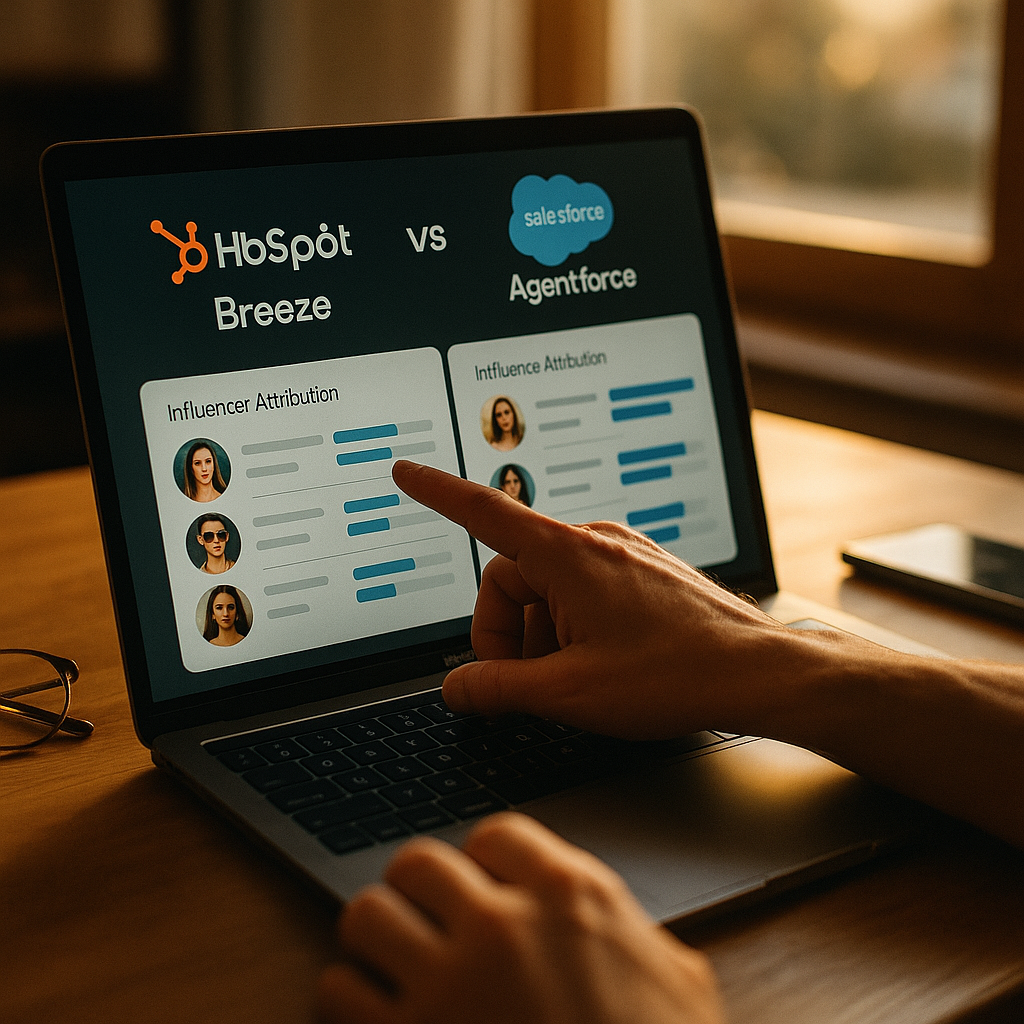
78% of marketers say proving influencer ROI is their biggest reporting headache, according to recent industry surveys — and now two CRM giants want to solve it with AI agents instead of dashboards. HubSpot Breeze vs Salesforce Agentforce isn’t just a feature comparison anymore. It’s a decision about who owns your attribution logic for the next three years. If you’re a mid-market brand running 20-plus creator partnerships across TikTok, YouTube, and retail media, this choice will shape your budget defense in every board meeting.
So let’s skip the vendor decks and get into what actually matters: data access, agent reasoning quality, and whether either platform can tell you which creator drove the sale, not just who touched it last.
Why This Comparison Even Matters Now
Influencer attribution used to live in spreadsheets and UTM parameters. That era is dying. Brands now expect their CRM to reason across touchpoints — an Instagram Reel view, a coupon code redemption, a CTV impression, a final purchase — and assign credit intelligently. That’s the promise of agentic AI inside CRM platforms.
HubSpot Breeze and Salesforce Agentforce both launched agent layers meant to automate this kind of cross-channel reasoning. But mid-market teams don’t have Salesforce’s enterprise integration budget or HubSpot’s native marketing hub sprawl to lean on blindly. You need to know which agent framework fits your actual creator stack, not just which one has the flashier keynote demo.
The real question isn’t which agent is smarter. It’s which one can see your influencer data clearly enough to reason about it at all.
HubSpot Breeze: Built for Marketing-Led Teams
Breeze is HubSpot’s agent suite, spanning prospecting, content, and customer service agents, layered on top of the existing Smart CRM. For influencer attribution specifically, the relevant piece is Breeze’s ability to ingest campaign data from connected marketing tools and apply predictive scoring to contact records.
Here’s what stands out for mid-market brands:
- Native marketing hub integration. If your influencer program already runs through HubSpot’s campaign tools, Breeze can attribute pipeline influence without a separate data pipeline build.
- Lower implementation lift. HubSpot’s onboarding for mid-market accounts typically runs weeks, not quarters. Breeze agents inherit existing workflow and lifecycle stage data automatically.
- Content-side reasoning. Breeze’s content agent can tag and classify creator assets (UGC clips, affiliate links, gifted-product mentions) which feeds attribution models more usable metadata than raw click data alone.
The tradeoff? Breeze’s attribution modeling is still maturing for multi-touch, cross-platform creator journeys. It handles inbound-driven attribution (someone clicks a creator’s link, fills a form) far better than it handles offline or CTV-influenced conversions. If your influencer strategy leans heavily on brand awareness plays with delayed purchase behavior, Breeze alone won’t close that loop. You’ll likely still need a dedicated server-side attribution layer feeding it clean signal.
Salesforce Agentforce: More Power, More Setup
Agentforce is Salesforce’s answer to the same problem, but architected for organizations that already treat Salesforce as their system of record for revenue operations. It’s built on Data Cloud, which means attribution reasoning can theoretically span far more data sources: paid media, POS transactions, service tickets, loyalty programs, and yes, influencer campaign performance.
Why mid-market teams consider it despite the complexity:
- Deeper reasoning across disparate data. Agentforce agents can be configured with custom prompts and topics that reference influencer campaign objects alongside opportunity and account data, useful if creators are part of B2B or high-ticket B2C sales cycles.
- Stronger governance controls. Salesforce’s Data Cloud permissions and audit trails matter if you’re in a regulated category (finance, healthcare, CPG with FTC disclosure risk) and need to show exactly how an agent arrived at an attribution conclusion.
- Extensibility. Agentforce integrates with Salesforce’s broader ecosystem (Marketing Cloud, Commerce Cloud), so if your influencer program touches commerce directly, the data model is already there.
The catch is cost and complexity. Agentforce pricing is consumption-based, tied to conversations or actions the agent completes, which makes budgeting unpredictable for teams new to agentic tools. Implementation also typically requires either an in-house Salesforce admin or a systems integrator, something many mid-market marketing teams don’t have on staff.
Data Readiness: The Part Vendors Don’t Lead With
Neither Breeze nor Agentforce can attribute what they can’t see. This is the uncomfortable truth buyers skip past during demos. Both platforms depend on clean, deduplicated identity data flowing in from your influencer platforms, affiliate networks, and ad exchanges.
If your creator program runs through five disconnected tools — a seeding platform, an affiliate network, a social listening tool, a CTV DSP — you have an identity resolution problem before you have an attribution problem. This is where a lot of mid-market teams get burned: they buy the agent layer expecting it to fix a data plumbing issue it was never designed to solve.
Before evaluating either vendor, audit your current signal fusion setup. Our CRM signal fusion evaluation guide walks through the questions to ask vendors about deduplication and identity graphs. If you’re running micro-creator programs specifically, the tracking method matters even more — see our breakdown of native tracking versus standalone tools for micro-creators for a sense of where Breeze and Agentforce fit relative to dedicated attribution point solutions.
An AI agent sitting on top of fragmented identity data will just automate bad attribution faster. Fix the plumbing first.
Cost and ROI: What Mid-Market Budgets Actually Absorb
Let’s talk numbers, roughly, because exact pricing shifts by contract and seat count.
HubSpot’s Breeze agents are bundled into higher-tier Marketing Hub and Sales Hub plans, meaning mid-market teams already paying for Professional or Enterprise tiers get agent access without a dramatically new line item. That predictability matters when you’re defending martech spend to finance.
Salesforce Agentforce uses a credit-based consumption model. Every agent action, a conversation, a data lookup, a recommendation, consumes credits. For a mid-market team running lean, this can spiral quickly if influencer attribution queries run at scale (think: attributing thousands of monthly affiliate link clicks). It’s powerful, but it rewards teams that can forecast usage precisely. Most can’t, at least not in year one.
A rough rule of thumb we’d suggest: if your influencer program generates under 10,000 trackable touchpoints a month and lives mostly in HubSpot already, Breeze’s bundled pricing wins on predictability. If you’re running 50,000+ touchpoints across commerce, service, and marketing with existing Salesforce infrastructure, Agentforce’s deeper data model justifies the consumption cost.
Governance and Compliance Considerations
Attribution isn’t just a reporting exercise anymore, it’s a compliance surface. The FTC’s endorsement guidelines increasingly expect brands to demonstrate traceability between creator content and consumer outcomes, especially in regulated verticals. If an AI agent is making attribution calls that inform payout structures or performance bonuses for creators, you need an audit trail that survives scrutiny.
Agentforce’s Data Cloud governance tools generally edge out Breeze here, offering more granular permission sets and logging. But HubSpot has invested heavily in transparency features for its own agents, publishing model behavior documentation that smaller compliance teams can actually parse without a data science degree. Check HubSpot’s product documentation directly rather than relying on sales collateral here, agent capabilities update fast.
If your influencer program includes affiliate commission structures tied to attribution outcomes, this governance layer isn’t optional. We’ve covered the specific risks in vetting AI tools for affiliate commission structures, worth a read before you sign either contract.
How to Actually Run the Evaluation
Skip the 90-minute vendor demo as your primary decision input. Instead:
- Map your current data sources. List every platform touching creator or campaign data: influencer marketplaces, affiliate networks, social platforms, POS, CTV. Identify overlap and gaps.
- Request a sandbox with real data. Both vendors offer trial or sandbox environments. Load a месяц of actual (anonymized) campaign data and see what the agent surfaces unprompted.
- Test edge cases. Ask the agent to attribute a purchase that involved three touchpoints across two platforms with a 14-day lag. See if it explains its reasoning or just outputs a number.
- Price out 12 months of realistic usage. For Agentforce, model your actual monthly touchpoint volume against credit costs. For Breeze, confirm which tier unlocks the specific agents you need.
- Check integration depth with your creator platforms. Whatever influencer marketplace or affiliate tool you use, confirm native or API-level integration exists, not just a CSV export workaround.
For teams evaluating broader identity and CDP readiness before committing to either CRM’s agent layer, our comparison of CDP platforms for agentic readiness is a useful parallel read, since the underlying data architecture questions overlap significantly with this CRM decision.
Industry benchmarks from eMarketer and Statista continue to show influencer marketing spend growing faster than overall digital ad budgets, which means attribution tooling decisions made now will compound over multiple budget cycles. Get this wrong and you’re not just stuck with a clunky dashboard, you’re stuck defending numbers you don’t fully trust.
Bottom line: choose HubSpot Breeze if your influencer attribution needs live primarily within marketing-sourced conversions and you value implementation speed. Choose Salesforce Agentforce if your creator program intersects with commerce, service, and complex B2B sales cycles and you have the technical resourcing to manage consumption-based pricing. Run the sandbox test with your own data before either contract lands on your desk.
FAQs
Is HubSpot Breeze or Salesforce Agentforce better for influencer attribution specifically?
Neither is purpose-built solely for influencer attribution. Breeze tends to work better for marketing-sourced, inbound-driven creator campaigns already running through HubSpot’s marketing tools. Agentforce fits brands where influencer activity intersects with broader Salesforce-tracked revenue data, including commerce and service interactions.
Can either platform replace a dedicated influencer attribution tool?
Not fully, at least not yet. Both depend on clean upstream data from influencer platforms, affiliate networks, and ad exchanges. Most mid-market teams still pair one of these CRM agents with a dedicated signal fusion or server-side attribution layer to close identity gaps.
How much does Salesforce Agentforce cost compared to HubSpot Breeze?
Agentforce uses consumption-based pricing tied to agent actions or conversations, which can be harder to forecast. Breeze is generally bundled into higher HubSpot Marketing Hub or Sales Hub tiers, offering more predictable costs for teams already on those plans.
What data do I need before evaluating either platform?
Map every source touching creator or campaign data, including influencer marketplaces, affiliate networks, social platforms, CTV, and POS systems. Identity resolution and deduplication issues will undermine either agent’s attribution reasoning regardless of which vendor you choose.
Does either platform address FTC disclosure compliance for influencer attribution?
Both offer governance and audit features, with Agentforce generally providing more granular permissioning through Data Cloud. Neither automates FTC compliance directly; brands still need documented processes for disclosure tracking alongside attribution reporting.
Visible FAQ (HTML)
FAQs
Is HubSpot Breeze or Salesforce Agentforce better for influencer attribution specifically?
Neither is purpose-built solely for influencer attribution. Breeze tends to work better for marketing-sourced, inbound-driven creator campaigns already running through HubSpot’s marketing tools. Agentforce fits brands where influencer activity intersects with broader Salesforce-tracked revenue data, including commerce and service interactions.
Can either platform replace a dedicated influencer attribution tool?
Not fully, at least not yet. Both depend on clean upstream data from influencer platforms, affiliate networks, and ad exchanges. Most mid-market teams still pair one of these CRM agents with a dedicated signal fusion or server-side attribution layer to close identity gaps.
How much does Salesforce Agentforce cost compared to HubSpot Breeze?
Agentforce uses consumption-based pricing tied to agent actions or conversations, which can be harder to forecast. Breeze is generally bundled into higher HubSpot Marketing Hub or Sales Hub tiers, offering more predictable costs for teams already on those plans.
What data do I need before evaluating either platform?
Map every source touching creator or campaign data, including influencer marketplaces, affiliate networks, social platforms, CTV, and POS systems. Identity resolution and deduplication issues will undermine either agent’s attribution reasoning regardless of which vendor you choose.
Does either platform address FTC disclosure compliance for influencer attribution?
Both offer governance and audit features, with Agentforce generally providing more granular permissioning through Data Cloud. Neither automates FTC compliance directly; brands still need documented processes for disclosure tracking alongside attribution reporting.
Top Influencer Marketing Agencies
The leading agencies shaping influencer marketing in 2026
Agencies ranked by campaign performance, client diversity, platform expertise, proven ROI, industry recognition, and client satisfaction. Assessed through verified case studies, reviews, and industry consultations.
Moburst

-
2

The Shelf
Boutique Beauty & Lifestyle Influencer AgencyA data-driven boutique agency specializing exclusively in beauty, wellness, and lifestyle influencer campaigns on Instagram and TikTok. Best for brands already focused on the beauty/personal care space that need curated, aesthetic-driven content.Clients: Pepsi, The Honest Company, Hims, Elf Cosmetics, Pure LeafVisit The Shelf → -
3

Audiencly
Niche Gaming & Esports Influencer AgencyA specialized agency focused exclusively on gaming and esports creators on YouTube, Twitch, and TikTok. Ideal if your campaign is 100% gaming-focused — from game launches to hardware and esports events.Clients: Epic Games, NordVPN, Ubisoft, Wargaming, Tencent GamesVisit Audiencly → -
4

Viral Nation
Global Influencer Marketing & Talent AgencyA dual talent management and marketing agency with proprietary brand safety tools and a global creator network spanning nano-influencers to celebrities across all major platforms.Clients: Meta, Activision Blizzard, Energizer, Aston Martin, WalmartVisit Viral Nation → -
5

The Influencer Marketing Factory
TikTok, Instagram & YouTube CampaignsA full-service agency with strong TikTok expertise, offering end-to-end campaign management from influencer discovery through performance reporting with a focus on platform-native content.Clients: Google, Snapchat, Universal Music, Bumble, YelpVisit TIMF → -
6

NeoReach
Enterprise Analytics & Influencer CampaignsAn enterprise-focused agency combining managed campaigns with a powerful self-service data platform for influencer search, audience analytics, and attribution modeling.Clients: Amazon, Airbnb, Netflix, Honda, The New York TimesVisit NeoReach → -
7

Ubiquitous
Creator-First Marketing PlatformA tech-driven platform combining self-service tools with managed campaign options, emphasizing speed and scalability for brands managing multiple influencer relationships.Clients: Lyft, Disney, Target, American Eagle, NetflixVisit Ubiquitous → -
8

Obviously
Scalable Enterprise Influencer CampaignsA tech-enabled agency built for high-volume campaigns, coordinating hundreds of creators simultaneously with end-to-end logistics, content rights management, and product seeding.Clients: Google, Ulta Beauty, Converse, AmazonVisit Obviously →