


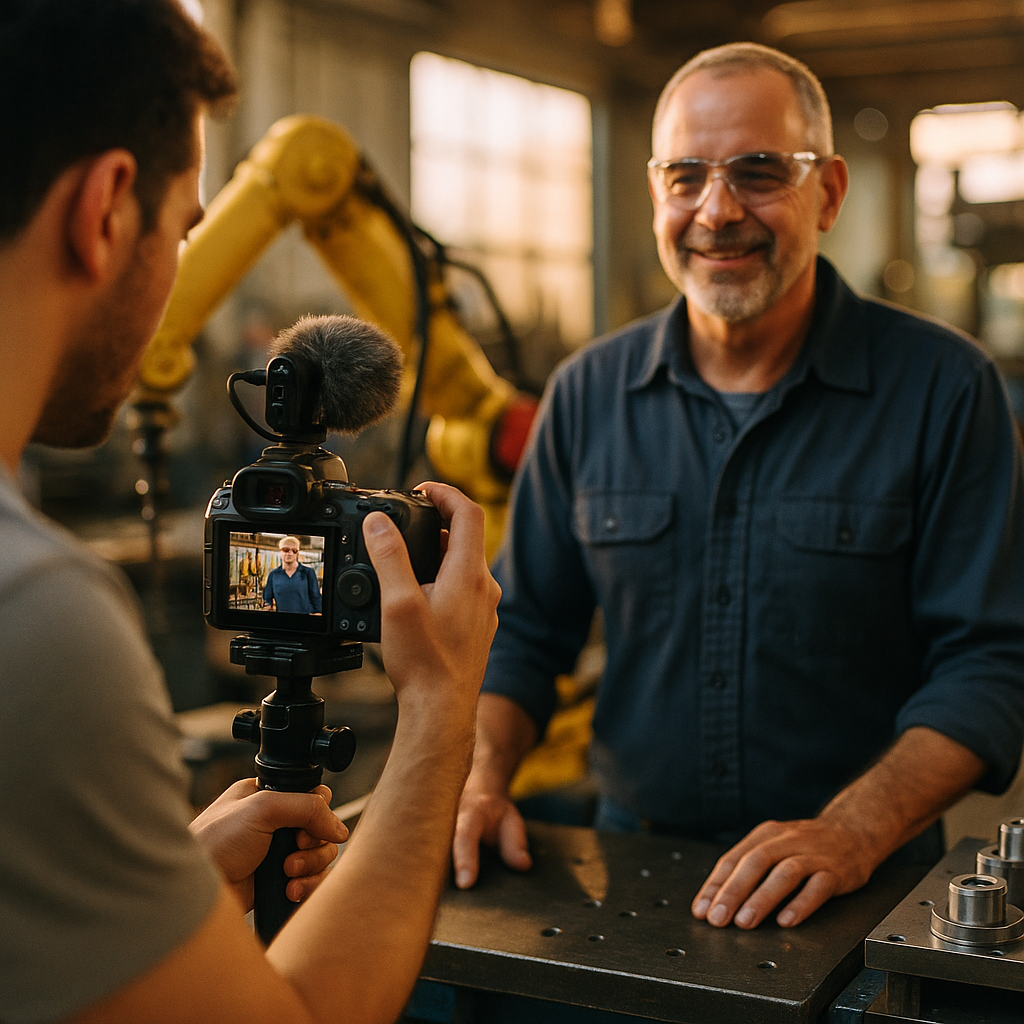
In 2025, buyers expect more than specs, pricing, and lead times—they want proof that real people stand behind the product. This case study follows a traditional manufacturer using video to humanize staff and rebuild trust across recruiting, sales, and customer success. You’ll see what they filmed, how they organized approvals, and which metrics mattered most—plus the simple shift that made it all work.
Why “humanizing manufacturing” matters in 2025
“Traditional” manufacturing often communicates through datasheets, certifications, and process promises. Those assets still matter, but they rarely answer the unspoken questions prospects and job candidates have: Who will I deal with? Will they respond? Do they care about quality when no one is watching?
Humanizing manufacturing works because it reduces perceived risk. In B2B buying, risk is personal: a purchasing manager worries about late deliveries; an engineer worries about out-of-spec parts; an operations lead worries about downtime. Seeing the people behind the work—operators, quality techs, customer service, maintenance—turns an abstract supplier into a dependable partner.
This case study centers on a mid-sized, family-owned industrial components manufacturer (we’ll call them Riverton Components) with decades of history, a skilled workforce, and strong customer retention—but a brand presence that felt cold and interchangeable online. In 2025, Riverton’s leadership set a goal: make the company feel as reliable on screen as it is on the factory floor.
Reader question: Isn’t video “fluffy” for industrial buyers? Riverton’s experience shows the opposite: when video is grounded in real roles, real processes, and real accountability, it supports serious buying decisions and shortens trust-building time.
Video marketing for manufacturers: the challenge and the opportunity
Riverton had three persistent problems:
- Sales friction: The website generated inquiries, but many leads asked basic questions already answered by the site. Sales reps spent time proving credibility instead of solving customer needs.
- Recruiting headwinds: Skilled trades candidates saw the company as “old school.” The employer brand didn’t reflect the modern equipment, safety culture, and career growth paths inside the plant.
- Internal invisibility: Great employees were unknown outside their departments. Customers knew account managers but rarely the technicians who ensured quality.
Riverton’s opportunity was straightforward: capture what already made the company strong—pride in workmanship, responsive support, and rigorous QA—and present it through the people doing the work.
The leadership team chose video because it can carry tone, credibility, and nuance in a way text alone can’t. A short clip of a quality manager explaining inspection steps, or a shipping lead walking through packaging checks, communicates competence quickly and memorably.
Reader question: What about competitors copying processes? Riverton avoided sensitive details. They focused on principles, responsibilities, and checkpoints—showing how they think and verify, not proprietary settings or customer-specific configurations.
Employee spotlight videos: building trust without feeling staged
Riverton’s first move was a structured series of employee spotlight videos designed to feel natural, not scripted. Each video ran 45–90 seconds for social platforms and had a longer 2–3 minute cut for the careers page, sales follow-ups, and onboarding.
The format they used:
- Open with a human detail: name, role, and how long they’ve been with the company.
- Show the work: a simple visual of the person in their environment—calibration bench, press brake, inspection station, shipping area.
- Define accountability: one sentence on what “good” looks like in their role (for example, “If I sign off, it ships—so I check it like it’s going into my own equipment”).
- Connect to customer impact: one real-world outcome: fewer defects, faster response, safer packaging, consistent tolerances.
- Close with approachability: an invitation to ask questions or a note about what they enjoy helping with.
They filmed operators, maintenance, QA, engineering support, customer service, and even the scheduler who coordinated production. That last one mattered: customers often blame “the factory” for delays, but a scheduler explaining capacity planning and communication norms made delivery conversations calmer and more transparent.
How they kept it authentic:
- No teleprompter. Interview questions were shared ahead of time, but answers stayed in employees’ own words.
- Real sound. Light background plant noise remained in some shots. It signaled a real facility, not a studio.
- Minimal polish. Basic color correction and captions, but no dramatic music that felt out of place for an industrial brand.
Reader question: What if employees are camera-shy? Riverton started with volunteers and union stewards who were respected on the floor. Once the first few videos were received positively—internally and externally—more people opted in.
Behind-the-scenes factory content: showing process, safety, and quality culture
After the spotlight series, Riverton expanded into behind-the-scenes factory content. The goal was not to “show off machinery,” but to demonstrate discipline: safety habits, inspection routines, and communication patterns.
Three recurring video themes drove the most trust:
- Quality at the point of work: short clips of first-article checks, gauge handling, and documentation habits. The message: quality is built in, not inspected in at the end.
- Safety behaviors: lockout/tagout reminders, PPE norms, housekeeping, and pre-shift checks—presented as routine professionalism, not corporate theater.
- Order journey walkthroughs: “Here’s what happens after you submit a PO” or “How we package to prevent damage in transit.” These reduced repetitive questions and improved expectation-setting.
Riverton also created a simple “Meet your team” page where videos were organized by function: quoting, engineering support, production, QA, shipping, customer service. Sales reps used these links in follow-up emails so prospects could see who they would actually work with.
Reader question: Does this help existing customers? Yes. Riverton found that customer contacts shared the videos internally to onboard new team members and justify vendor choice. That internal sharing strengthened account stickiness without additional sales effort.
Recruitment video strategy: attracting skilled talent with real stories
Recruitment became a major use case because manufacturing hiring is competitive in 2025. Riverton needed applicants who cared about quality and reliability—not just any applicant who clicked “apply.” Video helped self-select the right fit.
What they produced for hiring:
- Role-day-in-the-life clips: machinist, QA tech, maintenance, shipping, customer service. Each showed tools, pace, and teamwork.
- Trainer-led micro-lessons: 30–60 seconds on how Riverton teaches safety, how new hires are paired with mentors, and how raises and progression are earned.
- Leadership commitments: short statements from plant leadership on overtime policy, training investment, and safety expectations—kept specific, not vague.
Instead of generic “We’re like a family” language, Riverton featured measurable practices: structured onboarding checklists, cross-training options, and a clear standard for what “ready to work solo” means. Candidates responded because it sounded like a place with systems, not slogans.
Reader question: Won’t this expose weaknesses? Riverton treated video as accountability. If leadership wasn’t willing to state a policy on camera, they clarified the policy first. This improved internal alignment and reduced misunderstandings during hiring.
Manufacturing brand storytelling: workflow, governance, and measurable results
Humanizing staff with video only works when the operational workflow supports consistency and credibility. Riverton implemented a lightweight governance model to keep production moving without turning it into a bureaucratic mess.
Their practical workflow:
- Owner: Marketing led production and distribution, but HR and Quality had defined review checkpoints.
- Approvals: One review for safety/compliance, one for customer confidentiality. A 48-hour turnaround expectation prevented bottlenecks.
- Release plan: Two short videos per month, plus quarterly “process explainers.” They prioritized consistency over volume.
- Captioning and accessibility: Every video included captions for silent viewing and accessibility. This also improved comprehension on busy shop floors and mobile devices.
- Content reuse: Every shoot produced multiple edits: social cut, website cut, sales enablement cut, and a still-photo set for job posts.
How they measured outcomes:
- Sales: Riverton tracked reply rates on follow-up emails that included a “Meet the team” video link versus standard follow-ups. Sales also logged whether prospects referenced videos in calls.
- Recruiting: HR tracked completion rate of the careers page, application starts, and interview-to-offer acceptance conversations. Recruiters also asked, “Did you see any of our videos?” and recorded answers.
- Customer success: Customer service monitored whether onboarding questions decreased after customers received the “What happens after PO” walkthrough.
Reported impact (directional, not inflated): Within a few months, sales reported warmer first calls because prospects already recognized names and roles. HR reported better-informed candidates and fewer mismatched expectations. Customer service noted that new contacts understood escalation paths faster because the videos clearly introduced who handled what.
Reader question: What’s the biggest risk? Overproducing and underdelivering. Riverton avoided glossy claims and focused on showing everyday standards—who checks what, how issues are handled, and how people communicate. That alignment kept trust intact.
FAQs about using video to humanize staff in manufacturing
What types of videos work best for a traditional manufacturer?
Employee spotlights, order-journey explainers, quality culture clips, and day-in-the-life recruiting videos perform reliably. Prioritize roles customers and candidates interact with most: customer service, QA, shipping, and production leads.
How long should these videos be?
Plan for 45–90 seconds for social and 2–3 minutes for website and sales enablement. If a topic requires depth (like inspection steps), create a short series instead of one long video.
How do we protect confidential customer information?
Use controlled filming zones, remove customer paperwork from view, avoid screens, and have a confidentiality review step. Focus on principles and checkpoints rather than customer-specific parts, drawings, or settings.
Do we need professional production?
You need professional standards, not necessarily a large crew. Clear audio, stable framing, good lighting, and accurate captions matter more than cinematic visuals. Many manufacturers succeed with a small local videographer and a repeatable template.
How do we get employees comfortable on camera?
Start with volunteers, use conversational prompts, film in familiar work areas, and keep takes short. Share the final cut with the employee before publishing and respect opt-out decisions. Confidence spreads when early videos are handled thoughtfully.
What metrics should we track?
Track engagement (views, watch time, click-through), conversion behavior (career applications, contact form completions), and qualitative signals (sales call references, candidate comments). Also monitor support impact, such as reduced repetitive onboarding questions.
Riverton’s experience shows that video doesn’t replace manufacturing credibility—it carries it. By spotlighting real employees and the standards they follow, the company reduced buyer anxiety, improved recruiting fit, and clarified how work gets done. The takeaway is simple: build a repeatable video system that showcases accountability, not advertising. When people can see your team, they trust your process.
Top Influencer Marketing Agencies
The leading agencies shaping influencer marketing in 2026
Agencies ranked by campaign performance, client diversity, platform expertise, proven ROI, industry recognition, and client satisfaction. Assessed through verified case studies, reviews, and industry consultations.
Moburst

-
2

The Shelf
Boutique Beauty & Lifestyle Influencer AgencyA data-driven boutique agency specializing exclusively in beauty, wellness, and lifestyle influencer campaigns on Instagram and TikTok. Best for brands already focused on the beauty/personal care space that need curated, aesthetic-driven content.Clients: Pepsi, The Honest Company, Hims, Elf Cosmetics, Pure LeafVisit The Shelf → -
3

Audiencly
Niche Gaming & Esports Influencer AgencyA specialized agency focused exclusively on gaming and esports creators on YouTube, Twitch, and TikTok. Ideal if your campaign is 100% gaming-focused — from game launches to hardware and esports events.Clients: Epic Games, NordVPN, Ubisoft, Wargaming, Tencent GamesVisit Audiencly → -
4

Viral Nation
Global Influencer Marketing & Talent AgencyA dual talent management and marketing agency with proprietary brand safety tools and a global creator network spanning nano-influencers to celebrities across all major platforms.Clients: Meta, Activision Blizzard, Energizer, Aston Martin, WalmartVisit Viral Nation → -
5

The Influencer Marketing Factory
TikTok, Instagram & YouTube CampaignsA full-service agency with strong TikTok expertise, offering end-to-end campaign management from influencer discovery through performance reporting with a focus on platform-native content.Clients: Google, Snapchat, Universal Music, Bumble, YelpVisit TIMF → -
6

NeoReach
Enterprise Analytics & Influencer CampaignsAn enterprise-focused agency combining managed campaigns with a powerful self-service data platform for influencer search, audience analytics, and attribution modeling.Clients: Amazon, Airbnb, Netflix, Honda, The New York TimesVisit NeoReach → -
7

Ubiquitous
Creator-First Marketing PlatformA tech-driven platform combining self-service tools with managed campaign options, emphasizing speed and scalability for brands managing multiple influencer relationships.Clients: Lyft, Disney, Target, American Eagle, NetflixVisit Ubiquitous → -
8

Obviously
Scalable Enterprise Influencer CampaignsA tech-enabled agency built for high-volume campaigns, coordinating hundreds of creators simultaneously with end-to-end logistics, content rights management, and product seeding.Clients: Google, Ulta Beauty, Converse, AmazonVisit Obviously →