


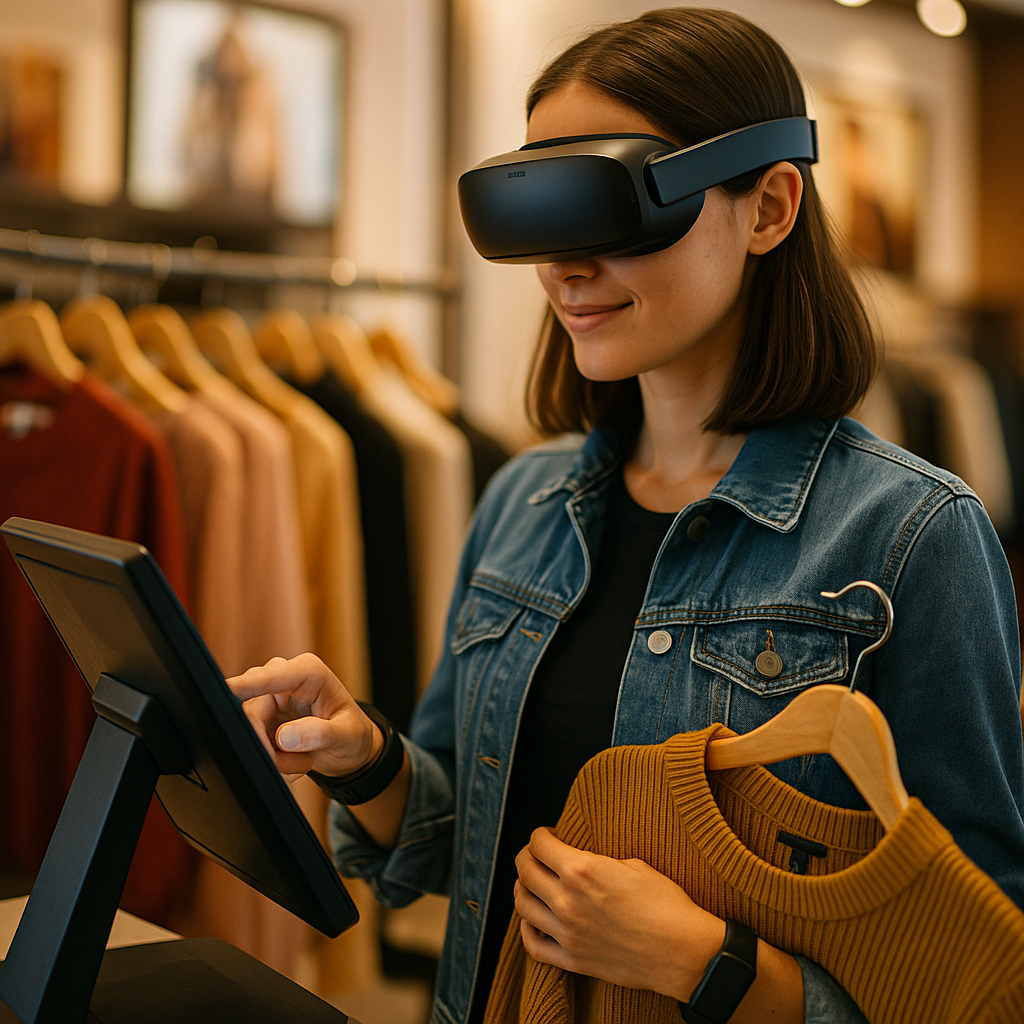
Bio metric feedback loops in immersive digital retail are changing how brands understand attention, comfort, intent, and trust inside virtual and blended shopping spaces. In 2026, retailers can adapt experiences in real time using signals such as gaze, heart rate variability, voice tone, posture, and micro-interactions. The result is more responsive commerce, but also sharper questions about consent, value, and ethics.
Immersive commerce technology is making shopping environments responsive
Immersive retail has moved beyond static product pages and simple 3D showrooms. Today’s leading experiences combine augmented reality, virtual reality, spatial computing, connected wearables, smart mirrors, and AI orchestration to create environments that react while a customer shops. That shift is what makes bio metric feedback loops so important.
A feedback loop begins when a system captures a signal, interprets it, changes the experience, and then measures the shopper’s response to that change. In digital retail, those signals may include eye tracking, blink rate, hand speed, dwell time, facial tension, speech cadence, and physiological measures from opt-in wearables. The retail platform uses those inputs to adjust product recommendations, store layout, pacing, lighting, audio, pricing presentation, or support prompts.
For example, a virtual beauty consultation might detect that a shopper lingers on ingredient explanations and appears uncertain during checkout. Instead of pushing a discount immediately, the system can present dermatologist-reviewed information, simplify shade comparison, and offer a live advisor. In a furniture AR app, elevated hesitation around room-scale placement could trigger alternate views, fit guidance, or material durability details.
This matters because immersive commerce technology creates a richer stream of intent data than clicks alone. A click can show action. A bio metric feedback loop can reveal context: whether a shopper is confused, overloaded, engaged, relaxed, or ready to decide. Used carefully, that context helps retailers remove friction rather than merely increase pressure.
Retailers should also recognize a practical truth: better data does not automatically produce better experiences. Systems need strong calibration, clear use cases, and human-centered design. Without those foundations, reactive retail can become distracting, invasive, or inaccurate. The strongest implementations start with limited, high-value moments where real-time adaptation clearly benefits the customer.
Real-time personalization in retail depends on useful signals, not just more data
Many retail teams already personalize with behavioral data such as browsing history, cart events, location, loyalty status, and prior purchases. Bio metric feedback loops add another layer by estimating how a shopper feels during the journey. That can make real-time personalization in retail more precise, but only if brands distinguish between meaningful signals and noise.
Useful signals often fall into four groups:
- Attention signals: gaze direction, fixation duration, product rotation behavior, voice search refinements
- Effort signals: repeated gestures, abandoned steps, excessive menu revisits, correction patterns
- Comfort signals: motion sensitivity indicators, pacing changes, headset removal in VR, negative vocal cues
- Decision signals: comparison intensity, return-to-item frequency, strong engagement with reviews, fit confidence interactions
Retailers can combine these with traditional commerce metrics to improve moments that strongly influence conversion and satisfaction. In apparel, that may mean adapting fit guidance when body-scan confidence drops. In luxury retail, it may mean reducing interface clutter when high-value customers want calm, focused exploration. In grocery, it may mean simplifying nutritional comparisons when cognitive load appears high.
The most effective systems are not trying to read minds. They are solving narrow problems with transparent logic. A headset experience that slows transitions when motion discomfort rises is useful. A virtual assistant that becomes less promotional when stress signals increase can feel supportive. A digital showroom that recognizes sustained attention on a premium feature and surfaces financing options may help a ready buyer complete the journey.
Retail leaders should ask three questions before deploying any adaptive feature:
- Is the signal reliable enough for the decision being made?
- Does the adaptation help the shopper complete a task or feel more confident?
- Can the customer understand and control how the adaptation happens?
If the answer to any of these is no, the feature likely needs redesign. Precision in personalization now depends less on collecting every possible signal and more on using the right signal at the right moment with a clear customer benefit.
Consumer biometrics data can improve conversion, fit confidence, and retention
The commercial upside of consumer biometrics data is real, especially when retailers focus on measurable pain points. The clearest gains usually show up in product discovery, fit assurance, checkout confidence, and post-purchase satisfaction.
In digital fashion, body-aware try-on tools paired with posture and gaze signals can identify uncertainty around silhouette, fabric drape, or sizing. Instead of forcing a customer to guess, the experience can surface tailored fit notes, movement simulations, or peer examples with similar measurements. This can reduce returns, which remains one of ecommerce’s most expensive operational problems.
In beauty retail, facial mapping and expression analysis can support shade matching, skincare routines, and educational content sequencing. When a shopper repeatedly compares ingredients, the platform can elevate efficacy data, allergy information, and regimen compatibility. That creates a more informed path to purchase and often improves long-term trust.
In electronics and automotive retail, bio metric cues can help brands simplify complex choices. If a customer shows signs of overload while comparing processor options, battery tradeoffs, or trim packages, the system can shift into guided decision mode. Instead of presenting more specs, it can rank options by the user’s stated priorities and interaction patterns.
There are also benefits beyond conversion:
- Lower abandonment: adaptive interfaces can reduce friction during high-effort tasks
- Better accessibility: systems can detect strain and offer alternative navigation paths
- Higher trust: education can replace aggressive selling when uncertainty is detected
- Improved loyalty: customers remember experiences that feel intuitive and respectful
Still, brands should avoid inflated claims. Consumer biometrics data is probabilistic, not absolute. Heart rate variability may suggest arousal, but not whether that arousal reflects excitement or frustration. Eye tracking may show focus, but not intent by itself. The strongest programs validate signals against outcomes, run controlled testing, and keep a human review process for high-impact decisions.
That approach aligns with EEAT principles. Helpful content and helpful experiences both depend on expertise, evidence, and restraint. Retailers that explain what data they use, why they use it, and how it improves the shopping journey will earn more confidence than those that hide behind vague claims about AI magic.
Retail privacy compliance will define who wins customer trust
No discussion of bio metric feedback loops is credible without a serious look at retail privacy compliance. Biometric and inferred emotional data can be highly sensitive. In immersive environments, the line between convenience and surveillance gets thin fast. Winning retailers in 2026 are not the ones that collect the most data. They are the ones that establish clear boundaries and prove they deserve access.
Consent must be active, specific, and easy to withdraw. If a shopper opts into gaze tracking for navigation support, that does not automatically justify using the same signal for dynamic pricing, ad targeting, or cross-session profiling. Purpose limitation is essential. So is data minimization.
Retailers should build around a simple governance model:
- Explain the benefit: tell users exactly what improves when a signal is enabled
- Limit the scope: collect only what the experience truly needs
- Separate sensitive uses: require distinct permission for materially different functions
- Protect the data: use encryption, strict access controls, and short retention windows
- Allow opt-out: maintain a high-quality experience even when biometric features are off
- Audit continuously: test for bias, false inference, and misuse
Trust also depends on language. Privacy notices should be readable, not defensive. A shopper should understand, in plain words, whether their facial data is stored, whether emotional inference is used, and whether the signal stays on-device or moves to the cloud. If a retailer cannot explain these choices clearly, the program is not ready.
Bias is another serious risk. Bio metric systems may perform unevenly across age groups, skin tones, disability profiles, accents, or cultural behaviors. That can create unfair or simply poor experiences. A system that mistakes concentration for frustration, or accessibility-related behavior for low intent, can alienate the very customers it aims to serve. Governance must include representative testing and escalation procedures when model performance drifts.
Retail privacy compliance is therefore not just a legal obligation. It is a product strategy. Transparent, limited, customer-benefiting data use is now a differentiator in immersive commerce.
Customer experience analytics now blends physiology, behavior, and context
Traditional analytics tell retailers what happened. Advanced customer experience analytics in immersive retail aims to explain why it happened and what to do next. When physiology, behavior, and environmental context are analyzed together, brands gain a more complete picture of journey quality.
Consider a shopper in a virtual home improvement store. They spend significant time with one kitchen design, request multiple material swaps, and pause repeatedly when budget options appear. Behavioral data alone might mark them as indecisive. Contextual analytics could reveal a more useful story: they are highly engaged but becoming overloaded by tradeoffs. The right intervention is not a flash sale. It is a simplified comparison, installment guidance, and a save-and-share option for collaborative decision-making.
This blended model supports better measurement across the funnel:
- Discovery quality: are shoppers finding relevant options without friction?
- Engagement depth: does attention reflect genuine consideration or confusion?
- Decision confidence: do interactions suggest readiness or unresolved doubt?
- Experience comfort: is the environment physically and cognitively easy to use?
- Post-purchase confidence: did the journey reduce future regret and returns risk?
Retail teams can operationalize these insights through experimentation. Test whether adaptive assistance reduces cognitive load in high-consideration categories. Measure whether opt-in biometric support improves confidence and lowers support tickets. Compare conversion quality, not just raw conversion rate, by tracking return behavior, review sentiment, and repeat purchase patterns.
One common follow-up question is whether smaller retailers can use these methods. The answer is yes, but they should start modestly. A smart mirror pilot, an AR fit assistant, or an accessibility-focused gaze navigation feature can provide meaningful insight without a full-scale immersive rebuild. The point is not to chase novelty. The point is to use richer feedback loops where they solve real customer problems.
Another frequent question is whether human associates become less important. In practice, the opposite can happen. Better analytics can tell associates when to step in, what information the shopper still needs, and how to provide help that feels relevant rather than intrusive. Human expertise remains critical, especially in high-trust categories such as health, finance-linked purchases, luxury, and complex home goods.
AI shopping experiences will be judged by utility, transparency, and restraint
The next phase of AI shopping experiences will not be won by the most dazzling virtual storefront. It will be won by retailers that make adaptive experiences genuinely useful. Customers do not want to be studied for the sake of experimentation. They want faster understanding, better fit, lower effort, and more confident decisions.
That means the future of bio metric feedback loops is less about spectacle and more about disciplined design. The strongest use cases share several traits:
- They solve a clear friction point such as fit uncertainty, information overload, or accessibility barriers
- They are transparent about what is being sensed and why
- They preserve choice by allowing users to decline, pause, or customize adaptive features
- They are validated through testing tied to meaningful business and customer outcomes
- They include human oversight for edge cases, complaints, and high-stakes recommendations
Retailers should also prepare for a more informed consumer. As public awareness of biometric data grows, shoppers will ask sharper questions: Is this stored? Is this shared? Is this used to manipulate me? Can I shop here without it? Brands that answer directly will stand apart from those that hide complexity behind broad terms and vague consent banners.
The opportunity is substantial. Immersive retail can become more accessible, more personal, and more effective when systems respond intelligently to real human signals. But utility must lead. Transparency must be built in. Restraint must guide every data decision. When those principles shape the experience, bio metric feedback loops can enhance digital retail without crossing the line that breaks trust.
FAQs about immersive retail personalization
What are bio metric feedback loops in retail?
They are systems that capture biometric or behavioral signals during shopping, interpret them, adapt the experience, and then measure the shopper’s response. In immersive retail, this can include gaze, posture, voice, gesture, and opt-in wearable data.
Are bio metric feedback loops the same as emotional AI?
No. Emotional inference may be one use case, but feedback loops are broader. They can optimize navigation, reduce motion discomfort, improve fit guidance, and simplify decision-making without making strong claims about emotion.
What biometric signals are most useful in immersive digital retail?
The most practical signals are usually gaze tracking, dwell time, repeated interactions, body movement, voice cues, and comfort indicators from devices or wearables. Retailers should prioritize signals that clearly improve the customer journey.
Do shoppers need to give consent for biometric data collection?
Yes. Consent should be explicit, easy to understand, and easy to revoke. Retailers should explain what data is collected, how it is used, whether it is stored, and what the customer gains by opting in.
Can small and mid-sized retailers benefit from this technology?
Yes. They can start with focused pilots such as AR fit tools, smart mirror consultations, or accessibility enhancements. A narrow, well-governed use case often delivers more value than a large but poorly defined rollout.
What are the biggest risks?
The main risks are privacy violations, weak consent practices, biased models, inaccurate inference, and manipulative use of sensitive signals. Strong governance, representative testing, and limited data use are essential.
How should success be measured?
Retailers should look beyond conversion rate. Measure fit confidence, return reduction, engagement quality, accessibility outcomes, support ticket changes, repeat purchase behavior, and customer trust indicators such as opt-in rates and satisfaction.
Will bio metric feedback loops replace human sales associates?
No. They work best as support tools. They can help associates understand shopper needs faster and provide more relevant assistance, especially in complex or high-consideration purchases.
Bio metric feedback loops give immersive retail a new layer of intelligence by turning customer signals into responsive, real-time experiences. Their value lies in reducing friction, improving confidence, and supporting better decisions. In 2026, the winning approach is clear: use biometric insight with consent, limit it to helpful purposes, and design every adaptation to strengthen trust.