


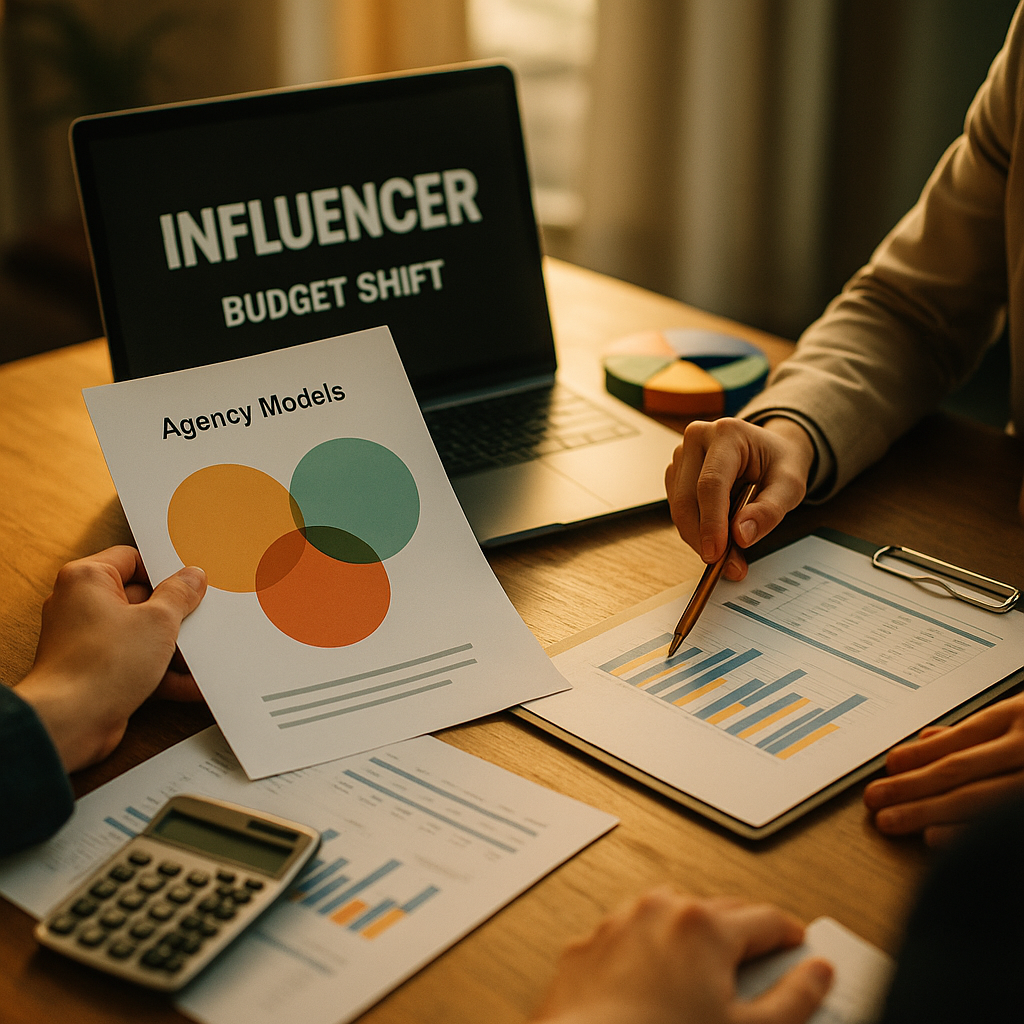
When the Budget Moves, the Agency Model Has to Move With It
Fifty-seven percent of brand marketers now rank influencer marketing as a top-three budget priority. That single stat should force a hard question: is your current agency-of-record structure actually built to capture that investment, or just billing against it?
The AOR model was designed for a different era. Media planning was linear, measurement was last-click, and creator relationships were handled by a junior team clipping social handles into a spreadsheet. None of that architecture is adequate for what influencer programs have become: a full-funnel, commerce-connected, AI-assisted channel that touches brand, performance, and product simultaneously.
The 57 percent priority shift is not just a budget story. It is an operational stress test. And right now, most agency structures are failing it.
What the Shift Is Actually Measuring
When brands say influencer marketing is a top priority, they mean something more specific than “we want more posts.” They mean creator content is now expected to perform across paid amplification, organic reach, social commerce, and brand search simultaneously. They mean the CFO is asking for attribution data that actually holds up. They mean compliance, whitelisting rights, and FTC disclosure are no longer afterthoughts.
The brands extracting the most value from the influencer surge are not the ones spending the most. They are the ones with the clearest operational architecture behind the spend.
Platforms like TikTok Shop, Meta’s Advantage+ catalog integration, and YouTube’s affiliate storefront have turned creator content into a direct commerce channel. That changes what “managing an influencer program” means. It is no longer a PR-adjacent function. It is performance media with a human face, and it needs to be resourced accordingly.
Understanding where your creator ad spend sits relative to broader digital channels is the first diagnostic step. Many brands have already crossed the threshold where creator content is their single largest content production cost. The agency model serving that spend should match its scale.
The Case for Specialist Creator Agencies
Specialist creator agencies, the Whalar-class players and their mid-market equivalents, have three structural advantages that generalists cannot replicate quickly: creator relationship depth, platform fluency, and content operations speed.
Relationship depth matters because the best mid-tier and nano creators are not discoverable through a SaaS dashboard alone. They have existing agency relationships that determine access, pricing, and prioritization. A specialist agency with 18 months of recurring work with a given creator cohort will negotiate faster, get better rates, and surface content that actually fits the brief. For context on how the vendor landscape is consolidating around this capability, the Accenture Song acquisition of Whalar signals exactly where integrated capability is being built.
Platform fluency is a real differentiator. TikTok’s algorithm, Instagram Reels ranking signals, and YouTube Shorts monetization all behave differently, and the operational playbook for each changes quarterly. A specialist team running 40 campaigns per month on TikTok has more current pattern recognition than an integrated agency running four.
The risk with specialist agencies is fragmentation. If your influencer program operates in a silo from paid media, CRM, and brand strategy, you will generate reach without revenue. That is a common failure mode at scale.
Where Integrated Media Agencies Actually Win
Integrated media agencies, the WPPs, IPGs, and their holding-company siblings, have been aggressively acquiring creator capability. The pitch is coherence: one team managing paid social, programmatic, and creator simultaneously, with unified measurement and a single P&L conversation. For enterprise brands running multi-market programs with complex paid amplification strategies, that coherence has real value.
The specific advantage shows up in whitelisting and paid amplification workflows. When a brand needs to take a creator’s organic post and push it through paid channels with precise audience targeting, that handoff between creator operations and paid media is operationally expensive if managed across two separate agencies. Integrated shops can compress that workflow significantly.
They also tend to have better infrastructure for creator partnership architecture at scale, including contract standardization, rights management, and compliance tracking. For regulated industries (financial services, healthcare, alcohol), the legal and compliance scaffolding of a large holding-company agency is often genuinely superior.
The honest weakness: integrated agencies frequently lack the creator relationship depth and speed of specialist shops. They are better at managing programs than building them. If your influencer strategy is still in the design phase, a generalist AOR may slow you down more than it helps.
The In-House Case: Real Leverage or False Economy?
More brands are building in-house creator teams, and some of them are getting it right. The value proposition is straightforward: lower per-execution cost, faster creative iteration, and proprietary data ownership. If your brand produces enough volume to justify a dedicated 4-6 person team (creator sourcing, campaign management, creative strategy, analytics), the economics can work.
But in-house teams are often underestimated in terms of what they actually require to function. The tooling alone, a discovery platform like Grin or Aspire, a content rights management system, a paid amplification integration, and a compliance layer, represents significant annual spend before a single creator is contracted. Factor in the CPA benchmarks by creator tier and you start to see where in-house economics actually break down: at the niche and nano level, where relationship management is time-intensive and yield per creator is lower.
In-house teams also struggle with creator diversity. Agency networks have breadth. An in-house team naturally gravitates toward a recurring cohort of trusted creators, which is efficient but produces creative fatigue over time. The brands doing this well use a hybrid model: in-house team for always-on programs with established creator rosters, specialist agency for tentpole campaigns and new category expansion.
The question is not “agency or in-house.” It is “which functions should live closest to the brand, and which require external network depth to execute well?”
The Measurement Gap Is Driving Agency Selection More Than Strategy Is
Here is a pattern worth examining: many brands are selecting agency partners based on measurement capability rather than creative or relationship strength. That is a structural response to CFO pressure. When you need to defend a $4M influencer line item to a finance team that still trusts GRP data, the agency that can produce clean creator ROI reporting versus broadcast alternatives wins the RFP, regardless of actual program quality.
This creates a perverse incentive: agencies that invest in measurement dashboards are rewarded over agencies that invest in creator relationships. Brands should pressure-test what the measurement is actually capturing. Vanity metrics dressed up in clean visualization are still vanity metrics. Ask specifically how your prospective agency handles multi-touch attribution, incrementality testing, and dark social. Those answers will reveal operational maturity faster than any case study deck.
Platform-side tools from Meta Business Suite, TikTok Ads Manager, and LinkedIn Campaign Manager are improving native creator attribution, but they remain walled gardens. Third-party measurement vendors like Measured, Rockerbox, and Triple Whale are increasingly necessary for cross-platform programs, and your agency’s familiarity with these tools is a legitimate evaluation criterion.
How to Reassess Your AOR Structure Right Now
The 57 percent priority shift is a mandate to audit your current setup against four operational questions:
- Speed: How many days from brief to live post? If the answer is more than 10 business days for an always-on activation, your operational model is the bottleneck.
- Attribution: Can you isolate the revenue contribution of creator content from paid amplification of that content? Most programs cannot, and that gap costs budget in every planning cycle.
- Creator access: Is your current agency or team sourcing from the full creator market, or from a managed roster that serves their operational convenience?
- Compliance coverage: Are FTC disclosure requirements, platform-specific branded content policies, and rights licensing handled systematically, or case by case? The FTC’s endorsement guidelines have teeth now, and enforcement is increasing.
If any of these four areas produces a weak answer, that is where the agency model needs to change. Not the whole model. The specific failure point.
For brands preparing their programs for where the creator economy is heading at scale, the underlying infrastructure question is the same regardless of which agency model you choose: are you building operations that compound over time, or just executing campaigns that reset to zero each quarter?
Also worth factoring in: agency consolidation is accelerating. The specialist landscape is being absorbed into integrated players at a rate that will limit your options within 18-24 months. If you want specialist depth, locking in preferred pricing and partnership terms now is a practical hedge, not just a negotiation tactic.
The final variable is AI. Agencies and in-house teams that have embedded AI into creator discovery, brief generation, and performance analysis are producing measurably better results at lower cost. That capability gap is widening fast. Whoever manages your influencer program should be able to articulate specifically how AI is being used operationally, and where human judgment is still required. Vague answers about “leveraging AI tools” are a red flag. See how leading organizations are approaching market sizing data and AI adoption benchmarks to calibrate your own expectations against industry norms.
Audit the four operational questions above, map where your current structure fails, and build the hybrid model around those specific gaps. That is the work.
Frequently Asked Questions
What does the 57 percent priority shift mean for existing AOR contracts?
It means most existing AOR contracts were written for a lower-stakes version of influencer marketing. If your AOR was appointed when influencer was a line item rather than a strategic channel, the scope of work, measurement requirements, and performance benchmarks almost certainly need renegotiation. Review your contract against current program volume and complexity before auto-renewing.
Should most brands choose a specialist creator agency or an integrated media agency?
It depends on program maturity. Brands in early-to-mid program development typically extract more value from specialist agencies because creator access and platform fluency matter more at that stage. Brands running high-volume, multi-market programs with complex paid amplification needs often benefit from integrated agency infrastructure. Many mature programs run a hybrid: specialist agency for creator relationships and content, integrated agency or in-house team for paid amplification and measurement.
What are the real risks of building a fully in-house creator team?
The primary risks are creator roster fatigue, platform blind spots, and underestimated tooling costs. In-house teams are excellent for always-on programs with established creator cohorts, but they tend to narrow over time. They also require significant investment in discovery platforms, rights management systems, and compliance infrastructure that is often invisible in initial business cases. A hybrid model typically outperforms a fully in-house model for brands spending above $2M annually on creator programs.
How should brands evaluate agency measurement capabilities?
Ask specifically about incrementality testing methodology, multi-touch attribution approach, and which third-party measurement vendors the agency works with. Clean dashboards are not evidence of measurement quality. Agencies running rigorous incrementality tests using holdout groups and integrating with tools like Measured or Rockerbox are operating at a meaningfully higher standard than those relying solely on platform-native analytics.
How is AI changing the agency selection decision?
AI capability is becoming a primary differentiator in agency selection. Agencies using AI for creator discovery, brief generation, performance forecasting, and content analysis are delivering faster turnaround and better optimization at lower cost. Brands should ask prospective agency partners for specific examples of AI in their workflow, not general claims. The gap between AI-enabled and traditional agencies is compounding quarterly and will significantly affect program output within the next 12-18 months.
Top Influencer Marketing Agencies
The leading agencies shaping influencer marketing in 2026
Agencies ranked by campaign performance, client diversity, platform expertise, proven ROI, industry recognition, and client satisfaction. Assessed through verified case studies, reviews, and industry consultations.
Moburst

-
2

The Shelf
Boutique Beauty & Lifestyle Influencer AgencyA data-driven boutique agency specializing exclusively in beauty, wellness, and lifestyle influencer campaigns on Instagram and TikTok. Best for brands already focused on the beauty/personal care space that need curated, aesthetic-driven content.Clients: Pepsi, The Honest Company, Hims, Elf Cosmetics, Pure LeafVisit The Shelf → -
3

Audiencly
Niche Gaming & Esports Influencer AgencyA specialized agency focused exclusively on gaming and esports creators on YouTube, Twitch, and TikTok. Ideal if your campaign is 100% gaming-focused — from game launches to hardware and esports events.Clients: Epic Games, NordVPN, Ubisoft, Wargaming, Tencent GamesVisit Audiencly → -
4

Viral Nation
Global Influencer Marketing & Talent AgencyA dual talent management and marketing agency with proprietary brand safety tools and a global creator network spanning nano-influencers to celebrities across all major platforms.Clients: Meta, Activision Blizzard, Energizer, Aston Martin, WalmartVisit Viral Nation → -
5

The Influencer Marketing Factory
TikTok, Instagram & YouTube CampaignsA full-service agency with strong TikTok expertise, offering end-to-end campaign management from influencer discovery through performance reporting with a focus on platform-native content.Clients: Google, Snapchat, Universal Music, Bumble, YelpVisit TIMF → -
6

NeoReach
Enterprise Analytics & Influencer CampaignsAn enterprise-focused agency combining managed campaigns with a powerful self-service data platform for influencer search, audience analytics, and attribution modeling.Clients: Amazon, Airbnb, Netflix, Honda, The New York TimesVisit NeoReach → -
7

Ubiquitous
Creator-First Marketing PlatformA tech-driven platform combining self-service tools with managed campaign options, emphasizing speed and scalability for brands managing multiple influencer relationships.Clients: Lyft, Disney, Target, American Eagle, NetflixVisit Ubiquitous → -
8

Obviously
Scalable Enterprise Influencer CampaignsA tech-enabled agency built for high-volume campaigns, coordinating hundreds of creators simultaneously with end-to-end logistics, content rights management, and product seeding.Clients: Google, Ulta Beauty, Converse, AmazonVisit Obviously →