


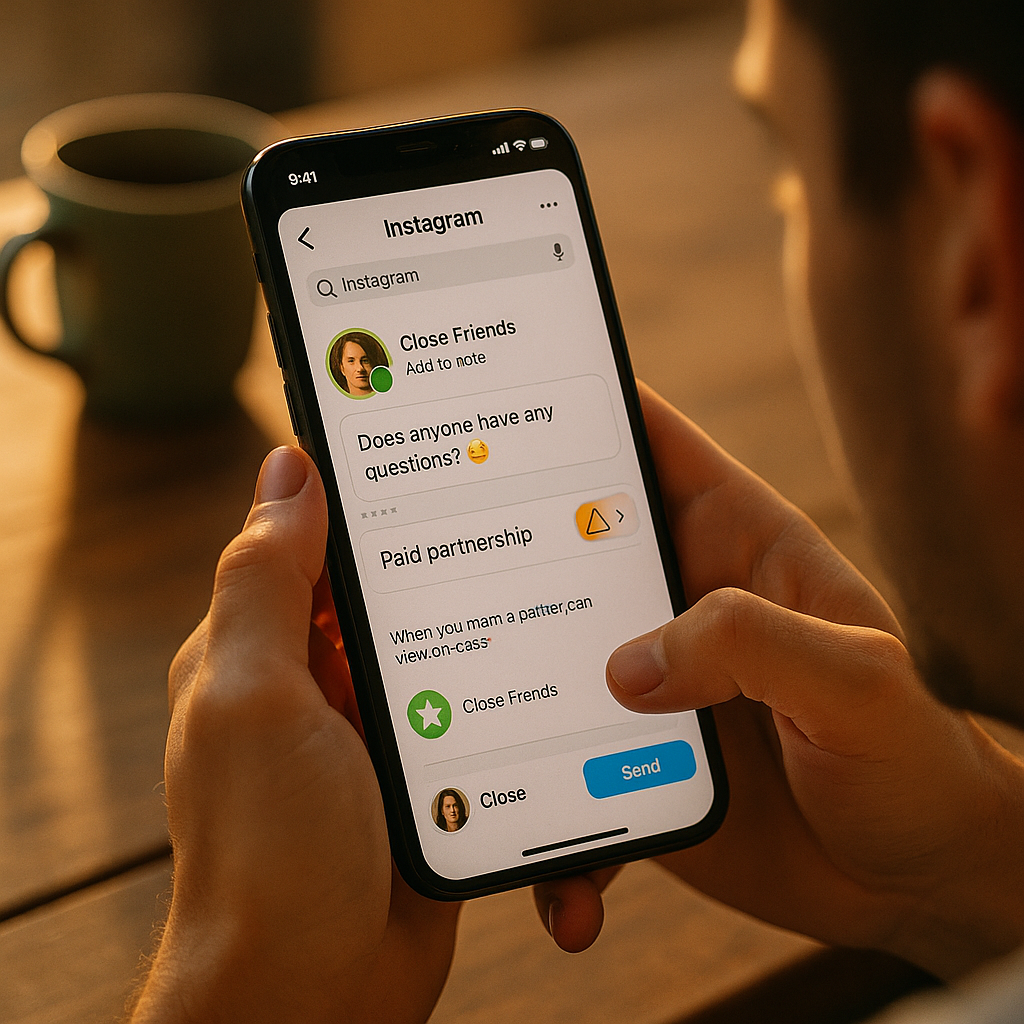
73% of consumers say they trust recommendations from people they follow more than branded ads — but what happens when that trust gets built inside a feature that was never designed to carry a #ad tag? Instagram Notes and Close Friends are quietly becoming the next battleground for sponsored content, and most brand compliance teams haven’t noticed. The Instagram Notes and Close Friends paid-partnership question isn’t hypothetical anymore. It’s a live compliance and measurement problem.
The Feature Nobody Briefed For
Notes launched as a throwaway status-update feature. Close Friends has existed since 2018 as a way to share a smaller, more candid version of your Story. Neither was built with brand deals in mind. Yet both have quietly become where creators put their most persuasive content — the stuff that actually converts.
Why? Because Notes sit at the top of the DM inbox, practically guaranteeing a glance. And Close Friends lists feel intimate, unscripted, almost like getting a text from someone you trust. Creators figured out fast that this is exactly the environment where a product mention lands differently than it does in a polished feed post. Less performance, more confidence. Marketers should recognize that pattern: it’s the same psychology that made brand trust playbooks built around intimacy so effective in the first place.
The problem is structural. Meta’s ad tools, disclosure prompts, and branded-content APIs were designed for public or semi-public formats — feed, Reels, Stories. Notes has a 60-character limit and disappears in 24 hours. Close Friends content isn’t discoverable, isn’t searchable, and in most cases isn’t archived unless the creator manually saves it. Try running a brand-safety audit on that.
When sponsored content moves into disappearing, closed-audience formats, “reach” stops being a number you can pull from a dashboard — it becomes an estimate you have to reconstruct after the fact.
Why Platforms Are Suddenly Paying Attention
Meta has been signaling for months that it wants tighter controls around paid partnerships across every surface, not just the obvious ones. Part of this is regulatory pressure. The FTC has made clear that disclosure obligations apply regardless of format — a Note counts the same as a feed post if compensation changed hands. Part of it is platform self-interest: Meta wants ad revenue from branded content, and undisclosed placements in private-feeling formats undercut that model entirely.
There’s also a trust argument Meta can’t ignore. Sprout Social’s ongoing research into consumer trust patterns keeps landing on the same conclusion — audiences reward authenticity but punish concealment hard once they discover it. If Close Friends starts filling up with quiet paid promos and nobody flags it, that erodes the exact intimacy that made the format valuable. Meta has every incentive to formalize disclosure before regulators or users force the issue.
This mirrors what’s already happening elsewhere in the ecosystem. LinkedIn’s trusted-voice discovery updates and TikTok’s trust-based distribution rules both reflect the same industry direction: platforms are rewarding perceived authenticity with reach, then building compliance scaffolding underneath it once brands start exploiting that reward.
What “Sponsored Reach” Even Means Now
Reach used to mean impressions. Clean, countable, exportable to a spreadsheet. That definition is breaking down fast, and Notes/Close Friends are the clearest example of why.
Consider the numbers. A creator with 200,000 followers might have a Close Friends list of 3,000. Tiny by comparison. But engagement rates on Close Friends content routinely outperform public Stories by wide margins, according to creator-agency benchmarking data reported across industry trade coverage this year. Fewer eyeballs, higher intent, more conversion per view. Which number matters more to a brand paying for the placement — reach or resonance?
That’s not a rhetorical dodge. It’s the actual measurement problem brands now face. Influencers Time has covered this shift extensively — the move from raw reach toward discovery-over-reach ranking logic across nearly every major platform. Notes and Close Friends just push that logic into its most extreme form: reach so narrow it barely registers, but influence so concentrated it can outperform paid media.
- Public feed post: High reach, lower average trust, fully trackable via Meta’s branded content tools.
- Story to general audience: Mid reach, mid trust, partially trackable, 24-hour lifespan.
- Close Friends Story: Low reach, high trust, minimal trackability, disappears fast.
- Notes: Extremely low reach, ambient visibility, essentially zero trackability today.
Brands buying “influence” instead of “impressions” need a completely different measurement framework. Most don’t have one yet.
The Disclosure Gap Is a Real Legal Exposure
Here’s where this stops being an interesting platform trend and starts being a genuine risk item for legal and compliance teams. The FTC’s Endorsement Guides don’t carve out exceptions for disappearing content or small audiences. A paid mention in a Close Friends Story that vanishes in 24 hours still requires clear, conspicuous disclosure at the time it’s posted — not after the fact, not buried, not implied.
The trouble is enforcement visibility. If a Note disappears and nobody screenshots it, how does a brand prove disclosure happened? How does an agency audit a Close Friends campaign after the fact if the content itself is gone? This is a documentation problem as much as a compliance one.
If your influencer contracts don’t specify screenshot or archival requirements for ephemeral formats, you have no audit trail — and no audit trail means no defense if a regulator or platform ever asks.
The UK’s Information Commissioner’s Office has similarly signaled that data and disclosure obligations don’t soften just because content is short-lived. Brands running UK or EU influencer programs should assume the same standard applies to Notes and Close Friends as to any other paid placement.
Practical fix: build screenshot and timestamp requirements directly into creator contracts for any campaign touching these formats. It’s not glamorous, but it’s the only reliable audit trail available right now.
How Brands Should Actually Brief This
Most creator briefs still assume public-facing content. That assumption needs to change for any campaign where a creator might reasonably use Notes or Close Friends to supplement the deliverable — which, increasingly, is most campaigns involving mid-tier and micro creators who lean on intimacy as a selling point.
A few adjustments worth making immediately:
- Name the formats explicitly in the contract. “Social content” is too vague. Specify whether Notes, Close Friends, Broadcast Channels, and disappearing Stories are in scope, and what disclosure language applies to each.
- Require real-time disclosure, not retroactive. A Note that says “loving this” with a product tag added later doesn’t meet FTC standards. Disclosure has to appear with the content, not after.
- Build screenshot capture into the workflow. Ask creators or their agencies to archive ephemeral posts at time of publish. This should be a standard line item, not an afterthought.
- Reframe KPIs around engagement quality, not reach volume. If a client is paying for Close Friends access, reach was never the point. Set expectations accordingly before the campaign, not during the recap.
This connects to a broader shift Influencers Time has tracked in how platforms recalibrate what “sponsored” even means. The Instagram AI discovery changes forcing Reels rebriefs, the Meta Andromeda update reshaping CPG creative, and the YouTube comment-signal ranking shift all point the same direction: platforms are rewarding signals brands can’t fully measure with legacy tools, then leaving compliance and attribution as an exercise for the marketer.
What Happens Next
Expect Meta to formalize this eventually. A branded-content tag inside Notes wouldn’t be technically hard to build — it’s a product decision, not an engineering constraint. Given the regulatory pressure and the revenue upside of monetizing intimate formats, it’s a reasonable bet this lands within the next product cycle or two. HubSpot’s research on influencer marketing trends has repeatedly flagged that platforms tend to formalize monetization tools roughly six to twelve months after creators start using a feature commercially at scale. Notes and Close Friends are well past that threshold already.
Until that happens, brands are operating in a gap. The safest posture is to treat these formats as fully in-scope for disclosure and measurement obligations now, rather than waiting for Meta to catch up. Being early on compliance costs almost nothing. Being late costs a regulatory inquiry, a canceled contract, or a headline nobody wants.
The Bottom Line
Set your creator contracts to require disclosure and archival for Notes and Close Friends content today — don’t wait for Meta to build the tools that make it easy. The brands that formalize this now will have clean audit trails; the ones that wait will be explaining gaps in ephemeral content to a regulator, a client, or both.
Frequently Asked Questions
Do Instagram Notes require FTC disclosure if a creator is paid to post one?
Yes. The FTC’s Endorsement Guides apply based on whether compensation or a material relationship exists, not on the format or its lifespan. A paid Note needs clear disclosure at the time it’s posted, same as a feed post or Story.
Can brands track engagement on Close Friends content the way they track public Stories?
Not fully. Meta’s current analytics and branded-content tools weren’t built for Close Friends’ closed-audience structure, so brands typically rely on creator-reported screenshots, manual archiving, or agency-side estimates rather than platform-native data.
Should brands include Notes and Close Friends in every creator contract?
Only if there’s a reasonable chance the creator will use those formats to support the campaign. For intimacy-driven or trust-based campaigns, it’s worth naming these formats explicitly and setting disclosure and archival requirements upfront rather than discovering the gap after launch.
Why do Close Friends posts often convert better than public content despite smaller audiences?
Smaller, self-selected audiences tend to have higher trust and intent. Recipients opted into the Close Friends list, so the content reads as personal rather than promotional, which tends to lift conversion even with far lower reach.
Is this trend specific to Instagram, or are other platforms doing the same thing?
It’s part of a broader pattern. TikTok, LinkedIn, and YouTube have all shifted toward rewarding trust and engagement signals over raw reach, requiring brands to rebrief creators and rebuild measurement frameworks around each platform’s evolving definition of authentic reach.
Top Influencer Marketing Agencies
The leading agencies shaping influencer marketing in 2026
Agencies ranked by campaign performance, client diversity, platform expertise, proven ROI, industry recognition, and client satisfaction. Assessed through verified case studies, reviews, and industry consultations.
Moburst

-
2

The Shelf
Boutique Beauty & Lifestyle Influencer AgencyA data-driven boutique agency specializing exclusively in beauty, wellness, and lifestyle influencer campaigns on Instagram and TikTok. Best for brands already focused on the beauty/personal care space that need curated, aesthetic-driven content.Clients: Pepsi, The Honest Company, Hims, Elf Cosmetics, Pure LeafVisit The Shelf → -
3

Audiencly
Niche Gaming & Esports Influencer AgencyA specialized agency focused exclusively on gaming and esports creators on YouTube, Twitch, and TikTok. Ideal if your campaign is 100% gaming-focused — from game launches to hardware and esports events.Clients: Epic Games, NordVPN, Ubisoft, Wargaming, Tencent GamesVisit Audiencly → -
4

Viral Nation
Global Influencer Marketing & Talent AgencyA dual talent management and marketing agency with proprietary brand safety tools and a global creator network spanning nano-influencers to celebrities across all major platforms.Clients: Meta, Activision Blizzard, Energizer, Aston Martin, WalmartVisit Viral Nation → -
5

The Influencer Marketing Factory
TikTok, Instagram & YouTube CampaignsA full-service agency with strong TikTok expertise, offering end-to-end campaign management from influencer discovery through performance reporting with a focus on platform-native content.Clients: Google, Snapchat, Universal Music, Bumble, YelpVisit TIMF → -
6

NeoReach
Enterprise Analytics & Influencer CampaignsAn enterprise-focused agency combining managed campaigns with a powerful self-service data platform for influencer search, audience analytics, and attribution modeling.Clients: Amazon, Airbnb, Netflix, Honda, The New York TimesVisit NeoReach → -
7

Ubiquitous
Creator-First Marketing PlatformA tech-driven platform combining self-service tools with managed campaign options, emphasizing speed and scalability for brands managing multiple influencer relationships.Clients: Lyft, Disney, Target, American Eagle, NetflixVisit Ubiquitous → -
8

Obviously
Scalable Enterprise Influencer CampaignsA tech-enabled agency built for high-volume campaigns, coordinating hundreds of creators simultaneously with end-to-end logistics, content rights management, and product seeding.Clients: Google, Ulta Beauty, Converse, AmazonVisit Obviously →