


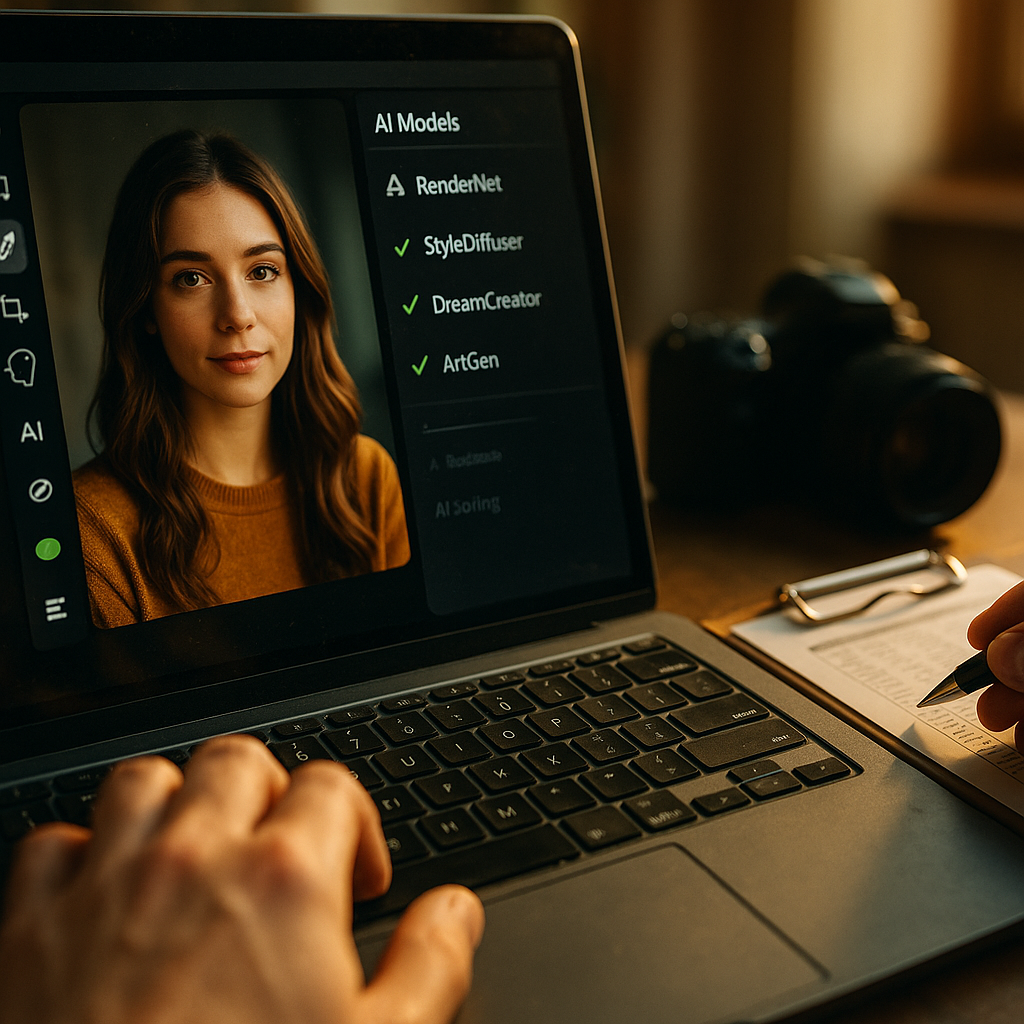
Quick question: if the FTC asked you tomorrow which AI tool generated the background in last month’s top-performing UGC ad, could you answer in under five minutes? Most marketing teams couldn’t. That gap is exactly why an AI model registry is becoming as standard as a DAM or a brand asset library — a system of record for which generative tool touched which creator asset, when, and under what license.
This isn’t a hypothetical compliance exercise anymore. It’s a documented liability sitting inside your content pipeline right now.
The Problem Nobody Budgeted For
Six months ago, a “content workflow” meant a creator shooting raw footage, a video editor cleaning it up, and a brand approving the final cut. Today, that same asset might pass through an AI upscaler, a background generator, a voice-cloning tool for dubbing, a caption-writing LLM, and an auto-editing platform like Opus Clip before it ever reaches a human reviewer. Each tool leaves an invisible fingerprint. None of it gets logged anywhere.
Now multiply that by a hundred creators, a dozen campaigns, and three or four AI vendors in rotation. You get a content supply chain with zero traceability — and a legal team that finds out about problems only after a takedown notice or a regulator’s letter arrives.
Marketing ops leaders are starting to treat this the way finance treats a general ledger: every transaction needs a source, a timestamp, and an owner. An AI model registry applies that same logic to creative assets touched by generative tools.
If you can’t answer “which model generated this” in one query, you don’t have an AI workflow — you have an AI liability.
What an AI Model Registry Actually Tracks
Strip away the vendor jargon and a registry is really a metadata layer. It sits on top of your existing DAM or content pipeline and records, at minimum:
- Which generative model or tool touched the asset (Midjourney, Runway, ElevenLabs, an in-house fine-tuned model, whatever)
- The version or checkpoint of that model at the time of generation
- What the tool was used for — background removal, voice synthesis, script drafting, thumbnail generation, translation
- The prompt or input parameters, where feasible
- The human reviewer or approver attached to the output
- Licensing terms tied to that specific model’s output (this one trips up more teams than any other)
Think of it less as a new tool and more as a discipline layered onto tools you already own. Some DAM vendors are shipping native model-tagging fields. Others require a middleware layer or a custom field mapped into your existing asset management system. Either way, the goal is the same: a queryable audit trail, not a folder full of good intentions.
This connects directly to broader governance work happening across marketing AI stacks. Teams building out an AI governance charter for marketing are finding that model registries are the operational backbone that makes the charter enforceable rather than aspirational. A charter says “we will track AI usage.” A registry is how you actually do it.
Why This Is Happening Now, Not Later
Three forces are converging, and none of them are going away.
Regulation caught up. The EU AI Act’s transparency requirements are pushing brands toward documentation they’ve never had to keep before. If you’re serving European audiences, the labeling and disclosure obligations under Article 50 essentially require you to know what generated your content in the first place. You can’t label AI-generated material for consumers if you can’t even confirm internally whether AI touched it.
Licensing disputes are getting expensive. Stock imagery lawsuits, voice-cloning claims, and music licensing disputes involving generative tools have all increased. When a brand can’t prove which model produced an asset, it can’t prove compliance with that model’s usage terms — and indemnification clauses in vendor contracts become worthless if you can’t demonstrate which vendor was actually used.
Multi-tool stacks are the norm, not the exception. A single 30-second UGC ad might involve four or five different AI tools stitched together. Research from eMarketer has tracked the accelerating adoption of generative tools across content production, and the trend line is unambiguous: brands aren’t using one AI tool, they’re using a stack. Stacks without tracking are audit nightmares waiting to happen.
Add to that the reality that fallback protocols are now common practice — when your primary model goes down or gets deprecated, you switch to a backup. That’s smart operationally. But it also means the same “final” asset might have been generated by two entirely different models depending on when in the campaign it was produced. Teams already thinking through an AI model fallback protocol need a registry to actually make the fallback traceable after the fact.
Where This Breaks Down in Practice
The theory is clean. The execution is messy. Here’s where most teams hit friction.
Creators aren’t logging their own tool usage. A UGC creator using CapCut’s AI features, an auto-caption tool, and a filter pack has no incentive to document any of it — and honestly, no easy way to. Brands relying purely on creator self-reporting are going to have gaps, full stop.
Agencies subcontract without disclosure. A creative agency might use one generative video tool in-house but hand overflow work to a freelancer using a completely different stack. If your registry only captures what happens inside your own martech environment, you’re missing the freelance layer entirely.
Legacy assets have no paper trail. Anything produced before your registry existed is a black box. Teams need to decide: do we retroactively audit the back catalog, or do we draw a line and say “everything from this date forward is tracked”? Most pragmatic teams choose the line-in-the-sand approach, then spot-check high-risk legacy assets (anything involving a real person’s likeness or voice) as a priority cleanup project.
A registry is only as good as its weakest input. If creators and freelancers aren’t logging tool usage at the source, the brand is left reconstructing history after the fact — usually during a crisis.
Building the Registry Without Building Another Silo
The worst outcome here is a registry that lives in a spreadsheet nobody updates. If it’s not embedded into the workflow people already use, it dies within a quarter.
Practical approach that’s working for mid-size teams:
- Anchor it to the brief, not the asset. Every creator brief should include a required field specifying which AI tools are pre-approved for that deliverable. This shifts tracking left, before production even starts, instead of trying to reverse-engineer it later.
- Make disclosure a contract term, not a courtesy. Creator and agency contracts should require tool disclosure as a deliverable condition, same as usage rights or exclusivity clauses.
- Pick one system of record. Whether that’s a custom field in your existing DAM, a lightweight database, or a dedicated registry tool, resist the urge to run parallel tracking systems. Fragmentation defeats the purpose.
- Tie it to your fraud and compliance stack. Teams already running AI fraud detection tools or compliance scanning should integrate model-tracking data into the same dashboard reviewers already check. One more login is one more excuse to skip the step.
- Assign clear ownership. Someone — usually a marketing ops lead or a creative operations manager — needs to own the registry the way a finance controller owns the ledger. Without an owner, it’s nobody’s job, which means it’s everybody’s excuse.
Some brands are extending this same logic into their AI agent media-buying governance frameworks, since automated bidding and creative-testing agents are themselves generative tools that touch assets and need the same audit trail.
What Happens If You Skip This
Not tracking model provenance doesn’t mean the risk disappears. It just means you find out about it later, more expensively, and usually in public.
Consider the scenarios that keep legal teams up at night: a synthetic voice clone used without proper consent documentation, a background image generated by a model currently in litigation over training data, an AI-written caption that hallucinated a health claim your creative brief never approved. Each of these is a five-minute fix if you can trace the asset back to its source tool. Each is a weeks-long forensic exercise, and a potential FTC disclosure problem, if you can’t.
There’s also a quieter cost: rebuild time. When a model gets deprecated, sued, or simply updated in a way that changes its output style, brands without a registry have to manually hunt through campaigns to figure out what needs replacing. Brands with a registry run one query and get a list.
This is the same operational logic driving interest in marketing-mix modeling for influencer spend — you can’t optimize, defend, or audit what you can’t measure. Model registries are the measurement layer for AI-touched creative, full stop.
Platforms like Meta for Business and TikTok Ads are also tightening their own AI-content disclosure requirements at the platform level, which means brand-side registries increasingly need to feed platform-facing labeling systems too. This isn’t a one-off compliance project. It’s infrastructure.
The Takeaway
Start small: require tool disclosure on every new creator brief starting this quarter, log it in one shared system, and assign a named owner to the registry before your next campaign kicks off. Waiting for a regulator or a lawsuit to force the issue is the expensive way to learn this lesson.
FAQs
What is an AI model registry in a marketing context?
It’s a structured record — usually embedded in or connected to a brand’s DAM — that logs which generative AI tools were used to create, edit, or modify a piece of creator content, including the tool version, purpose, and licensing terms attached to that output.
Do small and mid-size brands really need this, or just enterprise teams?
Any brand using more than one generative tool across creator content needs some version of this. Risk scales with volume of AI-touched assets, not company size. A mid-size brand running dozens of UGC campaigns with multiple AI editing tools has just as much exposure as an enterprise team.
How does this relate to EU AI Act compliance?
Article 50’s transparency obligations require disclosing AI-generated or AI-modified content to consumers in certain cases. You can’t reliably label content as AI-touched if you don’t have internal tracking confirming which assets were actually generated or modified by AI tools in the first place.
Can creators self-report tool usage instead of brands tracking it centrally?
Self-reporting alone is unreliable — creators often don’t know or don’t think to disclose every AI feature used in editing apps. The stronger approach combines contractual disclosure requirements with brand-side spot audits, rather than relying on creators as the sole source of truth.
What’s the biggest mistake brands make when building a registry?
Treating it as a retroactive documentation project instead of embedding it into the brief and contract process upfront. Registries that aren’t built into existing workflows get abandoned within a quarter.
Does a model registry slow down content production?
Not if it’s built into the brief stage rather than added as a post-production audit step. Adding one required field to a brief template takes seconds; reconstructing tool history after the fact takes hours or days.
Top Influencer Marketing Agencies
The leading agencies shaping influencer marketing in 2026
Agencies ranked by campaign performance, client diversity, platform expertise, proven ROI, industry recognition, and client satisfaction. Assessed through verified case studies, reviews, and industry consultations.
Moburst

-
2

The Shelf
Boutique Beauty & Lifestyle Influencer AgencyA data-driven boutique agency specializing exclusively in beauty, wellness, and lifestyle influencer campaigns on Instagram and TikTok. Best for brands already focused on the beauty/personal care space that need curated, aesthetic-driven content.Clients: Pepsi, The Honest Company, Hims, Elf Cosmetics, Pure LeafVisit The Shelf → -
3

Audiencly
Niche Gaming & Esports Influencer AgencyA specialized agency focused exclusively on gaming and esports creators on YouTube, Twitch, and TikTok. Ideal if your campaign is 100% gaming-focused — from game launches to hardware and esports events.Clients: Epic Games, NordVPN, Ubisoft, Wargaming, Tencent GamesVisit Audiencly → -
4

Viral Nation
Global Influencer Marketing & Talent AgencyA dual talent management and marketing agency with proprietary brand safety tools and a global creator network spanning nano-influencers to celebrities across all major platforms.Clients: Meta, Activision Blizzard, Energizer, Aston Martin, WalmartVisit Viral Nation → -
5

The Influencer Marketing Factory
TikTok, Instagram & YouTube CampaignsA full-service agency with strong TikTok expertise, offering end-to-end campaign management from influencer discovery through performance reporting with a focus on platform-native content.Clients: Google, Snapchat, Universal Music, Bumble, YelpVisit TIMF → -
6

NeoReach
Enterprise Analytics & Influencer CampaignsAn enterprise-focused agency combining managed campaigns with a powerful self-service data platform for influencer search, audience analytics, and attribution modeling.Clients: Amazon, Airbnb, Netflix, Honda, The New York TimesVisit NeoReach → -
7

Ubiquitous
Creator-First Marketing PlatformA tech-driven platform combining self-service tools with managed campaign options, emphasizing speed and scalability for brands managing multiple influencer relationships.Clients: Lyft, Disney, Target, American Eagle, NetflixVisit Ubiquitous → -
8

Obviously
Scalable Enterprise Influencer CampaignsA tech-enabled agency built for high-volume campaigns, coordinating hundreds of creators simultaneously with end-to-end logistics, content rights management, and product seeding.Clients: Google, Ulta Beauty, Converse, AmazonVisit Obviously →