


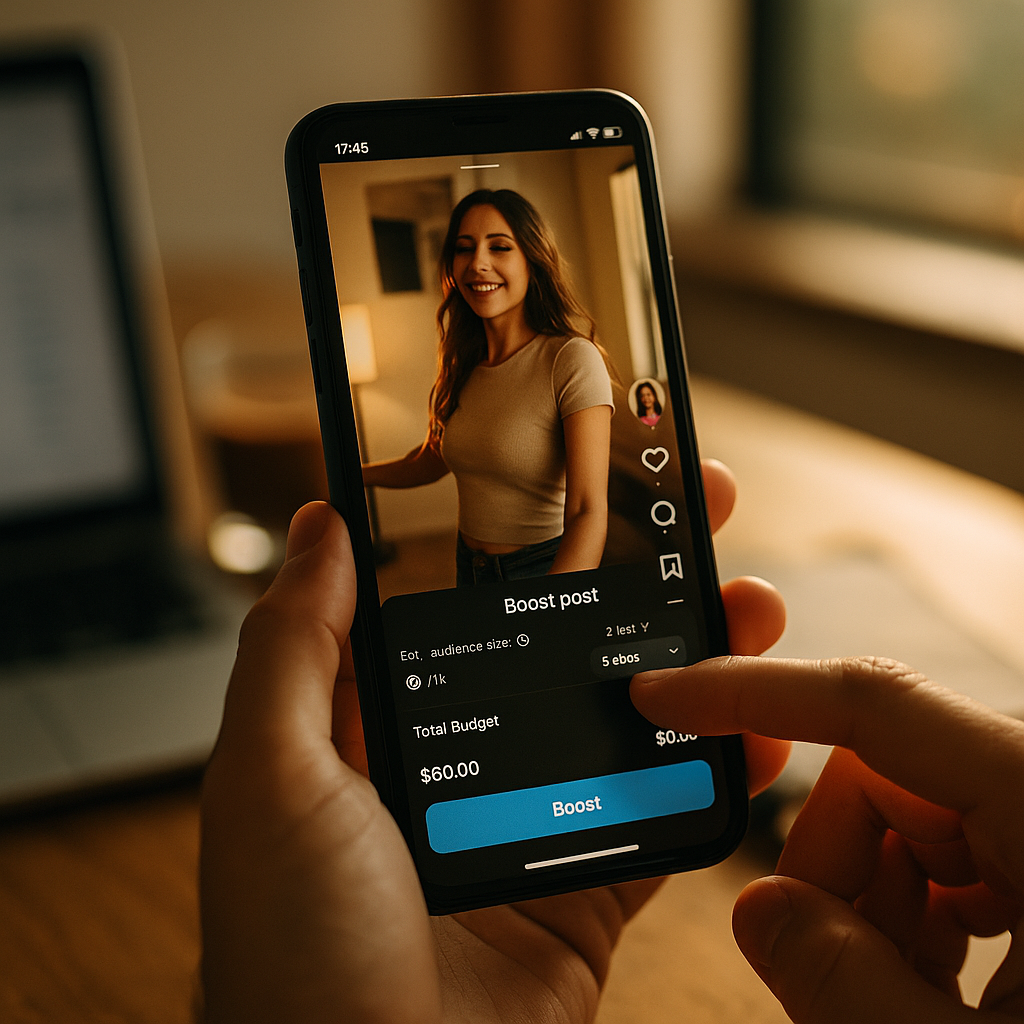
Organic reach on Instagram Reels has been flat or declining for most brand accounts since late 2024, according to multiple Sprout Social benchmark reports. Yet the same platform data shows boosted creator content routinely outperforms brand-made ads on cost per result. So why are most marketing teams still treating Instagram paid boosting as an afterthought instead of a core line item in their influencer budget?
This playbook breaks down exactly how to identify which creator Reels deserve ad dollars, how much to spend, and how to structure campaigns so boosted content actually drives measurable ROI instead of vanity impressions.
Why Boosting Beats Building From Scratch
Brand-produced ads still work. But they’re expensive to produce, and audiences have gotten remarkably good at scrolling past anything that smells like a commercial. Creator Reels, by contrast, arrive with built-in trust signals: a familiar face, a casual tone, a format that mimics the content people actually came to Instagram for.
When you boost a creator’s already-organic-performing Reel, you’re not gambling on an unproven asset. You’re doubling down on something the algorithm and real users have already validated. That’s the entire logic behind Instagram Paid Boosting Playbook: Amplifying Top-Performing Creator Reels for Maximum ROI, and it’s why performance marketers are shifting budget away from cold-start ad creative toward amplification of proven organic winners.
A Reel that hits strong organic watch-through in its first 48 hours is a far safer paid bet than any storyboard your creative team dreams up in isolation.
Identifying Which Reels Deserve Ad Spend
Not every well-performing Reel is boost-worthy. Views alone are a vanity metric. What you actually want to look for:
- Watch-through rate above 65 percent. A Reel people finish is a Reel the algorithm rewards, and paid distribution amplifies that reward.
- Save-to-view ratio outperforming account average. Saves signal purchase intent or genuine utility, both of which translate to better ad performance.
- Comment sentiment, not just comment volume. A hundred comments arguing about the product isn’t the same as a hundred comments asking “where do I buy this.”
- Early velocity. Reels that spike fast in the first six hours tend to have creative hooks strong enough to survive paid frequency without fatiguing.
Pull this data through Meta Business Suite or a third-party analytics layer, and set a 48 to 72 hour evaluation window before deciding what gets budget. Waiting longer risks missing peak relevance; moving faster risks boosting noise.
For deeper context on how the algorithm actually weighs these signals before you even spend a dollar, our breakdown of the Reels algorithm and watch depth is worth reading alongside this playbook.
Setting Up the Boost the Right Way
There are two paths into paid amplification of creator content: the blunt “Boost Post” button, and Meta’s Partnership Ads infrastructure that runs through the creator’s handle with proper usage rights attached. Use the second one. Almost always.
Partnership Ads let you run the creator’s Reel as an ad from their account, preserving the authenticity signal (their handle, their follower count, their engagement history) while giving you full Ads Manager targeting, budget control, and reporting. The simple boost button is fine for a quick $50 test, but it caps your targeting options and doesn’t scale.
Before any spend goes live, lock down usage rights in the contract. This isn’t optional legal boilerplate, it’s the difference between a clean campaign and a takedown request mid-flight. We’ve covered the mechanics in detail in this Partnership Ads setup guide, and it’s essential reading before your first boosted dollar goes out the door.
Budget Allocation: How Much Is Enough?
A common mistake: spreading boost budget thin across five or six “pretty good” Reels instead of concentrating spend on the one or two that are clearly outperforming. Concentration wins here. Industry data from eMarketer suggests brands that concentrate paid social budget on top-decile organic content see meaningfully lower cost per acquisition than those running diversified low-spend tests across many assets.
A workable starting framework:
- Test tier: $150-$300 per Reel across a 3-5 day window, targeting a broad lookalike of your existing customer base.
- Scale tier: For Reels that hold cost per result steady or improve during the test window, increase budget by 50 percent every 48 hours rather than doubling immediately. Sharp jumps reset the algorithm’s learning phase.
- Sustain tier: Top 10 percent performers get an “always on” budget, refreshed monthly, treated more like an evergreen ad unit than a campaign flight.
Set frequency caps. Creator Reels feel authentic precisely because they don’t feel like ads, and nothing kills that faster than the same viewer seeing it eight times in a week.
Targeting: Don’t Just Retarget Your Existing Audience
The temptation is to boost toward people who already follow you or have visited your site. That’s a mistake if your goal is growth rather than just reinforcement. Warm retargeting has its place lower in the funnel, but the real value of creator Reels is prospecting: reaching cold audiences who trust the creator more than they’d ever trust a brand ad.
Build lookalikes off your best customers, not off broad interest categories. Layer in the creator’s own audience demographics where Meta’s tools allow it. And test placement expansion, Reels boosted into Facebook feed and Explore sometimes outperform Instagram-only delivery, particularly for older millennial and Gen X audiences that brands frequently underestimate on this platform.
Treat boosted creator Reels as top-of-funnel prospecting assets first, retargeting fuel second. Reversing that order is the single most common budget-wasting mistake we see.
Attribution: The Part Everyone Gets Wrong
Boosted Reels rarely drive last-click conversions at the same rate as bottom-funnel search or shopping ads, and that’s fine. It’s not their job. But if your attribution model only credits last click, you’ll systematically underfund the channel that’s actually driving discovery and consideration.
Use view-through and engagement-based attribution windows in Meta Ads Manager, and cross-reference with brand lift studies or incrementality tests where budget allows. If you’re running Instagram checkout flows alongside boosted content, attribution gaps get even more pronounced, something we’ve unpacked in our look at fixing native checkout attribution gaps. The short version: don’t kill a channel because your dashboard can’t see its full impact.
Also watch how paid partnership labeling interacts with shopping tags. Mislabeled or missing disclosure tags can quietly tank ad approval or performance, a problem we detail in this paid partnership labels fix.
Compliance Isn’t Optional
Every boosted creator Reel is a paid advertisement under FTC guidelines, and that means clear disclosure, not just a buried hashtag. The Paid Partnership label inside Meta’s ad tools handles most of the heavy lifting, but brands are still legally on the hook if disclosure is inadequate. UK marketers running these campaigns should also review ICO guidance on advertising transparency before scaling spend internationally. Compliance review should happen before the boost goes live, not after a regulator flags it.
Measuring What Actually Matters
Track these metrics weekly, not just at campaign end:
- Cost per thruplay against your account average, to spot early creative fatigue.
- Click-through rate decay over the flight, which signals when a Reel needs rotation.
- Incremental reach beyond the creator’s organic follower base, confirming the boost is actually prospecting rather than preaching to the converted.
- Downstream engagement on the brand’s own account (profile visits, follows) as a secondary halo effect.
Benchmark against platform norms using tools like HubSpot’s social media reporting resources or Statista’s advertising benchmarks, and adjust internal KPIs accordingly rather than chasing generic “engagement rate” targets that don’t map to your actual funnel.
Next step: Audit your last 90 days of creator Reels this week, flag anything with above-average watch-through and saves, and put $200 behind the top three for a five-day test before your next budget cycle locks. That single move will tell you more about paid boosting ROI than another quarter of guesswork.
FAQs
What’s the minimum budget to test boosting a creator Reel?
Start with $150 to $300 per Reel over a 3-5 day window. This is enough to exit Meta’s learning phase and generate a statistically useful read on cost per result without overcommitting to an unproven asset.
Should I boost every high-performing Reel or just the best one?
Concentrate spend on your top-decile performers rather than spreading budget thin across several “good enough” Reels. Concentrated spend on proven winners consistently produces lower cost per acquisition than diversified low-budget tests.
Do I need the creator’s permission to boost their Reel as an ad?
Yes. You need explicit usage rights, ideally secured through Meta’s Partnership Ads setup, which also lets the ad run under the creator’s handle to preserve authenticity and trust signals.
How long should a boosted Reel campaign run before I judge performance?
Give it at least 5-7 days before making scale or kill decisions. Shorter windows don’t let Meta’s delivery system optimize, and longer windows risk running past the creative’s natural relevance peak.
Does boosting a creator Reel count as a paid ad for disclosure purposes?
Yes, unambiguously. FTC guidelines require clear disclosure on any paid promotional content, and Meta’s Paid Partnership label should be applied before the boost goes live, not retrofitted afterward.
FAQs
Top Influencer Marketing Agencies
The leading agencies shaping influencer marketing in 2026
Agencies ranked by campaign performance, client diversity, platform expertise, proven ROI, industry recognition, and client satisfaction. Assessed through verified case studies, reviews, and industry consultations.
Moburst

-
2

The Shelf
Boutique Beauty & Lifestyle Influencer AgencyA data-driven boutique agency specializing exclusively in beauty, wellness, and lifestyle influencer campaigns on Instagram and TikTok. Best for brands already focused on the beauty/personal care space that need curated, aesthetic-driven content.Clients: Pepsi, The Honest Company, Hims, Elf Cosmetics, Pure LeafVisit The Shelf → -
3

Audiencly
Niche Gaming & Esports Influencer AgencyA specialized agency focused exclusively on gaming and esports creators on YouTube, Twitch, and TikTok. Ideal if your campaign is 100% gaming-focused — from game launches to hardware and esports events.Clients: Epic Games, NordVPN, Ubisoft, Wargaming, Tencent GamesVisit Audiencly → -
4

Viral Nation
Global Influencer Marketing & Talent AgencyA dual talent management and marketing agency with proprietary brand safety tools and a global creator network spanning nano-influencers to celebrities across all major platforms.Clients: Meta, Activision Blizzard, Energizer, Aston Martin, WalmartVisit Viral Nation → -
5

The Influencer Marketing Factory
TikTok, Instagram & YouTube CampaignsA full-service agency with strong TikTok expertise, offering end-to-end campaign management from influencer discovery through performance reporting with a focus on platform-native content.Clients: Google, Snapchat, Universal Music, Bumble, YelpVisit TIMF → -
6

NeoReach
Enterprise Analytics & Influencer CampaignsAn enterprise-focused agency combining managed campaigns with a powerful self-service data platform for influencer search, audience analytics, and attribution modeling.Clients: Amazon, Airbnb, Netflix, Honda, The New York TimesVisit NeoReach → -
7

Ubiquitous
Creator-First Marketing PlatformA tech-driven platform combining self-service tools with managed campaign options, emphasizing speed and scalability for brands managing multiple influencer relationships.Clients: Lyft, Disney, Target, American Eagle, NetflixVisit Ubiquitous → -
8

Obviously
Scalable Enterprise Influencer CampaignsA tech-enabled agency built for high-volume campaigns, coordinating hundreds of creators simultaneously with end-to-end logistics, content rights management, and product seeding.Clients: Google, Ulta Beauty, Converse, AmazonVisit Obviously →