


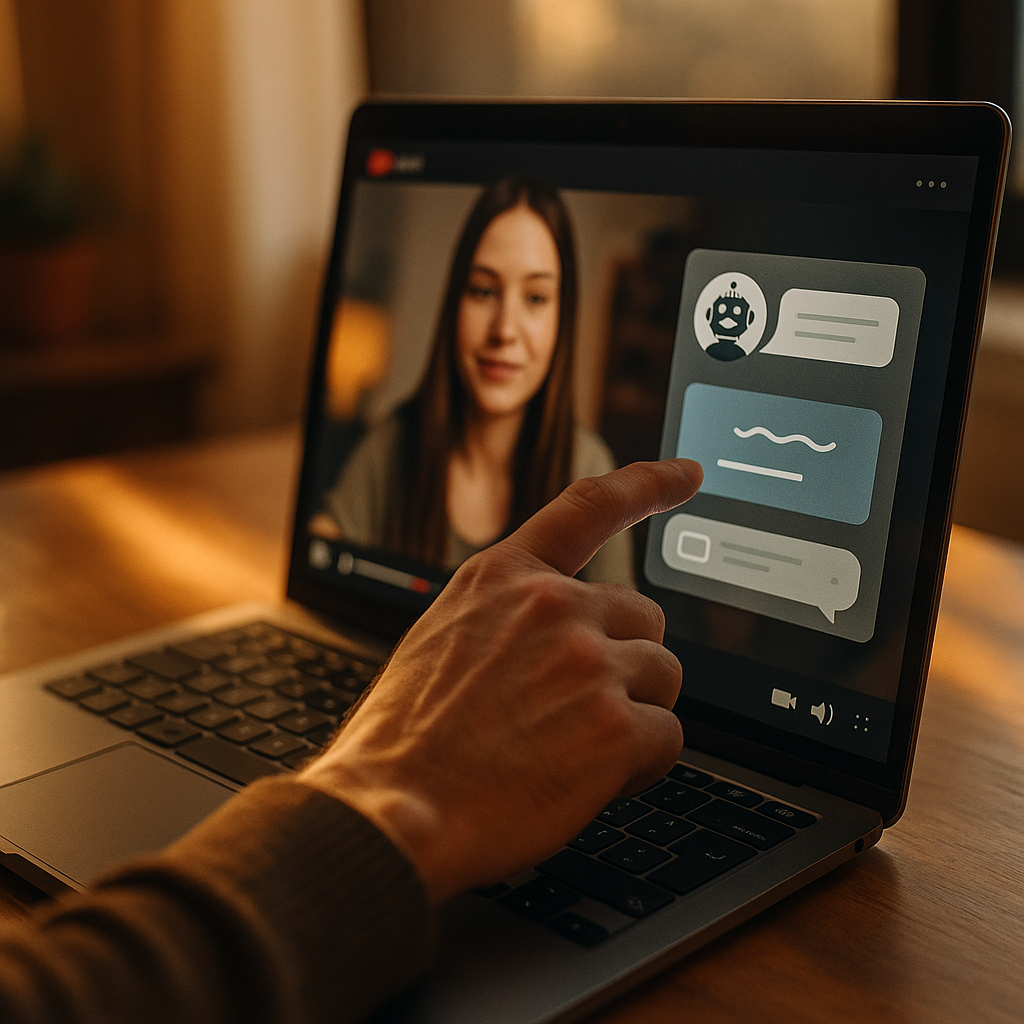
Livestream shopping converts at rates traditional ecommerce can only dream about, yet most brands still treat chat as a scrolling wall of noise nobody reads. Interactive AI chat overlays flip that script: they surface product questions, price checks, and buying intent directly on screen, in real time, without a host ever breaking their pitch. If your livestream strategy still relies on a moderator squinting at a chat feed, you’re already behind.
What Are Interactive AI Chat Overlays, Exactly?
An interactive AI chat overlay is a real-time layer that sits on top of a livestream video feed, reading incoming viewer comments, detecting purchase intent or product questions, and surfacing the most relevant ones as visual prompts on screen. Think of it as a smarter, faster version of the pinned comment. Instead of a producer manually copying a question into a graphic, an AI model scans the chat stream, ranks messages by relevance and urgency, and pushes the top ones into a visible overlay the host can react to instantly.
Some platforms take it further. Tools built on natural language processing can auto-answer basic questions (sizing, shipping windows, ingredient lists) without pulling the host away from selling, while flagging higher-value questions for a live response. This is not a chatbot bolted onto a video player. It’s a content format in its own right, one that blends the spontaneity of live commerce with the structure of a well-run FAQ.
Brands running AI-moderated chat overlays report meaningfully higher watch-through rates because viewers stay engaged waiting to see if their question gets surfaced, a dynamic traditional livestreams never had.
Why This Format Is Gaining Traction Now
Livestream shopping has been the retail story of the decade in China, and Western platforms have spent years trying to replicate that success. TikTok Shop, Amazon Live, and Whatnot have all poured resources into live commerce, but engagement has been uneven. Chat volume on a popular stream can hit hundreds of messages per minute. No human moderator can keep up, and viewers who ask a question and get ignored tend to bounce.
AI chat overlays solve a real operational bottleneck. According to eMarketer, live commerce continues to post double-digit growth in the US even as overall social commerce matures, and the brands winning share are the ones reducing friction between question and answer. An overlay that surfaces “does this run small?” the moment three viewers ask it isn’t a gimmick. It’s inventory of intent, made visible.
There’s also a retention angle worth flagging. Livestream shopping shares DNA with other interactive formats brands have tested, including live shopping audio rooms, where scripted Q&A already proved that structured interaction beats freeform chat for conversion. AI overlays essentially automate that structure at scale.
The ROI Case: What Brands Actually Gain
Marketing leadership doesn’t care about novelty. They care about whether a format moves revenue or reduces cost per acquisition. Here’s where AI chat overlays earn their budget line:
- Higher conversion at the moment of doubt. Most cart abandonment on livestreams happens because a viewer has an unanswered question. Surfacing and answering it in seconds, rather than losing the viewer to a tab switch, directly protects conversion.
- Lower staffing cost per stream. A single moderator paired with an AI overlay can manage chat volume that previously required two or three people. That’s a direct line to operational efficiency, especially for brands running multiple weekly streams.
- Better data capture. Every surfaced question, and every question the AI chooses not to surface, is a data point. Brands can mine that for FAQ content, product page copy, and even future ad hooks, similar to how hook testing at scale mines performance data for creative decisions.
- Compliance-friendly moderation. AI filters can flag spam, prohibited claims, or off-brand language before it ever reaches the host’s screen, reducing the risk of an unscripted moment turning into a PR headache.
None of this replaces a skilled host. It just means the host spends less energy triaging chat and more energy selling.
What the Format Looks Like in Practice
Picture a beauty brand running a product launch stream. As the host demos a serum, the overlay surfaces three clustered questions: “Is this okay for sensitive skin?”, “Does it work under makeup?”, and “When does the discount code expire?” The host answers all three in under thirty seconds, visibly, on screen, and viewers watch their own question get acknowledged in real time. That visibility loop is the entire mechanic. Viewers who see their comment matter tend to stay longer and buy more, a pattern that echoes what brands learned building multi-host livestreams with dedicated roles for engagement versus sales.
Some brands are also pairing overlays with countdown mechanics, borrowing tactics from countdown urgency clips, so the AI surfaces price and stock questions right as scarcity messaging kicks in. The combination of real-time answer plus real-time pressure is proving to be a strong conversion lever.
Where It Can Go Wrong
Let’s be honest about the risks, because this format has failure modes that don’t show up in a demo reel.
Bad question ranking kills trust. If the AI surfaces low-value or off-topic comments while ignoring genuine buying questions, viewers notice fast. The overlay needs tuning specific to your product category and audience, not a generic out-of-the-box model.
Overlays can clutter the frame. Livestream shopping already competes with product demos, price graphics, and host presence for screen real estate. A poorly designed overlay adds visual noise instead of clarity. Test placement and frequency before scaling to every stream.
Automated answers carry compliance risk. If an AI auto-responds to a health, financial, or efficacy claim question with anything approximating medical or financial advice, that’s a liability problem, not a convenience feature. The FTC has been increasingly attentive to AI-generated claims in commerce settings, and brands should treat auto-answers the same way they’d treat any influencer disclosure or claim, reviewed, documented, and defensible.
Treat every AI-generated response in a shoppable livestream as a brand claim, because legally and reputationally, that’s exactly what it is.
Building the Brief: What to Specify Before You Launch
Agencies and in-house teams rolling this out for the first time should treat the overlay build like any other content format brief, not an afterthought bolted onto the streaming platform’s default settings.
- Define which question categories the AI can auto-answer versus which must route to a live human (pricing exceptions, health claims, refund disputes).
- Set a review cadence for the AI’s ranking logic, weekly at minimum during the first quarter of use.
- Script host behavior for acknowledging surfaced questions, similar to how street interview ad briefs script how a host handles skeptical or off-script responses.
- Build a fallback plan for when the AI misfires mid-stream. Someone on the production team needs override authority.
- Log every flagged claim-adjacent question for legal review, especially in regulated categories like health, finance, or supplements, where ingredient deep dive videos already require careful claims substantiation.
This isn’t overkill. It’s the difference between a format that scales safely and one that generates a compliance incident on your third stream.
Choosing a Platform: What to Actually Compare
Not every livestream shopping platform offers native AI overlay tools yet, and the ones that do vary widely in sophistication. When evaluating vendors, ask about:
- Latency. If the AI takes more than a few seconds to surface a question, the “real-time” value proposition disappears.
- Language and dialect handling. If you sell internationally, confirm the model handles regional slang and non-English chat without embarrassing mistranslations.
- Integration with existing CRM or ecommerce stack. Surfaced questions should feed back into your customer data platform, not disappear after the stream ends.
- Human override controls. Your moderator needs a kill switch, full stop.
Platforms like TikTok Shop and Amazon Live continue to expand native live commerce tooling, and third-party overlay vendors are emerging specifically to fill the AI moderation gap. Check TikTok’s advertiser resources for the latest on native shopping features before committing to a third-party layer that might duplicate functionality already available.
Where This Format Is Headed
Expect overlays to get more predictive, not just reactive. Instead of waiting for a viewer to type “does this come in blue,” future versions will anticipate the question based on where in the product demo the host currently is, and pre-surface an answer graphic before anyone asks. That’s a subtle but important shift, from reactive moderation to proactive content design. It also mirrors the broader trend across formats like product launch simulcasts, where AI-assisted production is compressing the gap between content creation and content optimization to near zero.
The brands that treat interactive AI chat overlays as a genuine content format, with its own brief, its own compliance checklist, and its own performance benchmarks, will outperform the ones bolting on a plugin and hoping engagement improves on its own.
Next Step
Run one AI-moderated livestream this quarter with a documented claims-review process and a human override in place, then compare watch-through and conversion against your last three unmoderated streams. The gap will tell you whether this format deserves a permanent line in your content calendar.
FAQs
What is an interactive AI chat overlay in livestream shopping?
It’s a real-time visual layer on a livestream that uses AI to scan viewer chat, identify high-value questions or buying signals, and surface them on screen so the host can respond immediately without manually reading through the full chat feed.
Do AI chat overlays actually improve conversion rates?
Brands using them typically see improved watch-through time and reduced cart abandonment because viewer questions get answered in real time instead of going unaddressed, though results vary based on how well the AI ranking is tuned to the product category.
What are the compliance risks with AI-generated answers during a livestream?
Auto-generated responses to health, financial, or efficacy questions can constitute a brand claim, so any auto-answer feature should be limited to low-risk topics like sizing or shipping, with higher-risk questions routed to a trained human for a reviewed response.
How is this different from a standard livestream comment section?
A standard comment section just displays messages in order received. An AI overlay ranks and filters messages by relevance and intent, then visually surfaces the most important ones, turning chat from background noise into an active part of the on-screen content.
Which platforms currently support AI chat overlays for livestream shopping?
Major live commerce platforms are actively expanding native tooling in this space, and third-party overlay vendors are also emerging, so brands should evaluate latency, language support, and CRM integration before selecting a solution.
Top Influencer Marketing Agencies
The leading agencies shaping influencer marketing in 2026
Agencies ranked by campaign performance, client diversity, platform expertise, proven ROI, industry recognition, and client satisfaction. Assessed through verified case studies, reviews, and industry consultations.
Moburst

-
2

The Shelf
Boutique Beauty & Lifestyle Influencer AgencyA data-driven boutique agency specializing exclusively in beauty, wellness, and lifestyle influencer campaigns on Instagram and TikTok. Best for brands already focused on the beauty/personal care space that need curated, aesthetic-driven content.Clients: Pepsi, The Honest Company, Hims, Elf Cosmetics, Pure LeafVisit The Shelf → -
3

Audiencly
Niche Gaming & Esports Influencer AgencyA specialized agency focused exclusively on gaming and esports creators on YouTube, Twitch, and TikTok. Ideal if your campaign is 100% gaming-focused — from game launches to hardware and esports events.Clients: Epic Games, NordVPN, Ubisoft, Wargaming, Tencent GamesVisit Audiencly → -
4

Viral Nation
Global Influencer Marketing & Talent AgencyA dual talent management and marketing agency with proprietary brand safety tools and a global creator network spanning nano-influencers to celebrities across all major platforms.Clients: Meta, Activision Blizzard, Energizer, Aston Martin, WalmartVisit Viral Nation → -
5

The Influencer Marketing Factory
TikTok, Instagram & YouTube CampaignsA full-service agency with strong TikTok expertise, offering end-to-end campaign management from influencer discovery through performance reporting with a focus on platform-native content.Clients: Google, Snapchat, Universal Music, Bumble, YelpVisit TIMF → -
6

NeoReach
Enterprise Analytics & Influencer CampaignsAn enterprise-focused agency combining managed campaigns with a powerful self-service data platform for influencer search, audience analytics, and attribution modeling.Clients: Amazon, Airbnb, Netflix, Honda, The New York TimesVisit NeoReach → -
7

Ubiquitous
Creator-First Marketing PlatformA tech-driven platform combining self-service tools with managed campaign options, emphasizing speed and scalability for brands managing multiple influencer relationships.Clients: Lyft, Disney, Target, American Eagle, NetflixVisit Ubiquitous → -
8

Obviously
Scalable Enterprise Influencer CampaignsA tech-enabled agency built for high-volume campaigns, coordinating hundreds of creators simultaneously with end-to-end logistics, content rights management, and product seeding.Clients: Google, Ulta Beauty, Converse, AmazonVisit Obviously →