


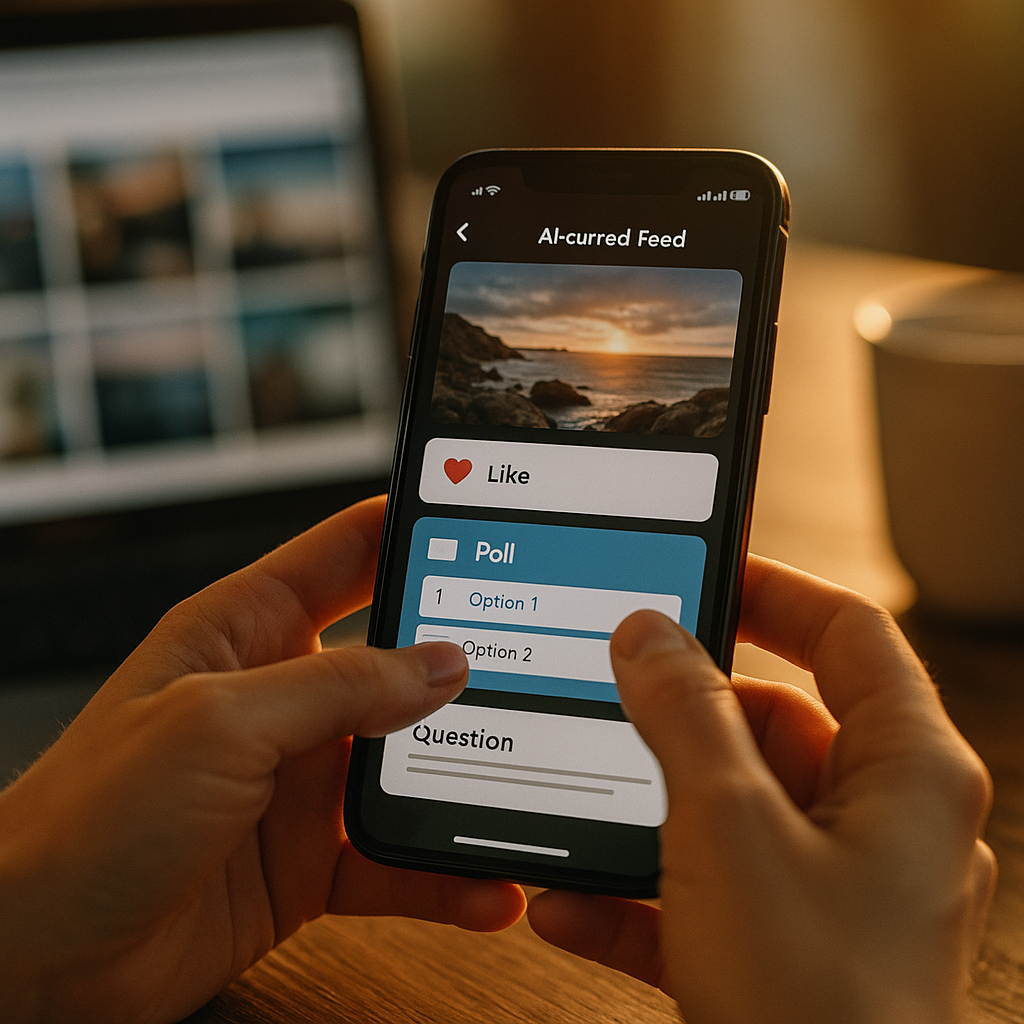
The Algorithm Doesn’t Care About Your Brand — It Cares About Interaction Signals
According to TikTok’s own business resources, videos that generate active interaction signals — poll taps, comment replies, shares, question sticker responses — receive up to 5.3x more distribution than passive-view content. That single data point should reshape how every brand briefs creators. Yet most briefs still optimize for watch time alone, ignoring the interactive formats for AI-curated feeds that recommendation engines now reward most aggressively.
The shift isn’t subtle. AI recommendation engines on TikTok, Instagram Reels, YouTube Shorts, and even LinkedIn’s video feed have evolved beyond completion rate as a primary ranking signal. They now weight interaction density — the ratio of active engagement events to impressions — as a core input for both organic surfacing and paid amplification efficiency. If your creator content doesn’t generate taps, votes, replies, and shares within the first distribution window, it dies quietly.
This article breaks down exactly how to brief creators for poll-triggered, question-layered, and participatory short-form content — with the operational specificity brand teams actually need.
Why AI Recommendation Engines Reward Interactive Formats Disproportionately
Let’s get specific about what’s happening under the hood. AI-curated feeds operate on reinforcement learning loops. Every user action — or inaction — feeds the model. Passive consumption (watching without engaging) provides a weak training signal. Active engagement (tapping a poll, typing a comment, sharing to a DM) provides a strong one.
Strong signals do two things simultaneously: they tell the algorithm this content is worth showing to similar users, and they increase the content’s velocity score during its critical first-hour distribution window. Meta’s engineering blog has confirmed that Reels ranking weighs “meaningful social interactions” — their term for actions requiring deliberate effort — more heavily than views alone. Meta’s business platform provides additional context on how these signals influence ad delivery optimization.
The brands winning organic distribution aren’t producing “better” content in the traditional sense. They’re engineering more interaction events per impression — and briefing creators to embed those interaction triggers structurally, not as afterthoughts.
This matters for paid, too. When you boost or spark-ads a piece of creator content that already carries high interaction density, the algorithm can optimize delivery more efficiently. Your CPMs drop. Your relevance scores climb. The organic and paid flywheel accelerates.
Three Interactive Format Categories — and How to Brief Each One
Not all interactive formats are created equal. We’ve identified three categories that consistently generate the engagement signals AI recommendation engines prioritize. Each requires a different briefing approach.
Poll-Triggered Formats
Poll-triggered content uses binary or multiple-choice decision points to fracture the audience into camps. This generates engagement through opinion expression — one of the strongest signals for share and comment behavior.
How to brief it:
- Specify the poll placement. Polls should appear 3-5 seconds into the video, not at the end. Early placement captures interaction before the scroll-away window closes.
- Brief for genuine tension. “Which do you prefer?” is weak. “Would you actually pay $200 for this?” creates stakes. The brief should provide 2-3 poll question options and let the creator choose the one that fits their voice.
- Require a reveal or payoff. The creator should reference the poll result in a follow-up piece of content. This creates a serialization loop that drives return visits — another algorithm signal.
- Include a comment prompt tied to the poll. Example: “Vote above, but tell me WHY in the comments.” This doubles the interaction event count per viewer.
A beauty brand we’ve tracked briefed 12 creators to use poll-triggered “Would you wear this to work?” formats around a new product line. The interaction rate averaged 11.2% — nearly triple the brand’s typical Reels benchmark. Understanding interactive short-form formats is essential for replicating this kind of result.
Question-Layered Formats
Question-layered content embeds multiple questions throughout the video — not just one at the end. Each question functions as a micro-interaction prompt that resets viewer attention and generates comment-section activity.
How to brief it:
- Provide a question architecture, not a script. Give creators three questions: an opening hook question (rhetorical or provocative), a mid-video opinion question (designed to split the audience), and a closing action question (“What should I try next?”).
- Use on-screen text questions as overlays. These function as accessibility hooks and increase the likelihood of response. Brief creators to use platform-native text tools, not post-production overlays, so the algorithm can parse them.
- Mandate a “wrong answer” setup. Questions framed as “Most people get this wrong — what do you think?” trigger corrective commenting, which is one of the highest-signal engagement behaviors across every major platform.
This layered approach works exceptionally well when paired with story arc briefs that maintain narrative momentum between question beats.
Participatory Formats
Participatory content directly invites the audience to create, respond, or co-create. Duets, stitches, remix prompts, and “show me yours” challenges all fall here. These generate the most valuable signal of all: derivative content creation, which the algorithm interprets as a virality indicator.
How to brief it:
- Design the “response frame.” Brief creators to leave visual or narrative space for audience responses. A split-screen layout with an empty side. A sentence that trails off. A ranking that’s obviously wrong.
- Specify the remix permissions. Ensure creators enable duet, stitch, and remix features. This sounds obvious, but audit data shows 30%+ of branded creator content ships with these features disabled.
- Provide a hashtag or response mechanic. Give creators a simple, ownable tag for responses. Don’t overthink it — functional beats clever.
For deeper tactics on leveraging remix features as amplifiers, brands should build participatory mechanics into every campaign brief by default.
The Brief Template: What to Include (and What to Leave Out)
Most creator briefs are too long and too prescriptive about the wrong things. They over-specify brand messaging and under-specify interaction design. Here’s what an interactive-format brief should contain:
- Format type: Specify poll-triggered, question-layered, or participatory (or a hybrid).
- Interaction placement map: Where in the video timeline should interaction prompts appear? Provide second-by-second guidance: “Poll by :04, mid-video question by :18, CTA by :28.”
- Engagement target: State a target interaction rate (e.g., 8%+ poll participation, 3%+ comment rate). This gives creators a performance lens, not just a creative one.
- Audience fracture points: Provide 2-3 opinion-splitting questions or scenarios the creator can adapt. These should be genuinely debatable — not leading questions with obvious brand-favorable answers.
- Follow-up content hook: Describe the serialization opportunity. “If this performs, here’s the Part 2 angle.” Creators who see a content series opportunity invest more creative energy.
- Platform-specific feature requirements: List exact native features to use (Instagram poll sticker, TikTok Q&A feature, YouTube Shorts comment pinning).
What to leave out: lengthy brand history, multi-paragraph messaging hierarchies, and rigid scripts. If you’re managing large creator rosters, systematizing this briefing process is critical — our guide on orchestrating 50+ creator campaigns covers the operational workflow.
The highest-performing interactive briefs we’ve analyzed share one trait: they give creators a structural framework for interaction design while leaving the creative expression entirely in the creator’s hands. Structure the mechanics. Free the voice.
Measuring What Matters: Interaction Density Over Vanity Metrics
Views don’t tell you anything about algorithmic momentum. Neither do likes, really. The metric that matters is interaction density: total active engagement events (poll votes + comments + shares + saves + stitch/duet creates) divided by impressions.
Benchmark data from Sprout Social’s analytics platform suggests that short-form video content averaging above 6% interaction density receives 2-4x more algorithmic distribution than content below that threshold. For interactive formats specifically, aim for 8-12%.
Track these KPIs per creator, per format type, per platform. Over time, you’ll build a performance map that tells you which creators excel at poll-triggered formats versus question-layered ones — and you’ll brief accordingly. This ties directly into building a UGC content engine that compounds results across campaigns.
Don’t forget the paid amplification layer. Content that clears your interaction density threshold becomes your spark ads and partnership ads shortlist. Content that doesn’t gets recycled for organic learnings but shouldn’t receive paid spend. This decision framework alone will improve your ROAS by filtering out low-signal content before budget touches it.
Platform-Specific Nuances That Change Your Briefing
A poll on TikTok and a poll on Instagram Reels behave differently — and the algorithms weigh them differently.
TikTok: The Q&A feature and comment reply videos generate outsized signal because they create new content nodes linked to the original. Brief creators to respond to top comments with video replies within 2 hours of posting. TikTok’s recommendation engine treats these reply videos as engagement multipliers for the parent content. See TikTok brief frameworks for detailed guidance.
Instagram Reels: Poll and question stickers in Stories drive profile visits, which feed the Reels algorithm indirectly. Brief creators to post a Story with an interactive sticker 30 minutes before the Reel drops, funneling engaged viewers to the Reel at launch.
YouTube Shorts: Comment pinning and the new poll card feature are underutilized. YouTube’s support documentation confirms that Shorts with pinned creator comments receive higher engagement clustering, which influences recommendation placement.
LinkedIn Video: The platform’s algorithm heavily rewards comment depth. Question-layered formats perform disproportionately well here because LinkedIn’s user base is conditioned to share expertise in comments. Brief creators to ask industry-specific “hot take” questions rather than consumer-facing ones.
Your Next Move
Pull your last five creator briefs. Count the number of specific interaction design instructions in each one. If the answer is zero — and it probably is — rewrite one brief this week using the format categories and template above, then compare interaction density against your baseline. That single A/B test will tell you more than any webinar ever could.
FAQs
What are interactive formats for AI-curated feeds?
Interactive formats for AI-curated feeds are short-form video content types — such as poll-triggered, question-layered, and participatory videos — specifically designed to generate active engagement signals (taps, votes, comments, shares, and remix actions) that AI recommendation engines use to prioritize content in organic and paid distribution.
How do poll-triggered videos improve algorithmic distribution?
Poll-triggered videos generate active interaction events (poll taps) that provide strong training signals to AI recommendation engines. These signals increase interaction density — the ratio of engagement events to impressions — which platforms like TikTok, Instagram, and YouTube use to determine whether content should be distributed to wider audiences during the critical first-hour window.
What interaction density rate should brands target for short-form creator content?
Brands should target an interaction density rate of 8-12% for interactive short-form formats. Industry benchmark data indicates that content averaging above 6% interaction density receives 2-4x more algorithmic distribution than content below that threshold. Interactive formats with embedded polls, questions, and participatory mechanics consistently outperform passive content.
How should brands brief creators differently for each platform?
Each platform weighs interaction signals differently. On TikTok, brief creators to use Q&A features and video comment replies within two hours of posting. On Instagram, pair Reels with interactive Story stickers posted 30 minutes before the Reel. On YouTube Shorts, use poll cards and pinned comments. On LinkedIn, focus on question-layered formats that prompt in-depth professional commentary.
What should be included in a creator brief for interactive formats?
An effective interactive format brief should include the format type (poll, question-layered, or participatory), an interaction placement map with second-by-second timing, a target interaction rate, audience-splitting questions or scenarios, a follow-up content hook for serialization, and platform-specific native feature requirements. Avoid rigid scripts and over-specified brand messaging.
Top Influencer Marketing Agencies
The leading agencies shaping influencer marketing in 2026
Agencies ranked by campaign performance, client diversity, platform expertise, proven ROI, industry recognition, and client satisfaction. Assessed through verified case studies, reviews, and industry consultations.
Moburst

-
2

The Shelf
Boutique Beauty & Lifestyle Influencer AgencyA data-driven boutique agency specializing exclusively in beauty, wellness, and lifestyle influencer campaigns on Instagram and TikTok. Best for brands already focused on the beauty/personal care space that need curated, aesthetic-driven content.Clients: Pepsi, The Honest Company, Hims, Elf Cosmetics, Pure LeafVisit The Shelf → -
3

Audiencly
Niche Gaming & Esports Influencer AgencyA specialized agency focused exclusively on gaming and esports creators on YouTube, Twitch, and TikTok. Ideal if your campaign is 100% gaming-focused — from game launches to hardware and esports events.Clients: Epic Games, NordVPN, Ubisoft, Wargaming, Tencent GamesVisit Audiencly → -
4

Viral Nation
Global Influencer Marketing & Talent AgencyA dual talent management and marketing agency with proprietary brand safety tools and a global creator network spanning nano-influencers to celebrities across all major platforms.Clients: Meta, Activision Blizzard, Energizer, Aston Martin, WalmartVisit Viral Nation → -
5

The Influencer Marketing Factory
TikTok, Instagram & YouTube CampaignsA full-service agency with strong TikTok expertise, offering end-to-end campaign management from influencer discovery through performance reporting with a focus on platform-native content.Clients: Google, Snapchat, Universal Music, Bumble, YelpVisit TIMF → -
6

NeoReach
Enterprise Analytics & Influencer CampaignsAn enterprise-focused agency combining managed campaigns with a powerful self-service data platform for influencer search, audience analytics, and attribution modeling.Clients: Amazon, Airbnb, Netflix, Honda, The New York TimesVisit NeoReach → -
7

Ubiquitous
Creator-First Marketing PlatformA tech-driven platform combining self-service tools with managed campaign options, emphasizing speed and scalability for brands managing multiple influencer relationships.Clients: Lyft, Disney, Target, American Eagle, NetflixVisit Ubiquitous → -
8

Obviously
Scalable Enterprise Influencer CampaignsA tech-enabled agency built for high-volume campaigns, coordinating hundreds of creators simultaneously with end-to-end logistics, content rights management, and product seeding.Clients: Google, Ulta Beauty, Converse, AmazonVisit Obviously →