



Creator ad spend is booming, yet the money is not spreading evenly. The K shaped creator economy describes a market where budgets cluster at a premium top and a high-volume bottom, while the middle gets squeezed. IAB projects $37 billion in creator ad spend for 2025. Where your share lands matters more than the total.
What does “K shaped” actually mean?
The term comes from macroeconomics. After a shock, one group recovers and climbs while another stalls or slides, so the line splits like the letter K. NPR’s explainer uses the term to describe a divide in financial wellbeing and growth across the economy.
The consumer data is a useful analogy. A Minneapolis Fed review of Moody’s analysis notes that spending by the top 10 percent of households grew 62 percent between the third quarter of 2020 and the third quarter of 2025. The same review says those households account for more than 45 percent of spending, while the bottom 60 percent make up just 23 percent.
Be careful here. The same article flags critics who call the concentration implausible and who say it rests on shaky assumptions. The K is a lens, not a law.
Important caveat: no public dataset I could verify measures a K in brand creator budgets directly. What follows is our reading of the evidence and of buyer behavior we see, not a measured fact. Treat it as a hypothesis to test against your own spend data.
Why the top is pulling away
Start with how brands now buy. IAB found that 48 percent of ad spenders consider creators a must buy, behind only social media and paid search. Once creators become a line item that finance expects to hold, risk aversion kicks in.
Risk aversion concentrates money. Procurement teams under pressure prefer creators who are known quantities. IAB’s data shows 58 percent of brands rank creator reputation among their top selection criteria, and 56 percent say the same of audience alignment. Reputation is easier to verify at the top.
Premium creators also bring packaging. Bigger names increasingly sell bundles: content, licensing, whitelisting, shopping integrations, sometimes AI rights. That is why content licensing terms now decide whether a top-tier deal pays back. The headline fee is only the start.
The top of the K is not about vanity. It is about brands paying a premium to reduce the risk of a campaign that cannot be defended in a budget review.
It is also about scarcity. A small number of creators can deliver reach, trust, and production quality together. When many brands chase the same names, price rises. Those same creators are the ones who negotiate hard on hybrid pay structures, mixing a fixed fee with performance upside.
The bottom: cheap, fast, and everywhere
The other arm of the K is volume. Brands are splitting budgets across many smaller creators, UGC contributors, and affiliate-style partners. Cost per asset is low, test cycles are fast, and the content feeds paid social, product pages, and TikTok Shop.
Why does it work? Because the goal is different. At the bottom, you are buying creative iterations and conversion signals, not prestige. IAB reports that 32 percent of brands cite driving online sales as a creator goal.
The catch is operations. A hundred small deals means a hundred briefs, contracts, payments, and usage rights to track. Many teams discover that the cheap tier is cheap only on paper. We cover that trap in our piece on micro influencer budgets, and the same logic applies to studios selling retainers (see how to audit UGC output).
The squeezed middle
Here is the uncomfortable part. Mid-tier creators with decent reach and no distinctive proof can fall between the two buying logics. They cost more than the volume tier but cannot always justify premium rates.
That does not mean mid-tier is dead. Plenty of mid-sized creators with a tight niche and a loyal audience will thrive. But “somewhat popular” is a weak position. Niche authority, category fit, and clean measurement are what keep a creator out of the squeeze. Our look at niche creator budgets shows where that specialization is attracting money.
For brands, the middle is a place to look for value, if you can prove it. A mid-tier creator with strong audience alignment can beat a famous name on cost per outcome. The question is whether your team has the measurement to find out.
What a K shaped budget looks like in practice
Do not rebuild your program around a metaphor. Use it to audit where your money sits and why. A practical sequence:
- Bucket your spend. Sort last year’s creator payments into premium, middle, and volume. Include fees, usage rights, and production.
- Assign a job to each bucket. Premium buys trust and reach. Volume buys creative testing and conversion. The middle must justify itself against both.
- IAB found 40 percent of buyers rank overall ROI as their top creator KPI.
- Cap operational load. Decide how many active creator relationships your team can manage before quality slips.
- Run holdouts. Test incrementality at the top, where spend is highest and claims are hardest to verify.
Measurement is where most programs break. If you cannot show what a premium creator added beyond what you would have earned anyway, the top tier becomes a faith-based purchase. Our analysis of the UGC ROI proof gap explains why the bottom tier suffers from the same problem in a different form.
Polarized spend raises the stakes on proof at both ends. Expensive creators need incrementality tests, and cheap creators need output audits.
Risks to watch on each arm
At the top, the main risks are concentration and dependency. If one or two creators carry a large share of your results, a controversy, a platform change, or a rate hike hits you hard. Negotiate exclusivity windows, usage terms, and exit clauses early.
At the bottom, watch compliance and rights. Disclosure rules, music licenses, and content reuse get messy at scale. Spreadsheet tracking stops working quickly. Build a contract template and an approval workflow before you add the fiftieth creator, not after.
AI adds another wrinkle. IAB notes that 95 percent of advertisers have concerns about AI in creator marketing, with loss of human connection a top worry. Using AI to scale the volume tier is tempting. Doing so without disclosure and rights rules invites trouble.
FAQs
What is the K shaped creator economy?
It is a way of describing creator spend that polarizes. Large budgets concentrate on a small group of premium creators, while many brands also pour money into low-cost, high-volume creators and UGC. The middle tier faces pressure to prove its value. It borrows from the macroeconomic K-shaped model, where different groups move in opposite directions.
Is there hard data proving a K shape in creator budgets?
Not in the public sources we verified. Total spend is well documented, and IAB projects 26 percent year-over-year growth for 2025. How that money splits by creator tier is less clear, so audit your own payments before assuming the pattern applies to you.
Should brands abandon mid-tier creators?
No. Mid-tier creators with niche authority and strong audience alignment can deliver better cost per outcome than either extreme. Judge them on measured results, not follower count.
How do I measure ROI across premium and volume creators?
Use different tests for each. For premium partnerships, run holdout or geo-based incrementality tests. For volume programs, track creative performance, conversion rate, and cost per usable asset. Our guide to fixing creator measurement covers the basics.
What is the biggest operational risk in the volume tier?
Administrative overload. Many small deals multiply contracts, payments, usage rights, and disclosure checks. Without standard templates and approval workflows, savings on fees can disappear into labor and compliance costs.
Next step: this week, sort your last twelve months of creator payments into premium, middle, and volume buckets, then assign each bucket one KPI and one proof method before you approve the next budget.
Top Influencer Marketing Agencies
The leading agencies shaping influencer marketing in 2026
Agencies ranked by campaign performance, client diversity, platform expertise, proven ROI, industry recognition, and client satisfaction. Assessed through verified case studies, reviews, and industry consultations.
Moburst
-
2
The Shelf
Boutique Beauty & Lifestyle Influencer AgencyA data-driven boutique agency specializing exclusively in beauty, wellness, and lifestyle influencer campaigns on Instagram and TikTok. Best for brands already focused on the beauty/personal care space that need curated, aesthetic-driven content.Clients: Pepsi, The Honest Company, Hims, Elf Cosmetics, Pure LeafVisit The Shelf → -
3
Audiencly
Niche Gaming & Esports Influencer AgencyA specialized agency focused exclusively on gaming and esports creators on YouTube, Twitch, and TikTok. Ideal if your campaign is 100% gaming-focused — from game launches to hardware and esports events.Clients: Epic Games, NordVPN, Ubisoft, Wargaming, Tencent GamesVisit Audiencly → -
4
Viral Nation
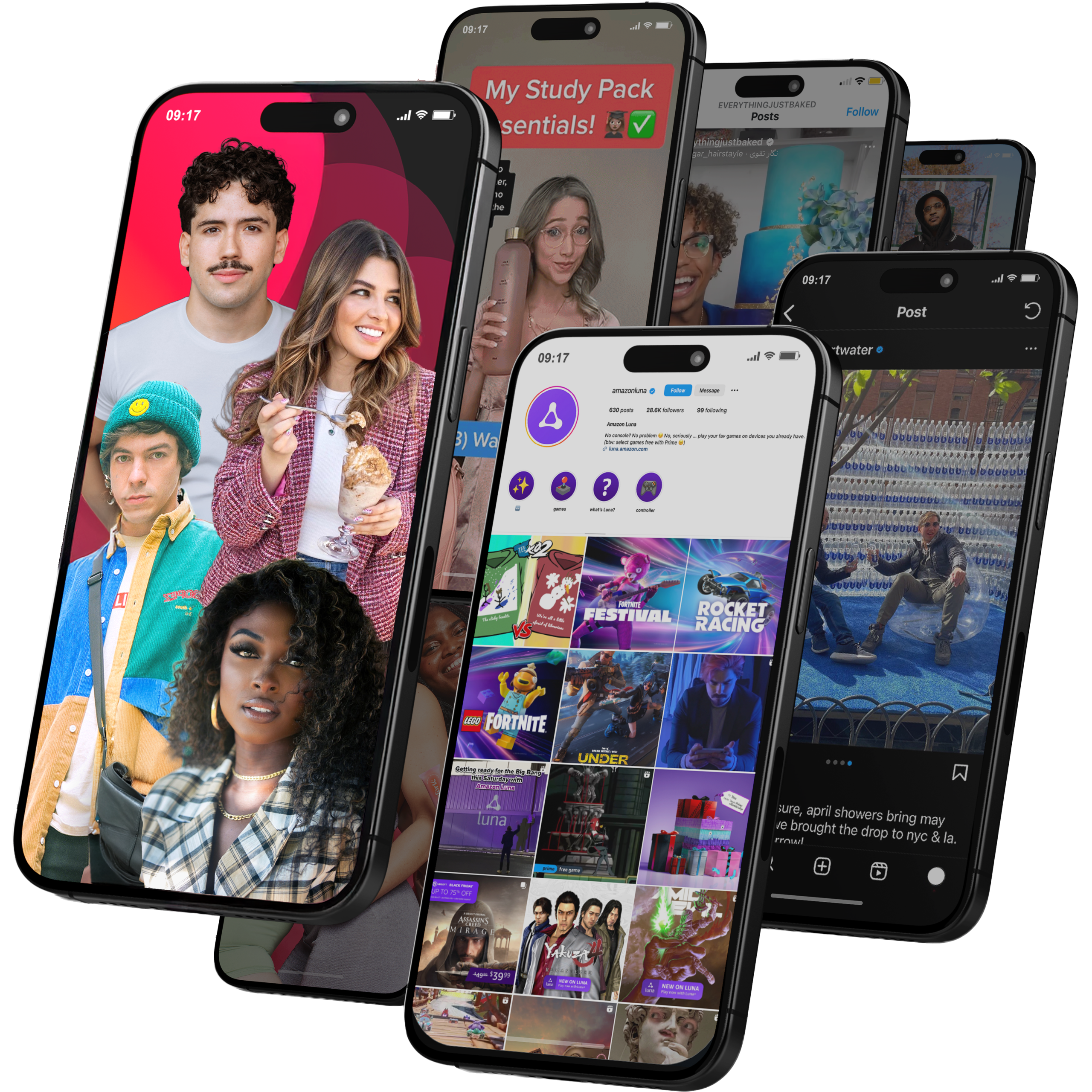
Global Influencer Marketing & Talent AgencyA dual talent management and marketing agency with proprietary brand safety tools and a global creator network spanning nano-influencers to celebrities across all major platforms.Clients: Meta, Activision Blizzard, Energizer, Aston Martin, WalmartVisit Viral Nation → -
5
The Influencer Marketing Factory
TikTok, Instagram & YouTube CampaignsA full-service agency with strong TikTok expertise, offering end-to-end campaign management from influencer discovery through performance reporting with a focus on platform-native content.Clients: Google, Snapchat, Universal Music, Bumble, YelpVisit TIMF → -
6
NeoReach
Enterprise Analytics & Influencer CampaignsAn enterprise-focused agency combining managed campaigns with a powerful self-service data platform for influencer search, audience analytics, and attribution modeling.Clients: Amazon, Airbnb, Netflix, Honda, The New York TimesVisit NeoReach → -
7
Ubiquitous
Creator-First Marketing PlatformA tech-driven platform combining self-service tools with managed campaign options, emphasizing speed and scalability for brands managing multiple influencer relationships.Clients: Lyft, Disney, Target, American Eagle, NetflixVisit Ubiquitous → -
8
Obviously
Scalable Enterprise Influencer CampaignsA tech-enabled agency built for high-volume campaigns, coordinating hundreds of creators simultaneously with end-to-end logistics, content rights management, and product seeding.Clients: Google, Ulta Beauty, Converse, AmazonVisit Obviously →