


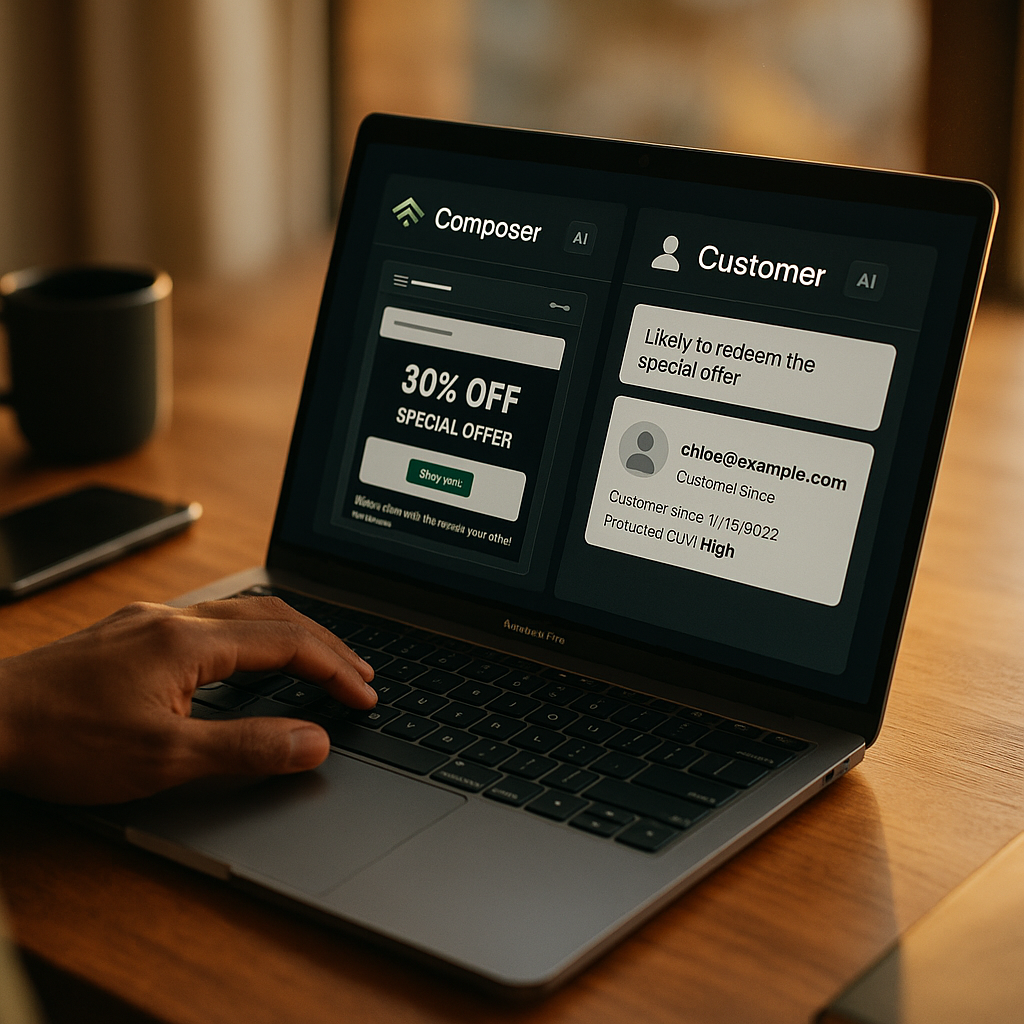
Klaviyo says its AI now writes, targets, and sends campaigns with minimal human input. If that’s true, why are agencies still staffing full-time email strategists? The gap between marketing claims and operational reality is exactly where buyers get burned. This guide breaks down what Klaviyo’s Composer and Customer Agent modules actually do, where they save real hours, and where they still need a human holding the wheel.
What Composer and Customer Agent Actually Are
Klaviyo has spent the past two years bolting generative AI onto its core email and SMS platform. Composer is the content layer: it drafts subject lines, body copy, and even layout variations based on brand voice inputs and historical performance data. Customer Agent sits one layer up. It’s the orchestration piece, deciding which segment gets which message, when, and through which channel, based on predicted engagement and purchase likelihood.
Together, they’re marketed as a system that can move from campaign brief to live send with almost no manual configuration. That’s the pitch, anyway. In practice, most mid-market teams use them as acceleration tools rather than full autopilot.
The distinction matters for procurement. If you’re buying Klaviyo expecting to cut headcount, you’ll be disappointed. If you’re buying it to compress campaign build time from days to hours, the math works much better.
The Autonomy Claim, Stress-Tested
“Autonomous” is doing a lot of heavy lifting in Klaviyo’s marketing. Let’s define terms. Full autonomy would mean the system identifies a business need, builds a campaign, and sends it without a human reviewing copy, timing, or audience. That’s not what’s happening today, even in Klaviyo’s most advanced tier.
What’s actually autonomous is the decisioning layer inside Customer Agent. It can independently determine send-time windows per subscriber, suppress fatigued segments, and reroute a campaign from email to SMS if open rates dip below a threshold. That’s meaningful automation. It’s just not campaign creation from a blank page.
Buyers who treat “autonomous composition” as literal will overestimate the platform’s readiness and underestimate the QA workload their team still needs to budget for.
Composer’s copy generation still requires brand guardrails, product catalog feeds, and a review pass before anything ships to a list larger than a few thousand contacts. Skip that review and you risk the same brand-voice drift that’s plagued generative AI tools since day one.
Where the ROI Actually Shows Up
Talk to teams running Klaviyo at scale and the ROI story isn’t “we fired our copywriter.” It’s cycle time. Campaigns that used to take three to five days from brief to send are landing in one day, sometimes same-day for reactive promos like flash sales or restock alerts.
- Faster A/B testing: Composer generates 4-6 subject line and copy variants in minutes, letting teams test statistically meaningful sample sizes without burning a strategist’s afternoon.
- Segment-level personalization at scale: Customer Agent can tailor send timing and channel mix per micro-segment, something that was theoretically possible before but rarely executed because of the manual lift.
- Reduced dependency on agency retainers for routine sends: Recurring lifecycle emails (welcome series, cart abandonment, post-purchase) are increasingly handled in-house because the drafting bottleneck is gone.
Klaviyo has reported that brands using its AI-assisted tools see measurable lifts in engagement metrics compared to manually built campaigns, though exact figures vary by vertical and list health. Treat any vendor-published benchmark with healthy skepticism until you’ve run your own pilot. Independent research from eMarketer continues to show that AI-assisted personalization tools outperform static segmentation, but the delta narrows significantly once a brand already has solid list hygiene and behavioral data.
The Data Dependency Nobody Mentions in the Sales Deck
Here’s the part vendors gloss over: Composer and Customer Agent are only as good as the data feeding them. If your product catalog is thin, your purchase history is fragmented across systems, or your email list hasn’t been cleaned in eighteen months, the AI will produce confident-sounding campaigns built on bad assumptions.
This is the same problem that shows up across the martech stack, not just in Klaviyo. Teams evaluating AI-native tools need to first ask whether their underlying data infrastructure can support autonomous decisioning at all. If you’re still stitching together attribution from five disconnected tools, adding an AI layer on top just automates the confusion faster. For a deeper look at this exact failure mode, see our breakdown of the fragmented martech attribution problem.
Klaviyo’s own documentation via HubSpot’s marketing automation research and comparable platforms consistently flags data quality as the top predictor of AI campaign performance, ahead of model sophistication.
How Composer Compares to Send-Time Optimization Elsewhere
Klaviyo isn’t alone in chasing autonomous send logic. Braze, Iterable, and OneSignal have all shipped predictive send-time features, and the competitive pressure is pushing every vendor to claim more autonomy than their systems reliably deliver. If you’re benchmarking Klaviyo against these platforms, it’s worth reading our detailed comparison of predictive send-time AI across the category, since the underlying modeling approaches differ more than the marketing copy suggests.
The key differentiator for Klaviyo is its native e-commerce data integration, particularly with Shopify. Customer Agent’s decisioning benefits from tighter access to real-time purchase and browse behavior than platforms that rely on third-party data connectors. That’s a genuine architectural advantage, not just marketing spin.
Governance, Compliance, and the Human-in-the-Loop Question
Autonomous send decisions raise real compliance questions, especially around frequency capping, consent management, and claims language in AI-generated copy. If Composer drafts a subject line that overstates a discount or implies a health claim your legal team hasn’t cleared, that’s your brand’s liability, not Klaviyo’s.
Set up a mandatory human review gate for any AI-generated copy touching regulated categories: health, finance, or anything with performance claims. The FTC’s guidance on endorsements and advertising applies regardless of whether a human or an algorithm wrote the copy. Regulators don’t grant an AI exemption.
Build a review workflow that flags AI-drafted campaigns above a certain send volume or containing specific trigger words (guaranteed, cure, free, limited time). This is table stakes for any brand running AI copy at scale, not just Klaviyo customers.
Procurement Checklist for Technical Buyers
Before signing a contract expansion for Composer and Customer Agent, run through this checklist with your martech and legal teams:
- Data readiness audit: Confirm your product feed, purchase history, and consent records are clean and synced. Garbage in, garbage out applies doubly to autonomous systems.
- Review workflow design: Decide which campaign types require human sign-off before send, and build that gate into your Klaviyo flow logic.
- Benchmark against current performance: Run a 60-90 day pilot comparing AI-assisted campaigns against your existing manual process on identical segments.
- Attribution clarity: Make sure your reporting stack can actually attribute lift to the AI features specifically, not just general seasonal or promotional effects. This is where a lot of teams overstate ROI because they lack clean attribution frameworks to isolate the variable.
- Vendor lock-in assessment: Understand how portable your automation logic is if you ever migrate off Klaviyo. Proprietary AI decisioning tends to be the hardest thing to replicate on a new platform.
Teams that skip the pilot phase and go straight to full deployment tend to be the ones posting complaints on G2 six months later about “AI campaigns that don’t sound like us.” That’s not a Klaviyo-specific failure. It’s what happens when any automation layer gets deployed without a data and governance foundation underneath it.
Frequently Asked Questions
FAQs
Does Klaviyo’s Composer fully automate campaign creation without human input?
No. Composer accelerates copy drafting and variant generation, but most teams still run a human review pass before sending, especially for larger lists or regulated product categories.
How is Customer Agent different from standard segmentation tools?
Customer Agent makes real-time decisions about send timing, channel selection, and frequency based on predicted engagement, rather than relying on static, pre-built segment rules that marketers set manually.
What data does Klaviyo need for these AI features to work well?
Clean purchase history, an up-to-date product catalog, accurate consent records, and consistent behavioral tracking. Weak or fragmented data significantly reduces the accuracy of AI-driven decisions.
Are there compliance risks with AI-generated marketing copy?
Yes. AI-drafted subject lines and copy can overstate claims or violate advertising regulations if not reviewed. Brands remain fully liable for compliance regardless of who or what wrote the content.
How does Klaviyo compare to Braze or Iterable for AI-driven send timing?
All three platforms offer predictive send-time features, but Klaviyo’s tighter native integration with e-commerce data sources like Shopify gives it an edge for retail-focused brands specifically.
Should smaller brands invest in Composer and Customer Agent?
Smaller brands with limited list volume and thin behavioral data may see minimal lift. These tools perform best once a brand has meaningful purchase history and list size to train predictions on.
Run a 90-day pilot on a single lifecycle flow before rolling Composer and Customer Agent across your entire program, and insist on a data readiness audit first. The platforms are genuinely capable, but the ROI only materializes when the data underneath them is clean.
Top Influencer Marketing Agencies
The leading agencies shaping influencer marketing in 2026
Agencies ranked by campaign performance, client diversity, platform expertise, proven ROI, industry recognition, and client satisfaction. Assessed through verified case studies, reviews, and industry consultations.
Moburst

-
2

The Shelf
Boutique Beauty & Lifestyle Influencer AgencyA data-driven boutique agency specializing exclusively in beauty, wellness, and lifestyle influencer campaigns on Instagram and TikTok. Best for brands already focused on the beauty/personal care space that need curated, aesthetic-driven content.Clients: Pepsi, The Honest Company, Hims, Elf Cosmetics, Pure LeafVisit The Shelf → -
3

Audiencly
Niche Gaming & Esports Influencer AgencyA specialized agency focused exclusively on gaming and esports creators on YouTube, Twitch, and TikTok. Ideal if your campaign is 100% gaming-focused — from game launches to hardware and esports events.Clients: Epic Games, NordVPN, Ubisoft, Wargaming, Tencent GamesVisit Audiencly → -
4

Viral Nation
Global Influencer Marketing & Talent AgencyA dual talent management and marketing agency with proprietary brand safety tools and a global creator network spanning nano-influencers to celebrities across all major platforms.Clients: Meta, Activision Blizzard, Energizer, Aston Martin, WalmartVisit Viral Nation → -
5

The Influencer Marketing Factory
TikTok, Instagram & YouTube CampaignsA full-service agency with strong TikTok expertise, offering end-to-end campaign management from influencer discovery through performance reporting with a focus on platform-native content.Clients: Google, Snapchat, Universal Music, Bumble, YelpVisit TIMF → -
6

NeoReach
Enterprise Analytics & Influencer CampaignsAn enterprise-focused agency combining managed campaigns with a powerful self-service data platform for influencer search, audience analytics, and attribution modeling.Clients: Amazon, Airbnb, Netflix, Honda, The New York TimesVisit NeoReach → -
7

Ubiquitous
Creator-First Marketing PlatformA tech-driven platform combining self-service tools with managed campaign options, emphasizing speed and scalability for brands managing multiple influencer relationships.Clients: Lyft, Disney, Target, American Eagle, NetflixVisit Ubiquitous → -
8

Obviously
Scalable Enterprise Influencer CampaignsA tech-enabled agency built for high-volume campaigns, coordinating hundreds of creators simultaneously with end-to-end logistics, content rights management, and product seeding.Clients: Google, Ulta Beauty, Converse, AmazonVisit Obviously →