


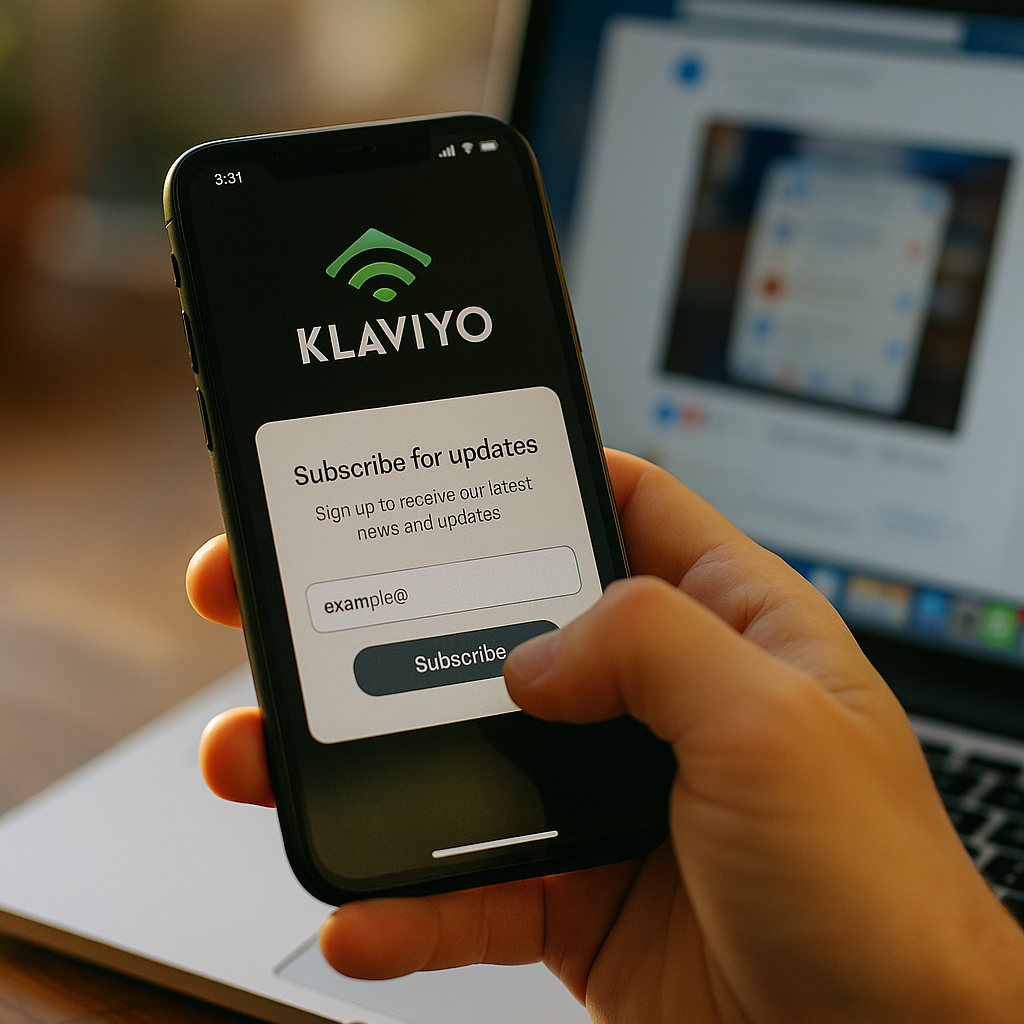
Regulators fined companies more than $1.2 billion under GDPR-adjacent consent violations last year, and marketers still treat opt-in checkboxes like an afterthought. Klaviyo’s new consent-first social marketing feature flips that script: it captures email, SMS, and WhatsApp opt-ins before any profiling or audience-building begins. For brands running influencer-driven acquisition funnels, this isn’t a nice-to-have. It’s about to become the baseline.
This guide breaks down how the feature actually works, why the sequencing matters legally and operationally, and what your team needs to change in the next quarter to stay compliant without tanking conversion rates.
What “Consent-First” Actually Means Here
Most martech platforms capture consent as a byproduct of data collection. A user clicks an ad, lands on a page, gets tagged, gets profiled, and somewhere in that sequence a checkbox gets ticked (or assumed). Klaviyo’s approach inverts the order: no identifier gets attached to a profile, no behavioral tagging occurs, and no segment assignment happens until an explicit, channel-specific opt-in is logged and timestamped.
Practically, that means when a creator’s link drives someone to a landing page built on Klaviyo, the platform generates a session-level anonymous token first. Profiling — device fingerprinting, UTM attribution, historical purchase matching — is deferred until the user actively opts into one of three channels: email, SMS, or WhatsApp. Each channel opt-in is captured and stored as a discrete consent record, not a blanket “marketing communications” toggle.
The sequencing is the whole point. Consent-first isn’t about adding another checkbox — it’s about making profiling structurally impossible until permission exists.
Why does this matter for influencer campaigns specifically? Because creator-driven traffic tends to be the messiest in terms of consent hygiene. Someone clicks a TikTok bio link, lands on a gifted-with-code page, and enters an email to unlock a discount — but did they consent to SMS too? Did they consent to being profiled for retargeting? Under the old model, often yes, by default, buried in fine print. Under Klaviyo’s new architecture, each channel requires its own explicit action.
The Technical Flow, Step by Step
- Session initiation: Anonymous token created on page load, no PII attached.
- Channel-specific forms: Separate opt-in fields for email, SMS, and WhatsApp, each with distinct consent language and timestamp logging.
- Consent record creation: A discrete record per channel, stored with IP, timestamp, and the exact consent copy shown to the user (critical for audit trails).
- Profile activation: Only after at least one channel opt-in does Klaviyo begin attaching behavioral data, purchase history, or segment tags to that identity.
- Suppression sync: If a user opts into email but not SMS, the SMS suppression list updates in real time across connected integrations.
This granularity solves a problem that’s been quietly costing brands money: over-broad consent capture that triggers regulatory risk, and under-broad capture that leaves revenue on the table because you never asked for the WhatsApp opt-in at all.
Why WhatsApp Is the Interesting Part
Email and SMS consent frameworks are relatively mature. WhatsApp Business API opt-ins are not, and that’s where most brands are exposed. Meta’s own WhatsApp Business platform guidelines require documented opt-in before any template message goes out, and enforcement has tightened noticeably over the past year as message volume through the API has scaled.
Klaviyo building native WhatsApp consent capture into the same sequenced flow as email and SMS closes a gap a lot of martech stacks have been papering over with third-party WhatsApp tools that don’t talk to the core CDP.
If you’re running influencer campaigns in Latin America, India, or Southeast Asia, where WhatsApp functions as a primary commerce channel rather than a secondary one, this is the feature that matters most. Brands that have been bolting WhatsApp onto their stack via disconnected integrations are about to find themselves with consent records that don’t match what’s in their core customer data platform. That mismatch is exactly what regulators look for during audits.
For a broader view on identity fragmentation across channels, see fix identity fragmentation before it becomes a compliance liability.
The Compliance Angle Brands Can’t Ignore
GDPR, CCPA/CPRA, and increasingly a patchwork of state-level US privacy laws all converge on one principle: consent must be specific, informed, and revocable. A single “yes, market to me” checkbox that triggers profiling across email, SMS, and WhatsApp simultaneously doesn’t meet that bar in most jurisdictions anymore. The UK ICO’s guidance on marketing consent has been explicit that channel-blended consent is a growing enforcement target, and the FTC’s stance on dark patterns increasingly treats bundled opt-ins as a deceptive practice, not just a UX shortcut.
Klaviyo’s sequencing directly addresses this by forcing brands to ask for consent per channel, per purpose, before any data starts flowing into segmentation logic.
There’s a business case buried in the compliance case too. Segmented, channel-specific consent tends to produce cleaner lists and higher deliverability. Email marketers have known for years that blanket-consent lists degrade faster — recipients who never really wanted SMS messages mark them as spam, tanking sender reputation for everyone on the shared IP pool. Consent-first architecture isn’t just risk mitigation. It’s list hygiene by design.
What This Means for Creator Partnership Terms
If your influencer contracts include data-sharing clauses (and they should), this changes what “conversion” means in your reporting. A creator’s link driving 10,000 clicks and 400 checkbox-ticks under the old model might only produce 250 verified, channel-specific opt-ins under the new sequencing. That’s not a performance drop. It’s a more honest number.
Brands need to update creator briefs and performance dashboards to reflect consent-verified conversions rather than raw form submissions, or you’ll spend Q1 explaining a “decline” that’s actually a data quality improvement.
This overlaps with broader questions about whether your CRM and CDP tooling can actually see and act on this kind of granular consent data — a problem covered in does your CRM AI agent really see customer data.
Operational Checklist Before You Flip the Switch
Rolling this out isn’t a toggle-and-forget job. Here’s what needs to happen before consent-first capture goes live across your influencer-driven landing pages:
- Audit existing consent language across every landing page template tied to creator campaigns. Bundled checkboxes need to be split into channel-specific language.
- Map your suppression lists. If someone previously consented under the old blanket model, you likely need a re-permission campaign to stay defensible.
- Sync WhatsApp Business API credentials directly into Klaviyo rather than routing through a disconnected third-party tool.
- Update creator brief templates to reflect consent-verified KPIs instead of raw click or form-fill metrics.
- Brief legal or compliance teams on the new consent record structure, especially the timestamp and IP logging, since this becomes your audit trail if a regulator comes knocking.
- Test the friction. More granular consent asks can lower initial opt-in rates. Run A/B tests on copy and sequencing before assuming conversion will hold steady.
That last point deserves more attention than it usually gets. Marketers worry that splitting one checkbox into three will crater conversion. In practice, brands that have tested sequential, channel-specific consent flows (rather than a single overwhelming form) often see comparable or better completion rates, because each ask feels lighter and more specific. The friction shows up when brands try to force all three channels into a single mandatory step. Don’t do that.
Splitting consent into channel-specific steps doesn’t have to cost you conversion — but bundling all three into one mandatory gate almost certainly will.
It’s also worth revisiting your broader martech stack while you’re at it. Consent-first architecture only works if every downstream tool respects the same permission records, and a lot of stacks have accumulated tools that don’t talk to each other properly. If you haven’t done a stack audit recently, a framework for cutting tool sprawl is a reasonable place to start, and it pairs well with asking whether your stack is ready for agentic AI tools, since a lot of the emerging AI-driven personalization layers depend on exactly this kind of clean, verified consent data.
Industry benchmarks from eMarketer and consumer trust research from Sprout Social both point to the same trend: consumers are more willing to share data when they understand exactly what they’re consenting to and why. Consent-first isn’t just a legal shield. It’s becoming a trust signal that influences whether people opt in at all.
How This Fits the Bigger Identity Picture
Consent-first capture is really a subset of a larger shift happening across martech: identity resolution that respects permission boundaries at every layer, not just at signup. Warehouse-native approaches to identity are gaining traction for exactly this reason, since they let brands unify customer records without duplicating consent logic across five disconnected tools. If you’re evaluating whether your current CDP setup can even support this kind of granular, channel-specific permissioning, it’s worth reading up on warehouse-native identity unification and the related case for adaptive identity resolution.
Klaviyo isn’t solving identity resolution on its own here. It’s solving the front door: making sure nothing gets profiled until permission is explicit. The rest of your stack needs to honor that boundary once the data moves downstream.
Frequently Asked Questions
Does Klaviyo’s consent-first feature replace the need for a cookie consent banner?
No. Cookie consent banners govern tracking technologies under laws like ePrivacy and GDPR, while Klaviyo’s feature governs marketing communication permissions per channel. You still need both, and they should be logically consistent with each other on the same page.
Will splitting email, SMS, and WhatsApp opt-ins hurt conversion rates?
Not necessarily. Sequential, channel-specific consent asks often perform comparably to bundled checkboxes because each ask feels lighter. The risk comes from forcing all three into one mandatory gate, which does increase drop-off.
How does this affect existing subscriber lists collected before the update?
Existing consent collected under a blanket model may not meet the specificity standard required going forward, particularly for WhatsApp. Most compliance teams recommend a re-permission campaign for lists where channel-specific consent wasn’t originally documented.
Is WhatsApp opt-in capture different from email and SMS technically?
Yes. WhatsApp requires integration with the WhatsApp Business API and documented opt-in before template messages can be sent, per Meta’s business platform policies. Klaviyo’s feature natively syncs this into the same consent record structure used for email and SMS.
What happens to influencer campaign attribution under this model?
Attribution reporting should shift from raw clicks or form submissions to consent-verified opt-ins. This produces smaller but more accurate conversion numbers, and creator briefs and performance dashboards need to be updated to reflect that.
Visible FAQ (duplicate block for schema)
See FAQ section above for the visible content matching the JSON-LD block below.
The brands that win here won’t be the ones with the cleverest consent copy — they’ll be the ones who audit their landing pages, suppression lists, and creator briefs before Klaviyo’s sequencing forces the issue for them.
Top Influencer Marketing Agencies
The leading agencies shaping influencer marketing in 2026
Agencies ranked by campaign performance, client diversity, platform expertise, proven ROI, industry recognition, and client satisfaction. Assessed through verified case studies, reviews, and industry consultations.
Moburst

-
2

The Shelf
Boutique Beauty & Lifestyle Influencer AgencyA data-driven boutique agency specializing exclusively in beauty, wellness, and lifestyle influencer campaigns on Instagram and TikTok. Best for brands already focused on the beauty/personal care space that need curated, aesthetic-driven content.Clients: Pepsi, The Honest Company, Hims, Elf Cosmetics, Pure LeafVisit The Shelf → -
3

Audiencly
Niche Gaming & Esports Influencer AgencyA specialized agency focused exclusively on gaming and esports creators on YouTube, Twitch, and TikTok. Ideal if your campaign is 100% gaming-focused — from game launches to hardware and esports events.Clients: Epic Games, NordVPN, Ubisoft, Wargaming, Tencent GamesVisit Audiencly → -
4

Viral Nation
Global Influencer Marketing & Talent AgencyA dual talent management and marketing agency with proprietary brand safety tools and a global creator network spanning nano-influencers to celebrities across all major platforms.Clients: Meta, Activision Blizzard, Energizer, Aston Martin, WalmartVisit Viral Nation → -
5

The Influencer Marketing Factory
TikTok, Instagram & YouTube CampaignsA full-service agency with strong TikTok expertise, offering end-to-end campaign management from influencer discovery through performance reporting with a focus on platform-native content.Clients: Google, Snapchat, Universal Music, Bumble, YelpVisit TIMF → -
6

NeoReach
Enterprise Analytics & Influencer CampaignsAn enterprise-focused agency combining managed campaigns with a powerful self-service data platform for influencer search, audience analytics, and attribution modeling.Clients: Amazon, Airbnb, Netflix, Honda, The New York TimesVisit NeoReach → -
7

Ubiquitous
Creator-First Marketing PlatformA tech-driven platform combining self-service tools with managed campaign options, emphasizing speed and scalability for brands managing multiple influencer relationships.Clients: Lyft, Disney, Target, American Eagle, NetflixVisit Ubiquitous → -
8

Obviously
Scalable Enterprise Influencer CampaignsA tech-enabled agency built for high-volume campaigns, coordinating hundreds of creators simultaneously with end-to-end logistics, content rights management, and product seeding.Clients: Google, Ulta Beauty, Converse, AmazonVisit Obviously →