


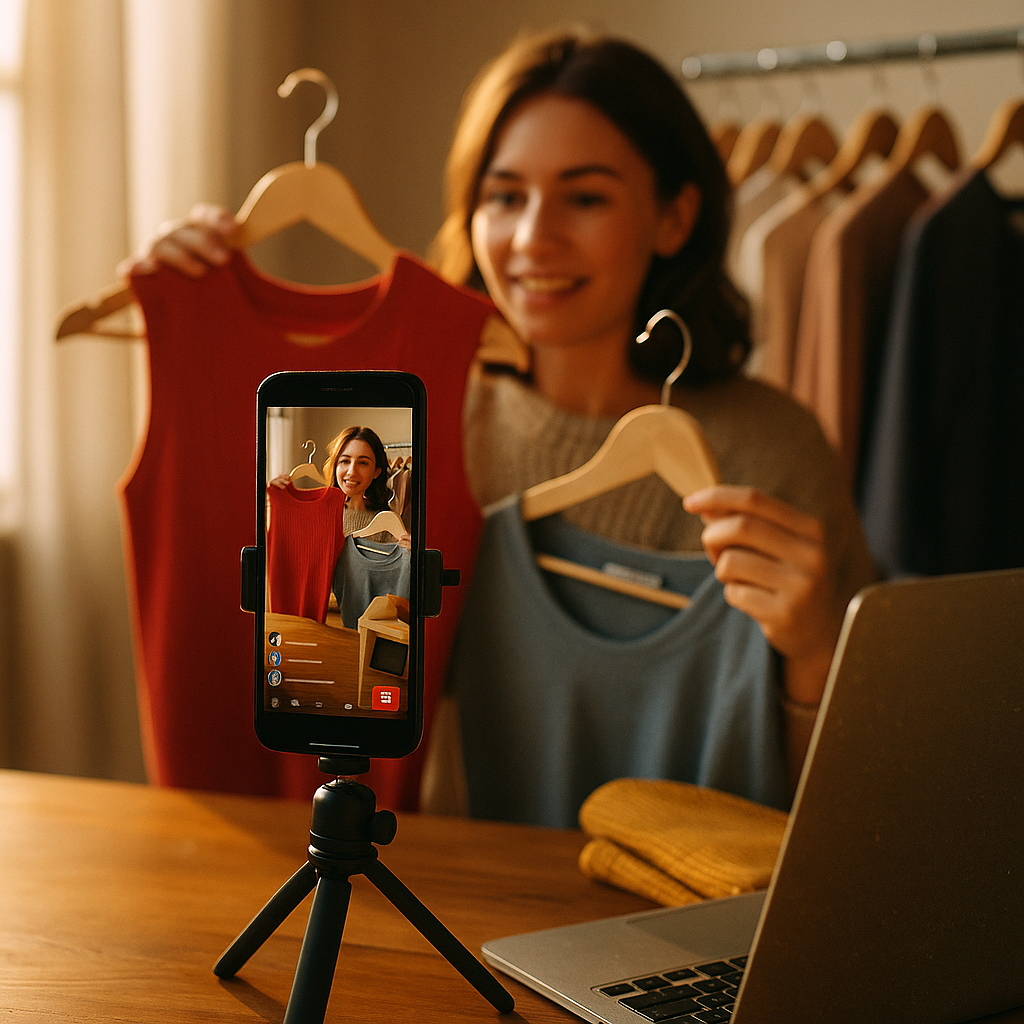
Social commerce is projected to top $1.2 trillion in global sales within the next two years, and brands are scrambling to figure out which format actually deserves the check. Shoppable video or live shopping? The honest answer is both, but not in equal measure, and not for every category. Here’s how the budget split is actually shaking out.
The Budget Split: Where the Money Is Actually Going
Ask ten brand marketers where their social commerce dollars are headed and you’ll get ten slightly different answers, but a pattern is emerging. Shoppable video, the pre-produced, tagged, swipe-to-buy clips that live permanently on a feed, is still absorbing the majority of budget. Live formats, the scheduled, hosted, often creator-fronted shopping events, are the fastest-growing line item even though they still trail in total spend.
Recent data from eMarketer suggests live commerce spend in mature markets is growing at roughly double the rate of evergreen shoppable video. That doesn’t mean live is winning outright. It means brands are testing it aggressively while keeping video as the dependable base layer.
The split isn’t shoppable video versus live shopping. It’s evergreen inventory versus event-driven spikes, and smart brands are budgeting for both simultaneously.
Shoppable Video: The Reliable Workhorse
Shoppable video earns its budget share because it’s predictable. A tagged product clip keeps converting for weeks, sometimes months, after it’s posted. It doesn’t require a live host, a scheduling calendar, or a war room on launch day. For brands managing lean teams, that’s not a small thing.
The economics also favor video for evergreen catalog items: skincare staples, apparel basics, home goods that don’t need urgency to sell. A well-tagged video from a mid-tier creator can keep generating affiliate revenue long after the campaign brief is closed. That’s part of why affiliate-based compensation has become the default structure for this format. Brands would rather pay a percentage of ongoing sales than a flat fee for content that keeps working.
Where shoppable video struggles is urgency. It doesn’t create the scarcity or event energy that drives a spike. That’s the gap live formats are filling.
Why Live Formats Are Eating Budget Faster Than Expected
Live shopping was supposed to be a Chinese-market phenomenon that never quite translated to Western audiences. That assumption is aging poorly. TikTok Shop’s live events, Amazon Live’s creator storefronts, and Instagram’s live shopping tools have all seen meaningful growth, and brands are reallocating budget accordingly.
Why now? A few reasons converge. Platforms have finally built the checkout infrastructure to make live purchases frictionless. Creators have gotten better at hosting, treating live sessions less like a QVC knockoff and more like a hangout with a shopping cart attached. And brands have realized live events generate a compressed sales spike that’s easy to measure against spend, which matters when finance teams are asking for proof.
That measurability connects directly to a broader shift covered in how sales lift became the default KPI for creator programs. Live events produce a clean before-and-after window that’s far easier to attribute than a slow-burn video campaign.
- Live sessions typically run 45 to 90 minutes and concentrate demand into a single window, useful for launches and limited drops.
- Conversion rates during live events often outperform standard shoppable video on a per-viewer basis, though total reach is usually smaller.
- Production costs are lower than people assume: a phone, a host, and a stable feed can outperform a polished pre-produced video for urgency-driven categories.
Platform by Platform: Who’s Winning the Format War
Not every platform treats these formats equally, and that matters for budget planning.
TikTok Shop has leaned hardest into live, positioning it as the centerpiece of its commerce strategy rather than a bolt-on feature. Brands running campaigns through TikTok’s ad platform are seeing live event tools baked directly into campaign management, which lowers the operational lift of running frequent sessions.
Instagram still favors shoppable video and Reels-based tagging, with live shopping treated more as a supplementary tool through Meta’s business suite. Brands using Instagram tend to allocate the bulk of commerce budget to video and reserve live for major launches only.
YouTube Shopping sits somewhere in between, with long-form shoppable video dominating but live premieres gaining traction for bigger product drops.
Amazon Live is a live-first environment by design, which makes it the exception rather than a hybrid.
The practical implication: budget allocation shouldn’t be uniform across platforms. A brand splitting 70/30 toward video on Instagram might run closer to 50/50 or even flip the ratio on TikTok. Chasing a single global ratio ignores how differently each platform has built its commerce stack.
Operational Risks Nobody Budgets For
Live shopping looks simple until you’ve run one badly. A dropped feed, a host who fumbles pricing, a checkout link that breaks mid-stream, these aren’t hypotheticals. They’re the reason live commerce still carries higher operational risk than shoppable video, even when the sales upside looks attractive.
There’s also a staffing question. Live events need real-time moderation, someone watching comments for compliance issues, and a backup plan if the primary host disconnects. Brands that treat live shopping as a lightweight add-on to an existing creator brief tend to get burned. The ones getting it right are building dedicated ops around it, which echoes the broader trend of creator partnership teams becoming permanent infrastructure rather than campaign-by-campaign hires.
Live commerce isn’t a content format, it’s an event. Budget for it like one, with contingency plans, not like a video shoot with a shopping button attached.
Compliance is another underweighted risk. Live sessions are harder to review before they go out, since there’s no pre-publish approval step. Brands operating in regulated categories (health, finance, anything FTC-sensitive) need clear disclosure protocols baked into the host’s script, not left to improvisation. The FTC’s endorsement guidelines apply just as strictly to live streams as they do to static posts, and enforcement doesn’t care that the content was unscripted.
Building the Split That Actually Works
There’s no universal ratio, but a few principles hold across categories. Evergreen, considered-purchase products (skincare, tech accessories, home goods) tend to perform better on shoppable video because buyers want time to evaluate. Limited drops, flash sales, and anything with built-in scarcity favors live formats, where urgency does the selling.
A workable starting framework for mid-sized brands testing the split:
- Allocate 60 to 70 percent of commerce budget to shoppable video for catalog depth and always-on conversion.
- Reserve 20 to 30 percent for scheduled live events tied to launches, restocks, or seasonal moments.
- Keep a flexible 10 percent to react to platform algorithm shifts or unexpected creator opportunities.
This isn’t a static formula. Categories with strong drop culture (sneakers, beauty limited editions, collectibles) should skew the ratio harder toward live. Categories built on repeat, considered purchases should lean further into video. The point is to stop treating this as an either/or decision and start treating it as a portfolio allocation, the same way ROI data has already pulled broader influencer budgets away from single-channel bets and toward diversified spend.
Measurement discipline matters here too. If you’re not tracking video and live performance separately, with separate CPMs and conversion benchmarks, you’re flying blind on which format is actually earning its keep. Tools from Sprout Social and reporting frameworks from HubSpot can help separate these data streams instead of lumping “social commerce” into one blended number that hides which format is doing the work.
It’s also worth remembering that format performance is downstream of creator selection. A high-follower creator doesn’t automatically drive better live conversion, and the same logic that shows niche creators beating celebrity reach on qualified leads applies just as much to who’s hosting your live event as who’s starring in your shoppable video.
What This Means for Budget Planning Next Cycle
The brands getting social commerce right aren’t picking a winner between shoppable video and live shopping. They’re building a deliberate split, weighted by category, platform, and purchase intent, then measuring each format on its own terms instead of one blended metric. Start your next budget cycle by auditing which of your SKUs actually benefit from urgency, and let that answer drive the ratio rather than a platform’s sales pitch.
Frequently Asked Questions
What’s the difference between shoppable video and live shopping in social commerce?
Shoppable video refers to pre-produced, tagged content that stays live indefinitely and generates ongoing conversions. Live shopping is a scheduled, hosted event where a creator or brand sells in real time, typically producing a concentrated sales spike rather than sustained long-term traffic.
Which social commerce format has better ROI?
It depends on the product category. Evergreen, considered purchases tend to perform better with shoppable video, while limited drops and scarcity-driven products often see stronger per-viewer conversion during live events. Neither format consistently outperforms the other across all categories.
How much budget should brands allocate to live shopping?
Most mid-sized brands are finding success allocating 20 to 30 percent of social commerce budget to live formats, reserving the majority for evergreen shoppable video, then adjusting based on category and platform performance.
Which platforms prioritize live shopping over shoppable video?
TikTok Shop and Amazon Live have built their commerce infrastructure around live formats. Instagram and YouTube still favor shoppable video as the primary format, treating live shopping as a supplementary tool for major launches.
What compliance risks come with live shopping campaigns?
Live sessions can’t be pre-approved before publishing, which raises disclosure and endorsement risk. Brands need clear FTC-compliant disclosure protocols built into host scripts and real-time moderation to catch compliance issues as they happen.
Top Influencer Marketing Agencies
The leading agencies shaping influencer marketing in 2026
Agencies ranked by campaign performance, client diversity, platform expertise, proven ROI, industry recognition, and client satisfaction. Assessed through verified case studies, reviews, and industry consultations.
Moburst

-
2

The Shelf
Boutique Beauty & Lifestyle Influencer AgencyA data-driven boutique agency specializing exclusively in beauty, wellness, and lifestyle influencer campaigns on Instagram and TikTok. Best for brands already focused on the beauty/personal care space that need curated, aesthetic-driven content.Clients: Pepsi, The Honest Company, Hims, Elf Cosmetics, Pure LeafVisit The Shelf → -
3

Audiencly
Niche Gaming & Esports Influencer AgencyA specialized agency focused exclusively on gaming and esports creators on YouTube, Twitch, and TikTok. Ideal if your campaign is 100% gaming-focused — from game launches to hardware and esports events.Clients: Epic Games, NordVPN, Ubisoft, Wargaming, Tencent GamesVisit Audiencly → -
4

Viral Nation
Global Influencer Marketing & Talent AgencyA dual talent management and marketing agency with proprietary brand safety tools and a global creator network spanning nano-influencers to celebrities across all major platforms.Clients: Meta, Activision Blizzard, Energizer, Aston Martin, WalmartVisit Viral Nation → -
5

The Influencer Marketing Factory
TikTok, Instagram & YouTube CampaignsA full-service agency with strong TikTok expertise, offering end-to-end campaign management from influencer discovery through performance reporting with a focus on platform-native content.Clients: Google, Snapchat, Universal Music, Bumble, YelpVisit TIMF → -
6

NeoReach
Enterprise Analytics & Influencer CampaignsAn enterprise-focused agency combining managed campaigns with a powerful self-service data platform for influencer search, audience analytics, and attribution modeling.Clients: Amazon, Airbnb, Netflix, Honda, The New York TimesVisit NeoReach → -
7

Ubiquitous
Creator-First Marketing PlatformA tech-driven platform combining self-service tools with managed campaign options, emphasizing speed and scalability for brands managing multiple influencer relationships.Clients: Lyft, Disney, Target, American Eagle, NetflixVisit Ubiquitous → -
8

Obviously
Scalable Enterprise Influencer CampaignsA tech-enabled agency built for high-volume campaigns, coordinating hundreds of creators simultaneously with end-to-end logistics, content rights management, and product seeding.Clients: Google, Ulta Beauty, Converse, AmazonVisit Obviously →