


Fifty-three percent of shoppers abandon a site after a single bad search experience, according to Statista consumer behavior data. Yet most Shopify brands still run search, recommendations, and personalization as three disconnected tools that never talk to each other. Bloomreach’s Loomi AI wants to collapse that stack into one brain. The question worth asking before you rip out your current setup: does unified beat best-of-breed, or is that just a vendor’s pitch dressed up as strategy?
What Loomi AI Actually Does on Shopify
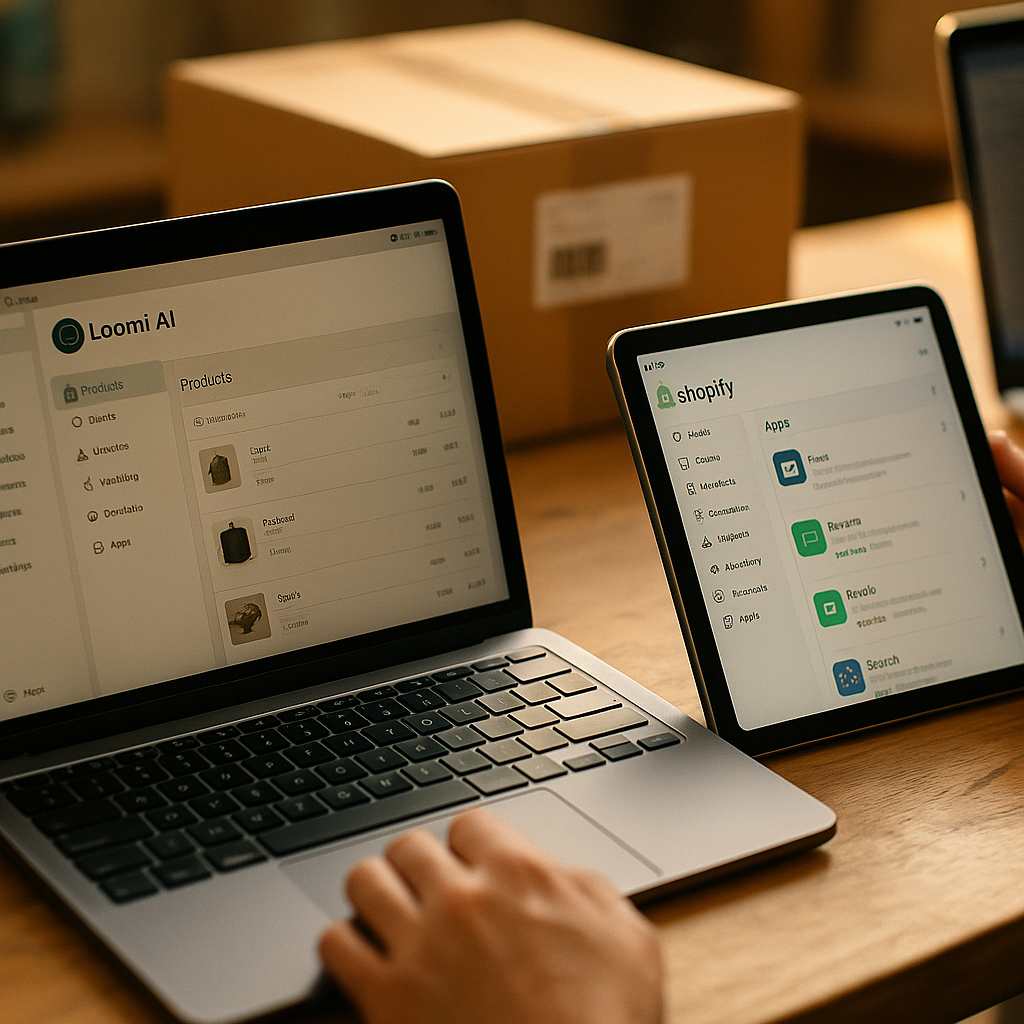
Loomi AI is Bloomreach’s generative layer sitting on top of its Discovery engine, now packaged as a native Shopify app. It handles product search, category merchandising, and on-site recommendations from a single data model, rather than three separate ones feeding off different logic. The pitch: instead of your search vendor guessing intent from keywords, your recommendation engine guessing from browsing history, and your personalization tool guessing from email behavior, one system learns from all three simultaneously.
For a mid-market Shopify Plus merchant, that’s not a small distinction. It’s the difference between a customer searching “waterproof hiking boots,” seeing relevant results, and then getting recommended a rain jacket because the system understands intent, not just keyword match. Point solutions can approximate this. Loomi claims to do it natively, without the API gymnastics.
The Point-Solution Stack Isn’t Dead, It’s Just Expensive
Let’s be honest about why most brands ended up with fragmented stacks in the first place: each tool was genuinely best-in-class at launch. A dedicated search vendor like Algolia or Klevu often out-performs bundled search in raw relevance tuning. A standalone recommendation engine can be tuned tighter for specific verticals. The stack grew because specialization won, tool by tool.
The cost shows up later. Data has to sync across systems, usually through middleware or custom API work. Each tool has its own admin panel, its own support contract, its own renewal cycle. Marketing ops teams end up spending as much time managing integrations as they do optimizing campaigns. That’s the real tax nobody prices into the initial tool evaluation.
The real cost of a point-solution stack isn’t the software fees — it’s the headcount spent reconciling data between tools that were never designed to share a brain.
Where Unification Actually Pays Off
Unified personalization wins clearest in mid-funnel behavior: a shopper who searches, browses, abandons, and returns days later. If search and recommendations share the same customer graph, that return visit picks up context instantly. In a fragmented stack, the recommendation engine often starts cold, treating the returning visitor like a stranger because it never received the search signal in the first place.
Bloomreach reports engagement lift figures in the double digits for merchants who consolidate search and recommendations onto Loomi, though as with any vendor-supplied benchmark, treat that as a directional signal rather than gospel. Ask for case studies in your specific vertical before you believe the topline number. Furniture and fashion behave very differently from grocery or electronics when it comes to search-to-recommendation handoff.
Where a Best-of-Breed Stack Still Wins
Unification isn’t automatically superior. If your brand runs a highly specialized catalog — think configurable industrial parts, or a beauty brand with deep shade-matching logic — a purpose-built search tool may simply out-tune a generalist. Loomi’s AI is strong at pattern recognition across large catalogs, but niche logic sometimes needs a niche vendor.
There’s also a lock-in consideration. Moving your entire search and recommendation layer onto one vendor’s AI model means your merchandising strategy is now tied to that vendor’s roadmap. If Bloomreach shifts pricing, changes its model architecture, or gets acquired, you’re migrating everything at once instead of swapping one component. That’s a real risk, not a hypothetical one — martech consolidation has accelerated acquisition activity across the sector in the past two years.
This tension mirrors what we’ve seen play out in adjacent categories. Our comparison of AI martech platforms found the same pattern: unification wins on operational efficiency, but locks you into one vendor’s AI logic for better or worse.
The Data Model Question Nobody Asks Early Enough
Before evaluating Loomi against a stack, ask a harder question: whose customer data model wins? If you’re running a customer data platform separately from your commerce stack, you already have a source of truth for identity and behavior. Layering Loomi on top means deciding whether Bloomreach’s engagement data feeds your CDP, or your CDP feeds Bloomreach, or both try to reconcile independently and create duplicate profiles.
This is the same architectural fault line we flagged when comparing AI-native CDPs against legacy platforms. Unified personalization tools are only as good as the identity resolution underneath them. A brilliant recommendation engine fed bad or duplicated customer records will still produce mediocre results.
Total Cost of Ownership, Realistically
Point solutions are usually cheaper per-tool but more expensive in aggregate once you count integration labor, data engineering, and the opportunity cost of slow iteration. A unified platform like Loomi typically costs more upfront in licensing but reduces the hidden operational overhead.
Run the math for your own org before committing either way:
- Integration headcount: How many FTEs currently maintain API connections between your search, recommendation, and personalization tools?
- Time-to-launch for new merchandising rules: Does a promotional push require touching three admin panels or one?
- Vendor renewal overlap: Are you paying for redundant AI features across tools that Loomi would consolidate?
- Data latency: How long does it take for a search event to influence a recommendation in your current stack — instant, hourly, or daily batch?
That last point is often the tiebreaker. Batch-based syncing between disconnected tools means your “personalization” is really yesterday’s personalization. Loomi’s pitch rests heavily on real-time signal sharing, which matters more for high-velocity categories like flash-sale fashion than for considered purchases like furniture.
Compliance and Data Governance Don’t Disappear With Consolidation
Merging systems doesn’t remove your obligations around consent and data use — it just centralizes them. A single vendor holding your search, browsing, and purchase behavior in one model means a single point of failure if that vendor mishandles consent signals or cross-border data transfer. Review Bloomreach’s data processing terms against your obligations under regimes referenced by the FTC and, for UK/EU operations, the ICO.
This isn’t unique to Loomi. Any consolidation play — CDP, CRM, or commerce AI — raises the stakes on vendor due diligence. We’ve covered this same governance gap in what to verify before connecting martech systems, and the checklist applies just as well here: data residency, retention windows, and model training use of your customer data all need contract-level clarity, not marketing-page assurances.
A Practical Evaluation Framework
Rather than debating unified versus point-solution in the abstract, run a structured pilot. Bloomreach typically allows a phased rollout on Shopify — search first, then recommendations, then full personalization. Use that sequencing to your advantage:
- Benchmark current search relevance and recommendation click-through against Loomi in an A/B split for 60-90 days.
- Track integration hours saved (or spent) against your current point-solution maintenance load.
- Stress-test the vendor’s uptime and latency claims under your actual traffic, not their demo environment.
- Confirm data portability terms before signing a multi-year contract — know what happens if you need to exit.
This mirrors the diligence approach we’ve recommended for evaluating autonomous decisioning in CDPs — treat AI vendor claims as hypotheses to test, not facts to accept. Our autonomous decisioning vetting guide and the broader MCP adoption scorecard both apply the same discipline: pilot before you consolidate, and get the exit terms in writing.
So, Which One Actually Wins?
For most mid-market Shopify merchants running 10,000-100,000 SKUs with a lean ops team, unified personalization through Loomi likely reduces total overhead and speeds up merchandising iteration. For large enterprise catalogs with highly specialized search logic, or brands already deeply invested in a best-of-breed stack that’s performing well, ripping it out for the sake of unification is a solution looking for a problem.
The honest answer is that “unified beats point-solution” is not universally true — it’s true for teams whose bottleneck is integration overhead, and false for teams whose bottleneck is search precision in a niche category. Diagnose your actual bottleneck before choosing your architecture.
Frequently Asked Questions
Is Loomi AI only available for Shopify stores?
No. Loomi AI is Bloomreach’s broader generative AI layer across its Discovery and Engagement products, but it’s now packaged as a native Shopify app for easier installation on Shopify Plus and standard Shopify stores.
How long does a Loomi AI migration typically take?
Phased rollouts (search, then recommendations, then full personalization) commonly run 60-120 days depending on catalog size and existing data cleanliness. Brands with messy product data or duplicate SKUs should expect longer timelines for data normalization before AI performance stabilizes.
Does unifying search and recommendations always improve conversion rates?
Not automatically. Gains depend on category velocity, catalog size, and how disconnected your prior stack was. Brands with already-tight point-solution integrations see smaller lift than those running fully siloed, batch-synced tools.
What happens to my existing search vendor contract if I switch to Loomi?
You’ll need to run parallel systems during a testing window, then formally exit your prior vendor contract. Review termination notice periods and data export terms before starting a Loomi pilot to avoid double-paying during transition.
Can Loomi AI integrate with a separate CDP I already use?
Yes, though integration depth varies. Confirm whether Bloomreach treats your CDP as the source of identity truth or maintains its own customer graph — reconciling both incorrectly can create duplicate or conflicting customer profiles.
Run a 90-day A/B pilot before committing to either architecture, and make vendor exit terms non-negotiable in the contract — that’s the difference between a strategic upgrade and a costly lock-in mistake.
Top Influencer Marketing Agencies
The leading agencies shaping influencer marketing in 2026
Agencies ranked by campaign performance, client diversity, platform expertise, proven ROI, industry recognition, and client satisfaction. Assessed through verified case studies, reviews, and industry consultations.
Moburst

-
2

The Shelf
Boutique Beauty & Lifestyle Influencer AgencyA data-driven boutique agency specializing exclusively in beauty, wellness, and lifestyle influencer campaigns on Instagram and TikTok. Best for brands already focused on the beauty/personal care space that need curated, aesthetic-driven content.Clients: Pepsi, The Honest Company, Hims, Elf Cosmetics, Pure LeafVisit The Shelf → -
3

Audiencly
Niche Gaming & Esports Influencer AgencyA specialized agency focused exclusively on gaming and esports creators on YouTube, Twitch, and TikTok. Ideal if your campaign is 100% gaming-focused — from game launches to hardware and esports events.Clients: Epic Games, NordVPN, Ubisoft, Wargaming, Tencent GamesVisit Audiencly → -
4

Viral Nation
Global Influencer Marketing & Talent AgencyA dual talent management and marketing agency with proprietary brand safety tools and a global creator network spanning nano-influencers to celebrities across all major platforms.Clients: Meta, Activision Blizzard, Energizer, Aston Martin, WalmartVisit Viral Nation → -
5

The Influencer Marketing Factory
TikTok, Instagram & YouTube CampaignsA full-service agency with strong TikTok expertise, offering end-to-end campaign management from influencer discovery through performance reporting with a focus on platform-native content.Clients: Google, Snapchat, Universal Music, Bumble, YelpVisit TIMF → -
6

NeoReach
Enterprise Analytics & Influencer CampaignsAn enterprise-focused agency combining managed campaigns with a powerful self-service data platform for influencer search, audience analytics, and attribution modeling.Clients: Amazon, Airbnb, Netflix, Honda, The New York TimesVisit NeoReach → -
7

Ubiquitous
Creator-First Marketing PlatformA tech-driven platform combining self-service tools with managed campaign options, emphasizing speed and scalability for brands managing multiple influencer relationships.Clients: Lyft, Disney, Target, American Eagle, NetflixVisit Ubiquitous → -
8

Obviously
Scalable Enterprise Influencer CampaignsA tech-enabled agency built for high-volume campaigns, coordinating hundreds of creators simultaneously with end-to-end logistics, content rights management, and product seeding.Clients: Google, Ulta Beauty, Converse, AmazonVisit Obviously →