


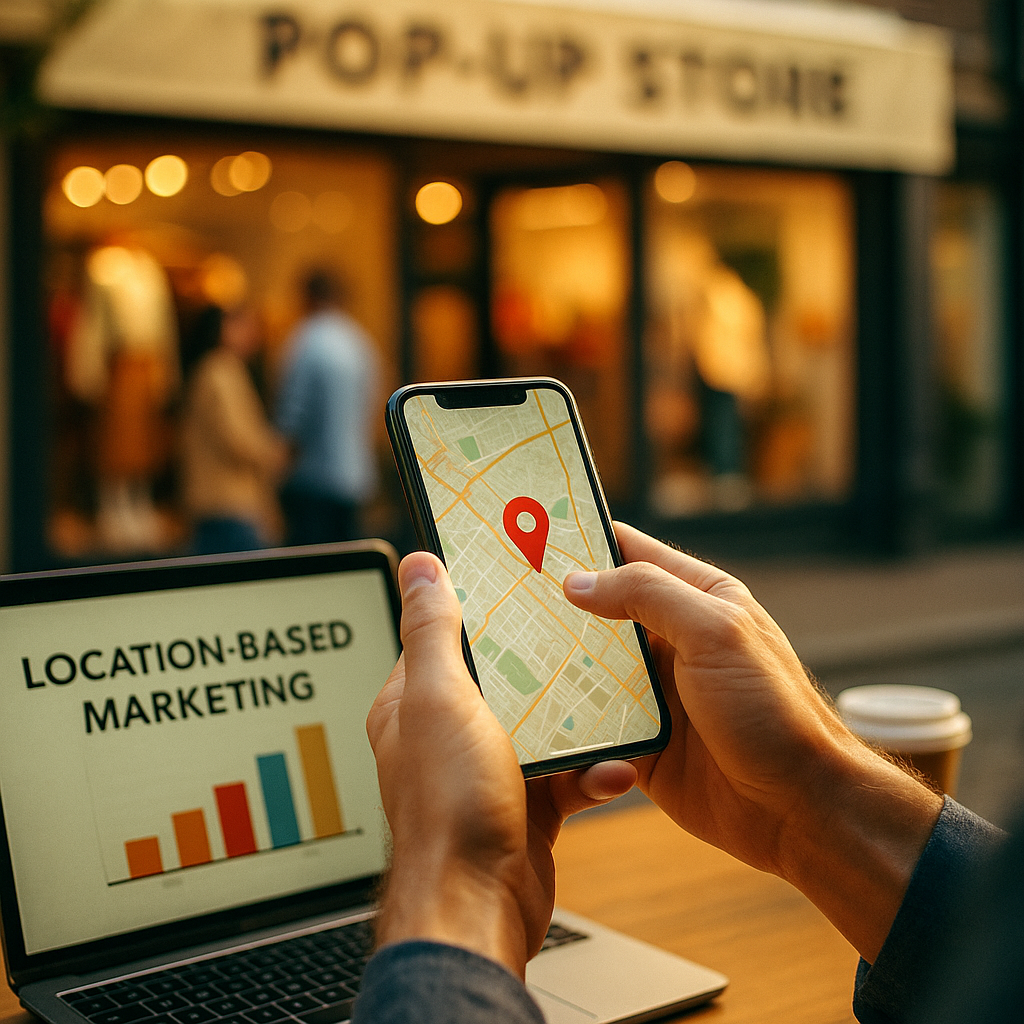
Mastering location-based marketing is the fastest way to turn a pop-up from “nice idea” into a revenue-generating, foot-traffic magnet. In 2025, shoppers expect timely, nearby offers, and pop-ups win when they appear in the right place with the right message. This guide breaks down practical tactics, tools, and measurement so you can launch smarter, spend efficiently, and build repeatable success—starting with your next site.
Location-based marketing strategy: start with goals, audiences, and trade areas
Pop-up retail succeeds when you treat location as a performance channel, not just a venue choice. Before picking platforms or designing ads, define the outcome you want in plain numbers: daily footfall, conversion rate, average order value, email/SMS sign-ups, or a product launch “trial count.” Then align your location-based marketing strategy to the decisions people make within a limited radius and timeframe.
Build three simple maps:
- Primary trade area: where most walk-ins will originate (often 5–20 minutes travel time depending on the city and transit).
- Secondary trade area: adjacent neighborhoods where you can win with stronger incentives or targeted messaging.
- Competitor and complement map: competitors, plus high-synergy neighbors (gyms, cafés, coworking spaces, entertainment venues) that can feed your pop-up.
Segment for intent, not demographics alone. A pop-up can attract “gift buyers,” “trend-seekers,” “last-minute planners,” or “fans of a creator collab.” Pair each segment with a micro-moment and an appropriate distance trigger. For example, gift buyers respond near transit hubs and lunch-hour corridors; trend-seekers respond near event venues and fashion districts.
Answer the follow-up question: “How do I pick the best radius?” Use travel time, not miles. In dense areas, a 10-minute walk radius can outperform a 1-mile radius. In suburban zones, a 10–15 minute drive radius usually aligns better with real behavior. Treat radius as an experiment variable you can tighten or expand based on early performance.
Geo-targeting for pop-up shops: choose the right tactics (geo-fencing, geo-conquesting, and radius ads)
Geo-targeting for pop-up shops works best when you match tactics to shopper intent and the pop-up’s lifecycle. Your first week may prioritize awareness; your final weekend may prioritize urgency and conversion. Use a mix of approaches so you’re not dependent on one channel’s inventory or attribution model.
Core tactics to deploy:
- Radius targeting: Show ads to people within a set travel time of the pop-up. Best for “nearby now” messaging like limited drops or same-day perks.
- Geo-fencing: Create a virtual boundary around a zone (street cluster, mall, event). Useful for capturing high-intent audiences near complementary locations.
- Geo-conquesting: Target visitors to competitor areas with a clear differentiator. Keep it ethical and value-led: compare benefits, not insults.
- Venue and event targeting: Align messaging with concerts, sports, conferences, or seasonal markets. Pop-ups thrive on event-driven foot traffic.
How to avoid wasted spend:
- Layer by time: Run stronger bids during peak hours and commute windows, and lower spend overnight.
- Exclude irrelevant areas: Industrial zones, low-access blocks, or regions separated by physical barriers (highways, rivers) that reduce walkability.
- Cap frequency: Overexposure irritates locals fast. Set frequency caps and rotate creatives weekly.
What messaging converts best near a pop-up? Keep it simple and specific: “2 blocks away,” “Open until 8,” “Try it in person,” “Limited-run item,” “Free customization today.” Pair proximity with a tangible reason to visit right now.
Hyperlocal advertising: creative, offers, and local context that drive foot traffic
Hyperlocal advertising wins because it feels like a helpful tip, not a generic brand ad. Pop-ups have a built-in advantage: scarcity. Your job is to translate that scarcity into locally relevant creative that people can act on immediately.
Creative principles that perform in hyperlocal ads:
- Show the exact destination: storefront photo, recognizable corner, or landmark. Reduce uncertainty and “Where is it?” friction.
- Use location cues in copy: neighborhood names, cross streets, nearby transit stops, or “next to” references.
- Highlight a single action: “Reserve,” “Walk in,” “Pick up,” “Try on,” or “Meet the maker.” Too many options reduce response.
- Make the offer measurable: a QR code, a keyword for staff, or a scannable mobile pass that ties back to the campaign.
Offer frameworks that don’t cheapen the brand:
- Experience-first: free personalization, mini-workshop, tasting, early access slot.
- Community-first: donate per purchase to a local cause, neighborhood resident perk with proof of address, or partner with nearby businesses.
- Scarcity-first: limited quantity items, timed drops, or “today only” bundles.
Build trust fast (EEAT): Include clear store hours, return policy basics, accessibility notes, and staff presence details. If you sell regulated products or handle sensitive categories, add compliance language and make it easy to contact you. Trust boosts conversion and reduces negative reviews.
Answer the follow-up question: “Should I localize landing pages?” Yes. Create a dedicated pop-up page with address, embedded map link, event calendar, FAQs, and an email/SMS sign-up. Track it separately from your main store so you can evaluate the pop-up’s true performance.
Proximity marketing with mobile: SMS, push, QR, and in-store measurement
Proximity marketing with mobile turns nearby attention into trackable actions. In 2025, shoppers may see your ad and still need one more nudge: a reminder, a reservation link, or a fast path to purchase. Mobile-first execution also improves attribution because you can connect clicks, scans, and redemptions to location.
High-performing proximity tools:
- SMS capture: Offer a reason to join (exclusive drop time, VIP line, in-store credit). Use double opt-in and state message frequency clearly.
- Mobile wallet passes: A scannable pass can store the offer, update with push-style alerts, and simplify redemption.
- QR codes: Place at the entrance, fitting rooms, product tables, and partner locations nearby. Each QR should represent one intent (menu, booking, join list, product details).
- Short links with UTM parameters: Great for posters, receipts, and partner mentions where QR scanning may be inconsistent.
In-store tracking that respects privacy:
- Redemption-based attribution: keyword, barcode, or QR scan at checkout tied to a campaign.
- Consent-based analytics: track sign-ups and customer journeys through opt-in forms rather than passive collection.
- Footfall counters: simple door counters help you separate “busy” from “profitable.” Compare footfall to transactions to spot conversion issues.
Answer the follow-up question: “How soon should I message new sign-ups?” Within minutes while intent is highest. Send a welcome text with the address and hours, then a second message timed to the next peak window (for example, late afternoon). Keep it concise, include an opt-out, and avoid daily blasts unless the pop-up is very short-lived and the value is clear.
Local SEO for pop-ups: listings, maps, reviews, and “near me” discovery
Local SEO for pop-ups is not optional. Many shoppers discover pop-ups through map apps and “near me” searches, especially when they are already in the area. The key is to reduce confusion: pop-ups can be temporary, and temporary businesses often lose traffic because of inaccurate hours or incomplete listings.
Checklist for strong map visibility:
- Create a dedicated location presence: If your platform supports it, set up a temporary location listing or a clearly labeled “Pop-up” profile. Use consistent name, address, and phone formatting everywhere.
- Confirm hours and special hours: Update for events, early closures, or private sessions. Inaccurate hours create negative reviews quickly.
- Add photos weekly: storefront, interior, hero products, and a clear “how to find us” photo. Visual certainty drives visits.
- Use local keywords naturally: neighborhood names, nearby landmarks, and “pop-up” wording in your description and site page.
- Publish short updates: announce drops, collabs, or weekend activations through your local profile if the platform supports posts.
Reviews are an acquisition channel. Ask for reviews at the moment of delight (after a customization, after a helpful fitting, after a smooth pickup). Make it easy with a QR at checkout and on receipts. Respond to reviews quickly, especially if someone reports difficulty finding the location.
Answer the follow-up question: “What if my pop-up is inside another store?” Be explicit: “Located inside [Host Name], second floor,” include entrance instructions, and add photos showing the path. Confusion kills intent, and the shopper will default to the nearest alternative.
Retail analytics and attribution: prove ROI, optimize fast, and scale to the next city
Pop-ups reward teams that measure daily and adjust quickly. Retail analytics and attribution do not need to be complex, but they must be consistent. Your goal is to connect each location tactic to outcomes: visits, sales, sign-ups, and repeat purchases after the pop-up ends.
Use a simple measurement framework:
- Inputs: ad spend, promo cost, staffing, event fees, partnerships.
- Leading indicators: map views, direction requests, landing page clicks, QR scans, SMS sign-ups, reservation volume.
- Core outcomes: footfall, conversion rate, revenue, margin, average order value, units per transaction.
- Lagging outcomes: repeat purchases online, list growth value, customer lifetime value projections.
Attribution methods that work for pop-ups:
- Offer-code attribution: One code per channel (paid social, search, partners, flyers). Keep codes short and readable.
- Geo holdout testing: Run ads in one comparable area and withhold in another for a short period to estimate lift.
- Time-based analysis: Compare hour-by-hour footfall and sales against ad delivery and SMS timing.
Operational tweaks that lift performance quickly:
- If footfall is high but conversion is low: simplify product assortment, add clear pricing, shorten lines, improve staff scripting, and create a “fast buy” table.
- If ads drive clicks but not visits: fix directions, add landmark cues, clarify parking/transit, and tighten the radius to higher-intent zones.
- If visits are strong but AOV is low: introduce bundles, limited add-ons, or an in-store-only premium option.
Build a repeatable playbook. After the pop-up, document what worked by neighborhood type, radius settings, offers, and partner sources. That knowledge is your advantage when you expand to the next market.
FAQs
What is location-based marketing in pop-up retail?
It is the use of geographic signals—such as proximity, neighborhoods, venues, and travel time—to deliver relevant ads, messages, and experiences that drive visits to a temporary store and measure the results.
How far should I target around my pop-up?
Start with a travel-time radius: about 10 minutes walking in dense urban areas and 10–15 minutes driving in suburban areas. Then refine based on direction requests, visit rates, and conversion data from the first few days.
Which channels work best for geo-targeted pop-up campaigns?
Typically, a mix performs best: map and local search for intent, paid social for discovery, and SMS/retargeting for reminders. Add partnerships with nearby venues to capture existing foot traffic.
How do I measure whether geo-targeted ads actually bring people in?
Use redemption codes, QR scans, and opt-in sign-ups tied to specific campaigns. Pair that with footfall counts and hourly sales data to identify lift during ad and message windows.
Is geo-fencing privacy-safe?
It can be when implemented responsibly. Use consent-based data collection whenever possible, avoid sensitive location targeting, and focus on aggregated performance reporting rather than attempting to identify individuals.
What should my pop-up landing page include?
Address with a map link, hours (including special hours), clear photos, how-to-find-us directions, current offer or event details, accessibility notes, and an email/SMS sign-up with transparent consent language.
How early should I start promoting a pop-up?
Begin awareness 2–4 weeks out if the pop-up is significant, then shift to proximity-heavy messaging during the final week and throughout the run. If it is a very short activation, start earlier with list-building and partner announcements.
Can I succeed with location-based marketing on a small budget?
Yes. Tight radiuses, time-of-day scheduling, partner placements, strong local listings, and measurable offers often outperform broad targeting. Allocate spend to the best-performing hours and neighborhoods after the first 72 hours of data.
What is the biggest mistake brands make with pop-up geo-targeting?
Targeting too broadly with generic creative. Pop-ups need “right here, right now” specificity—clear directions, accurate hours, and a compelling reason to visit today.
Conclusion
Location is your pop-up’s growth engine when you treat it as a measurable marketing channel. Set clear goals, use travel-time targeting, deploy hyperlocal creative, and connect mobile-first tactics to trackable offers. Keep your map presence accurate and review-ready, then optimize daily using simple attribution. The takeaway: build a repeatable, data-backed local playbook so every new pop-up launches faster and performs better.