


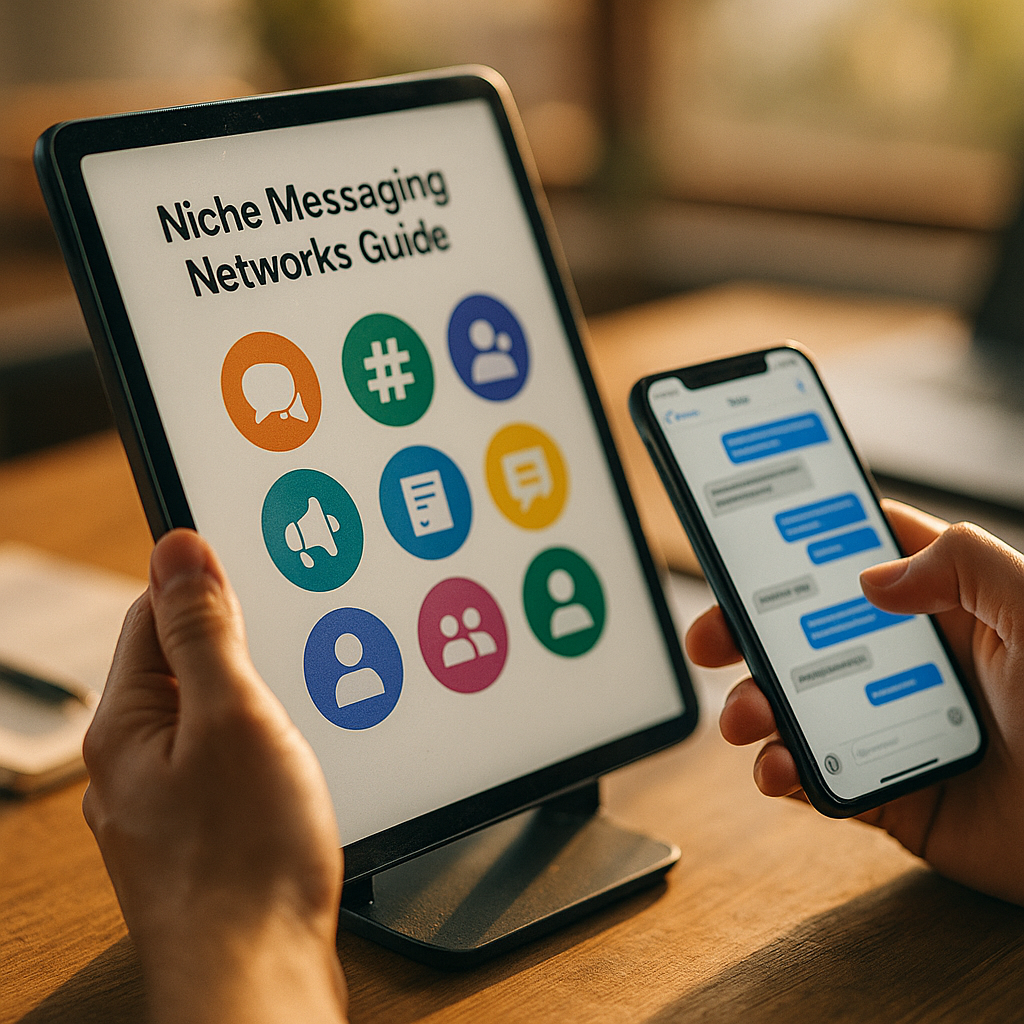
In 2025, buyers and candidates increasingly live inside specialized communities, not public feeds. This playbook for reaching leads on niche professional messaging networks shows how to earn access, start credible conversations, and convert interest without spam. You will learn where these networks sit in your funnel, what to say, and how to measure outcomes. Ready to turn “hard-to-reach” into reachable?
Why niche messaging networks outperform broad channels for targeted B2B outreach
Niche professional messaging networks are private, role-based environments where members expect practical peer exchange. Think communities attached to industry tools, trade associations, accredited groups, alumni spaces, paid masterminds, or invite-only operator circles. These environments tend to outperform broad social platforms for targeted B2B outreach because intent is higher and noise is lower.
To use them effectively, treat them as relationship infrastructure rather than an ad channel. The goal is not volume; it is precision and trust. Leads in these spaces often have stronger buying power because membership itself signals seniority, specialization, or budget ownership. Your first job is to match the network’s purpose:
- Problem-solving networks (operators, admins, implementers): strong for product-led offers, templates, troubleshooting, office hours.
- Status networks (executives, founders): strong for insight-led outreach, peer benchmarks, strategic audits.
- Credential networks (licensed professionals): strong for compliance-safe education, vetted case studies, referrals.
- Vendor-adjacent networks (tool communities): strong for integrations, playbooks, and partnership introductions.
A practical rule: if your message can’t be framed as something a respected peer would send, it does not belong in a niche network. Start by identifying which roles congregate there, what “good citizenship” looks like, and what behavior gets removed by moderators.
How to map accounts and choose channels with niche professional networks
Choosing the right niche professional networks is an account-mapping exercise, not a guessing game. You want alignment between who you sell to, what they discuss weekly, and how introductions happen.
Step 1: Build a “network map” for your ICP. For each buyer role, list where they ask for recommendations, share vendor experiences, or request templates. Sources include partner managers, customer success teams, conference attendee lists, and member directories you already access through memberships.
Step 2: Score each network with a simple rubric.
- Role density: Are your buyers and champions active weekly?
- Conversation format: 1:1 messaging, group threads, introductions, or office hours?
- Moderation strictness: Tight rules can be a benefit if you can provide value.
- Searchability: Can you find threads about your category, competitors, or pain points?
- Warm intro paths: Are there “intro” channels, member spotlights, or partner programs?
Step 3: Define a channel-specific objective. Examples:
- Research: learn language, objections, and buying triggers.
- Reputation: become the person who posts useful answers with proof.
- Pipeline: convert requests for help into short diagnostic calls.
- Partnerships: find consultants/agencies who influence deals.
Step 4: Set constraints to avoid reputation damage. Decide in advance: no unsolicited links, no “spray and pray,” and no pitching in public threads unless explicitly invited. In niche networks, one poor interaction can travel faster than one good case study.
Build credibility fast with professional community engagement
In small networks, your profile and early behavior create your “trust score.” Strong professional community engagement is the shortest path to permissioned conversations.
Optimize your presence for verification, not persuasion. Use a profile that matches your real identity, includes a clear role, and makes it easy to understand what you do without sounding like an ad. Add one line of proof such as a measurable outcome, a well-known customer type (not necessarily a logo list), or a credential that matters to that profession.
Follow a 10-day credibility sprint.
- Days 1–2: Observe. Save recurring pain points and note how members ask for help.
- Days 3–5: Reply to questions with concrete steps. Offer checklists, not pitches.
- Days 6–8: Post one original resource: a short template, a decision tree, a “what I’d do first” guide.
- Days 9–10: Invite feedback. Ask a specific question that helps members do their job better.
Use evidence responsibly. EEAT is not about sounding authoritative; it is about being verifiable and helpful. When sharing outcomes, state context and limits: company size range, constraints, timeline, and what you would do differently. Avoid inflated claims or “guarantees.” If you reference data, prioritize primary sources (your own anonymized benchmarks) or reputable industry research, and summarize it in plain language.
Make moderators your allies. Read the rules, then ask privately what “good contribution” looks like. Offer to host an office hour or create a member-only resource that solves an ongoing issue. In networks with strict anti-promo rules, moderator-sanctioned education is often the only scalable path to visibility.
Messaging frameworks for direct outreach strategy that doesn’t feel like spam
A high-performing direct outreach strategy in niche networks relies on relevance, restraint, and clear consent. The objective of the first message is not a meeting; it is a useful exchange that earns the right to continue.
Use the “Context → Value → Permission” framework.
- Context: reference a thread, question, or shared interest that proves you belong in the room.
- Value: give a specific, small recommendation tailored to their situation.
- Permission: ask if they want a deeper resource or a short call.
Example first message (member asked for tool recommendations):
“I saw your note about reducing onboarding time for distributed teams. One quick win we’ve used: a 3-step ‘first week’ checklist paired with a single owner for approvals. If you share your team size and current tool stack, I can suggest a lightweight version that works without adding software. Want that?”
Example first message (no explicit request, but relevant thread activity):
“Your comment on audit-ready workflows matched what we see with regulated teams. We built a simple evidence map that ties each control to a stored artifact and an owner. I can send the outline here (no links). Would it help?”
Keep outreach ratios honest. For every 1 direct message you send, aim to post or reply with value at least 3 times publicly. Members notice patterns. If you only appear in inboxes, you will be seen as a solicitor.
Qualify without interrogating. Ask one question at a time, anchored to their goal:
- Outcome: “What would ‘fixed’ look like in 30 days?”
- Constraints: “Any compliance or procurement constraints I should know?”
- Current process: “How are you handling it today?”
Move to a call only when it is the fastest way to help. When they say yes, propose a short, bounded next step: 15 minutes, one agenda item, and a promise of a takeaway (template, checklist, or decision criteria) regardless of fit.
Turn conversations into pipeline with lead nurturing and proof
Niche networks excel at opening doors; you still need disciplined lead nurturing to convert interest into qualified opportunities. The key is to keep the momentum without hijacking the relationship.
Use a “micro-asset ladder.” Instead of sending a full deck, offer progressively deeper help:
- Level 1: a short checklist or a 5-step reply in-message.
- Level 2: a one-page template tailored to their scenario.
- Level 3: a quick diagnostic with 2–3 findings and next actions.
- Level 4: a case study summary with context, metrics, and constraints.
Make proof easy to trust. In 2025, buyers scrutinize screenshots, testimonials, and claims. Provide evidence in a way that respects confidentiality and compliance:
- Anonymized outcomes: “Mid-market healthcare services firm, 300–800 staff, reduced cycle time by 22% in 6 weeks.”
- Process proof: show your method (audit steps, QA checklist, implementation timeline).
- Risk clarity: state what could derail success and how you mitigate it.
Answer the real follow-up questions before they ask. Common ones include: implementation effort, stakeholder time, security posture, integration requirements, and pricing model. Create short, reusable answers that you can paste without sounding canned, then personalize one line to their context.
Know when to introduce email or CRM. Many networks dislike off-platform harvesting. Ask permission explicitly:
“If you’d like, I can email the template so you can forward internally. What’s the best address, and should I copy anyone?”
Once permission is granted, log the source as the specific network and thread topic. That context becomes powerful later when you re-engage: it reminds them you started with their problem, not your quota.
Measure results, stay compliant, and scale with outreach metrics
Scaling niche-network outreach in 2025 requires more than counting replies. Strong outreach metrics balance effectiveness with reputation and compliance.
Track a full-funnel scoreboard.
- Engagement: helpful replies posted, resources shared, questions answered.
- Conversation quality: number of back-and-forth messages before a call request.
- Conversion: diagnostic calls booked, qualified opportunities created, win rate.
- Cycle time: days from first interaction to next step.
- Reputation signals: inbound messages, tag mentions, referrals, moderator invitations.
Set guardrails for privacy and platform rules. Many professional groups have strict policies against scraping, automated outreach, or unsolicited promotions. Build an internal policy that covers:
- Consent: only move off-platform with explicit permission.
- Data minimization: store only what you need for follow-up and fulfillment.
- Security: avoid sharing sensitive documents in DMs unless approved.
- Disclosure: be clear about your role and commercial interest when relevant.
Scale via systems, not volume. The safest way to scale is to standardize high-value contributions: a recurring office hour, a quarterly benchmark post, a template series, or a member-only Q&A. Then use light-touch DMs to follow up with people who engaged.
Build a “community-to-pipeline” operating rhythm. Weekly: answer 5 questions, post 1 resource, send up to 5 permission-based DMs. Monthly: publish 1 deeper insight and request feedback. Quarterly: run one educational event with moderator approval. This rhythm grows pipeline while keeping your presence credible.
FAQs about reaching leads on niche professional messaging networks
-
What counts as a niche professional messaging network?
Any role- or industry-specific community where messaging and discussion happen primarily among professionals, often with moderation and membership criteria. Examples include association communities, tool-based member groups, invite-only operator networks, and credentialed professional circles.
-
How do I avoid getting banned for outreach?
Read the rules, avoid unsolicited pitching, contribute publicly before messaging, and ask permission before sharing links or moving off-platform. When unsure, ask moderators what is acceptable and offer educational value instead of promotion.
-
Should I automate outreach in these networks?
In most cases, no. Automation increases the risk of violating rules and damaging your reputation. Use systems to organize insights and follow-ups, but keep messages human, specific, and consent-based.
-
How many messages should I send per week?
Let engagement set the pace. A practical starting point is a low-volume approach: a handful of personalized DMs tied to recent interactions, supported by consistent public contributions. If replies drop or members react negatively, reduce volume and increase value posts.
-
What offer works best for first conversations?
Lead with a small, concrete help item: a checklist, template, decision criteria, or a short diagnostic. Avoid starting with a demo. Make the next step time-bounded and outcome-focused.
-
How do I prove credibility without sharing confidential client details?
Share anonymized case summaries with context, your process and quality controls, and realistic constraints. Offer references only when appropriate and permitted, and focus on teachable insights that demonstrate expertise.
-
How do I measure ROI from community outreach?
Track source by network, the topic that triggered the conversation, and downstream outcomes such as qualified opportunities and win rate. Also measure reputation indicators like inbound referrals and moderator invitations, which often precede revenue.
Reaching leads in niche networks works when you treat access as earned, not assumed. Map where your buyers actually talk, show up with repeatable help, and use permission-based messaging that respects the community. Track outcomes beyond replies, including reputation signals and conversion quality. The takeaway: prioritize trust-building actions that create conversations members welcome, then convert with proof and clear next steps.
Top Influencer Marketing Agencies
The leading agencies shaping influencer marketing in 2026
Agencies ranked by campaign performance, client diversity, platform expertise, proven ROI, industry recognition, and client satisfaction. Assessed through verified case studies, reviews, and industry consultations.
Moburst

-
2

The Shelf
Boutique Beauty & Lifestyle Influencer AgencyA data-driven boutique agency specializing exclusively in beauty, wellness, and lifestyle influencer campaigns on Instagram and TikTok. Best for brands already focused on the beauty/personal care space that need curated, aesthetic-driven content.Clients: Pepsi, The Honest Company, Hims, Elf Cosmetics, Pure LeafVisit The Shelf → -
3

Audiencly
Niche Gaming & Esports Influencer AgencyA specialized agency focused exclusively on gaming and esports creators on YouTube, Twitch, and TikTok. Ideal if your campaign is 100% gaming-focused — from game launches to hardware and esports events.Clients: Epic Games, NordVPN, Ubisoft, Wargaming, Tencent GamesVisit Audiencly → -
4

Viral Nation
Global Influencer Marketing & Talent AgencyA dual talent management and marketing agency with proprietary brand safety tools and a global creator network spanning nano-influencers to celebrities across all major platforms.Clients: Meta, Activision Blizzard, Energizer, Aston Martin, WalmartVisit Viral Nation → -
5

The Influencer Marketing Factory
TikTok, Instagram & YouTube CampaignsA full-service agency with strong TikTok expertise, offering end-to-end campaign management from influencer discovery through performance reporting with a focus on platform-native content.Clients: Google, Snapchat, Universal Music, Bumble, YelpVisit TIMF → -
6

NeoReach
Enterprise Analytics & Influencer CampaignsAn enterprise-focused agency combining managed campaigns with a powerful self-service data platform for influencer search, audience analytics, and attribution modeling.Clients: Amazon, Airbnb, Netflix, Honda, The New York TimesVisit NeoReach → -
7

Ubiquitous
Creator-First Marketing PlatformA tech-driven platform combining self-service tools with managed campaign options, emphasizing speed and scalability for brands managing multiple influencer relationships.Clients: Lyft, Disney, Target, American Eagle, NetflixVisit Ubiquitous → -
8

Obviously
Scalable Enterprise Influencer CampaignsA tech-enabled agency built for high-volume campaigns, coordinating hundreds of creators simultaneously with end-to-end logistics, content rights management, and product seeding.Clients: Google, Ulta Beauty, Converse, AmazonVisit Obviously →