


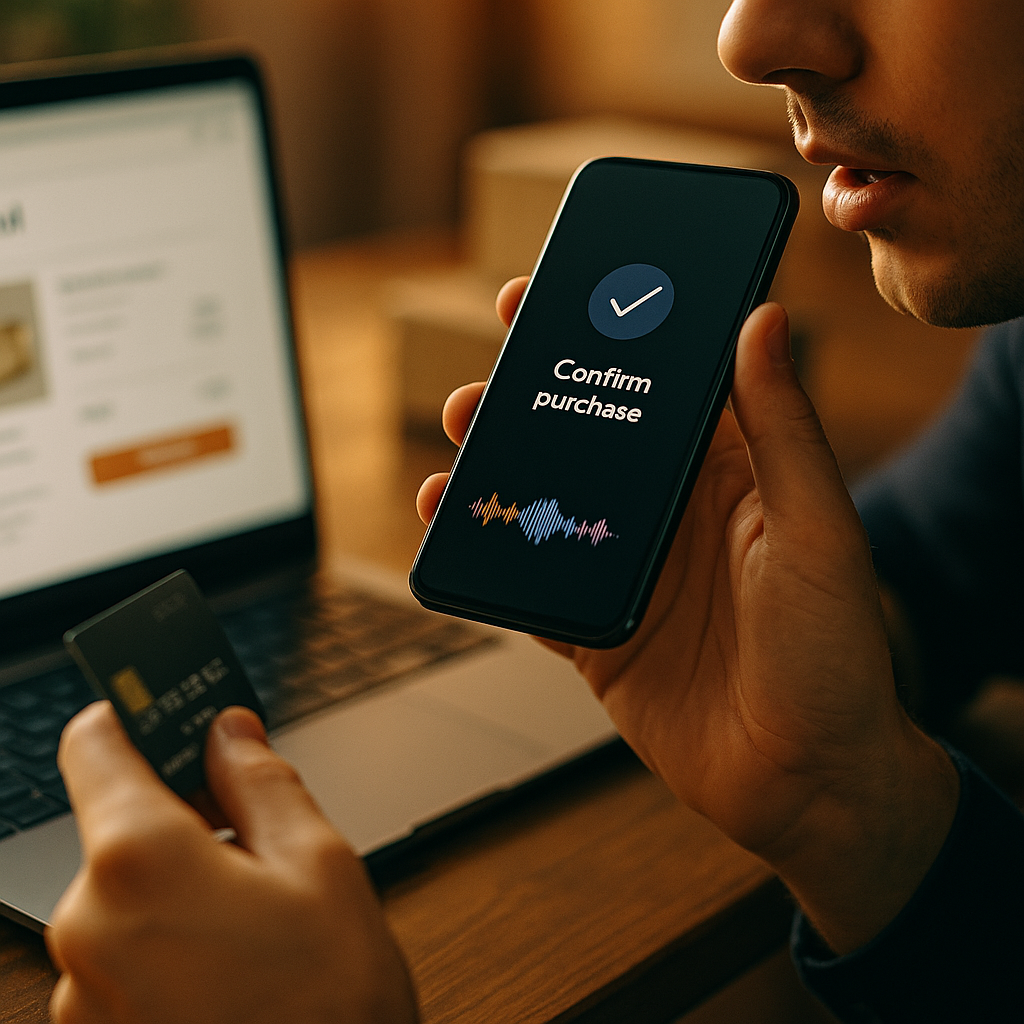
In 2025, brands are racing to reduce checkout friction in voice-first commerce, where every word must earn its place. The science of micro copy for AI driven voice checkout interfaces blends linguistics, cognitive psychology, and trust design into short phrases that guide users to pay confidently. When customers can’t see buttons or forms, your words become the interface—so what should they say next?
Voice checkout UX principles: why microcopy matters more than UI
In a visual checkout, layout, color, and whitespace shoulder much of the burden: they signal hierarchy, reassure users, and show progress. In a voice checkout, those visual cues disappear. Microcopy becomes the primary navigation, validation, and trust layer. That shift changes how you should write and measure copy.
Microcopy in voice checkout must do three jobs at once:
- Orient: Tell users where they are in the flow and what will happen next.
- Constrain: Limit choices to reduce cognitive load and speech recognition errors.
- Reassure: Confirm intent, cost, and safety to prevent abandonment.
Because voice is transient, users can’t “scan” for errors. They rely on short-term memory, which is fragile under stress and distraction (common during checkout). That’s why effective voice microcopy is short, structured, and confirmatory, with built-in recovery paths.
Design your script as if it were a calm cashier: direct, respectful, and ready to clarify. This approach also supports accessibility by default, since voice experiences often serve users multitasking, driving, or with limited vision.
Conversational design for payments: cognitive science you can apply today
Great voice checkout microcopy aligns with how people process spoken language. You don’t need academic jargon, but you do need to respect three realities: working memory limits, ambiguity in speech, and higher perceived risk around payments.
1) Working memory is tight in audio. People retain fewer details from spoken prompts than from text they can re-read. Keep prompts to one objective and one decision. If you must include numbers, group them and repeat critical totals.
Practical pattern: State goal → give key detail → ask a single question.
Example: “Your total is $42.80 including shipping. Place the order?”
2) Ambiguity increases with natural language. Voice inputs like “yes,” “okay,” or “sure” can be misheard, and responses can be contextually unclear. Reduce ambiguity by offering constrained responses and reflecting the user’s choice back to them.
Example: “Say ‘confirm’ to pay, or ‘change’ to edit your address.”
3) Payments trigger risk sensitivity. Users become vigilant at the moment money moves. Microcopy that explicitly states what will be charged, when, and to which method reduces perceived risk. Avoid vague confirmations like “Done” or “You’re all set” before the payment has actually succeeded.
Answer the follow-up question before it’s asked: Will I be charged now? Can I cancel? What if the address is wrong? Build those answers into short, timed prompts at the right moment, not all at once.
Checkout microcopy best practices: structure, brevity, and error recovery
Voice checkout fails when it forces users to guess the “right” response or when it hides the path to fix mistakes. Strong microcopy uses predictable structures, minimal branching, and clear recovery options.
Use a consistent step format. Users trust flows they can predict. Keep the order stable: confirm cart, confirm delivery, confirm payment method, final confirm.
Use progressive disclosure. Provide only the detail needed to decide. If users want more, offer a drill-down command such as “details” or “repeat.”
- Default: “Shipping is free and arrives Tuesday. Confirm?”
- If asked for details: “Free standard shipping. Delivery window: 9 a.m. to 6 p.m. Tuesday.”
Write for interruption. Real users pause, get distracted, or speak over the assistant. Add light re-entry microcopy that restates context without sounding punitive.
Example: “No problem. We’re at payment. Your total is $42.80. Say ‘confirm’ to pay or ‘change’ to edit.”
Design explicit error recovery. Voice recognition and NLU will miss. The microcopy must handle:
- No input: “I didn’t catch that. Say ‘confirm’ to pay, or ‘cancel’ to stop.”
- Unclear input: “I heard ‘change.’ Do you want to change your address or your payment method?”
- Conflict (e.g., address not deliverable): “That address can’t receive deliveries. Say ‘new address’ to try again, or ‘cancel’.”
Avoid hidden penalties. If “cancel” exits the whole checkout, say so. If it only cancels the current step, say that. Misleading exits cause distrust and support tickets.
Choose verbs that match intent. Users should never wonder what happens after “confirm.” Preferred verbs: “place order,” “pay,” “send receipt,” “change,” “remove,” “cancel checkout.”
Trust and compliance language: secure, transparent, and user-first
Checkout microcopy is also a legal and trust surface. The goal is not to sound like a contract; it’s to communicate the essentials clearly and meet payment and privacy expectations.
State the charge and the trigger. Users want to know what happens immediately after they speak. Make the moment of commitment unambiguous.
Example: “If you say ‘confirm,’ I’ll charge $42.80 to your Visa ending 1234 and place the order.”
Make consent explicit and revocable. If the assistant saves payment methods, addresses, or voice profiles, say so in plain language with an easy opt-out.
Example: “Want me to save this card for next time? Say ‘save’ or ‘no’.”
Use privacy microcopy that answers: what, why, how long. Keep it short, but meaningful.
- What: “I’ll use your address to deliver this order.”
- Why: “So the courier can reach you.”
- How long: “You can delete saved addresses anytime in Settings.”
Avoid security theater. Phrases like “100% secure” can backfire if anything goes wrong. Prefer concrete reassurance: encryption, verification steps, and receipts.
Example: “I’ll send a receipt to your email and in the app. You can dispute charges from your account page.”
Handle shared-device risk. Voice checkout often happens on smart speakers in shared spaces. Microcopy should offer a privacy-safe path, like switching to a paired phone for the final confirmation.
Example: “For security, I can finish payment on your phone. Say ‘send to phone’ or ‘continue here’.”
Personalization and tone: adapting microcopy to user intent without creepiness
AI-driven voice checkout interfaces can personalize prompts based on history, context, and predicted intent. Done well, personalization reduces steps. Done poorly, it feels invasive. Microcopy sets the boundary.
Personalize the flow, not the intimacy. Use personalization to remove friction—default the last-used address, suggest the preferred shipping speed—but avoid over-familiar tone or unnecessary references to past behavior.
Good: “Use your usual delivery address on Pine Street?”
Risky: “Ordering again like last Thursday night?”
Offer choice with minimal pressure. If you recommend an option, show it’s optional and easy to change.
Example: “Fastest delivery is Tuesday for $4.99. Free delivery arrives Thursday. Which do you want?”
Use tone to reduce stress, not to entertain. Checkout is a high-stakes moment. Humor can distract or feel inappropriate. Aim for calm confidence and short confirmations.
Adapt to user expertise. Returning customers want speed; new customers want reassurance. Let microcopy branch based on signals (first purchase, prior checkout completion, user asking for “details”).
- New user: “I’ll summarize before you pay: items, delivery, and total.”
- Returning user: “Same address and card as last time. Confirm to place the order?”
Be careful with sensitive inference. Don’t reference health, financial, or other sensitive categories unless the user explicitly brought them up in the current session. If the product itself is sensitive, use discreet language and offer private confirmation routes.
Testing and optimization: measuring voice microcopy performance with EEAT signals
In 2025, optimizing microcopy means combining qualitative listening with quantitative funnel metrics. It also means aligning with EEAT: demonstrating real expertise, transparent intent, and user benefit.
Define success metrics that match voice reality. Visual checkout metrics alone won’t capture voice friction. Track:
- Prompt completion rate: percentage of users who answer the question asked.
- Repair rate: how often users must repeat or rephrase.
- Step abandonment: where users exit (cart review, address, payment, final confirm).
- Time-to-confirm: seconds from total stated to final confirmation.
- Escalation rate: how often users switch to phone/app or human support.
Run A/B tests on intent clarity, not just wording. Many teams test synonyms, but the bigger wins come from structural changes: fewer options, better ordering of information, and clearer calls-to-action.
Example test:
- Variant A: “Would you like to place the order now?”
- Variant B: “Say ‘confirm’ to pay $42.80, or ‘change’ to edit.”
Use conversation replay responsibly. If you review transcripts or audio to improve the model, disclose it clearly and minimize data retention. Provide a straightforward opt-out. This supports trust and reduces regulatory risk.
Demonstrate expertise in your experience. EEAT isn’t only for articles; it applies to product experiences. Your interface should show competence through:
- Accurate summaries (items, quantities, fees) before charging.
- Consistent terminology (don’t alternate “submit” and “place order”).
- Transparent fees (tax, shipping, discounts) presented in a stable order.
- Accessible language (plain words, no jargon, easy repeats).
Close the loop with user research. Ask users what felt uncertain. In voice checkout, uncertainty is the enemy of conversion. If users say “I wasn’t sure if it already charged me,” your microcopy needs a stronger commitment line and a clearer success confirmation.
FAQs about microcopy for AI voice checkout
What is microcopy in a voice checkout interface?
Microcopy is the short, functional language that guides a user through checkout—confirming items, collecting delivery details, explaining totals, requesting consent, and handling errors. In voice, it replaces many visual cues, so it must be structured, brief, and explicit about outcomes.
How long should a voice checkout prompt be?
Aim for one objective per prompt and one decision. Many effective prompts land between one and two short sentences, then a clear question. If you must share multiple details (total, shipping date, payment method), state them in a consistent order and offer “repeat” or “details.”
What words reduce payment anxiety in voice checkout?
Concrete, verifiable words reduce anxiety: the exact total, what it includes, the payment method (masked), and what happens after confirmation (receipt, ability to cancel or dispute). Avoid vague reassurances like “totally secure” and instead explain the next steps clearly.
How do you prevent accidental purchases on smart speakers?
Use explicit confirmation language and consider step-up verification for high-risk scenarios: “Say ‘confirm’ to charge $42.80,” plus optional PIN, device handoff to a phone, or a requirement to confirm the last four digits of a saved method. Also offer an immediate “cancel checkout” command at every step.
Should voice checkout use “yes/no” questions?
Sometimes, but “yes/no” can be misrecognized and can feel ambiguous. Often, constrained command words work better: “say ‘confirm’ or ‘change’.” If you do use yes/no, reflect the user’s choice back: “You said yes—placing the order now.”
How do you handle errors without annoying users?
Keep error prompts calm, brief, and helpful. State what went wrong in plain language, offer the two most likely next actions, and preserve context so users don’t have to repeat everything. Escalate gracefully: after repeated failures, offer “send to phone” or “connect to support.”
Microcopy decides whether voice checkout feels effortless or risky, because in 2025 your words are the buttons, labels, and receipts users can’t see. Use cognitive-friendly structure, explicit consent language, and predictable recovery paths to reduce confusion at the moment of payment. Test prompts by completion and repair rates, not vibes. The takeaway: write like a trustworthy cashier—clear totals, clear choices, clear outcomes.
Top Influencer Marketing Agencies
The leading agencies shaping influencer marketing in 2026
Agencies ranked by campaign performance, client diversity, platform expertise, proven ROI, industry recognition, and client satisfaction. Assessed through verified case studies, reviews, and industry consultations.
Moburst

-
2

The Shelf
Boutique Beauty & Lifestyle Influencer AgencyA data-driven boutique agency specializing exclusively in beauty, wellness, and lifestyle influencer campaigns on Instagram and TikTok. Best for brands already focused on the beauty/personal care space that need curated, aesthetic-driven content.Clients: Pepsi, The Honest Company, Hims, Elf Cosmetics, Pure LeafVisit The Shelf → -
3

Audiencly
Niche Gaming & Esports Influencer AgencyA specialized agency focused exclusively on gaming and esports creators on YouTube, Twitch, and TikTok. Ideal if your campaign is 100% gaming-focused — from game launches to hardware and esports events.Clients: Epic Games, NordVPN, Ubisoft, Wargaming, Tencent GamesVisit Audiencly → -
4

Viral Nation
Global Influencer Marketing & Talent AgencyA dual talent management and marketing agency with proprietary brand safety tools and a global creator network spanning nano-influencers to celebrities across all major platforms.Clients: Meta, Activision Blizzard, Energizer, Aston Martin, WalmartVisit Viral Nation → -
5

The Influencer Marketing Factory
TikTok, Instagram & YouTube CampaignsA full-service agency with strong TikTok expertise, offering end-to-end campaign management from influencer discovery through performance reporting with a focus on platform-native content.Clients: Google, Snapchat, Universal Music, Bumble, YelpVisit TIMF → -
6

NeoReach
Enterprise Analytics & Influencer CampaignsAn enterprise-focused agency combining managed campaigns with a powerful self-service data platform for influencer search, audience analytics, and attribution modeling.Clients: Amazon, Airbnb, Netflix, Honda, The New York TimesVisit NeoReach → -
7

Ubiquitous
Creator-First Marketing PlatformA tech-driven platform combining self-service tools with managed campaign options, emphasizing speed and scalability for brands managing multiple influencer relationships.Clients: Lyft, Disney, Target, American Eagle, NetflixVisit Ubiquitous → -
8

Obviously
Scalable Enterprise Influencer CampaignsA tech-enabled agency built for high-volume campaigns, coordinating hundreds of creators simultaneously with end-to-end logistics, content rights management, and product seeding.Clients: Google, Ulta Beauty, Converse, AmazonVisit Obviously →