


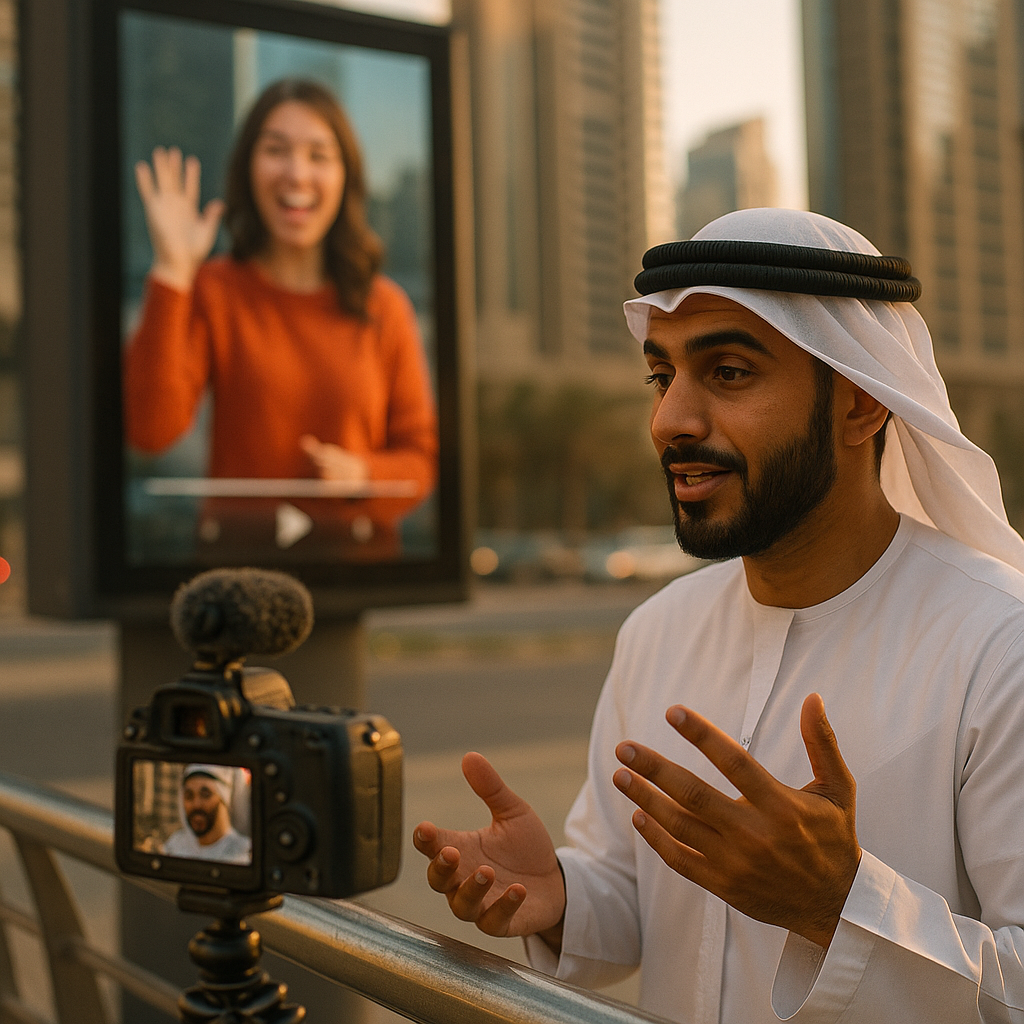
The Middle East’s programmatic DOOH market is projected to grow at double-digit rates through the late 2020s — and most global brand teams are still treating it as a footnote. That’s a strategic error the Middle East programmatic DOOH and creator content convergence is about to make very expensive to ignore.
The MENA DOOH Opportunity Is Not What You Think
Forget the image of static billboards in desert heat. The Gulf’s out-of-home infrastructure has been quietly undergoing a technical overhaul. Dubai, Riyadh, and Abu Dhabi now host some of the highest-density digital OOH screen networks per capita in the world, driven by smart city investment mandates from Vision 2030 and UAE Centennial 2071. Screens in Mall of the Emirates, King Abdullah Financial District, and Lusail City in Qatar are now fully programmatic, addressable, and in many cases, connected to DSPs including The Trade Desk and Hivestack.
The 2026 State of the Nation analysis from regional media bodies confirms what planners have been quietly tracking: programmatic DOOH spend in MENA grew approximately 38% year-on-year, outpacing programmatic display growth in the same markets. That’s not a rounding error. That’s a channel inflection point.
Programmatic DOOH in MENA is growing nearly twice as fast as programmatic display. Brands still allocating DOOH as a “nice to have” are leaving addressable, high-attention inventory on the table.
Why Creator Content and DOOH Are Converging Now
The short answer: creative agility. Programmatic DOOH’s core promise — the ability to swap creative in near real-time based on triggers like weather, footfall, time of day, or live event context — finally has a content supply chain to match it. Creator content, particularly short-form vertical video repurposed into landscape DOOH formats, gives brands a volume of culturally resonant assets that traditional production can’t match on cost or speed.
In the MENA context, this matters more than almost anywhere else. Cultural nuance, language switching between Arabic and English, Ramadan-specific messaging cadences, and the social sensitivity of certain categories mean that creator-generated content from locally embedded talent often outperforms globally produced brand assets. A creator based in Jeddah or Dubai understands tone in ways a London or New York creative team structurally cannot.
The operational model that’s emerging: brands brief regional micro-creators for social-first content, then license that content for programmatic DOOH deployment. The same Ramadan campaign asset that runs on TikTok at midnight drives the DOOH screen in a Riyadh mall food court the next afternoon. Same message. Different channel. Same creator voice.
If you want to understand the format-level ROI implications of this kind of cross-channel repurposing, the vertical breakdown matters — certain content types translate to DOOH better than others, and food, lifestyle, and luxury categories lead the pack in MENA specifically.
The Multi-Channel Architecture That Actually Works
Here’s where most global strategy decks fall apart: they treat DOOH as a reach amplifier bolted onto a social campaign, not as an integrated signal layer. The smarter architecture is sequential and data-connected.
- Phase 1 — Creator social seeding: Deploy 8-15 micro and mid-tier creators across Instagram Reels, TikTok, and Snapchat (critical in MENA; Snapchat penetration in Saudi Arabia remains extraordinarily high). Track engagement velocity and content resonance by geography.
- Phase 2 — Signal-triggered DOOH amplification: Use social engagement data as a proxy signal to inform DOOH scheduling. High-engagement creator content in specific city zones gets promoted on screens in those zones. Platforms like Lamar and Viola Communications in the Gulf are building these feedback loop capabilities.
- Phase 3 — Paid social retargeting: Users exposed to DOOH in high-footfall areas are then retargeted on Meta and TikTok with creator content. The DOOH impression functions as a brand priming layer; the social retarget closes attention.
This isn’t theoretical. FMCG brands operating across UAE and KSA have been piloting this sequencing for 18 months. The results being shared in closed-door briefings at regional media summits point to 20-30% uplift in aided brand recall versus social-only campaigns.
For brands reassessing amplified creator spend in the context of full-funnel media mix, this architecture represents the kind of integration that justifies larger creator licensing deals — because the content works harder across more surfaces.
Creator Selection for MENA Is Not a Standard Brief
The most expensive mistake global teams make: applying a Western creator selection framework to MENA campaigns. Follower count means significantly less here than cultural authority, community trust, and religious sensitivity.
A creator with 180,000 followers in Riyadh who consistently posts during Ramadan, whose content is family-safe, and who has demonstrated relationship with their audience over years will outperform a 2M-follower lifestyle creator with no Gulf context. This is where cultural relevance scoring becomes operationally necessary, not optional.
The DOOH integration layer adds another dimension: creators whose content translates visually to large-format screens. Vertical video optimized for 9:16 doesn’t always adapt cleanly to 16:9 DOOH canvas. Brands need to brief for format flexibility from the start, specifying deliverable aspect ratios and safe zones in the creator contract. That’s a technical requirement most creator briefs in MENA currently ignore.
Snapchat deserves specific attention. Its penetration among Saudi and Emirati audiences aged 18-35 is documented consistently as among the highest globally. Any creator campaign designed for MENA that excludes Snapchat is working with a structurally incomplete channel map.
In Saudi Arabia, a creator without a meaningful Snapchat presence is often reaching less than half the addressable audience your campaign brief assumes. Build Snapchat into the brief, not the footnotes.
Compliance and Brand Safety in the Gulf
This section can’t be summarized. It needs to be taken seriously.
MENA’s regulatory environment for advertising — particularly for categories like financial services, food and beverage, and health — involves approvals from bodies including the UAE’s National Media Council (now integrated under the UAE Media Regulatory Office) and Saudi Arabia’s General Authority for Media Regulation. Creator content that runs on programmatic DOOH may require separate clearance from content that runs purely on social. Global legal teams often miss this distinction.
The FTC’s influencer disclosure rules remain the reference framework for many global brands, but local Gulf regulations on disclosure, product claims, and comparative advertising differ meaningfully. Brands operating across both US and MENA markets need dual compliance workflows.
Creator contracts in the region should also specify territorial rights explicitly. A creator licensing deal for social use in GCC markets doesn’t automatically include rights for OOH display. That’s a legal gap that has already generated disputes between brands and talent agencies in Dubai.
Budget Allocation Signals From Regional Planners
The intelligence from regional media buyers in Q1 of this year is directionally consistent: DOOH is taking share from outdoor print at roughly the pace digital display took from print a decade ago. The shift is accelerating because inventory is now available programmatically through platforms like OUTFRONT Media and regional players, reducing the minimum commitment threshold that previously kept smaller brands out of OOH entirely.
For global brands, this changes the budget math. A creator content campaign for MENA that previously allocated 80% social and 20% production can now rationally reallocate toward a 60% social / 25% programmatic DOOH / 15% production model — because creator content reduces the production cost ceiling and DOOH inventory is increasingly accessible at non-premium buy sizes.
The micro-creator amplification model is particularly well-suited to this reallocation. When creator fees are distributed across 10-15 regional micro-creators instead of one celebrity, the content volume needed to fuel both social and DOOH channels is achievable without inflating the production budget.
Separately, if you’re evaluating how creator tiers affect CAC in this kind of multi-channel architecture, the comparison between celebrity co-creator ROI vs. micro-creator programs is directly applicable to MENA campaign planning — the dynamics hold even in a market this specific.
What to Do Before Your Next MENA Campaign Brief Lands
Map your DOOH inventory access in the specific GCC cities your campaign targets — not just “UAE” or “KSA” as catch-all regions. Identify whether your DSP has direct programmatic DOOH integration in those markets or whether you need a local media buyer to bridge the gap. Then audit your creator brief template for format flexibility requirements and territorial licensing language before a single creator is approached.
Frequently Asked Questions
What is programmatic DOOH and how does it differ from traditional OOH in MENA?
Programmatic DOOH (digital out-of-home) refers to digital billboard and screen inventory that is bought and sold through automated platforms, similar to programmatic display advertising online. In MENA, this means brands can purchase screen time in malls, transit hubs, and city centers in Dubai, Riyadh, and Abu Dhabi through DSPs like The Trade Desk, with creative that can be swapped in near real-time based on triggers like time of day or audience context. Traditional OOH in the region required fixed-period placements negotiated directly with media owners, with no real-time flexibility.
Which platforms are most important for creator campaigns targeting MENA audiences?
Instagram, TikTok, and Snapchat are the three non-negotiable platforms for MENA creator campaigns, particularly in Saudi Arabia and the UAE. Snapchat has exceptionally high penetration among 18-35 year-olds in the Gulf and is frequently underweighted in global campaign briefs. YouTube also remains relevant for longer-form content, and X (formerly Twitter) maintains strong traction among opinion leaders in the region.
How should brands handle compliance for creator content running on programmatic DOOH in the Gulf?
Brands should engage local legal counsel familiar with the UAE Media Regulatory Office and Saudi Arabia’s General Authority for Media Regulation requirements. Creator content approved for social distribution may require separate regulatory clearance before it runs on OOH screens. Creator contracts must explicitly include territorial rights for OOH use, not just digital social platforms. Category-specific restrictions — particularly for food, health, and financial services — vary significantly from Western regulatory frameworks.
What creator tier works best for MENA DOOH-integrated campaigns?
Micro and mid-tier creators with genuine regional embeddedness consistently outperform macro or celebrity creators on cultural resonance in MENA. For DOOH integration specifically, the priority should be creators who can deliver content in multiple aspect ratios and whose visual style translates to large-format screens. Brands should brief explicitly for 9:16 social deliverables and 16:9 DOOH-ready versions from the outset, and evaluate creators on cultural authority scores alongside standard reach metrics.
How should global brands allocate budget across social and programmatic DOOH for MENA?
Regional media buyers are observing a shift toward a 60% social / 25% programmatic DOOH / 15% production split for integrated campaigns in GCC markets. The increased availability of programmatic DOOH inventory at non-premium buy sizes, combined with the reduced production cost that creator content enables, makes this reallocation financially viable even for brands with mid-sized MENA budgets. The exact split should be calibrated against campaign objectives, city-level screen density, and whether the brand is in an awareness or conversion phase.
Top Influencer Marketing Agencies
The leading agencies shaping influencer marketing in 2026
Agencies ranked by campaign performance, client diversity, platform expertise, proven ROI, industry recognition, and client satisfaction. Assessed through verified case studies, reviews, and industry consultations.
Moburst

-
2

The Shelf
Boutique Beauty & Lifestyle Influencer AgencyA data-driven boutique agency specializing exclusively in beauty, wellness, and lifestyle influencer campaigns on Instagram and TikTok. Best for brands already focused on the beauty/personal care space that need curated, aesthetic-driven content.Clients: Pepsi, The Honest Company, Hims, Elf Cosmetics, Pure LeafVisit The Shelf → -
3

Audiencly
Niche Gaming & Esports Influencer AgencyA specialized agency focused exclusively on gaming and esports creators on YouTube, Twitch, and TikTok. Ideal if your campaign is 100% gaming-focused — from game launches to hardware and esports events.Clients: Epic Games, NordVPN, Ubisoft, Wargaming, Tencent GamesVisit Audiencly → -
4

Viral Nation
Global Influencer Marketing & Talent AgencyA dual talent management and marketing agency with proprietary brand safety tools and a global creator network spanning nano-influencers to celebrities across all major platforms.Clients: Meta, Activision Blizzard, Energizer, Aston Martin, WalmartVisit Viral Nation → -
5

The Influencer Marketing Factory
TikTok, Instagram & YouTube CampaignsA full-service agency with strong TikTok expertise, offering end-to-end campaign management from influencer discovery through performance reporting with a focus on platform-native content.Clients: Google, Snapchat, Universal Music, Bumble, YelpVisit TIMF → -
6

NeoReach
Enterprise Analytics & Influencer CampaignsAn enterprise-focused agency combining managed campaigns with a powerful self-service data platform for influencer search, audience analytics, and attribution modeling.Clients: Amazon, Airbnb, Netflix, Honda, The New York TimesVisit NeoReach → -
7

Ubiquitous
Creator-First Marketing PlatformA tech-driven platform combining self-service tools with managed campaign options, emphasizing speed and scalability for brands managing multiple influencer relationships.Clients: Lyft, Disney, Target, American Eagle, NetflixVisit Ubiquitous → -
8

Obviously
Scalable Enterprise Influencer CampaignsA tech-enabled agency built for high-volume campaigns, coordinating hundreds of creators simultaneously with end-to-end logistics, content rights management, and product seeding.Clients: Google, Ulta Beauty, Converse, AmazonVisit Obviously →