


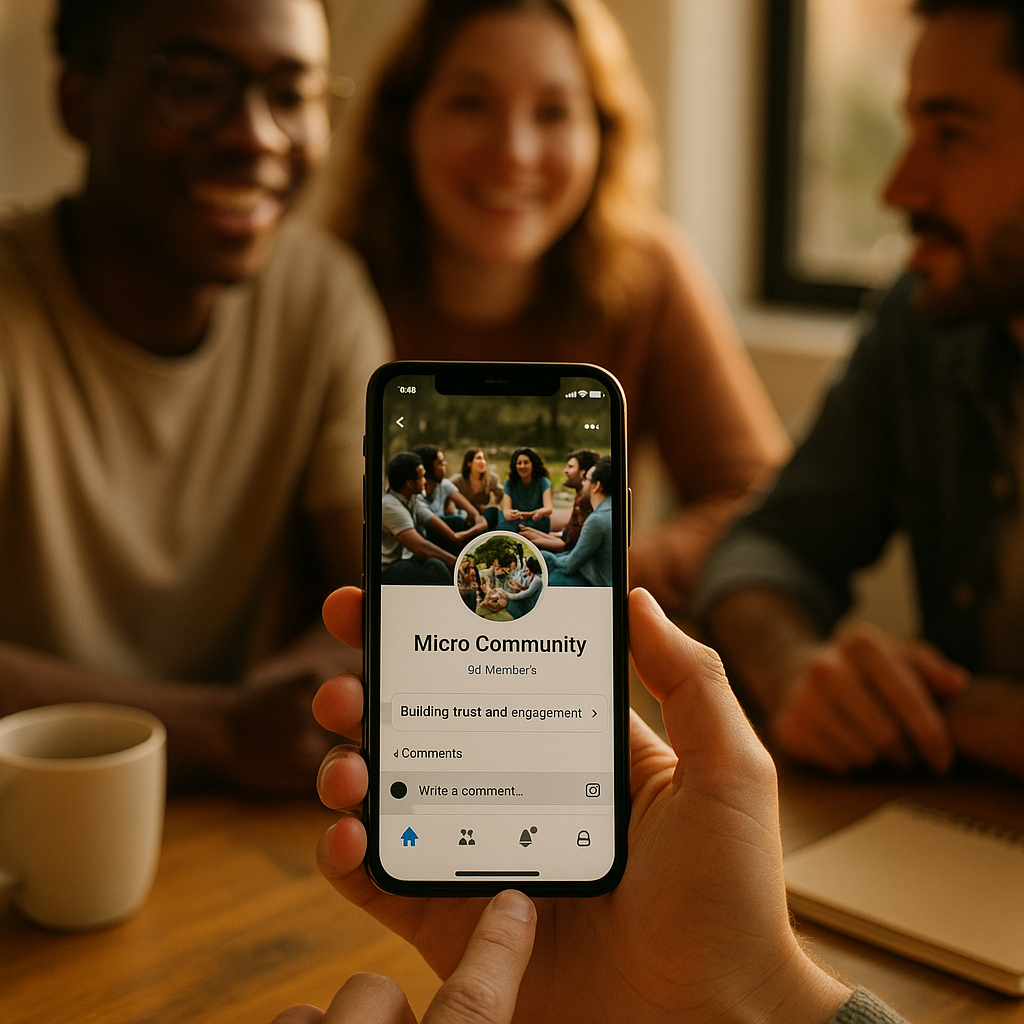
The micro community surge is changing how brands, creators, and members build trust online. In 2025, people want fewer distractions, clearer norms, and real relationships—not endless feeds. Groups of fifty can deliver attention, belonging, and accountability that huge audiences rarely sustain. If you’ve ever felt invisible in a crowd, this shift explains why—and how to use it to grow.
Micro communities definition: what “fifty” really means
A micro community is a small, purpose-driven group—often 20 to 150 people—organized around a shared identity, goal, location, craft, or problem. “Fifty” isn’t a magical number, but it represents a practical threshold where everyone can be known, conversations stay coherent, and norms can be upheld without heavy-handed moderation.
In large audiences, most people participate passively. In micro groups, participation becomes part of membership. That difference changes everything:
- Recognition: Members notice when you show up (and when you don’t).
- Shared context: You spend less time re-explaining basics and more time solving real issues.
- Social accountability: People contribute because relationships are visible, not abstract.
- Faster feedback loops: Ideas, products, and behaviors get corrected quickly.
If you’re deciding whether to build “a following” or “a group,” the practical question is: do you want reach, or do you want results? Micro communities can still create reach, but they do it through members who advocate, refer, and co-create.
Community engagement: why groups of fifty outperform huge audiences
Big audiences are great for awareness. They are weaker at sustained engagement because attention and trust don’t scale linearly. In a group of fifty, your contribution matters; in a group of fifty thousand, it becomes content noise.
Here’s why engagement is typically higher in smaller groups:
- Lower “participation anxiety”: Posting in front of 50 feels like speaking in a workshop. Posting in front of 50,000 feels like speaking on stage.
- Better relevance: Micro communities form around sharper needs, so discussions feel immediately useful.
- Clearer norms: Small groups can enforce “how we do things here” without endless rule documents.
- Less algorithm dependence: Many micro communities live in spaces where you can reliably reach members (threads, chats, email, or private platforms) instead of chasing feed volatility.
Readers often ask: “Doesn’t scale matter?” It does—after engagement. High engagement in a small group produces assets that can scale: case studies, testimonials, referrals, co-created templates, member-led events, and product insights. Fifty committed members can create more business impact than fifty thousand indifferent viewers.
Trust-based marketing: the new moat in 2025
In 2025, trust is not a brand statement; it’s a lived experience. Micro communities are trust engines because they create repeated interactions, shared standards, and direct access to decision-makers. That combination supports Google’s EEAT expectations—experience, expertise, authoritativeness, and trustworthiness—because it yields verifiable proof of value.
How micro communities naturally align with EEAT:
- Experience: Members share real implementations, mistakes, and outcomes—not just theories.
- Expertise: Specialists can demonstrate skill through ongoing help, reviews, and live problem-solving.
- Authoritativeness: Authority emerges when peers cite, reuse, and recommend your work inside and outside the group.
- Trustworthiness: Clear moderation, privacy boundaries, and transparent policies reduce spam and manipulation.
If you sell services, a micro community can become your proof of work. If you sell products, it becomes your product discovery and QA layer. If you’re a creator, it becomes your editorial board—telling you what to make next and what to stop making.
Practical trust builders that work at fifty members:
- Member directory with intent: Include “what I’m working on” and “what I can help with.”
- Weekly office hours: One hour of live help beats constant low-quality posting.
- Visible follow-through: Track requests and outcomes so members see momentum.
- Conflict handling: Enforce rules quickly and calmly; inconsistency kills trust.
Many people worry micro communities feel “exclusive.” The healthier framing is “bounded.” A bounded group protects attention and creates psychological safety, which encourages honest questions and better outcomes.
Audience segmentation: how to design a micro community that works
A successful micro community is designed, not just opened. The most common failure is building around a vague identity (“entrepreneurs”) instead of a specific job-to-be-done (“bootstrapped founders shipping their first B2B onboarding flow”). Sharp segmentation increases relevance and reduces moderation burden.
Use this segmentation checklist before you invite anyone:
- Shared problem: What are members trying to achieve in the next 30–90 days?
- Shared language: Do they use the same terms and tools, or will everyone talk past each other?
- Shared level: Beginners, intermediates, and experts need different structures.
- Shared commitment: What participation is expected—weekly check-ins, peer reviews, co-working?
- Non-goals: What is explicitly not allowed (promo dumping, anonymous takedowns, harassment)?
Answer the follow-up question now: “What do we talk about every week?” If you can’t name three recurring conversation tracks, the group will drift into random chatter. Strong micro communities usually center on:
- Progress: Wins, blockers, and next actions.
- Feedback: Review requests, teardown threads, peer critique.
- Resources: Tools, templates, and trusted recommendations with context.
Finally, set a membership cap on purpose. When people know the group is curated and finite, they treat it as valuable. You can always create a waitlist or spin up additional cohorts later.
Retention strategy: the operating system that keeps fifty active
Micro communities don’t thrive on constant posting; they thrive on reliable rhythms. Retention comes from members getting outcomes, not notifications. The best retention strategy is a simple operating system that makes participation easy and rewarding.
A lightweight weekly operating system:
- Monday: One prompt for weekly goals (members reply with 1–3 outcomes).
- Midweek: One structured thread for help (members ask for feedback using a template).
- Friday: One win-and-learn recap (what worked, what didn’t, what changed).
Make the group measurable without turning it into a dashboard. Track a few signals that tie to real value:
- Activation: Percentage of new members who post an intro and one question in their first week.
- Contribution balance: Number of members giving help versus only asking.
- Outcome rate: How many members report a shipped result each month.
- Referral rate: How many new members come from existing members.
Members also ask: “How do I prevent burnout as the host?” Use constraints:
- Office hours instead of 24/7 replies: Consolidate your time into predictable windows.
- Member-led roles: Assign rotating facilitators, greeters, and topic leads.
- Templates: Standardize intros, help requests, and resource shares.
Moderation matters more than platforms. Even the best tool fails if spam, vague promos, or hostility go unchecked. Publish a short code of conduct, enforce it consistently, and explain decisions in a calm, factual way.
Creator economy communities: how to scale from fifty to fifty thousand without losing the magic
“Fifty beats fifty thousand” doesn’t mean you should avoid growth. It means you should scale through micro communities, not replace them with one massive room. The scalable model is a network of small groups, cohorts, or chapters—each with clear leadership and consistent standards.
Three scaling patterns that preserve quality:
- Cohort model: Run time-bound groups (6–8 weeks) with a clear outcome, then alumni channels.
- Chapter model: Create local or role-based chapters (e.g., “Design leads,” “Ops,” “NYC chapter”).
- Tiered model: Keep a free broadcast layer for awareness and a paid or vetted inner group for outcomes.
What changes at scale (and what must not):
- You can standardize: Onboarding, rules, event formats, facilitation playbooks.
- You must protect: Psychological safety, relevance, and member-to-member usefulness.
For brands, the smart move is to treat micro communities as product teams: each group reveals needs, language, objections, and success stories. For creators, micro communities become your highest-signal audience: fewer vanity metrics, more repeat customers and collaborators.
One more common follow-up: “Do micro communities hurt discoverability?” They can if you hide everything. The fix is to make outcomes public while keeping discussions private. Publish anonymized learnings, member spotlights (with permission), and resource libraries that demonstrate credibility without exposing personal conversations.
FAQs
What is a micro community, exactly?
A micro community is a small, focused group built around a specific shared goal or identity, typically small enough that members can recognize each other and maintain consistent norms. The point is not smallness for its own sake; it’s creating a setting where participation and trust are natural.
Why do groups of fifty often beat fifty thousand for business results?
Because they create higher engagement, clearer feedback, and stronger trust. In a small group, members contribute, collaborate, and act. Those behaviors produce referrals, product insights, and retention—outcomes that large audiences struggle to generate consistently.
How do I choose the right size for my community?
Choose the smallest size that still delivers diversity of perspectives. If you need fast peer feedback and accountability, 30–80 often works well. If you need broader networking, 80–150 can work if you add facilitation and structured prompts.
Should a micro community be free or paid?
Either can work. Free groups need stronger moderation and clearer boundaries to prevent low-intent participation. Paid groups can improve commitment, but only if the value is outcome-driven (office hours, structured feedback, vetted peers), not just access.
What platform is best for a micro community?
The best platform is the one your members will use consistently and that supports clear threads, search, and moderation. Prioritize usability, notifications control, and exportability of content. Platform choice matters less than onboarding, norms, and weekly rhythms.
How do I keep engagement high without spamming people?
Run predictable weekly rhythms: goal setting, a structured help thread, and a recap. Focus on member outcomes and peer-to-peer support. Reduce noise by limiting promotional posts, using templates, and consolidating announcements.
How do I prevent the community from becoming self-promotion?
Set explicit rules: promotions only in dedicated threads, require context, and ask members to contribute help before sharing offers. Enforce consistently, and remove repeat offenders quickly to protect trust.
Can micro communities support SEO and content marketing?
Yes. They generate high-quality insights, language, and case studies that improve topical authority. Publish what you learn as guides, FAQs, and examples (with permission and anonymization). The community becomes a research engine for helpful content.
Micro communities win in 2025 because attention and trust have become scarce. A group of fifty creates recognition, relevance, and accountability—conditions that drive real outcomes. Instead of chasing bigger numbers, build a bounded space with clear norms, weekly rhythms, and measurable member success. When fifty people grow together, they naturally attract the next fifty—and the impact compounds.
Top Influencer Marketing Agencies
The leading agencies shaping influencer marketing in 2026
Agencies ranked by campaign performance, client diversity, platform expertise, proven ROI, industry recognition, and client satisfaction. Assessed through verified case studies, reviews, and industry consultations.
Moburst

-
2

The Shelf
Boutique Beauty & Lifestyle Influencer AgencyA data-driven boutique agency specializing exclusively in beauty, wellness, and lifestyle influencer campaigns on Instagram and TikTok. Best for brands already focused on the beauty/personal care space that need curated, aesthetic-driven content.Clients: Pepsi, The Honest Company, Hims, Elf Cosmetics, Pure LeafVisit The Shelf → -
3

Audiencly
Niche Gaming & Esports Influencer AgencyA specialized agency focused exclusively on gaming and esports creators on YouTube, Twitch, and TikTok. Ideal if your campaign is 100% gaming-focused — from game launches to hardware and esports events.Clients: Epic Games, NordVPN, Ubisoft, Wargaming, Tencent GamesVisit Audiencly → -
4

Viral Nation
Global Influencer Marketing & Talent AgencyA dual talent management and marketing agency with proprietary brand safety tools and a global creator network spanning nano-influencers to celebrities across all major platforms.Clients: Meta, Activision Blizzard, Energizer, Aston Martin, WalmartVisit Viral Nation → -
5

The Influencer Marketing Factory
TikTok, Instagram & YouTube CampaignsA full-service agency with strong TikTok expertise, offering end-to-end campaign management from influencer discovery through performance reporting with a focus on platform-native content.Clients: Google, Snapchat, Universal Music, Bumble, YelpVisit TIMF → -
6

NeoReach
Enterprise Analytics & Influencer CampaignsAn enterprise-focused agency combining managed campaigns with a powerful self-service data platform for influencer search, audience analytics, and attribution modeling.Clients: Amazon, Airbnb, Netflix, Honda, The New York TimesVisit NeoReach → -
7

Ubiquitous
Creator-First Marketing PlatformA tech-driven platform combining self-service tools with managed campaign options, emphasizing speed and scalability for brands managing multiple influencer relationships.Clients: Lyft, Disney, Target, American Eagle, NetflixVisit Ubiquitous → -
8

Obviously
Scalable Enterprise Influencer CampaignsA tech-enabled agency built for high-volume campaigns, coordinating hundreds of creators simultaneously with end-to-end logistics, content rights management, and product seeding.Clients: Google, Ulta Beauty, Converse, AmazonVisit Obviously →