


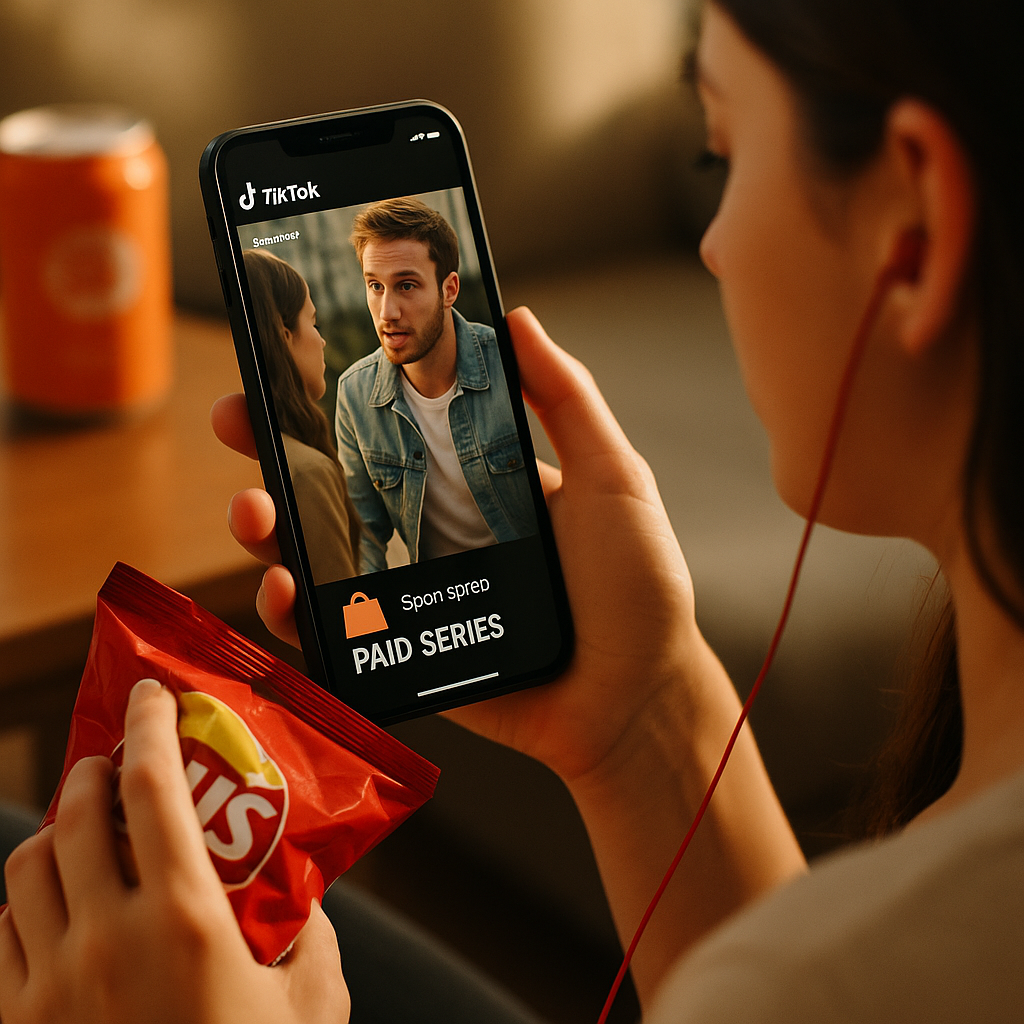
A $1.3 Billion Signal That Most Brand Strategists Are Still Ignoring
The US micro-drama market hit $1.3 billion in revenue, and most brand budgets haven’t registered the shift. That’s not a content trend. That’s a monetized distribution channel with serialized audience behavior baked in — and TikTok’s paid series feature just added a direct commerce layer on top of it. For brand strategists thinking about where serialized short-form content fits into influencer and sponsorship architecture, the window to move early is narrowing fast.
What Micro-Drama Actually Is (and Why It’s Different From Short-Form Video)
Micro-drama is not TikTok content with a plot. It’s episodic, scripted, short-form video — typically 60 to 90 seconds per episode, released in series of 20 to 80 episodes — built specifically to drive compulsive sequential viewing. The format originated in China, where platforms like ReelShort and DramaBox turned it into a subscription and pay-per-episode business worth hundreds of billions of yuan before Western operators caught up.
The critical distinction for marketers: micro-drama creates return audience behavior. Standard short-form video is algorithmic and ephemeral. Viewers don’t return for the next video; they consume whatever the feed serves. Serialized micro-drama inverts that model. Viewers come back for the next episode. That habit loop is the commercial foundation that makes brand integration financially defensible at a level that individual short-form posts never reached.
ReelShort, the US-facing platform operated by Crazy Maple Studio, reported millions of monthly active users and ranked among the top-grossing entertainment apps in the Apple App Store. That’s not a niche experiment. That’s an audience that has already demonstrated willingness to pay for serialized short-form content.
TikTok’s Paid Series Feature Changes the Brand Math
TikTok launched its paid series functionality to allow creators to gate episodic content behind a paywall, with pricing set directly by the creator. On the surface, that looks like a creator monetization tool. From a brand strategy perspective, it’s something more important: proof that TikTok is building infrastructure for premium serialized content consumption on the same platform where impulse purchase behavior is already highest.
When a creator’s paid series audience overlaps with TikTok Shop’s purchase-intent user base, brand integration stops being a media buy and starts functioning like a subscription-linked commerce placement.
Think about the structural implications. A creator running a 30-episode paid series has a committed audience that has already demonstrated purchase intent twice: once by subscribing to the series, once by existing on a platform optimized for social commerce. A brand integrating into that series gets access to an audience that self-selected for both entertainment engagement and transactional behavior. That combination doesn’t exist anywhere else in the current media landscape at this scale and this cost point.
For teams already working TikTok Shop into their creator content strategy, the paid series layer adds a pre-qualified audience filter that should improve conversion rates on product integrations. This isn’t theoretical — it’s an extension of audience segmentation logic that performance marketers already apply to email and paid social.
The Sponsorship Architecture That Actually Works Here
Standard influencer deal structures don’t map cleanly onto serialized content. A flat-fee post deal assumes single-event reach. Micro-drama series deals require a different contract architecture: multi-episode placement rights, storyline integration approval gates, revenue share consideration if the series monetizes directly, and performance metrics tied to episode completion rates rather than impressions.
There are three integration models worth evaluating:
- Narrative product integration: The brand’s product becomes a functional story element across multiple episodes. Think of how a specific skincare line could be woven into a protagonist’s routine as a character trait, not a mid-roll interruption. Audiences in serialized formats develop parasocial investment in characters, which transfers brand affinity at a depth that a 15-second pre-roll never reaches.
- Series sponsorship with episode credits: Brand takes a named sponsorship position for the full series, with attribution built into every episode. This mirrors TV sponsorship models but at a fraction of the cost and with audience demographic precision that broadcast can’t offer.
- Commerce-linked exclusive episodes: A brand co-funds an exclusive episode or episode arc that’s unlocked through product purchase, affiliate link, or loyalty program action. The viewer exchanges a transactional behavior for premium content access. This collapses the funnel entirely.
The third model is the most aggressive but also the most measurable. If you’re already benchmarking CPA performance across creator niches, a gated-episode model gives you a near-perfect attribution event: content unlock equals conversion. CFO conversations get significantly easier when you can point to that data.
Audience Retention Data Is the New Reach Metric
This is where micro-drama brand deals diverge most sharply from traditional influencer metrics. Reach and impressions are largely irrelevant in a serialized context. What matters is episode completion rate, series return rate, and drop-off point by episode. These metrics tell you whether audience attention is holding across the arc where your brand is integrated.
Platforms like TikTok for Business and third-party analytics tools are beginning to surface episode-level performance data for creators. Brands negotiating series deals should contractually require access to this data as part of the partnership agreement. Retention curves by episode are the equivalent of audience share data in broadcast TV — they tell you whether your placement is happening in front of an engaged audience or a depleted one.
Contracts that don’t include episode-level performance reporting are leaving critical measurement infrastructure on the table. Given the direction creator contract models are evolving, building these data-access clauses into deal terms now is far easier than retrofitting them after a series launches.
Risk Factors Brand Teams Need to Underwrite
Serialized content creates longer brand exposure windows, which cuts both ways. If a creator’s series generates controversy in episode 12, your brand is associated with every episode that came before it. Standard influencer compliance frameworks aren’t built for this kind of extended narrative exposure. Your brand safety protocols need to account for storyline review, not just content review at a single post level.
FTC disclosure requirements for serialized paid integrations are also more complex than standard sponsored post disclosures. Each episode containing a material brand connection needs individual disclosure, not a series-level note in the bio. Get your legal team to review this before deals close, not after.
Talent risk is amplified in serialized formats because creator reputation compounds over episode duration. The mitigation strategy here is to treat micro-drama series partnerships more like production partnerships than media buys: deeper due diligence, more granular creative approval rights, and exit clauses tied to specific behavioral thresholds, not just general morality clauses. Teams building out scalable creator partnership architecture should be incorporating these serialized-content risk parameters into their standard frameworks now.
The brands that will dominate micro-drama commerce integrations are the ones that treat series partnerships with the same contractual rigor they apply to broadcast media buys — not the ones repurposing their standard influencer brief.
Budget Allocation and Where This Fits in the Channel Mix
Micro-drama series integrations are not a replacement for broad-reach influencer programs. They’re a precision layer that sits between high-reach social content and performance-driven affiliate activity. Budget-wise, think of series sponsorships in the $25,000 to $150,000 range for established creators on TikTok and ReelShort, depending on series length, episode count, and exclusivity terms. That’s mid-tier television sponsorship territory, with significantly better audience targeting and measurability.
For teams working within shifting budget architectures, this category fits most logically as a test allocation carved from the experimental content budget or from the portion of the linear TV reallocation that hasn’t been committed yet. The performance case for testing now is straightforward: the market is at $1.3 billion and growing, audience behavior is proven, and platform infrastructure (TikTok’s paid series, ReelShort’s app ecosystem) is maturing. The cost of first-mover positioning at this stage is a fraction of what it will be in 18 months when every CPG brand has a series deal in market.
Monitor the market sizing data from research firms closely — projections for the global micro-drama sector point toward sustained double-digit annual growth, with mobile-first markets in North America and Southeast Asia leading the acceleration. The window for early, cost-efficient series partnerships is measurably open right now.
Start with one creator, one series, one commerce-linked episode arc. Measure completion rates, track attribution against your existing CPA benchmarks, and let the data build the internal case for scale before your competitors figure out the same playbook.
Frequently Asked Questions
What is micro-drama content and how does it differ from standard short-form video?
Micro-drama is scripted, episodic short-form video — typically 60 to 90 seconds per episode — released in series of 20 or more episodes designed to drive sequential viewing. Unlike standard short-form video, which is algorithmically served and consumed in isolation, micro-drama builds return audience behavior where viewers come back for the next episode. This creates a sustained engagement pattern that is fundamentally more valuable for brand integration than single-post influencer content.
How does TikTok’s paid series feature create brand sponsorship opportunities?
TikTok’s paid series feature allows creators to gate episodic content behind a paywall. For brands, this means integrations within a paid series reach an audience that has already demonstrated willingness to pay for content — a high-intent, pre-qualified viewer group. When this overlaps with TikTok Shop’s commerce infrastructure, brand integrations function closer to subscription-linked placements than traditional media buys, with stronger conversion potential and clearer attribution.
What contract terms should brands require for micro-drama series sponsorships?
Brands should negotiate multi-episode placement rights, storyline integration approval across all relevant episodes, individual FTC-compliant disclosure requirements per episode, contractual access to episode-level performance data (completion rates, drop-off points), and exit clauses tied to specific behavioral thresholds. These deals require more rigorous contractual architecture than standard influencer post agreements because brand exposure extends across an entire narrative arc.
What budget range should brands expect for micro-drama series integrations?
Series sponsorships on established platforms like TikTok and ReelShort typically range from approximately $25,000 to $150,000 depending on series length, episode count, creator reach, and exclusivity terms. This positions micro-drama integrations in mid-tier television sponsorship territory but with significantly better audience targeting precision and measurable performance data. Brands entering now can typically negotiate better terms than will be available once category competition increases.
Which metrics should brands use to evaluate micro-drama sponsorship performance?
The primary metrics are episode completion rate, series return rate, and episode-level drop-off analysis. These replace traditional reach and impression metrics as the key performance indicators for serialized content. For commerce-linked integrations, CPA tracking against episode unlock events or affiliate attribution per episode arc provides direct conversion measurement. Brands should require contractual access to episode-level analytics data before any series deal closes.
How does brand safety risk differ in serialized content versus single-post influencer deals?
Serialized content extends brand exposure across multiple episodes and an entire narrative arc, meaning any controversy arising in later episodes reflects back on all prior brand integrations. Standard single-post brand safety protocols are insufficient. Brands need storyline review rights, episodic content approval gates, and exit clauses tied to specific behavioral triggers — not just broad morality clauses — to manage risk across the full duration of a series partnership.
Top Influencer Marketing Agencies
The leading agencies shaping influencer marketing in 2026
Agencies ranked by campaign performance, client diversity, platform expertise, proven ROI, industry recognition, and client satisfaction. Assessed through verified case studies, reviews, and industry consultations.
Moburst

-
2

The Shelf
Boutique Beauty & Lifestyle Influencer AgencyA data-driven boutique agency specializing exclusively in beauty, wellness, and lifestyle influencer campaigns on Instagram and TikTok. Best for brands already focused on the beauty/personal care space that need curated, aesthetic-driven content.Clients: Pepsi, The Honest Company, Hims, Elf Cosmetics, Pure LeafVisit The Shelf → -
3

Audiencly
Niche Gaming & Esports Influencer AgencyA specialized agency focused exclusively on gaming and esports creators on YouTube, Twitch, and TikTok. Ideal if your campaign is 100% gaming-focused — from game launches to hardware and esports events.Clients: Epic Games, NordVPN, Ubisoft, Wargaming, Tencent GamesVisit Audiencly → -
4

Viral Nation
Global Influencer Marketing & Talent AgencyA dual talent management and marketing agency with proprietary brand safety tools and a global creator network spanning nano-influencers to celebrities across all major platforms.Clients: Meta, Activision Blizzard, Energizer, Aston Martin, WalmartVisit Viral Nation → -
5

The Influencer Marketing Factory
TikTok, Instagram & YouTube CampaignsA full-service agency with strong TikTok expertise, offering end-to-end campaign management from influencer discovery through performance reporting with a focus on platform-native content.Clients: Google, Snapchat, Universal Music, Bumble, YelpVisit TIMF → -
6

NeoReach
Enterprise Analytics & Influencer CampaignsAn enterprise-focused agency combining managed campaigns with a powerful self-service data platform for influencer search, audience analytics, and attribution modeling.Clients: Amazon, Airbnb, Netflix, Honda, The New York TimesVisit NeoReach → -
7

Ubiquitous
Creator-First Marketing PlatformA tech-driven platform combining self-service tools with managed campaign options, emphasizing speed and scalability for brands managing multiple influencer relationships.Clients: Lyft, Disney, Target, American Eagle, NetflixVisit Ubiquitous → -
8

Obviously
Scalable Enterprise Influencer CampaignsA tech-enabled agency built for high-volume campaigns, coordinating hundreds of creators simultaneously with end-to-end logistics, content rights management, and product seeding.Clients: Google, Ulta Beauty, Converse, AmazonVisit Obviously →