


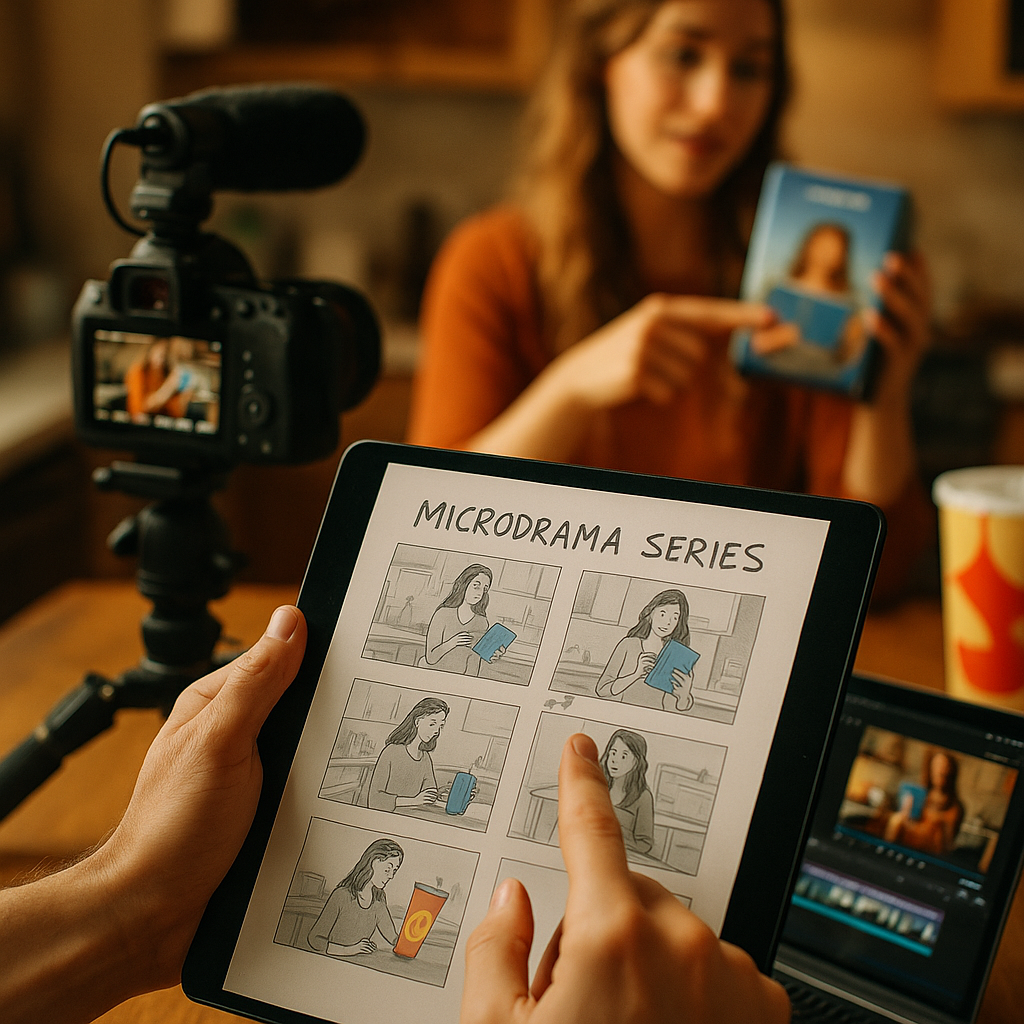
Brands that treat microdrama like a sponsored post are leaving serious money on the table. A recent eMarketer analysis found that episodic short-form content drives 3x higher completion rates than one-off sponsored videos. The brief is where that performance advantage gets built or destroyed. Here is how creative directors should write short-form microdrama series briefs for brand integration that actually hold together across episodes.
Why Most Brand Microdrama Briefs Fail Before Shooting Starts
The failure mode is almost always the same. A brand hands a creator a list of product talking points, a logo placement requirement, and a vague note about “keeping it authentic.” The creator builds a story. The brand then requests revisions that embed the product more aggressively. The narrative collapses. The audience disengages. The CTA converts at 0.4%.
The root problem is that most briefs are written by people thinking about a single piece of content, not a series architecture. Microdrama demands a different document entirely. It requires narrative scaffolding, clearly delineated roles for human talent versus AI-generated assets, and a CTA strategy mapped to story beats rather than bolted on at the end. When you understand the ROI difference in episodic versus one-off formats, the urgency of getting the brief right becomes obvious.
A brief that separates narrative direction from brand integration requirements is not a creative courtesy — it is a performance optimization tool. Productions built on structurally sound briefs consistently outperform ad-hoc integrations on completion rate, share rate, and CTA click-through.
Structuring the Brief: Four Layers Every Creative Director Needs
Think of the brief as four distinct layers that must coexist without contradiction.
Layer 1: Series Bible Lite. Even a 5-episode vertical drama needs a compressed story bible. Character names, core conflict, episode arc structure, and the emotional journey the audience should experience by the finale. This does not need to be a 40-page document. Two hundred words of tight narrative direction will do more work than a 10-slide deck full of mood board images. Reference the structural principles for scripted vertical series when defining your arc.
Layer 2: Talent Direction and AI Asset Delineation. This is where most briefs leave money on the table. Human talent handles emotional anchoring, relationship dynamics, and any dialogue that requires trust signals. AI-generated assets handle world-building, establishing shots, b-roll, background crowd simulation, and set extension. The brief must specify which scenes or visual elements are candidates for AI generation, which tools the production team is cleared to use (Runway, Sora, Pika, Kling), and what quality bar the AI output must meet before human editors touch it.
Layer 3: Brand Integration Map by Episode. Do not leave integration to creative improvisation. Map each episode with a specific integration window, the type of integration permitted (visual prop, dialogue mention, environmental placement, character behavior), and the duration or frequency cap. Episode 1 should build narrative credibility with minimal brand presence. Episode 3 is where product utility can emerge organically through plot. Episode 5 closes with the strongest CTA because the audience has already invested emotionally.
Layer 4: CTA Architecture. More on this below, but the brief should specify the call-to-action type, placement trigger (scene-based or post-roll), and the conversion destination for every episode independently.
AI-Generated Supporting Assets: What to Brief and What to Protect
The tension here is real. AI-generated assets dramatically reduce production costs on vertical drama — background environments, digital extras, weather effects, and transition sequences can all be produced at a fraction of live-shoot cost. But audiences in 2026 are sophisticated. They can detect incoherence between a human-shot foreground and a poorly composited AI background, and that visual seam breaks immersion faster than any product mention.
The brief must specify visual consistency requirements. If the lead talent is shot in natural light on a Sony FX3, the AI-generated environmental extensions need to match that color temperature and grain profile. Tools like Runway’s Gen-3 Alpha and Adobe Firefly for scene extension now offer enough control to match production aesthetics when properly directed. The brief should include reference frames, not just written descriptions.
Also protect the talent’s performance space. AI-generated crowd reactions and facial expressions should never replace or overlap human talent reaction shots. Brief this explicitly. Creative directors who leave it ambiguous will get a mixed cut that looks like a tech demo, not a drama. For additional guidance on hybrid production standards, the production quality benchmarks brands are now expected to match are a useful calibration point.
Embedding Commerce CTAs Without Breaking Story
This is the discipline that separates professional brand integration from advertorial content that audiences skip. The answer is not to hide the CTA. It is to earn the right to make the ask through narrative setup.
Three approaches work consistently in short-form microdrama:
- The Plot-Motivated Purchase: A character’s problem within the story is solved by the product, and the CTA follows the resolution moment. The audience has just watched the product work. The ask feels like a natural extension of what they experienced, not an interruption.
- The Episode Cliffhanger + Bridge CTA: The CTA appears between the cliffhanger moment and the next-episode tease. Audiences who are emotionally invested are in a high-engagement state at that precise second. A link in bio or swipe-up to a product that appears in the next episode creates forward momentum rather than friction. This approach pairs well with compounding reach strategies for series formats.
- The Character Endorsement Layer: Human talent makes a first-person aside — breaking the fourth wall briefly — where they speak as themselves rather than their character. Used once per series, not once per episode, this technique maintains trust while creating a clear commercial moment without damaging the fictional frame.
The brief should specify which technique applies to each episode and prohibit the production team from layering multiple CTA techniques in a single episode. Overloading any one episode destroys the effect of all of them.
Commerce CTAs in narrative content should be treated like seasoning, not sauce. One well-placed, story-integrated product moment per episode will always outperform three forced mentions. Brief for restraint and enforce it in your revision process.
FTC Compliance and Disclosure Inside a Narrative Frame
Disclosure in scripted format is not optional and not ambiguous. FTC guidelines require clear and conspicuous disclosure regardless of whether the content is presented as fiction. The brief must include mandatory disclosure language, specify where in the video it appears (opening frame, persistent overlay, or end card), and confirm that AI-generated elements that could be mistaken for real environments or crowds are disclosed if they could materially mislead consumers about the product context.
This is also where the brief’s integration map from Layer 3 pays a compliance dividend. A documented episode-by-episode integration map gives your legal team a clear audit trail. For scripted formats, also review the FTC-specific considerations for scripted series briefs before production lock.
Distribution Logic Belongs in the Brief
A microdrama series brief that does not address distribution sequencing is incomplete. TikTok’s algorithm favors series that maintain consistent posting cadence and generate comment threads that continue across episodes. TikTok for Business recommends a 48 to 72-hour release window between episodes to maximize rewatch loops and comment accumulation before the next drop.
The brief should specify the posting cadence, whether episodes will be pinned or sequenced in a playlist, and how the brand’s paid amplification budget will be allocated across episodes. Typically, Episode 1 receives the heaviest paid push to seed the series. Episodes 3 and 5 receive secondary amplification timed to conversion windows. Paid amplification strategy for creator content is a lever most brands underuse on serialized formats.
Also brief for platform-specific adaptation. A 90-second TikTok episode has a different pacing requirement than the same content repurposed for YouTube Shorts or Instagram Reels. If the series will be distributed across surfaces, the brief should include a platform adaptation section that specifies what can be trimmed, what must remain intact for brand compliance reasons, and whether AI-generated scene extensions are available to fill different aspect ratios.
The Brief Document Itself: Format Recommendations
Keep it under 1,200 words. Use a table for the episode integration map. Use numbered lists for compliance requirements. Use narrative paragraphs only for the series bible section. Attach a visual reference deck separately rather than embedding images in the brief document.
Route the brief through three sign-off gates before it reaches the production team: creative strategy, brand legal (for FTC compliance and AI asset disclosure), and the talent’s management if the series involves influencer talent with their own brand partnership restrictions. A brief that survives all three gates without fundamental revision is a brief that will survive production.
Start your next microdrama brief by writing the integration map before you write the story. Knowing exactly where and how the brand lives in each episode will shape better narrative decisions than building the story first and retrofitting the integration later.
FAQs
What is a short-form microdrama series brief for brand integration?
It is a production direction document that outlines the narrative arc, episode structure, brand integration points, AI asset usage guidelines, CTA placement strategy, and compliance requirements for a branded short-form drama series. Unlike a standard influencer brief, it functions as both a creative and commercial roadmap across multiple episodes.
How many episodes should a branded microdrama series run?
Five to seven episodes is the most operationally effective range for brand integration purposes. It is long enough to build audience habit and emotional investment, short enough to maintain production quality and budget control. Fewer than four episodes limits the brand’s ability to map integration across the narrative arc without overloading any single episode.
How should AI-generated assets be disclosed in a microdrama series?
If AI-generated environments, crowds, or visual elements could materially mislead viewers about the product’s real-world context, they must be disclosed in line with FTC guidelines. The disclosure should appear in the opening frame or as a persistent overlay. Check current FTC guidance on AI-generated content and consult legal before production lock.
Where in a microdrama episode should a brand CTA appear?
The highest-converting placement for a commerce CTA in narrative short-form content is immediately after the episode’s emotional peak or between a cliffhanger moment and the next-episode tease. Avoid mid-narrative CTA placement, which disrupts story flow and typically underperforms by 40 to 60% compared to post-peak placement.
Can AI-generated talent replace human creators in microdrama brand integration?
Not effectively for primary narrative roles. Human talent drives the trust signals and emotional engagement that make product integration feel credible rather than transactional. AI-generated assets perform well in supporting roles: environmental design, b-roll, background simulation, and scene transitions. A hybrid model that uses human talent for all character-driven scenes and AI tools for production asset generation is the current industry standard for cost-efficient, high-quality branded microdrama.
Top Influencer Marketing Agencies
The leading agencies shaping influencer marketing in 2026
Agencies ranked by campaign performance, client diversity, platform expertise, proven ROI, industry recognition, and client satisfaction. Assessed through verified case studies, reviews, and industry consultations.
Moburst

-
2

The Shelf
Boutique Beauty & Lifestyle Influencer AgencyA data-driven boutique agency specializing exclusively in beauty, wellness, and lifestyle influencer campaigns on Instagram and TikTok. Best for brands already focused on the beauty/personal care space that need curated, aesthetic-driven content.Clients: Pepsi, The Honest Company, Hims, Elf Cosmetics, Pure LeafVisit The Shelf → -
3

Audiencly
Niche Gaming & Esports Influencer AgencyA specialized agency focused exclusively on gaming and esports creators on YouTube, Twitch, and TikTok. Ideal if your campaign is 100% gaming-focused — from game launches to hardware and esports events.Clients: Epic Games, NordVPN, Ubisoft, Wargaming, Tencent GamesVisit Audiencly → -
4

Viral Nation
Global Influencer Marketing & Talent AgencyA dual talent management and marketing agency with proprietary brand safety tools and a global creator network spanning nano-influencers to celebrities across all major platforms.Clients: Meta, Activision Blizzard, Energizer, Aston Martin, WalmartVisit Viral Nation → -
5

The Influencer Marketing Factory
TikTok, Instagram & YouTube CampaignsA full-service agency with strong TikTok expertise, offering end-to-end campaign management from influencer discovery through performance reporting with a focus on platform-native content.Clients: Google, Snapchat, Universal Music, Bumble, YelpVisit TIMF → -
6

NeoReach
Enterprise Analytics & Influencer CampaignsAn enterprise-focused agency combining managed campaigns with a powerful self-service data platform for influencer search, audience analytics, and attribution modeling.Clients: Amazon, Airbnb, Netflix, Honda, The New York TimesVisit NeoReach → -
7

Ubiquitous
Creator-First Marketing PlatformA tech-driven platform combining self-service tools with managed campaign options, emphasizing speed and scalability for brands managing multiple influencer relationships.Clients: Lyft, Disney, Target, American Eagle, NetflixVisit Ubiquitous → -
8

Obviously
Scalable Enterprise Influencer CampaignsA tech-enabled agency built for high-volume campaigns, coordinating hundreds of creators simultaneously with end-to-end logistics, content rights management, and product seeding.Clients: Google, Ulta Beauty, Converse, AmazonVisit Obviously →