


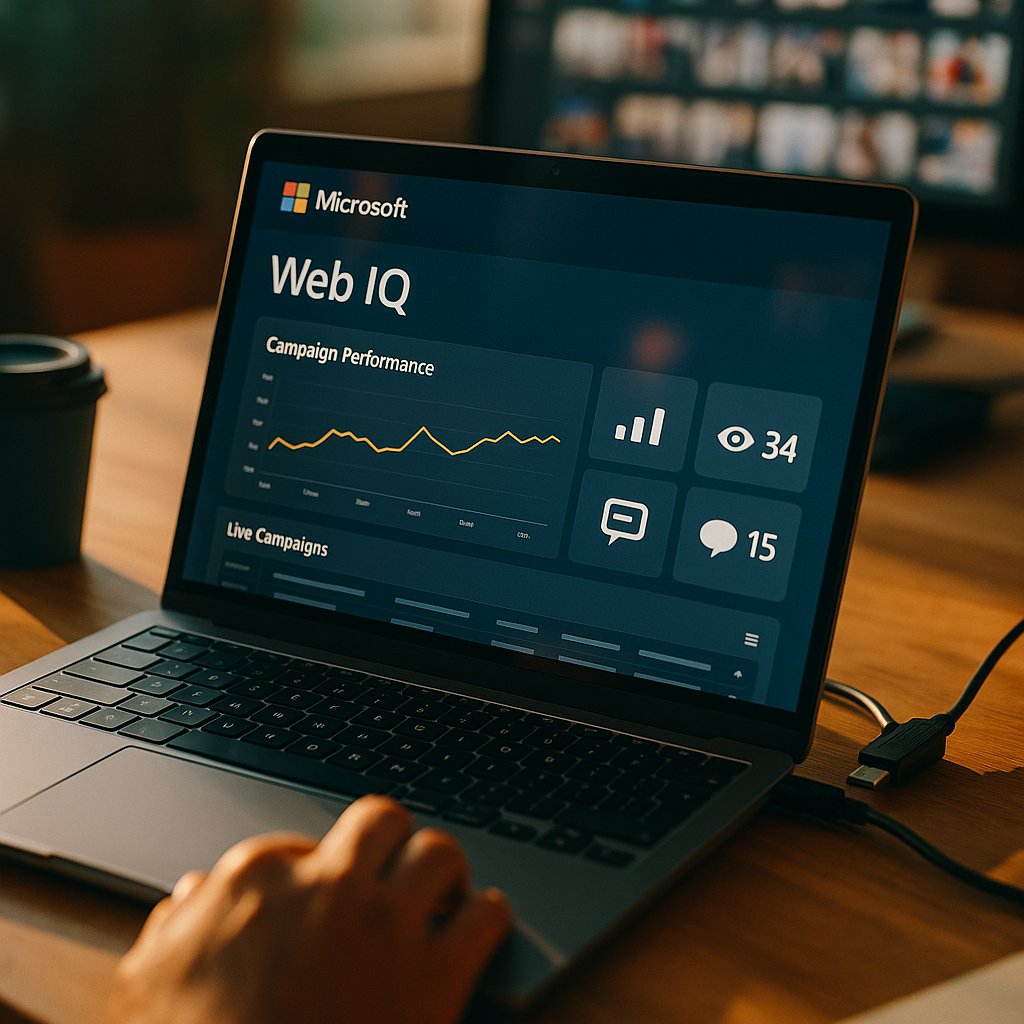
Your Campaign Data Is Already Stale
By the time a weekly performance report lands in your inbox, the creator content it references has already been live for days. Microsoft’s Web IQ Agent changes that equation. For brand teams running always-on influencer programs, embedding this AI agent into workflow infrastructure isn’t a nice-to-have — it’s a competitive requirement.
What Web IQ Agent Actually Does (And What It Doesn’t)
Microsoft’s Web IQ Agent, part of the Copilot ecosystem, functions as a real-time web retrieval layer that can query live web data, extract structured signals from public-facing pages, and surface them directly inside productivity tools your team already uses: Teams, SharePoint, Power BI, and connected Azure pipelines.
For influencer campaign operations, that means the agent can pull live engagement rates from creator posts, monitor brand mention sentiment across public forums, and flag content anomalies as they happen — not after a Monday morning debrief.
What it doesn’t do: it won’t access private platform APIs without integration scaffolding, and it won’t make budget decisions autonomously. Those guardrails matter. Brand teams that understand the agent’s actual scope deploy it more effectively than those chasing an all-in-one fantasy.
Real-time doesn’t mean real-time everywhere by default. Web IQ Agent retrieves from publicly indexable web surfaces. Connecting it to gated data — Meta Business Suite, TikTok Ads Manager, or proprietary creator dashboards — requires deliberate API bridge architecture.
Building the Integration Layer: Where Most Teams Get It Wrong
The failure mode isn’t technical. It’s structural. Brand teams often bolt AI agents onto existing workflows as a dashboard view, then wonder why nobody uses them after week three. The right model treats Web IQ Agent as an active participant in workflow triggers, not a passive reporting pane.
Here’s a practical architecture that works:
- Trigger layer: Set Web IQ Agent to query creator post URLs at defined intervals (hourly, per campaign phase) and push anomaly alerts into Teams channels or Slack via Power Automate.
- Enrichment layer: Feed retrieved data into a Power BI semantic model that sits alongside first-party CRM data. For deeper identity resolution across creator audiences, pairing this with a tool like Databricks makes sense — see how identity graphs support creator campaigns for a fuller picture.
- Recommendation layer: Use Copilot’s language interface to query the enriched dataset conversationally. “Which creator posts are underperforming engagement benchmarks by more than 20% in the last 48 hours?” becomes a one-line prompt, not a two-hour analyst task.
- Override layer: Humans must retain approval authority over any content recommendation or spend reallocation the agent surfaces. This isn’t optional from a brand governance standpoint.
The override layer deserves more attention than most teams give it. As agentic AI governance frameworks make clear, autonomous agents operating without defined escalation paths create brand risk that no efficiency gain can offset.
Live Performance Monitoring: The Specific Use Cases Worth Prioritizing
Not all real-time monitoring creates equal value. Brand teams should sequence their Web IQ Agent deployments around use cases with the clearest ROI signal.
Content compliance monitoring. The agent can continuously crawl creator post URLs and compare visible disclosures against FTC guidelines. A mismatch between required ad disclosure language and live post copy triggers an alert before it becomes a regulatory issue. The FTC’s endorsement guidelines have become stricter — automated monitoring is no longer optional for programs with more than a handful of active creators.
Sentiment drift detection. Web IQ Agent can monitor comment sections and social threads around a campaign’s branded hashtags, flagging sharp sentiment shifts. This is especially valuable during product launches or culturally sensitive campaign moments where a 6-hour response lag is genuinely damaging. Pairing this with a dedicated brand drift detection layer gives you both the signal and the correction playbook.
Competitor content intelligence. The agent can be tasked with monitoring competitor brand sponsorship activity at the creator level — surfacing new partnerships, identifying content formats gaining traction, and feeding that intelligence into your own content recommendation cycle.
Asset performance signals feeding creative refresh. When Web IQ Agent detects that a creator’s post is outperforming engagement benchmarks, that signal should automatically queue a creative brief for similar formats. Real-time performance signals driving asset routing is a pattern that’s already proving out in production environments.
Governance Isn’t a Blocker — It’s the Architecture
Senior practitioners know that governance conversations that happen after deployment are expensive. Build them in before the first query fires.
Define data classification rules upfront: which retrieved data is shareable across the full campaign team, which requires compliance review before acting on, and which triggers an automatic legal hold. Microsoft’s Purview compliance platform integrates natively with Copilot infrastructure and should be part of any enterprise Web IQ Agent deployment.
Audit trails matter here. Every agent action, query log, and surfaced recommendation should be recorded in a tamper-evident log. This protects you during influencer contract disputes and provides documentation if a regulator ever asks how a compliance decision was made. The operational model for AI campaign governance and audit trails maps directly to this requirement.
Also worth setting explicitly: the agent’s recommendation scope. Is it authorized to suggest content changes? Budget reallocation? Creator offboarding? Each action type should have a corresponding human approval threshold. Treating these as override protocols rather than edge cases is the operational maturity marker that separates teams running AI well from teams running AI dangerously.
An AI agent without a defined escalation matrix isn’t a productivity tool — it’s an unmanaged liability. Define the boundary between agent recommendation and human decision before the first campaign goes live.
Content Recommendation at Scale: Making the Agent Useful for Creative Teams
The performance monitoring function is the entry point. The content recommendation function is where Web IQ Agent creates compounding value over a campaign lifecycle.
When the agent surfaces that short-form video content from micro-creators in a specific category is driving 3x the click-through rate of static posts, that insight should flow directly into the brief template your content team uses. This is where the integration between Web IQ Agent and tools like Adobe GenStudio or your internal content management system becomes critical. Scaling UGC pipelines with AI depends on exactly this kind of signal-to-brief automation.
The agent’s natural language interface also reduces the query friction that kills adoption. Analysts who would previously spend an afternoon pulling data and formatting a slide can now ask the agent directly and redirect their time toward interpretation and strategy. According to research published by McKinsey, AI-assisted marketing teams report significant reductions in time spent on data retrieval tasks — time that flows back into higher-value creative and strategic work.
One practical tip: assign a Web IQ Agent “owner” within the campaign team. Not an IT administrator — a marketing operations lead who understands both the business objective and the technical integration. This person is responsible for refining query logic, escalating false positives, and ensuring agent outputs are being actioned rather than ignored.
Teams scaling creator programs should also look at how AI channel mix rebalancing complements live performance data retrieval — particularly when budget decisions need to move at the speed the data is surfacing. For teams benchmarking readiness, HubSpot’s marketing benchmarks and Sprout Social’s analytics resources provide useful reference points for what “good” performance monitoring infrastructure looks like at scale.
Start With One Campaign, Build the Template
Pick one active influencer campaign, connect Web IQ Agent to its creator post URLs, set up three trigger alerts (engagement anomaly, sentiment shift, disclosure compliance), and run it for four weeks alongside your existing reporting. The delta between what you know on Monday morning now versus what you’d know in real-time will make the infrastructure investment case for you — no slide deck required.
Frequently Asked Questions
What is Microsoft Web IQ Agent and how does it apply to influencer marketing?
Microsoft Web IQ Agent is a real-time web retrieval capability within the Microsoft Copilot ecosystem. For influencer marketing teams, it can query live creator content URLs, monitor brand mentions, track public sentiment, and surface performance anomalies as they happen — enabling teams to act on campaign data in hours rather than days.
Does Web IQ Agent require custom development to integrate with campaign workflows?
Some integration work is required, but it doesn’t need to be a large engineering project. Using Power Automate, Teams connectors, and Power BI, brand teams can build trigger-based alert pipelines without deep coding. Connecting the agent to gated platforms like Meta Business Suite or TikTok Ads Manager does require additional API bridge configuration.
How does real-time campaign monitoring with Web IQ Agent reduce compliance risk?
The agent can continuously monitor creator post URLs for required disclosure language, flagging any content that deviates from FTC guidelines before it generates regulatory exposure. Automated compliance monitoring at scale is significantly more reliable than manual review, particularly for programs running 20 or more active creators simultaneously.
What human oversight controls should brand teams build into a Web IQ Agent deployment?
Every agent deployment should include defined escalation thresholds: which recommendations require human approval before action, which data classifications trigger a compliance review, and which outputs are logged for audit purposes. The agent should surface recommendations, not execute decisions — human override authority must be preserved at each action tier.
How does Web IQ Agent support content recommendations, not just monitoring?
When the agent identifies content formats or creator posting patterns that are outperforming benchmarks, those signals can be fed directly into brief templates and creative workflows. This closes the loop between performance data and creative production, reducing the lag between insight and execution that typically costs brands meaningful campaign momentum.
Top Influencer Marketing Agencies
The leading agencies shaping influencer marketing in 2026
Agencies ranked by campaign performance, client diversity, platform expertise, proven ROI, industry recognition, and client satisfaction. Assessed through verified case studies, reviews, and industry consultations.
Moburst

-
2

The Shelf
Boutique Beauty & Lifestyle Influencer AgencyA data-driven boutique agency specializing exclusively in beauty, wellness, and lifestyle influencer campaigns on Instagram and TikTok. Best for brands already focused on the beauty/personal care space that need curated, aesthetic-driven content.Clients: Pepsi, The Honest Company, Hims, Elf Cosmetics, Pure LeafVisit The Shelf → -
3

Audiencly
Niche Gaming & Esports Influencer AgencyA specialized agency focused exclusively on gaming and esports creators on YouTube, Twitch, and TikTok. Ideal if your campaign is 100% gaming-focused — from game launches to hardware and esports events.Clients: Epic Games, NordVPN, Ubisoft, Wargaming, Tencent GamesVisit Audiencly → -
4

Viral Nation
Global Influencer Marketing & Talent AgencyA dual talent management and marketing agency with proprietary brand safety tools and a global creator network spanning nano-influencers to celebrities across all major platforms.Clients: Meta, Activision Blizzard, Energizer, Aston Martin, WalmartVisit Viral Nation → -
5

The Influencer Marketing Factory
TikTok, Instagram & YouTube CampaignsA full-service agency with strong TikTok expertise, offering end-to-end campaign management from influencer discovery through performance reporting with a focus on platform-native content.Clients: Google, Snapchat, Universal Music, Bumble, YelpVisit TIMF → -
6

NeoReach
Enterprise Analytics & Influencer CampaignsAn enterprise-focused agency combining managed campaigns with a powerful self-service data platform for influencer search, audience analytics, and attribution modeling.Clients: Amazon, Airbnb, Netflix, Honda, The New York TimesVisit NeoReach → -
7

Ubiquitous
Creator-First Marketing PlatformA tech-driven platform combining self-service tools with managed campaign options, emphasizing speed and scalability for brands managing multiple influencer relationships.Clients: Lyft, Disney, Target, American Eagle, NetflixVisit Ubiquitous → -
8

Obviously
Scalable Enterprise Influencer CampaignsA tech-enabled agency built for high-volume campaigns, coordinating hundreds of creators simultaneously with end-to-end logistics, content rights management, and product seeding.Clients: Google, Ulta Beauty, Converse, AmazonVisit Obviously →