


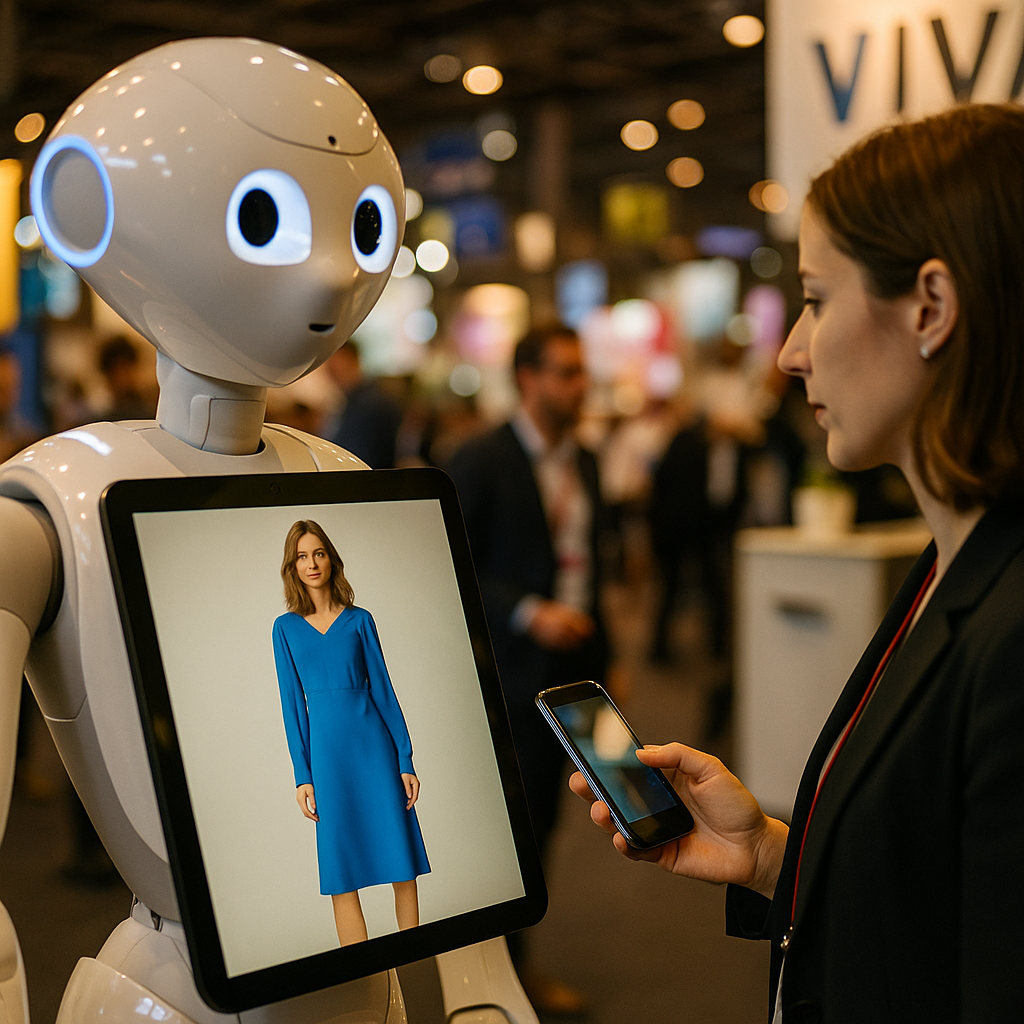
What Happens When the Fitting Room Goes Conversational?
Conversational AI shopping assistants are no longer a retail novelty. According to Statista, the global AI in retail market is projected to exceed $45 billion by 2032, and fashion is absorbing a disproportionate share of that investment. VivaTech has become the stage where that investment gets stress-tested in public, and the signals coming out of this year’s event should be shaping your next budget conversation right now.
Why Fashion Is the Hardest Category to Automate (and Why That’s Changing)
Fashion has always resisted the clean logic of algorithmic recommendation. Size inconsistency across brands, the tactile dimension of fabric, the deeply personal nature of style identity — these are not problems a keyword search ever solved well. The conventional wisdom was that luxury shoppers, especially, would never trust a bot to understand aspiration.
That assumption is cracking. The generation of conversational AI tools being showcased at VivaTech — from Salesforce’s Einstein Commerce capabilities to emerging players like Bloomreach‘s AI-powered product discovery layer — are not operating like the chatbots of five years ago. They understand context, intent, and emotional register. A shopper who types “something to wear that doesn’t look like I’m trying too hard to a Parisian dinner” is now getting coherent, curated results. That is a qualitative leap.
For brand strategists, this creates an immediate operational question: is your product data architecture ready to feed these systems? Most luxury brands have beautiful creative assets and catastrophically inconsistent product metadata. That gap is now a competitive liability.
The Luxury Tier vs. Mid-Market Divide: Two Very Different Use Cases
The deployment logic differs sharply by market tier, and conflating them is a costly mistake.
For luxury brands (think Moncler, Brunello Cucinelli, or LVMH’s e-commerce properties), conversational AI serves primarily as a concierge layer — preserving the high-touch service expectation while scaling it digitally. The goal is not volume conversion; it is relationship depth. These tools are being trained on client purchase history, styling preferences, and even prior in-store interactions to produce recommendations that feel bespoke. A shopper returning to a Maison Valentino digital assistant should feel the same ambient recognition they’d get walking into a flagship on Avenue Montaigne.
Mid-market brands face a different mandate. For Zara, COS, or Reiss, the AI assistant is primarily a discovery engine solving the paradox of choice problem. When a retailer carries 20,000 SKUs, search friction is a direct revenue drain. Conversational interfaces reduce that friction by collapsing the browse-to-decision journey. eMarketer data shows that AI-guided sessions convert at rates 2.4 times higher than unassisted browse sessions in fashion retail — a figure that makes the infrastructure investment relatively easy to justify to a CFO.
The product data gap is the silent saboteur of conversational AI in fashion. Brands investing in AI shopping interfaces without first auditing their metadata quality are building on sand.
What VivaTech Is Actually Revealing About Implementation Maturity
VivaTech’s fashion tech pavilion is useful precisely because it surfaces the gap between vendor promises and brand readiness. Several recurring themes are worth tracking for any brand evaluating deployment.
Multimodal input is becoming table stakes. Assistants that handle only text queries are already being outclassed. The leading demos are combining voice, image upload (“find me something like this”), and behavioral signals in real time. Brands that haven’t mapped their customer journey to multimodal input points are already running behind the next deployment cycle.
Personalization without first-party data is theater. The most compelling demonstrations at VivaTech are powered by rich first-party behavioral data. Brands that have invested in loyalty infrastructure, CRM integration, and zero-party data collection are seeing dramatically better assistant performance. For brands still relying on third-party signals, the honest answer is that the AI is producing generic outputs dressed in personalization language.
The compliance layer is non-negotiable. GDPR, AI Act provisions, and emerging national frameworks for AI transparency all apply to these systems. Brands operating in EU markets need to ensure that their AI shopping assistants meet disclosure requirements and that recommendation logic can be audited. This is not a legal team issue in isolation — it belongs in the brief alongside UX and conversion targets. Understanding agentic marketing compliance gaps is now a direct part of the AI shopping deployment conversation.
The Creator Economy Intersection Nobody Is Talking About
Here is where things get strategically interesting for brands running influencer programs alongside their AI commerce buildout. Conversational AI assistants are beginning to surface creator content as part of the recommendation pathway. A shopper asking an AI assistant how to style a specific trench coat may be served a creator lookbook, a styling reel, or a shoppable post — all pulled from the brand’s content ecosystem and ranked by relevance and recency.
This creates a direct feedback loop between your creator content quality and your AI assistant’s performance. Poor metadata on creator assets, inconsistent tagging, and low production quality all degrade the assistant’s ability to serve that content effectively. Brands with structured creator production and compliance standards are finding that their creator libraries become genuine AI training assets. That is a new ROI argument for investment in creator program infrastructure.
It also raises questions about attribution. When a shopper discovers a product through an AI assistant that surfaced a creator’s content, who gets credited? Most current attribution models are not equipped to handle this. For brands thinking about creator content in AI-mediated buying journeys, building the measurement framework now — before volume scales — is the smarter move.
Agentic Commerce Is the Next Frontier Worth Watching
Beyond conversational assistants, VivaTech is also previewing agentic commerce: AI systems that don’t just recommend but actively execute purchases on behalf of users within predefined parameters. A shopper might authorize their AI agent to reorder a fragrance when stock runs low, or to alert and purchase when a waitlisted piece comes available in their size.
For fashion brands, this represents both an enormous opportunity and a serious operational challenge. Agentic systems need clean inventory data, robust API infrastructure, and fraud-prevention layers that most fashion retail tech stacks are not currently optimized to provide. Understanding how bot traffic interacts with brand infrastructure is directly relevant here — the same architectural questions apply. The brands investing now in backend readiness will capture the agentic commerce wave. Everyone else will be retrofitting under competitive pressure.
Agentic commerce will reward brands that invested in backend data hygiene. The AI doesn’t care about your brand positioning if your inventory API returns errors.
Practical Moves for Brand Strategists Right Now
If you are evaluating conversational AI shopping deployment or trying to make the case internally, the highest-leverage actions are not the obvious ones. Buying an AI commerce platform is step three, not step one.
- Audit your product data first. Run a sample of 500 SKUs through a structured metadata review. Size consistency, descriptive copy quality, and image tagging are your baseline variables.
- Map the conversational journey, not just the conversion funnel. Where in the discovery-to-purchase path does a human or AI conversation add the most value? That tells you where to deploy.
- Build your creator content taxonomy now. If creator assets will feed into AI recommendations, they need to be tagged and structured to be machine-readable. Revisit your brief and measurement frameworks with this use case explicitly in view.
- Get legal and compliance into the room early. AI Act requirements for high-risk AI systems, automated profiling disclosures, and opt-out mechanisms all need to be designed in, not bolted on.
- Set realistic first-party data milestones. If you don’t have sufficient behavioral data to power meaningful personalization, be honest about what the assistant will actually deliver in year one.
For a structured view of how AI skills are reshaping the marketing function more broadly, the 90-day AI upskilling framework for senior marketers is worth the read before your next technology procurement cycle.
The FTC’s guidance on AI endorsements and automated marketing systems is also worth reviewing before any public-facing AI shopping assistant goes live in US markets.
Start with the product data audit. Every other decision cascades from that foundation.
Frequently Asked Questions
What is a conversational AI shopping assistant in fashion retail?
A conversational AI shopping assistant is a software interface that uses natural language processing and machine learning to help shoppers discover, evaluate, and purchase products through dialogue — via text, voice, or image input. In fashion, these tools interpret style intent, size preferences, occasion context, and aesthetic signals to deliver curated recommendations, functioning as a digital equivalent of a knowledgeable sales associate.
How does conversational AI differ from traditional product recommendation engines?
Traditional recommendation engines match products based on collaborative filtering (what similar users bought) or rule-based logic. Conversational AI interprets free-form, contextual queries in natural language — “something elegant but not formal for a rooftop event” — and refines recommendations through dialogue. It adapts in real time to user responses rather than serving a static list, which produces higher-quality discovery outcomes and measurably better conversion rates.
What first-party data does a brand need to power an effective AI shopping assistant?
At minimum, a brand needs structured purchase history, browsing behavior, size and preference data from account profiles, and a clean, consistently tagged product catalog. Loyalty program data and zero-party preference data (explicitly provided by customers) significantly improve personalization quality. Brands without this infrastructure should expect generic recommendation outputs regardless of which AI platform they deploy.
Are there regulatory requirements brands must meet when deploying AI shopping assistants in Europe?
Yes. Under the EU AI Act, automated recommendation systems used in consumer-facing commerce are subject to transparency and risk classification requirements. GDPR provisions on automated decision-making and profiling also apply. Brands must be able to explain recommendation logic upon request, provide clear opt-out mechanisms, and ensure that personal data used to power personalization is processed lawfully. Legal review before deployment is essential, not optional.
How should luxury brands approach AI shopping assistants differently from mass-market brands?
Luxury brands should position conversational AI as a digital concierge — designed to extend the high-touch service expectation of a flagship store into digital channels. The priority is relationship depth and personalization fidelity, not volume throughput. Mass-market and mid-market brands should focus on reducing browse friction and solving the paradox of choice across large SKU catalogs. The KPIs, tone of voice, and integration depth differ significantly between these two use cases.
Top Influencer Marketing Agencies
The leading agencies shaping influencer marketing in 2026
Agencies ranked by campaign performance, client diversity, platform expertise, proven ROI, industry recognition, and client satisfaction. Assessed through verified case studies, reviews, and industry consultations.
Moburst

-
2

The Shelf
Boutique Beauty & Lifestyle Influencer AgencyA data-driven boutique agency specializing exclusively in beauty, wellness, and lifestyle influencer campaigns on Instagram and TikTok. Best for brands already focused on the beauty/personal care space that need curated, aesthetic-driven content.Clients: Pepsi, The Honest Company, Hims, Elf Cosmetics, Pure LeafVisit The Shelf → -
3

Audiencly
Niche Gaming & Esports Influencer AgencyA specialized agency focused exclusively on gaming and esports creators on YouTube, Twitch, and TikTok. Ideal if your campaign is 100% gaming-focused — from game launches to hardware and esports events.Clients: Epic Games, NordVPN, Ubisoft, Wargaming, Tencent GamesVisit Audiencly → -
4

Viral Nation
Global Influencer Marketing & Talent AgencyA dual talent management and marketing agency with proprietary brand safety tools and a global creator network spanning nano-influencers to celebrities across all major platforms.Clients: Meta, Activision Blizzard, Energizer, Aston Martin, WalmartVisit Viral Nation → -
5

The Influencer Marketing Factory
TikTok, Instagram & YouTube CampaignsA full-service agency with strong TikTok expertise, offering end-to-end campaign management from influencer discovery through performance reporting with a focus on platform-native content.Clients: Google, Snapchat, Universal Music, Bumble, YelpVisit TIMF → -
6

NeoReach
Enterprise Analytics & Influencer CampaignsAn enterprise-focused agency combining managed campaigns with a powerful self-service data platform for influencer search, audience analytics, and attribution modeling.Clients: Amazon, Airbnb, Netflix, Honda, The New York TimesVisit NeoReach → -
7

Ubiquitous
Creator-First Marketing PlatformA tech-driven platform combining self-service tools with managed campaign options, emphasizing speed and scalability for brands managing multiple influencer relationships.Clients: Lyft, Disney, Target, American Eagle, NetflixVisit Ubiquitous → -
8

Obviously
Scalable Enterprise Influencer CampaignsA tech-enabled agency built for high-volume campaigns, coordinating hundreds of creators simultaneously with end-to-end logistics, content rights management, and product seeding.Clients: Google, Ulta Beauty, Converse, AmazonVisit Obviously →