


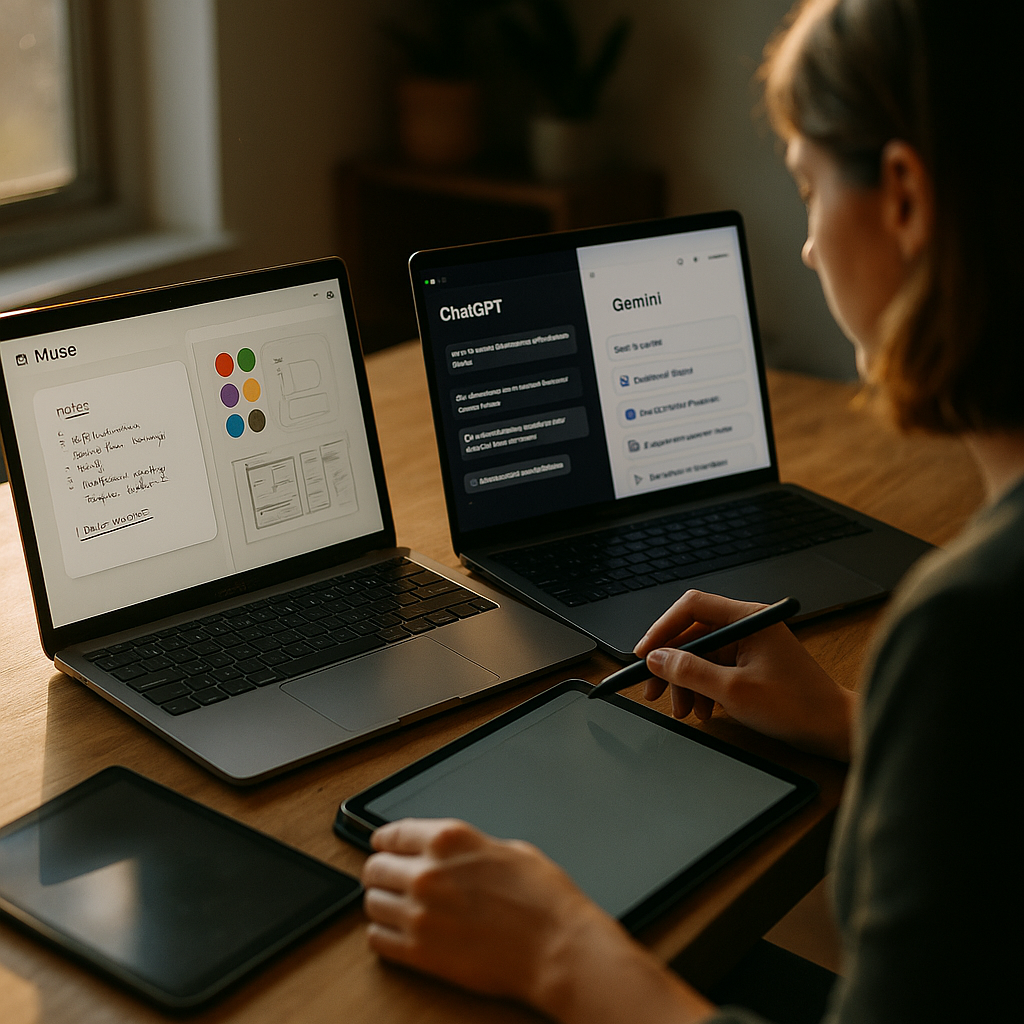
Three AI assistants now claim they can run your creator ops stack end to end. Only one of them was actually built for it. Meta’s Muse, OpenAI’s ChatGPT Agents, and Google’s Gemini Agents all promise to automate briefing, outreach, reporting, and payouts, but the overlap in marketing copy hides real differences in what each tool is good at. If you’re choosing an AI assistant for creator ops right now, the wrong pick costs you weeks of workflow rebuilding later.
Three Tools, Three Different Starting Points
Muse didn’t start life as a creator ops tool. It launched as an ad campaign automation engine inside Meta’s ads ecosystem, and its agentic features grew outward from there, as covered in our look at how Muse automates ad campaigns for small teams. That lineage matters. Muse is strongest when the task touches paid media, budget pacing, or Meta’s own ad inventory. Ask it to optimize a Reels boost spend and it’s in its element. Ask it to manage a 40 creator UGC pipeline across TikTok, YouTube, and a DTC Shopify store, and you’re asking it to stretch outside its training.
ChatGPT Agents, by contrast, grew out of a general purpose reasoning model that OpenAI has been bolting task execution onto. It can browse, fill forms, draft documents, and chain multi step actions across connected apps. Its strength is flexibility. Our earlier coverage of how ChatGPT drafts campaign briefs found it handles unstructured creative work well, but agency judgment still has to catch tone and brand fit issues before anything ships.
Gemini Agents lean hard into Google’s data graph. If your creator ops already live inside Google Workspace, Google Ads, and YouTube Studio, Gemini has a structural home field advantage. It can pull YouTube Analytics, cross reference Google Ads spend, and populate a Sheet without you exporting a single CSV. That’s not nothing when half your reporting headaches come from stitching platforms together manually.
The tool that wins isn’t the one with the flashiest demo. It’s the one that already lives where your creator data lives.
How They Actually Perform on Creator Ops Tasks
Strip away the marketing decks and test these three on the tasks creator ops teams actually do every week: sourcing, briefing, contract drafting, payment reconciliation, and performance reporting.
- Creator sourcing and vetting: Gemini Agents pull ahead here, largely because YouTube and Google Search data give it a richer view of audience overlap and fraud signals. Muse can source within Meta’s ecosystem but struggles cross platform. ChatGPT Agents can browse the open web but lack a native audience graph, so results need more manual verification.
- Briefing and content direction: ChatGPT Agents remain the strongest writer of the three. Drafts read more naturally and adapt tone faster, which lines up with what we found when testing AI briefs against agency-level editing standards.
- Contract and payment workflows: None of the three should be running this unsupervised. Our reporting on AI agents drafting creator contracts found legal review is still non negotiable, and the same logic applies to agentic payout systems that need a human guarding exceptions and disputes.
- Reporting and attribution: Gemini’s native tie into Google Analytics and YouTube gives it an edge for owned channel reporting. Muse edges ahead for anything touching Meta ad spend. ChatGPT Agents can synthesize reports from exported data but won’t pull live metrics as cleanly.
Where Each One Breaks Down
No assistant handles everything, and pretending otherwise is how teams end up with a six month automation project that quietly dies in Q3.
Muse breaks when you ask it to think outside Meta’s walled garden. It wasn’t built to reason about a TikTok Shop checkout flow or a YouTube mid roll placement, and forcing it into those lanes produces shallow, generic output. If your creator program is Meta heavy, this is a non issue. If it’s platform agnostic, you’ll hit the ceiling fast.
ChatGPT Agents break on data freshness and platform integration depth. It can reason brilliantly about a brief or a negotiation script, but it doesn’t have a native, persistent connection to your ad accounts or CDP the way Gemini does to Google’s stack. You’ll spend more time on connector setup and permissions management, a cost our piece on no code decision agents flagged as a recurring governance gap across the industry.
Gemini Agents break when creativity matters more than data. Ask it to write a punchy, off kilter brand voice brief and it tends toward safe, corporate phrasing. It’s an operations brain, not a creative one. Teams that lean on Gemini for reporting still often route final creative copy through a separate tool.
Picking an assistant by brand name instead of workflow fit is the single most common mistake creator ops leads make right now.
The Cost and Governance Question Nobody Skips Anymore
Pricing models differ enough to actually change your math. Muse is bundled into Meta’s ads platform, so cost scales with ad spend rather than seat count, which is appealing if your program is already ad heavy but painful if you’re mostly organic. ChatGPT Agents and Gemini Agents both run on tiered subscription and API usage pricing, and heavy agentic workflows (multi step browsing, document generation, repeated API calls) can get expensive fast if nobody’s watching consumption.
Governance is the bigger issue, honestly. Every one of these tools can take action on your behalf, which means every one of them needs a human checkpoint somewhere in the loop. Our coverage of no code agent deployment in financial services found the same pattern applies to marketing: speed without governance just moves the risk downstream. Build approval gates before you scale any of these tools past pilot stage, not after something goes wrong.
There’s also a compliance angle brand teams underestimate. The FTC’s disclosure guidance still applies regardless of whether a human or an AI agent drafted the sponsored content language. If Gemini or ChatGPT Agents auto generate a caption for a sponsored post, someone on your team is still legally responsible for checking it complies.
A Simple Framework for Picking One
Stop asking “which AI assistant is best.” Ask “which platforms does my creator program already live on, and which assistant reduces the most manual stitching.”
- Meta heavy program, paid media dominant: Muse is the logical default. It’s already embedded where your spend lives.
- Cross platform program with heavy creative output needs: ChatGPT Agents wins on brief quality, negotiation drafting, and flexible reasoning across unfamiliar formats.
- YouTube and Google Ads centric program, data heavy reporting culture: Gemini Agents reduce the most manual reporting work and tie cleanest into existing Workspace habits.
- Hybrid programs running all three platforms at scale: Most mature teams end up running two tools in tandem, one for creative and briefing, one for data and reporting, rather than forcing a single assistant to do both.
That last point surprises people, but it tracks with broader industry data. eMarketer’s research on marketing tool stacks consistently shows larger teams run multiple specialized tools rather than one generalist platform, and creator ops is following the same pattern as it matures past the experimentation phase.
Also factor in your attribution setup before committing. If your measurement already has blind spots, as explored in our piece on AI traffic and attribution gaps, bolting a new agentic tool on top without fixing tracking first just compounds the problem. Get your attribution model right, then layer automation on top of it, not the other way around.
Frequently Asked Questions
Which AI assistant is best for small creator ops teams?
For small teams with limited headcount, ChatGPT Agents tend to offer the most immediate value because of flexible reasoning and lower setup overhead. Muse and Gemini Agents both deliver more value once you have deeper platform specific data to feed them.
Can Muse handle non Meta platforms like TikTok or YouTube?
Muse can pull in some cross platform data through connectors, but its core reasoning and automation strengths are built around Meta’s ad ecosystem. Expect shallower performance on TikTok Shop or YouTube specific workflows.
Do these AI agents replace a creator ops manager?
No. All three still require human oversight for contract terms, payment disputes, compliance review, and brand voice decisions. Think of them as speed multipliers for a manager, not replacements for one.
Is it safe to let an AI agent approve creator payments automatically?
Most compliance and finance teams recommend keeping a human in the approval loop, especially for exception handling and dispute resolution. Full autonomy on payouts introduces risk that outweighs the time saved.
How do I measure ROI when comparing these tools?
Track hours saved on manual reporting and sourcing, reduction in campaign turnaround time, and error rates in generated briefs or contracts. Pair that with actual subscription and API cost to get a true cost per workflow comparison.
Bottom line: map your creator program’s platform footprint before you map your budget to a tool. Run a two week pilot on your messiest workflow (reporting, sourcing, or briefing) with your top candidate, and measure hours saved before committing to a full rollout.
Frequently Asked Questions
Which AI assistant is best for small creator ops teams?
For small teams with limited headcount, ChatGPT Agents tend to offer the most immediate value because of flexible reasoning and lower setup overhead. Muse and Gemini Agents both deliver more value once you have deeper platform specific data to feed them.
Can Muse handle non Meta platforms like TikTok or YouTube?
Muse can pull in some cross platform data through connectors, but its core reasoning and automation strengths are built around Meta’s ad ecosystem. Expect shallower performance on TikTok Shop or YouTube specific workflows.
Do these AI agents replace a creator ops manager?
No. All three still require human oversight for contract terms, payment disputes, compliance review, and brand voice decisions. Think of them as speed multipliers for a manager, not replacements for one.
Is it safe to let an AI agent approve creator payments automatically?
Most compliance and finance teams recommend keeping a human in the approval loop, especially for exception handling and dispute resolution. Full autonomy on payouts introduces risk that outweighs the time saved.
How do I measure ROI when comparing these tools?
Track hours saved on manual reporting and sourcing, reduction in campaign turnaround time, and error rates in generated briefs or contracts. Pair that with actual subscription and API cost to get a true cost per workflow comparison.
Top Influencer Marketing Agencies
The leading agencies shaping influencer marketing in 2026
Agencies ranked by campaign performance, client diversity, platform expertise, proven ROI, industry recognition, and client satisfaction. Assessed through verified case studies, reviews, and industry consultations.
Moburst

-
2

The Shelf
Boutique Beauty & Lifestyle Influencer AgencyA data-driven boutique agency specializing exclusively in beauty, wellness, and lifestyle influencer campaigns on Instagram and TikTok. Best for brands already focused on the beauty/personal care space that need curated, aesthetic-driven content.Clients: Pepsi, The Honest Company, Hims, Elf Cosmetics, Pure LeafVisit The Shelf → -
3

Audiencly
Niche Gaming & Esports Influencer AgencyA specialized agency focused exclusively on gaming and esports creators on YouTube, Twitch, and TikTok. Ideal if your campaign is 100% gaming-focused — from game launches to hardware and esports events.Clients: Epic Games, NordVPN, Ubisoft, Wargaming, Tencent GamesVisit Audiencly → -
4

Viral Nation
Global Influencer Marketing & Talent AgencyA dual talent management and marketing agency with proprietary brand safety tools and a global creator network spanning nano-influencers to celebrities across all major platforms.Clients: Meta, Activision Blizzard, Energizer, Aston Martin, WalmartVisit Viral Nation → -
5

The Influencer Marketing Factory
TikTok, Instagram & YouTube CampaignsA full-service agency with strong TikTok expertise, offering end-to-end campaign management from influencer discovery through performance reporting with a focus on platform-native content.Clients: Google, Snapchat, Universal Music, Bumble, YelpVisit TIMF → -
6

NeoReach
Enterprise Analytics & Influencer CampaignsAn enterprise-focused agency combining managed campaigns with a powerful self-service data platform for influencer search, audience analytics, and attribution modeling.Clients: Amazon, Airbnb, Netflix, Honda, The New York TimesVisit NeoReach → -
7

Ubiquitous
Creator-First Marketing PlatformA tech-driven platform combining self-service tools with managed campaign options, emphasizing speed and scalability for brands managing multiple influencer relationships.Clients: Lyft, Disney, Target, American Eagle, NetflixVisit Ubiquitous → -
8

Obviously
Scalable Enterprise Influencer CampaignsA tech-enabled agency built for high-volume campaigns, coordinating hundreds of creators simultaneously with end-to-end logistics, content rights management, and product seeding.Clients: Google, Ulta Beauty, Converse, AmazonVisit Obviously →