


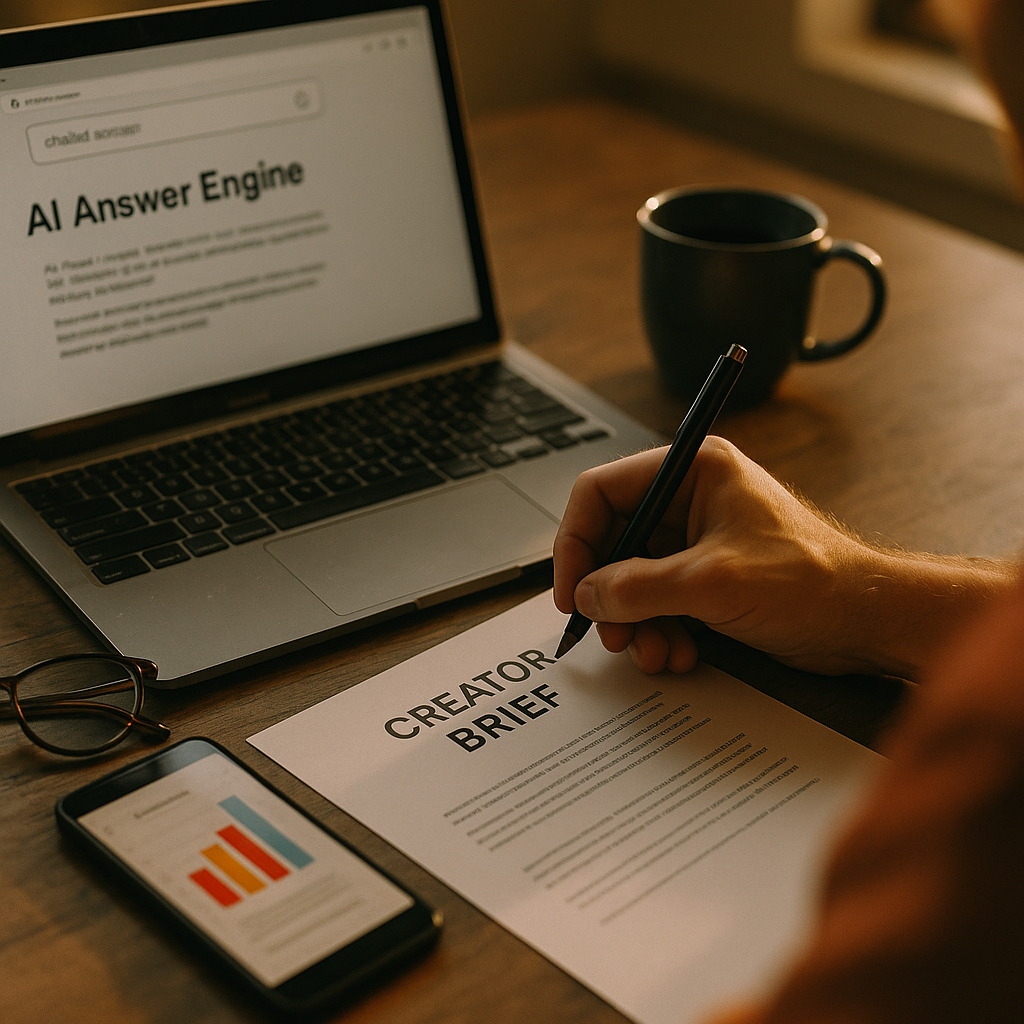
AI Answer Engines Are Eating the Top of Your Funnel
Roughly 40% of Gen Z consumers now start product research on an AI answer engine rather than a search engine or social platform, according to data from Statista. That single shift changes who owns your brand’s first impression — and it isn’t your creators. Not yet. But it can be, if you restructure how creator content is briefed.
Perplexity and ChatGPT don’t surface content because it went viral. They surface content because it is factually dense, clearly attributed, and structured in a way that a large language model can parse and cite. Most creator briefs today are built entirely around the opposite: emotional resonance, aesthetic cohesion, and social engagement signals. That mismatch is leaving significant top-of-funnel real estate uncontested.
Why Your Current Creator Briefs Are Invisible to AI
A typical creator brief in an influencer program asks for authenticity, a relatable hook, a CTA, and maybe three talking points. What it almost never asks for is a verifiable product claim, a cited specification, or a structured answer to a specific consumer question. That’s a problem because Perplexity’s retrieval model and ChatGPT’s browsing capability are both optimized to find content that directly answers a query with specificity and authority.
Think about what happens when a consumer types “best magnesium supplement for sleep” into Perplexity. The engine retrieves and synthesizes pages that contain explicit, verifiable claims: dosage figures, absorption rates, comparison data. A creator’s Instagram caption that says “this actually helped me sleep so much better” contributes nothing to that result. A creator’s long-form YouTube description that says “contains 300mg of magnesium glycinate, which has a higher bioavailability than magnesium oxide according to [source]” is a candidate for citation.
AI answer engines don’t reward relatability. They reward verifiability. Every creator brief that omits specific, citable product claims is a missed citation opportunity across Perplexity, ChatGPT, and every LLM that follows.
This is the core brief restructuring problem. Brands have trained creators to talk around products. AI engines need creators to talk about products with precision. For a deeper look at how this dynamic is reshaping YouTube-specific creator workflows, the new creator brief framework for AI search is a useful reference point.
The Anatomy of an AI-Optimized Creator Brief
Restructuring a brief for AI discoverability doesn’t mean stripping the creative soul out of the content. It means adding a factual substrate underneath the creative layer. Here’s how that breaks down in practice.
Mandatory claim blocks. Every brief should include a section called “citable facts” — a list of 5 to 10 product claims the creator must state verbatim or near-verbatim in their content. These are not taglines. They are specifications: ingredient concentrations, certifications, third-party test results, clinical study references, or comparative performance data. The creator can frame these however feels natural, but the underlying claim must be present and accurate.
Question-answer formatting requirements. AI retrieval systems are heavily optimized around direct question-answer pairs. Brief creators to include at least one or two explicit Q&A-style segments in their long-form content (YouTube videos, podcasts, blog posts, Substack notes). “A lot of people ask me whether this is safe for daily use. Here’s what the label says and what the company confirmed…” That structure is retrievable. A vague affirmation is not.
Platform tiering by retrieval depth. Not all platforms are equally crawlable or citable by AI engines. Publicly indexed content (YouTube descriptions, creator blog posts, LinkedIn articles, public Substack newsletters) carries far more AI retrieval weight than Stories, TikTok captions, or Instagram Reels descriptions. Your brief should explicitly flag which deliverables are “AI-indexed priority” formats and which are purely social-feed-optimized. Allocate your most factually rich content requirements to the indexable tier.
This also connects to the broader discipline of GEO strategy for AI search, where structuring content for generative engine optimization directly reduces customer acquisition costs by improving organic AI-surface discoverability.
Claim Accuracy Is Now a Brand Safety Issue
There’s a risk dimension here that most influencer program managers haven’t fully absorbed. When a creator’s content is cited by Perplexity or surfaced by ChatGPT, that content becomes semi-permanent brand attribution. An inaccurate claim in a YouTube description that never got traction in 2024 could resurface as a cited “fact” in an AI answer today. That’s a compliance exposure.
This means the legal and compliance review step — typically applied to paid posts and sponsored disclosures — must now extend to the factual content layer of every briefed deliverable. Every claim in the “citable facts” block needs to be FTC-compliant, substantiated, and consistent with your product labeling. The FTC’s endorsement guidelines already require substantiation for product claims; AI surfacing simply raises the stakes because a false claim can now be cited at scale by an engine that millions of consumers trust as authoritative.
Brands running large creator programs should be investing in governance infrastructure that can verify claim accuracy before content publishes. Tools like AI-assisted campaign governance workflows are increasingly being deployed to catch factual inconsistencies in creator content before they become indexed liabilities.
Which Formats Win in AI Retrieval
Long-form always beats short-form for AI indexation. That’s not a preference — it’s a structural reality of how LLMs ingest and weight content. A 12-minute YouTube video with a fully written description, timestamped chapters, and a linked transcript gives AI retrieval systems multiple surfaces to parse. A 15-second Reel gives them almost nothing.
The practical implication: brands need to rebalance their creator mix toward creators who produce indexable long-form content, even if those creators have smaller social followings. A niche YouTuber with 80,000 subscribers who writes detailed video descriptions and maintains a linked blog is more valuable for AI discoverability than a macro-influencer whose entire output lives in disappearing Stories.
Podcast creators are an underrated asset here. Podcast transcripts, episode show notes, and associated blog posts are all heavily indexed. If a host spends three minutes discussing your product’s clinical study results in an episode, and that transcript is publicly available, that content is a legitimate candidate for AI citation. Brief accordingly.
The creator you’ve been overlooking because their follower count doesn’t move a media plan might be your most valuable AI-surface asset. Indexable long-form content from a 50K-subscriber creator can generate more AI citations than 10 macro-influencer Stories combined.
For brands thinking about how AI bot traffic is already reshaping content performance metrics, the data on AI bot traffic and creator content optimization is worth reviewing — it reframes how you measure the value of a piece of content beyond human engagement rates.
Practical Brief Restructuring: A Starting Checklist
- Add a “Citable Facts” mandatory section to every brief, with 5-10 verified, FTC-compliant product claims the creator must incorporate.
- Require at least one Q&A segment in all long-form deliverables, structured as an explicit question followed by a direct, specific answer.
- Tier deliverables by AI-indexability: flag YouTube descriptions, blog posts, and newsletter content as “AI-priority” formats with higher factual density requirements.
- Include source attribution guidance: instruct creators to reference the source of any claim (clinical study, third-party lab, brand documentation) — this is what AI engines use to assess credibility.
- Brief for entity clarity: the brand name, product name, and key category terms should appear in full in the first 150 words of any written content, and clearly spoken in the first 90 seconds of any video. AI retrieval systems weight early-content entity mentions heavily.
- Add a compliance review gate for all citable claim content before publication, not just for disclosure language.
If you’re scaling this across dozens or hundreds of creators, consider pairing this brief structure with AI-augmented UGC pipelines that can enforce brief compliance at volume without requiring manual review of every asset.
The broader competitive landscape is also shifting. Platforms like HubSpot and Sprout Social are already integrating AI search performance metrics into content dashboards. Brands that build AI-optimized creator content practices now will have a measurable data advantage when those attribution models mature. eMarketer projects continued acceleration in AI-assisted product discovery, making this a near-term operational priority, not a future-state experiment.
The AI-indexed content your creators publish today is already being read, synthesized, and cited by engines your prospects trust. The only question is whether what they find is strategically controlled brand messaging or an accidental collection of vague endorsements that tell the AI nothing useful.
Start with one product line. Rebuild one brief. Add the citable facts block and a Q&A requirement. Run it through 10 long-form creator deliverables and audit how often your product claims appear in Perplexity results within 60 days. That’s your proof of concept, and it costs almost nothing to run.
Frequently Asked Questions
What makes creator content discoverable by AI answer engines like Perplexity and ChatGPT?
AI answer engines prioritize content that is factually specific, clearly attributed, and structured around direct question-answer formats. Creator content that includes verifiable product claims, specific ingredient or specification data, source citations, and explicit Q&A segments is far more likely to be retrieved and cited than content built purely around emotional storytelling or aesthetic appeal.
Do I need to change every creator brief, or just specific formats?
You should prioritize restructuring briefs for long-form, publicly indexed formats first: YouTube videos and descriptions, creator blog posts, LinkedIn articles, podcast show notes, and Substack newsletters. Short-form social content like TikTok, Instagram Reels, and Stories has minimal AI retrieval value and can retain its existing brief structure for social-feed performance.
How do I ensure creator claims are accurate enough to be cited safely by AI engines?
Build a “Citable Facts” block into every brief containing only pre-approved, FTC-compliant, substantiated claims. Run all factual content through a compliance review gate before publication — not just for disclosure language, but for claim accuracy. Any claim that would require substantiation under FTC endorsement guidelines should be verified against your product labeling and any referenced studies before a creator uses it.
Which types of creators are most valuable for AI search discoverability?
Creators who produce long-form, publicly indexed content perform best for AI retrieval, regardless of follower count. Niche YouTubers with detailed video descriptions, podcast hosts with public transcripts and show notes, and creators who maintain active blogs or newsletters are more valuable for AI discoverability than macro-influencers whose output is primarily short-form or ephemeral social content.
How is GEO (Generative Engine Optimization) different from traditional SEO, and why does it matter for creator briefs?
Traditional SEO optimizes content to rank in link-based search results. GEO optimizes content to be retrieved, synthesized, and cited by AI answer engines that generate direct responses rather than ranked lists. For creator briefs, this means the emphasis shifts from keyword density and backlinks to factual specificity, entity clarity, structured Q&A formatting, and verifiable source attribution — all of which can be built directly into the brief requirements you give to creators.
Top Influencer Marketing Agencies
The leading agencies shaping influencer marketing in 2026
Agencies ranked by campaign performance, client diversity, platform expertise, proven ROI, industry recognition, and client satisfaction. Assessed through verified case studies, reviews, and industry consultations.
Moburst

-
2

The Shelf
Boutique Beauty & Lifestyle Influencer AgencyA data-driven boutique agency specializing exclusively in beauty, wellness, and lifestyle influencer campaigns on Instagram and TikTok. Best for brands already focused on the beauty/personal care space that need curated, aesthetic-driven content.Clients: Pepsi, The Honest Company, Hims, Elf Cosmetics, Pure LeafVisit The Shelf → -
3

Audiencly
Niche Gaming & Esports Influencer AgencyA specialized agency focused exclusively on gaming and esports creators on YouTube, Twitch, and TikTok. Ideal if your campaign is 100% gaming-focused — from game launches to hardware and esports events.Clients: Epic Games, NordVPN, Ubisoft, Wargaming, Tencent GamesVisit Audiencly → -
4

Viral Nation
Global Influencer Marketing & Talent AgencyA dual talent management and marketing agency with proprietary brand safety tools and a global creator network spanning nano-influencers to celebrities across all major platforms.Clients: Meta, Activision Blizzard, Energizer, Aston Martin, WalmartVisit Viral Nation → -
5

The Influencer Marketing Factory
TikTok, Instagram & YouTube CampaignsA full-service agency with strong TikTok expertise, offering end-to-end campaign management from influencer discovery through performance reporting with a focus on platform-native content.Clients: Google, Snapchat, Universal Music, Bumble, YelpVisit TIMF → -
6

NeoReach
Enterprise Analytics & Influencer CampaignsAn enterprise-focused agency combining managed campaigns with a powerful self-service data platform for influencer search, audience analytics, and attribution modeling.Clients: Amazon, Airbnb, Netflix, Honda, The New York TimesVisit NeoReach → -
7

Ubiquitous
Creator-First Marketing PlatformA tech-driven platform combining self-service tools with managed campaign options, emphasizing speed and scalability for brands managing multiple influencer relationships.Clients: Lyft, Disney, Target, American Eagle, NetflixVisit Ubiquitous → -
8

Obviously
Scalable Enterprise Influencer CampaignsA tech-enabled agency built for high-volume campaigns, coordinating hundreds of creators simultaneously with end-to-end logistics, content rights management, and product seeding.Clients: Google, Ulta Beauty, Converse, AmazonVisit Obviously →