


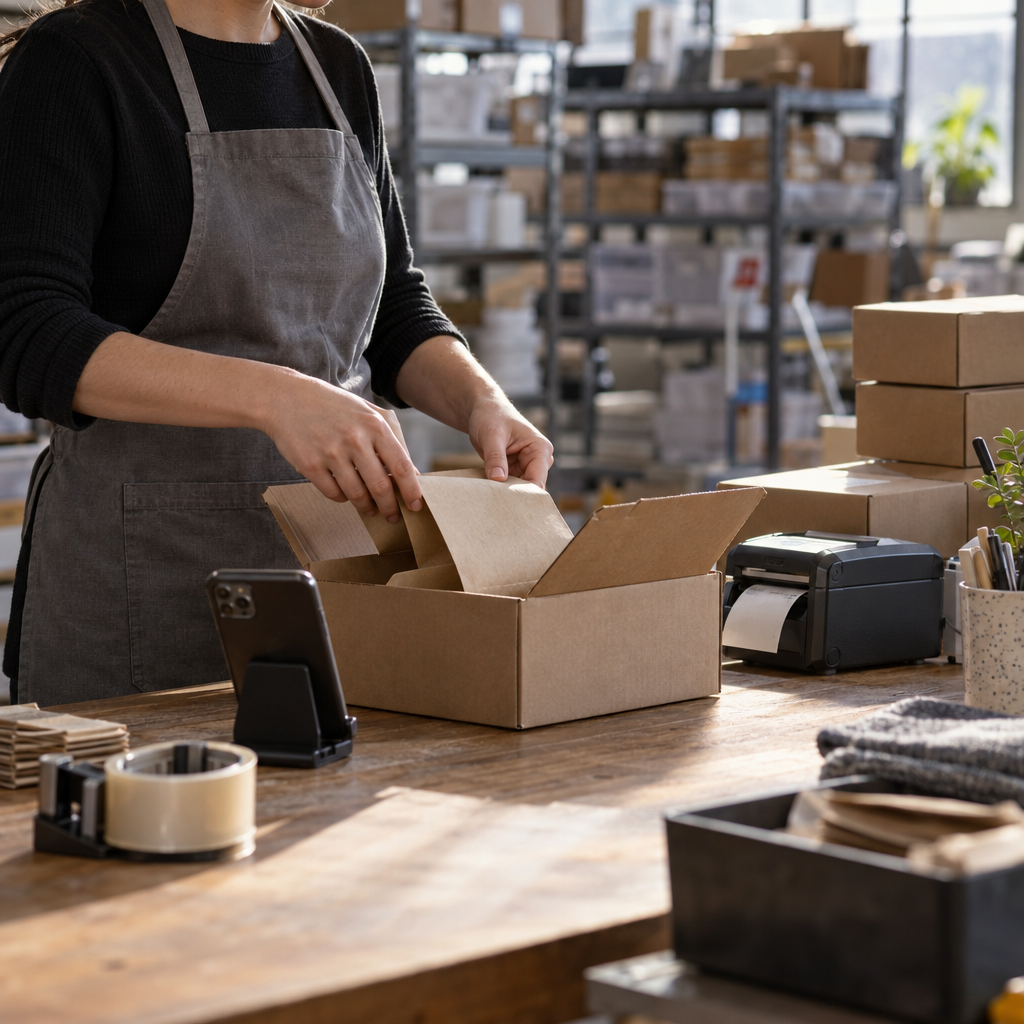
Is your fulfillment video proof of a real business, or a data leak with a soundtrack? Pack an order with me fulfillment content has become a reliable way for small brands to look human at scale. It also puts your packing table, your labels and your customer data on camera. The brief decides which one you get.
Why this format works (and why brands get nervous)
Packing videos are slow, tactile and oddly calming. A hand folds tissue paper, a sticker goes on, a handwritten note is tucked in. There is no pitch. That absence is the pitch.
For brand teams, the appeal is practical. The format is cheap to shoot, easy to repeat and it answers a question shoppers silently ask: will this thing actually show up, and will it look good when it does? It also pairs naturally with pack opening videos, so you can show both ends of the journey.
The nervousness is fair. A fulfillment surface is full of things you never meant to publish: customer names, street addresses, order numbers, supplier labels, inventory counts, even the shipping software in the background. One frame can expose all of it.
Define “authentic” before you define “allowed”
Most briefs fail by asking for “raw and real” without saying what that means. Creators then guess, and the guesses range from over-polished to alarmingly transparent.
Spell it out. Authenticity in this format is the visible craft: the sounds, the textures, the small decisions. It is not the data. Here is a split that works as a starting point:
- Show: hands, products, packaging materials, the folding and sealing sequence, thank-you inserts, the finished parcel.
- Never show: real customer names, addresses, order numbers, tracking barcodes, supplier names on cartons, stock levels, cost-of-goods paperwork.
- Show with care: a shipping label (use a dummy or blurred one), a packing slip (use a template with placeholder data), a dashboard (use a demo account).
The safest packing video is one where nothing on screen is real except the craft. Use dummy orders, and the authenticity survives while the exposure disappears.
Build the brief around a fake order
This is the single most useful operational move. Create a staged order in your system with a fictional recipient, then ship the kit to the creator with a prepared label and packing slip. Every on-camera document is then safe by design, so nobody has to rely on a creator remembering to blur something in the edit.
If the creator is packing real stock on their own premises (common with creator-owned product lines or affiliate sellers), the logic is the same. Give them a template slip and a printed label with placeholder text.
Do not trust post-production blurring as your main control. Blurs slip, auto-captions read text aloud, and a paused frame on a phone is easy to screenshot and zoom. Prevention beats redaction.
What goes into the brief
Keep it to one page. Creators ignore a ten-page PDF, and a short document is easier to enforce.
- Objective and audience. Are you building trust with first-time buyers, or reinforcing loyalty with repeat customers? The answer changes the pacing and the voiceover.
- Shot list. Overhead of the table, close-up of the fold, the insert going in, the seal, the final box. A tight list keeps the video short and focused. If you already brief multi-shot demos, the approach in multi-angle product demos transfers directly.
- Redaction rules. The show and never-show list above, in plain language, with one example photo of a safe frame.
- Claims guardrails. No “ships same day,” “plastic-free” or “carbon neutral” unless you can back it up. Packing visuals invite sustainability and speed claims, and those are the ones regulators and competitors notice.
- Disclosure instructions. Where and how the paid relationship is labeled.
- Approval flow. Who reviews, how fast, and what triggers a reshoot.
The first three seconds still matter
Slow content can still need a hook. A packing video that opens on a long shot of an empty table loses people before the first fold. Brief an opener with motion: the box lid flipping open, the tape gun’s sound, a sticker peeled in close-up. The logic mirrors what we cover in first three second hooks.
Many people watch these with the sound off, too. Add on-screen text for the product name and one detail (“hand-wrapped in recycled tissue” only if true). For more on that, see silent unboxing proof maps.
Disclosure: the part nobody wants to film
A cozy packing video does not feel like an ad, which is exactly why disclosure matters. If a creator is paid, gifted product or earns commission, that connection needs to be clear. The FTC’s Endorsement Guides say that a connection consumers wouldn’t expect should be disclosed clearly and conspicuously. The same FTC page also notes that responsibility for disclosure does not sit with the creator alone, so the brand carries exposure too.
Practical implications for the brief:
- Require the platform’s branded content or paid partnership label where available.
- Add a spoken or on-screen disclosure early, not buried in a caption.
- If the video is on TikTok Shop, check the platform’s own rules. The TikTok Shop Creator Terms of Use say creators must follow applicable disclosure obligations and use TikTok’s Branded Content tools in addition.
One more risk deserves attention. If you are tempted to “stage” the packing of orders that never existed, or to present a creator’s scripted reaction as a spontaneous customer review, you are drifting toward fake testimonial territory. The FTC’s final rule on reviews and testimonials addresses testimonials that misrepresent who is giving them, and it lets the agency seek civil penalties. A staged demo order is fine when it is presented as a demo. A fake customer story is not.
Approval checklist before anything goes live
Run every cut through a frame-by-frame check. It takes five minutes and has saved more than one team from an awkward takedown.
- Pause at every cut and scan for addresses, barcodes, names, order numbers.
- Read the auto-generated captions. They sometimes transcribe a customer name the creator mumbled.
- Check reflections: a laptop screen, a window, a glossy product surface.
- Confirm every claim has a source in your files.
- Confirm the disclosure is visible without tapping “more.”
Then measure. Track completion rate, saves and add-to-cart clicks rather than views alone. Saves tend to signal intent in this format, though you should benchmark against your own account history rather than industry averages. Series of videos compound better than one-offs, a point explored in mini documentary brand series.
Should the founder do it?
Sometimes. A founder packing orders is a strong signal, but it raises the stakes on what gets said off the cuff. If you go that route, apply the same guardrails and read founder cameo guidance first. Casual chatter about margins, supplier delays or “we’re almost sold out” can become a claim problem in seconds.
Take one hour this week to build a dummy order kit (fake label, template slip, safe-frame example), attach it to a one-page brief, and make it the standard for every packing video you commission.
FAQs
What is a “pack an order with me” video?
It is a short video, usually shot overhead or first-person, showing someone preparing a customer order for shipment. The appeal is the tactile process: wrapping, labeling, adding inserts and sealing the parcel.
Do brands need to disclose a paid packing video?
Yes, if there is a material connection such as payment, free product or commission. The FTC expects clear and conspicuous disclosure, and platforms like TikTok require use of their branded content tools alongside it.
How do I keep customer data out of the frame?
Use a fictional order with a dummy recipient, placeholder label and template packing slip. Do not rely on blurring in the edit as your primary protection.
Can a creator pack real orders on camera?
It is possible, but it carries the highest privacy risk. If you allow it, require that no personal data, order numbers or barcodes appear, and review every frame before publishing.
What claims should I avoid in fulfillment content?
Avoid unsubstantiated speed, sustainability and quality claims, such as same-day shipping or eco-friendly packaging, unless your records support them. Packing visuals make these claims feel obvious, which is why they attract scrutiny.
Which metrics show whether the format is working?
Watch completion rate, saves, profile visits and add-to-cart clicks. Compare against your own previous content, since benchmarks vary widely by category and platform.
Top Influencer Marketing Agencies
The leading agencies shaping influencer marketing in 2026
Agencies ranked by campaign performance, client diversity, platform expertise, proven ROI, industry recognition, and client satisfaction. Assessed through verified case studies, reviews, and industry consultations.
Moburst

-
2

The Shelf
Boutique Beauty & Lifestyle Influencer AgencyA data-driven boutique agency specializing exclusively in beauty, wellness, and lifestyle influencer campaigns on Instagram and TikTok. Best for brands already focused on the beauty/personal care space that need curated, aesthetic-driven content.Clients: Pepsi, The Honest Company, Hims, Elf Cosmetics, Pure LeafVisit The Shelf → -
3

Audiencly
Niche Gaming & Esports Influencer AgencyA specialized agency focused exclusively on gaming and esports creators on YouTube, Twitch, and TikTok. Ideal if your campaign is 100% gaming-focused — from game launches to hardware and esports events.Clients: Epic Games, NordVPN, Ubisoft, Wargaming, Tencent GamesVisit Audiencly → -
4

Viral Nation
Global Influencer Marketing & Talent AgencyA dual talent management and marketing agency with proprietary brand safety tools and a global creator network spanning nano-influencers to celebrities across all major platforms.Clients: Meta, Activision Blizzard, Energizer, Aston Martin, WalmartVisit Viral Nation → -
5

The Influencer Marketing Factory
TikTok, Instagram & YouTube CampaignsA full-service agency with strong TikTok expertise, offering end-to-end campaign management from influencer discovery through performance reporting with a focus on platform-native content.Clients: Google, Snapchat, Universal Music, Bumble, YelpVisit TIMF → -
6

NeoReach
Enterprise Analytics & Influencer CampaignsAn enterprise-focused agency combining managed campaigns with a powerful self-service data platform for influencer search, audience analytics, and attribution modeling.Clients: Amazon, Airbnb, Netflix, Honda, The New York TimesVisit NeoReach → -
7

Ubiquitous
Creator-First Marketing PlatformA tech-driven platform combining self-service tools with managed campaign options, emphasizing speed and scalability for brands managing multiple influencer relationships.Clients: Lyft, Disney, Target, American Eagle, NetflixVisit Ubiquitous → -
8

Obviously
Scalable Enterprise Influencer CampaignsA tech-enabled agency built for high-volume campaigns, coordinating hundreds of creators simultaneously with end-to-end logistics, content rights management, and product seeding.Clients: Google, Ulta Beauty, Converse, AmazonVisit Obviously →