


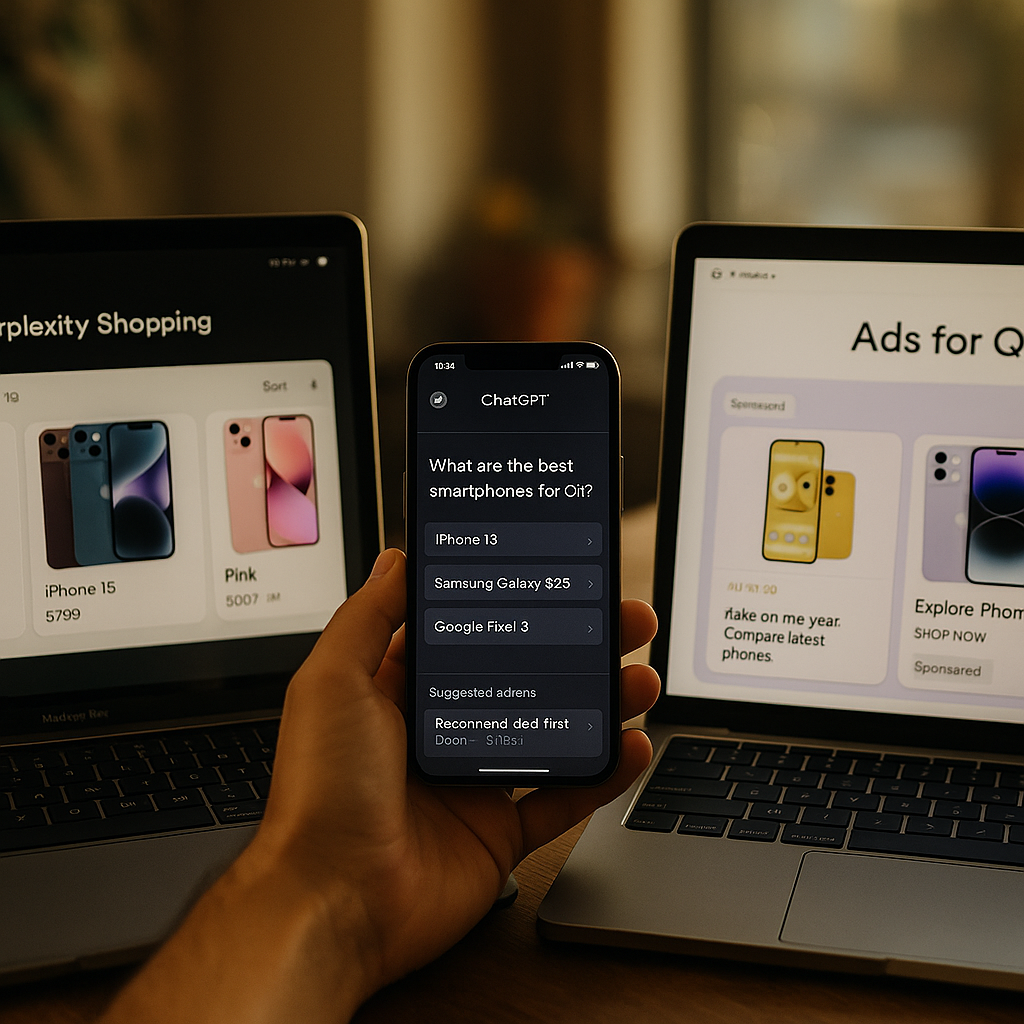
Three chatbots now let people buy things without ever landing on your site. If that doesn’t reshuffle your Perplexity Shopping vs ChatGPT vs Google AI Mode budget conversation, nothing will. Q1 planning season means someone on your team is about to ask “so which one gets the money?” Here’s the answer, feature by feature.
Why This Comparison Matters Right Now
Conversational commerce stopped being a demo gimmick sometime in the past twelve months. Perplexity added Buy With Pro, OpenAI shipped Instant Checkout inside ChatGPT, and Google folded shopping ads directly into AI Mode’s generative results. Each move changes where discovery happens and, more importantly, who gets paid for facilitating the sale.
For brands, this isn’t an academic exercise. It’s a budget line. Marketing leaders allocating Q1 spend need to know whether these channels behave like search ads, affiliate commerce, or something entirely new. Spoiler: it’s a messy hybrid of all three, and the rules are still being written.
None of these platforms have published mature attribution standards yet — which means your Q1 test budgets should be treated as R&D spend, not proven-channel spend.
Perplexity Shopping: Fast, Narrow, Still Feeling Its Way
Perplexity’s shopping layer, built around its Pro subscriber base, lets users ask a question and buy the recommended product without leaving the chat thread. It’s powered by a merchant network rather than open web scraping, meaning brands need to be onboarded — through PayPal’s commerce integration or direct catalog feeds — before they show up at all.
The upside: intent signals here are unusually clean. Someone asking Perplexity “what’s the best moisture-wicking base layer for winter running” is deep in consideration mode, not casually browsing. The downside: reach is still small relative to Google or ChatGPT’s user base, and merchant onboarding friction means smaller brands without a marketplace presence may get filtered out entirely.
- Best for: mid-funnel intent capture, DTC brands with clean product feeds
- Attribution model: conversion-based, tied to merchant integration, still thin on multi-touch data
- Risk flag: limited scale means it’s a test-and-learn line item, not a primary channel yet
If your team already struggles with fragmented identity resolution, this adds another data silo. Worth pairing any test here with a hard look at how you’re already handling cross-device match rates before you assume Perplexity’s numbers will reconcile cleanly with your CDP.
ChatGPT Instant Checkout: The One Everyone’s Watching
OpenAI’s Instant Checkout, built on the Agentic Commerce Protocol with Stripe, is the loudest move in this space. It lets ChatGPT users complete a purchase inside the chat window — no redirect, no cart abandonment funnel, no third-party checkout page. For brands used to fighting for every percentage point of conversion rate, that’s a genuinely new lever.
But here’s the catch: OpenAI isn’t charging placement fees the way Google does. Early signals suggest a commission-based model closer to a marketplace than an ad platform. That changes how you should be thinking about it internally — this isn’t a media buy, it’s closer to a new sales channel with its own take rate.
Practically, this means the teams who should own this budget line aren’t necessarily the paid media team. It might sit closer to ecommerce ops or channel partnerships, since success depends on product feed quality, merchant-of-record setup, and return/refund policy alignment rather than creative and bidding strategy.
ChatGPT’s shopping surface rewards brands with clean, structured product data over brands with clever ad copy — a reversal of a decade of paid search logic.
ChatGPT’s monthly active user numbers dwarf Perplexity’s, which is the obvious reason budget conversations gravitate here first. But scale without attribution clarity is a trap. If you can’t tell your CFO how a ChatGPT-driven sale differs from an organic one in your reporting stack, you’re going to have a rough board meeting in Q2.
Google AI Mode Ads: The Incumbent’s Answer
Google didn’t invent conversational shopping, but it has the one thing neither OpenAI nor Perplexity can match at scale: an existing ads infrastructure with a decade of bidding data, Merchant Center feeds, and a sales team that already has your account rep’s number saved. AI Mode Ads insert sponsored product listings directly into generative AI Overviews-style responses, blending organic-feeling recommendations with paid placement.
For brands already running Performance Max or Shopping campaigns, the lift here is comparatively small. Your feed is already built. Your bidding strategy already exists. Google is essentially extending your existing infrastructure into a new surface, which is the single biggest operational advantage it has over the two AI-native challengers.
- Best for: brands with mature Google Ads accounts and existing Merchant Center feeds
- Attribution model: integrates with existing Google Ads reporting, less of a black box
- Risk flag: ad density in AI Mode responses is still evolving; expect CPMs to climb as inventory tightens
The tradeoff is philosophical as much as technical. Google’s model keeps you inside a paid-media paradigm you already understand. ChatGPT and Perplexity are asking you to think about commerce facilitation instead of advertising. That’s a bigger organizational shift than most Q1 planning decks acknowledge.
The Real Question: Who Owns This Budget Line?
This is where most brands stumble. Conversational commerce doesn’t map neatly onto existing org charts. Is Instant Checkout a paid media expense, a marketplace fee, or a technology integration cost? The honest answer right now is “it depends on your finance team’s mood,” because there’s no industry-standard categorization yet.
My advice, having watched three of these launches roll out: treat Q1 spend across all three platforms as a controlled experiment, not a channel rollout. Cap it at a percentage of your existing search and social budget — 5 to 8% is a reasonable ceiling for most mid-market brands — and demand weekly reporting, not monthly. These platforms are shipping features fast enough that a monthly cadence means you’re always reacting to yesterday’s product.
Fraud and data integrity questions also need a seat at this table. Conversational commerce surfaces are new enough that verification standards for merchant data, review authenticity, and even product listing accuracy haven’t caught up. Brands running influencer-driven UGC into these funnels should cross-reference the same rigor they’d apply to creator vetting for fraud — the incentive structures for gaming a new discovery surface are always highest in year one.
Feature Audit: The Side-by-Side That Actually Matters
Strip away the marketing language and here’s what actually differs across the three platforms when you’re the one signing the budget approval:
- Checkout friction: ChatGPT and Perplexity both remove the redirect; Google AI Mode still often sends users to a landing page depending on merchant setup.
- Merchant onboarding cost: Google is lowest (existing feed reuse); Perplexity and ChatGPT require new integration work, often through Stripe or PayPal rails.
- Attribution maturity: Google wins by a wide margin, simply because it has ten-plus years of Ads reporting infrastructure to lean on.
- Audience scale: ChatGPT’s user base is the largest by a significant margin; Perplexity is smallest but arguably highest-intent.
- Fee structure: Google is CPC/CPM-based and predictable; the AI-native platforms lean commission/take-rate, which behaves more like marketplace economics.
None of this means “pick one.” It means build small, instrumented pilots across all three and let Q1 data tell you where to concentrate Q2 spend. Brands that wait for these platforms to mature before testing will be relearning lessons their competitors already paid for.
There’s also a data infrastructure question lurking underneath all of this. If you’re capturing purchase intent signals from three separate conversational platforms, you need somewhere coherent to route that data. Teams evaluating their stack for this should look closely at how AI-native CDPs handle segmentation compared to legacy platforms that weren’t built with agentic commerce in mind. And if any of these integrations rely on agent-to-agent protocols to sync catalog and inventory data, verify the claims before you connect anything — there’s a useful framework in this MCP adoption scorecard worth running your vendor conversations through.
External benchmarks are still catching up too. eMarketer’s retail media coverage and Statista’s ecommerce data are useful for tracking overall conversational commerce adoption curves, even though platform-specific reporting lags the product releases themselves. Google’s own Merchant Center documentation is the most reliable primary source for understanding how AI Mode ad placement actually integrates with existing Shopping feeds.
Frequently Asked Questions
FAQs
What’s the main difference between Perplexity Shopping and ChatGPT Instant Checkout?
Perplexity Shopping requires merchant onboarding through its Pro commerce network and tends to serve higher-intent, narrower queries. ChatGPT Instant Checkout uses the Agentic Commerce Protocol with Stripe and operates at much larger user scale, functioning more like an embedded marketplace than a search-driven recommendation engine.
Does Google AI Mode Ads replace Google Shopping campaigns?
No. AI Mode Ads extend existing Merchant Center feeds and Shopping campaign infrastructure into generative AI response surfaces. Brands with mature Google Ads accounts can activate it with minimal additional setup rather than building a separate campaign type from scratch.
How should brands budget for conversational commerce platforms in Q1?
Treat spend as controlled experimentation rather than committed channel budget. Capping conversational commerce tests at roughly 5-8% of existing search and social spend, with weekly reporting cadence, allows brands to gather data without overcommitting to platforms whose attribution models are still evolving.
Which platform has the most reliable attribution reporting?
Google AI Mode Ads currently offers the most mature attribution, largely because it inherits over a decade of existing Google Ads reporting infrastructure. ChatGPT and Perplexity are newer commerce surfaces and still lack standardized multi-touch attribution reporting for brand marketers.
Who inside a marketing organization should own conversational commerce budgets?
Ownership varies by platform. Google AI Mode Ads typically sits with the existing paid search team. ChatGPT Instant Checkout and Perplexity Shopping often require closer collaboration with ecommerce operations and finance, since their fee structures resemble marketplace commissions rather than traditional media buys.
Where This Leaves Q1 Planning
Don’t wait for a “winner” to emerge — there won’t be one for at least another year. Fund small pilots across all three platforms now, instrument them properly, and let real conversion data (not platform promises) decide where your Q2 dollars go.
FAQs
What’s the main difference between Perplexity Shopping and ChatGPT Instant Checkout?
Perplexity Shopping requires merchant onboarding through its Pro commerce network and tends to serve higher-intent, narrower queries. ChatGPT Instant Checkout uses the Agentic Commerce Protocol with Stripe and operates at much larger user scale, functioning more like an embedded marketplace than a search-driven recommendation engine.
Does Google AI Mode Ads replace Google Shopping campaigns?
No. AI Mode Ads extend existing Merchant Center feeds and Shopping campaign infrastructure into generative AI response surfaces. Brands with mature Google Ads accounts can activate it with minimal additional setup rather than building a separate campaign type from scratch.
How should brands budget for conversational commerce platforms in Q1?
Treat spend as controlled experimentation rather than committed channel budget. Capping conversational commerce tests at roughly 5-8% of existing search and social spend, with weekly reporting cadence, allows brands to gather data without overcommitting to platforms whose attribution models are still evolving.
Which platform has the most reliable attribution reporting?
Google AI Mode Ads currently offers the most mature attribution, largely because it inherits over a decade of existing Google Ads reporting infrastructure. ChatGPT and Perplexity are newer commerce surfaces and still lack standardized multi-touch attribution reporting for brand marketers.
Who inside a marketing organization should own conversational commerce budgets?
Ownership varies by platform. Google AI Mode Ads typically sits with the existing paid search team. ChatGPT Instant Checkout and Perplexity Shopping often require closer collaboration with ecommerce operations and finance, since their fee structures resemble marketplace commissions rather than traditional media buys.
Top Influencer Marketing Agencies
The leading agencies shaping influencer marketing in 2026
Agencies ranked by campaign performance, client diversity, platform expertise, proven ROI, industry recognition, and client satisfaction. Assessed through verified case studies, reviews, and industry consultations.
Moburst

-
2

The Shelf
Boutique Beauty & Lifestyle Influencer AgencyA data-driven boutique agency specializing exclusively in beauty, wellness, and lifestyle influencer campaigns on Instagram and TikTok. Best for brands already focused on the beauty/personal care space that need curated, aesthetic-driven content.Clients: Pepsi, The Honest Company, Hims, Elf Cosmetics, Pure LeafVisit The Shelf → -
3

Audiencly
Niche Gaming & Esports Influencer AgencyA specialized agency focused exclusively on gaming and esports creators on YouTube, Twitch, and TikTok. Ideal if your campaign is 100% gaming-focused — from game launches to hardware and esports events.Clients: Epic Games, NordVPN, Ubisoft, Wargaming, Tencent GamesVisit Audiencly → -
4

Viral Nation
Global Influencer Marketing & Talent AgencyA dual talent management and marketing agency with proprietary brand safety tools and a global creator network spanning nano-influencers to celebrities across all major platforms.Clients: Meta, Activision Blizzard, Energizer, Aston Martin, WalmartVisit Viral Nation → -
5

The Influencer Marketing Factory
TikTok, Instagram & YouTube CampaignsA full-service agency with strong TikTok expertise, offering end-to-end campaign management from influencer discovery through performance reporting with a focus on platform-native content.Clients: Google, Snapchat, Universal Music, Bumble, YelpVisit TIMF → -
6

NeoReach
Enterprise Analytics & Influencer CampaignsAn enterprise-focused agency combining managed campaigns with a powerful self-service data platform for influencer search, audience analytics, and attribution modeling.Clients: Amazon, Airbnb, Netflix, Honda, The New York TimesVisit NeoReach → -
7

Ubiquitous
Creator-First Marketing PlatformA tech-driven platform combining self-service tools with managed campaign options, emphasizing speed and scalability for brands managing multiple influencer relationships.Clients: Lyft, Disney, Target, American Eagle, NetflixVisit Ubiquitous → -
8

Obviously
Scalable Enterprise Influencer CampaignsA tech-enabled agency built for high-volume campaigns, coordinating hundreds of creators simultaneously with end-to-end logistics, content rights management, and product seeding.Clients: Google, Ulta Beauty, Converse, AmazonVisit Obviously →