


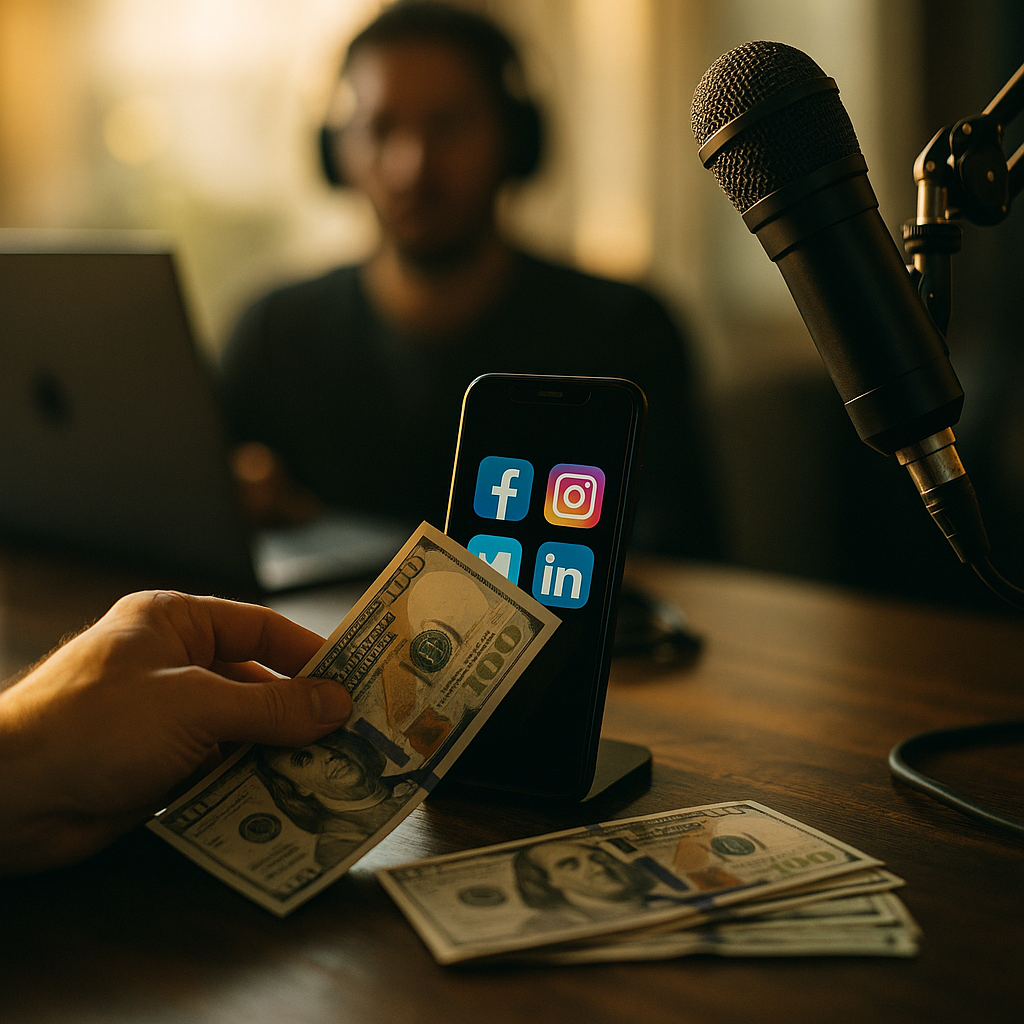
Nearly 60% of marketers say paid social CPMs rose again last year, while podcast ad inventory remains comparatively cheap and underpriced relative to attention. So why are so many brands still parking 90% of creator budget in feeds that are getting more expensive and less trusted? Podcast sponsorships are quietly becoming the arbitrage play of the year, and the brands testing audio now will own the best inventory before everyone else catches on.
Why Social Budgets Are Hitting a Ceiling
Let’s be honest about what’s happening inside most paid social budgets right now. CPMs keep climbing, organic reach keeps shrinking, and the algorithms keep changing the rules mid-quarter. You’ve felt it. Your CFO has definitely felt it.
Meta and TikTok auctions are more competitive than ever, and the inventory that used to feel like a growth lever now behaves more like a tax. That doesn’t mean social stops working. It means the marginal dollar spent there buys less than it used to, and finance teams are starting to ask uncomfortable questions about why. If you’ve already gone through a zero based budget reset, you’ve probably seen this math up close.
Podcasts, meanwhile, sit in a strange pocket of the market. Listener trust is high, ad load is low relative to other formats, and host-read spots still convert at rates that make performance marketers uncomfortable with how little math is involved. Edison Research and various industry surveys have repeatedly shown podcast listeners rank host endorsements among the most trusted ad formats they encounter, well above banner ads and even above influencer posts on some platforms.
The brands winning in audio right now aren’t the ones with the biggest budgets. They’re the ones willing to treat podcast sponsorships as a measurable media channel instead of a vibes-based sponsorship buy.
The Case for Testing Audio Isn’t Hype, It’s Math
Here’s the uncomfortable truth: most brands still buy podcast sponsorships the way they bought radio spots in the 1990s. A host reads a script, a promo code gets tracked loosely, and nobody connects the spend to pipeline with any rigor. That’s not a podcast problem. That’s a measurement problem, and it’s exactly why so many finance leaders remain skeptical of the format.
But the tooling has caught up. Dynamic ad insertion, podcast-specific attribution platforms, and better promo code hygiene mean you can now treat a podcast sponsorship almost like a programmatic social buy, with CAC tracking, incrementality testing, and multi-touch attribution layered on top. If your team has already built CAC payback benchmarks for creator spend, you already have the framework. You’re just applying it to a new channel.
The audience quality argument matters too. Podcast listeners skew toward longer session times, higher completion rates, and demographics that are increasingly hard to reach on paid social, particularly professionals who’ve started filtering out feed ads entirely. That’s an audience social can’t reliably deliver anymore at a reasonable CPM.
What Does a Test Budget Actually Look Like?
Don’t blow up your social budget to fund this. That’s the first mistake teams make, and it’s an easy one to avoid.
Start with a reallocation of 10% to 15% of existing paid social spend, not a net-new budget ask. This keeps the test self-funded and avoids the awkward board conversation about adding headcount or line items for an unproven channel. A reasonable structure looks like this:
- Allocate spend across three to five shows in adjacent verticals, not just the obvious category leader.
- Run a minimum 90-day test window. Podcast attention compounds slower than social, so a two-week burst tells you almost nothing.
- Use unique promo codes or landing pages per show so attribution doesn’t collapse into a single bucket.
- Hold back a control group on social spend so you can measure incrementality, not just correlation.
This is the same discipline teams apply when they shift spend from paid feeds into creator-owned channels, as covered in our breakdown of UGC budget reallocation. The principle transfers directly: treat the new channel like media, not like sponsorship goodwill.
Measuring ROI Without Falling Back on Vanity Metrics
Downloads are not a KPI. Say it with me. Downloads tell you how many episodes got pulled onto a device, not how many humans actually heard your ad, let alone acted on it.
Instead, build your measurement stack around three layers. First, direct response signals: promo code redemptions, unique landing page visits, and branded search lift during flight dates. Second, brand lift surveys run pre and post campaign, which platforms like Spotify Ad Analytics and Magellan AI can help structure. Third, and most important for finance buy-in, blended CAC and payback period comparisons against your existing creator and paid social channels.
This is where the GMV-over-engagement mindset pays off. If your team has already moved away from engagement-first reporting toward KPIs finance actually trusts, applying that same rigor to podcast sponsorships makes the channel instantly more defensible in budget reviews.
A podcast sponsorship that can’t be tied to a CAC number isn’t a test. It’s a donation with better production value.
Third-party tools matter here too. Chartable, Podsights (now part of Spotify), and Magellan AI all offer attribution layers specifically built for audio, and they integrate reasonably well with existing martech stacks. If your organization has recently gone through a vendor consolidation, this is worth revisiting alongside the broader conversation around attribution tools winning budget reallocation as martech spend tightens.
Risk, Compliance, and the Disclosure Gap Nobody Talks About
Podcast sponsorships carry a disclosure risk that’s easy to underestimate, especially if your legal team has only ever reviewed social influencer contracts. Host-read ads blur the line between editorial and advertising more than a sponsored Instagram post ever did, and regulators are paying attention.
The FTC’s endorsement guidelines apply to audio just as much as they apply to video and static posts. Make sure host contracts explicitly require clear disclosure language at the start of any sponsored segment, not buried thirty seconds into a read. Review the FTC’s own guidance directly at ftc.gov before finalizing your contract templates, and don’t assume your agency’s boilerplate already covers it.
There’s also a brand safety dimension that’s harder to automate in audio than in social. You can’t easily run keyword exclusion the same way you would on a programmatic display buy, and host opinions on unrelated topics can bleed into brand perception in ways a single sponsored post never does. Build a lightweight vetting process here, similar in spirit to the layered approach described in our creator vetting framework, but adapted for show history, host track record, and past controversy checks rather than just follower counts.
Building the Framework: A Phased Rollout
Treat this like any other channel test, with clear phase gates and kill criteria defined before you spend a dollar.
- Phase one (weeks one through four): Lock in three to five show partners, finalize disclosure language, and set up tracking infrastructure before the first ad airs.
- Phase two (weeks five through twelve): Run the full flight with consistent creative and a held-out control group on social spend for comparison.
- Phase three (weeks thirteen and beyond): Compare blended CAC, payback period, and incremental lift against your paid social baseline, then decide whether to scale, hold, or kill.
This phased structure mirrors the always-on budgeting logic many teams already use for creator programs, where spend gets split across test, scale, and retention buckets rather than dumped into one undifferentiated line item. If you haven’t formalized that split yet, our piece on splitting spend across budget buckets is a useful starting point before you extend the model into audio.
One more thing worth flagging: don’t let the podcast test live in a silo owned by a single junior buyer. Give it the same governance rigor you’d apply to any new spend category, with a named owner accountable for the CAC comparison at the ninety day mark. According to eMarketer research on audio ad spend trends, podcast advertising continues to grow faster than most legacy digital formats, which means the window for buying undervalued inventory won’t stay open indefinitely.
Start small, measure hard, and let the CAC data make the case to finance instead of your gut. If podcast sponsorships beat your social baseline on payback period after one full test cycle, that’s your signal to scale the reallocation, not just repeat the test.
Frequently Asked Questions
How much social budget should a brand reallocate to test podcast sponsorships?
Most teams start with 10% to 15% of existing paid social spend, which is enough to fund three to five show partnerships for a meaningful test window without requiring a new budget ask from finance.
How long should a podcast sponsorship test run before evaluating results?
A minimum of 90 days is recommended. Podcast listener behavior and attention compound more slowly than social engagement, so shorter flights rarely produce statistically useful data.
What’s the best way to measure podcast sponsorship ROI?
Combine direct response signals like unique promo codes and landing pages with brand lift surveys and blended CAC comparisons against existing channels. Downloads alone are not a reliable performance metric.
Are there disclosure requirements specific to podcast advertising?
Yes. FTC endorsement guidelines apply to host-read ads just as they do to social posts, and disclosure language needs to appear clearly at the start of any sponsored segment rather than buried mid-read.
Which tools help with podcast attribution and tracking?
Platforms like Chartable, Podsights, and Magellan AI provide attribution layers built specifically for audio, and most integrate with existing marketing attribution stacks used for social and creator spend.
Top Influencer Marketing Agencies
The leading agencies shaping influencer marketing in 2026
Agencies ranked by campaign performance, client diversity, platform expertise, proven ROI, industry recognition, and client satisfaction. Assessed through verified case studies, reviews, and industry consultations.
Moburst

-
2

The Shelf
Boutique Beauty & Lifestyle Influencer AgencyA data-driven boutique agency specializing exclusively in beauty, wellness, and lifestyle influencer campaigns on Instagram and TikTok. Best for brands already focused on the beauty/personal care space that need curated, aesthetic-driven content.Clients: Pepsi, The Honest Company, Hims, Elf Cosmetics, Pure LeafVisit The Shelf → -
3

Audiencly
Niche Gaming & Esports Influencer AgencyA specialized agency focused exclusively on gaming and esports creators on YouTube, Twitch, and TikTok. Ideal if your campaign is 100% gaming-focused — from game launches to hardware and esports events.Clients: Epic Games, NordVPN, Ubisoft, Wargaming, Tencent GamesVisit Audiencly → -
4

Viral Nation
Global Influencer Marketing & Talent AgencyA dual talent management and marketing agency with proprietary brand safety tools and a global creator network spanning nano-influencers to celebrities across all major platforms.Clients: Meta, Activision Blizzard, Energizer, Aston Martin, WalmartVisit Viral Nation → -
5

The Influencer Marketing Factory
TikTok, Instagram & YouTube CampaignsA full-service agency with strong TikTok expertise, offering end-to-end campaign management from influencer discovery through performance reporting with a focus on platform-native content.Clients: Google, Snapchat, Universal Music, Bumble, YelpVisit TIMF → -
6

NeoReach
Enterprise Analytics & Influencer CampaignsAn enterprise-focused agency combining managed campaigns with a powerful self-service data platform for influencer search, audience analytics, and attribution modeling.Clients: Amazon, Airbnb, Netflix, Honda, The New York TimesVisit NeoReach → -
7

Ubiquitous
Creator-First Marketing PlatformA tech-driven platform combining self-service tools with managed campaign options, emphasizing speed and scalability for brands managing multiple influencer relationships.Clients: Lyft, Disney, Target, American Eagle, NetflixVisit Ubiquitous → -
8

Obviously
Scalable Enterprise Influencer CampaignsA tech-enabled agency built for high-volume campaigns, coordinating hundreds of creators simultaneously with end-to-end logistics, content rights management, and product seeding.Clients: Google, Ulta Beauty, Converse, AmazonVisit Obviously →