


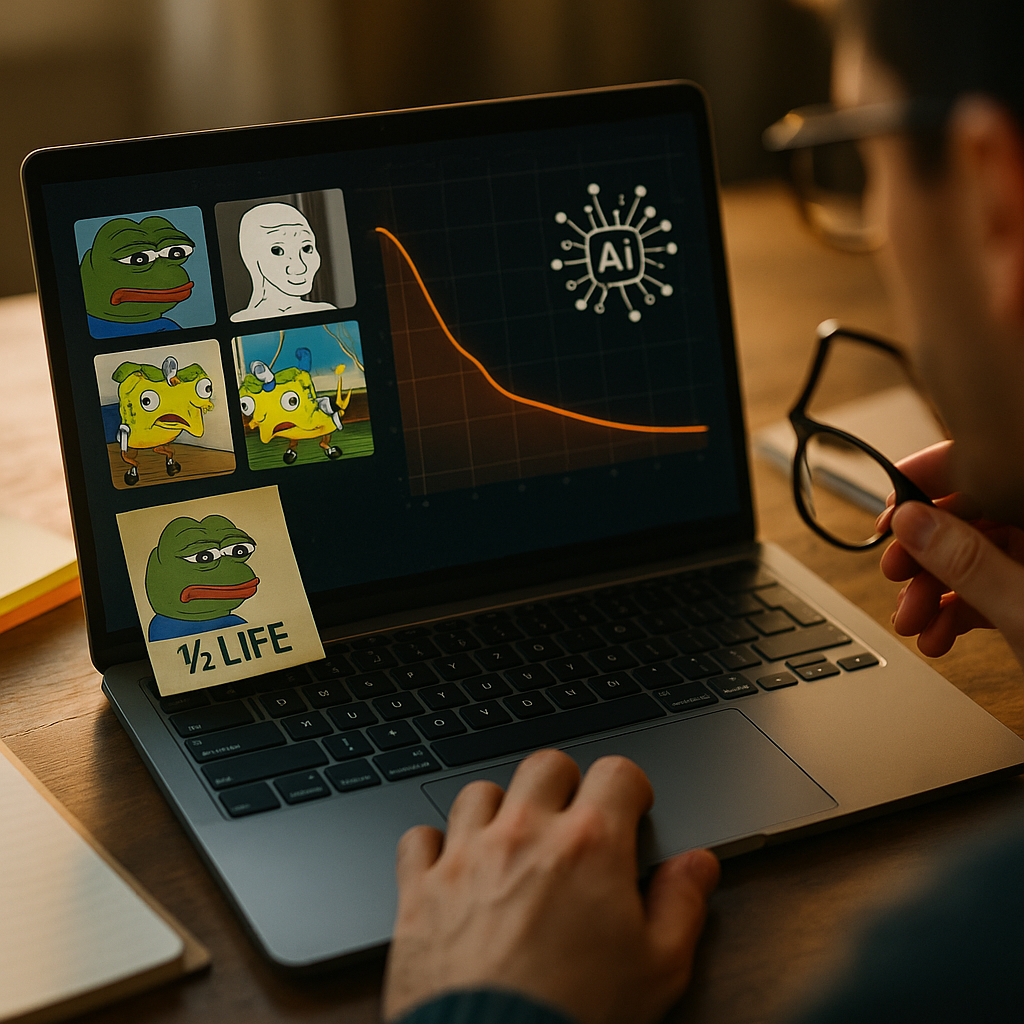
In 2025, creators and brands compete for attention in feeds where trends rise and fall in days. Using AI to Predict the Cultural Half-Life of Social Media Memes turns that chaos into measurable signals, helping teams decide what to post, boost, or retire. This article explains the models, metrics, and ethics behind meme forecasting so you can act faster than the timeline—and still sound human.
Memetic longevity metrics: defining “cultural half-life” with measurable signals
A meme’s “cultural half-life” is the time it takes for its cultural impact to drop by half after peak visibility. To predict it, you first need to define what “impact” means for your goals and platforms. The best practice is to track multiple signals that capture both reach and resonance, then convert them into a single decay curve you can model.
Core metrics that approximate meme impact include:
- Attention volume: posts per hour/day that contain the meme template, phrase, sound, or visual motif.
- Engagement intensity: normalized engagement rate (likes, comments, shares, saves) adjusted for account size and typical baseline.
- Remix velocity: how quickly new variants appear (image edits, duets, stitches, re-uploads, caption rewrites).
- Network spread: the number of distinct communities adopting it (language clusters, fandoms, niche subreddits, creator circles).
- Sentiment and intent: whether the meme is used for humor, critique, solidarity, marketing, or harassment.
To convert these into a “half-life,” analysts often fit a decay function to a time series built from a weighted index, such as:
Meme Impact Index = (w1 × normalized mentions) + (w2 × normalized shares) + (w3 × remix velocity) + (w4 × community breadth)
Half-life is then the time from peak until the index drops to 50% of that peak, with guardrails for secondary spikes (a celebrity re-share or news event can temporarily revive a meme). A practical approach is to compute both organic half-life (excluding paid amplification) and observed half-life (including everything), because paid boosts can change what looks like “culture” into “distribution.”
Answering the common follow-up: Is half-life always a clean decline? No. Many memes have “aftershocks.” AI works best when you model peaks as episodes, estimate half-life per episode, and compare patterns across categories (sounds vs. images vs. catchphrases) and across platforms.
Trend forecasting models: how AI predicts meme decay before it happens
AI forecasting for meme half-life combines time-series prediction, graph learning, and multimodal understanding. In 2025, the strongest systems do not rely on a single model; they run an ensemble, then calibrate outputs against historical backtests.
Common model families used in trend forecasting include:
- Time-series models: forecasting mention volume and engagement using methods such as state-space models, gradient-boosted regressors over lag features, or deep sequence models. These capture decay shape, seasonality, and volatility.
- Survival analysis: treating “meme relevance” as something that “fails” when it drops below a threshold, producing a probability that the meme remains culturally active after X days.
- Graph neural networks: modeling how the meme moves across creator networks and communities, predicting when it saturates and stops spreading.
- Multimodal embedding models: clustering memes by visual template, audio signature, caption style, and semantic intent to infer decay based on similar historical memes.
What the model predicts is usually a curve: expected impact over time with uncertainty intervals, plus a scalar half-life estimate. That uncertainty matters operationally. A forecast with a wide interval signals that external triggers (news, influencer adoption, platform features) could change the trajectory quickly.
Which inputs matter most? Early velocity is powerful: how fast a meme grows in the first hours or days after takeoff. But velocity alone can mislead; some memes burn bright and collapse, while others grow slower and persist. To improve accuracy, AI systems also use:
- Creator mix: whether adoption comes from a narrow clique or diverse accounts with different audiences.
- Remix diversity: the number of distinct variants, not just the count of posts.
- Context volatility: whether the meme depends on a single event likely to pass quickly.
- Platform mechanics: algorithmic boosts, trending audio placement, and search discoverability.
Teams often ask: Can AI predict the next meme? It can identify emerging candidates and their likely life cycles, but “creation” is still human. AI is more reliable at forecasting how long a meme will matter once it’s detectable than at inventing what culture will find funny.
Social media analytics signals: collecting data without breaking trust
Prediction quality depends on data quality and governance. The best implementations treat analytics as a product: consistent definitions, documented sources, and privacy-aware pipelines.
Primary data sources in social media analytics typically include:
- Platform APIs and approved partners: where available, this is the cleanest route for counts and metadata.
- First-party performance data: your own posts, audience interactions, and campaign history.
- Public web signals: public posts that reference the meme across platforms, captured with rate-limited, compliant methods.
- Search and discovery signals: internal platform search volume (if accessible) and external search interest where relevant.
Multimodal extraction is essential because memes travel as images and audio as much as text. That means:
- Computer vision to detect templates, faces, and layout motifs.
- Audio fingerprinting to track sound reuse and edits.
- Natural language processing to capture phrases, sarcasm markers, and context.
To follow EEAT expectations and reduce risk, document:
- Provenance: where each dataset came from and what permissions apply.
- Coverage limits: what platforms, languages, and regions you do not see well.
- Bias checks: which communities may be underrepresented due to privacy settings or API constraints.
- Retention policy: how long you store raw content versus aggregated features.
A likely follow-up: Do you need to store user-level content? Often, no. Many teams can store hashed identifiers, aggregated counts, and derived features (embeddings, template IDs) while minimizing personal data. When you can’t avoid handling sensitive content, restrict access, log usage, and prefer redaction or on-the-fly processing.
Meme lifecycle modeling: what makes memes fade, revive, or persist
AI forecasts improve when you model the forces that shape meme lifecycles. In practice, the “half-life” is a result of saturation, novelty decay, and competitive attention from new trends.
Key drivers of meme decay include:
- Saturation: the template becomes overused; audiences stop rewarding it.
- Context expiration: jokes tied to a specific moment lose relevance quickly.
- Format fatigue: the same punchline structure becomes predictable.
- Platform churn: algorithm shifts and interface changes move attention elsewhere.
Key drivers of meme persistence include:
- High remixability: the meme supports endless “slots” for new situations.
- Cross-community translation: it works in multiple subcultures and languages.
- Emotional range: it can express different sentiments beyond one joke.
- Template simplicity: low effort to recreate increases adoption.
Revival mechanics are especially important for half-life predictions because they create secondary peaks. AI systems should detect “revival triggers,” such as:
- Influencer reintroduction: a large creator reuses the template with a fresh twist.
- News alignment: a current event maps cleanly onto the meme’s structure.
- Platform resurfacing: recommendation loops bring older content back.
Operationally, you can treat revivals as separate events and ask two useful questions: What is the probability of revival within 30 days? and If it revives, how large will the rebound be compared to the first peak? That helps decide whether to archive the meme or keep creative assets ready for a fast response.
Brand safety and cultural context: using AI without losing the room
Predicting half-life is not the same as predicting appropriateness. A meme can be popular and still be a poor fit for a brand, or even harmful. EEAT-aligned teams combine AI scoring with human review, especially when the meme touches identity, politics, tragedy, or harassment.
Best-practice safeguards include:
- Context classification: models that label usage contexts (playful, mocking, celebratory, adversarial) and track shifts over time.
- Toxicity and harassment detection: tuned to slang and evolving coded language, with human escalation paths.
- Community impact checks: evaluate whether the meme targets a group or relies on stereotypes.
- Creative intent alignment: ensure the meme supports your message rather than replacing it.
How to prevent “cringe risk” with data: build a “brand-fit window” that combines half-life with audience receptivity. For example, even if a meme has a long cultural half-life, your brand’s opportunity might be short if your audience adopts it late. In forecasting terms, measure your audience’s adoption lag compared to the broader platform, then post when you are within an acceptable lag threshold.
A direct follow-up question is: Should brands chase short half-life memes? Only when you can execute quickly and authentically. If your approval process takes days, prioritize memes with longer predicted half-lives or evergreen templates that can be refreshed without feeling late.
Content strategy optimization: turning half-life predictions into a repeatable workflow
Half-life prediction becomes valuable when it changes decisions: what to publish, when to boost, and when to stop. The most effective teams embed forecasts into a lightweight operating system that connects data, creative, and distribution.
A practical workflow looks like this:
- Detect: monitor emerging memes and cluster variants by template/sound/phrase.
- Forecast: generate half-life estimates and uncertainty bands; flag likely revivals.
- Decide: choose one of three actions: ride now, prepare, or skip, based on brand fit and forecast horizon.
- Create: produce variants that match community norms; avoid over-branding the joke.
- Distribute: post organically first when possible; use paid support only if it does not distort cultural authenticity.
- Measure: compare predicted vs. actual decay; update weights and assumptions.
What to do with the half-life number depends on your constraints:
- If half-life is very short: prioritize speed, minimal polish, and rapid iteration; keep copy simple and platform-native.
- If half-life is medium: invest in one strong execution plus a few remixes; schedule follow-ups before the forecasted drop-off.
- If half-life is long: build a reusable creative kit (templates, caption patterns) and deploy in multiple waves, watching for context shifts.
How to validate accuracy: run backtests on past memes, measure error (for example, mean absolute error in days), and report performance by platform and meme type. Be transparent internally about limitations. Forecasting is probabilistic; the goal is better decisions, not perfect predictions.
FAQs: AI meme forecasting and cultural half-life
What does “cultural half-life” mean for a meme?
It is the time it takes for a meme’s measured cultural impact to fall to half of its peak level. Impact is typically calculated from mentions, engagement, remix activity, and community spread.
Can AI accurately predict when a meme will die?
AI can estimate likely decay patterns once a meme shows early traction, but it cannot guarantee an exact end date. External events, influencer adoption, and platform changes can extend or revive a meme unexpectedly.
Which platforms are best for half-life prediction?
Platforms with consistent public signals and strong remix mechanics tend to be easier to model. Accuracy improves when you can measure both adoption volume and remix diversity, not just views.
How much data do you need to forecast a meme’s half-life?
You need enough observations to detect a clear growth phase and early peak behavior. In practice, teams start forecasting when velocity and community spread exceed baseline noise and the meme cluster is stable.
Does paid promotion change a meme’s cultural half-life?
Yes. Paid boosts can inflate visibility and delay decline, but that may not reflect genuine cultural adoption. Separate organic half-life from observed half-life to avoid confusing distribution with resonance.
How do you keep meme forecasting ethical and privacy-safe?
Use compliant data sources, minimize personal data collection, store aggregated features when possible, document provenance and limits, and keep humans in the loop for sensitive contexts and brand safety decisions.
AI can forecast meme cultural half-life by modeling how attention, remixing, and community spread decay after a peak. The best results come from clear definitions, multimodal data, and ensembles that quantify uncertainty. Pair predictions with human cultural judgment and brand safety checks. The takeaway: treat half-life as a decision tool—post faster when it’s short, build reusable assets when it’s long.