


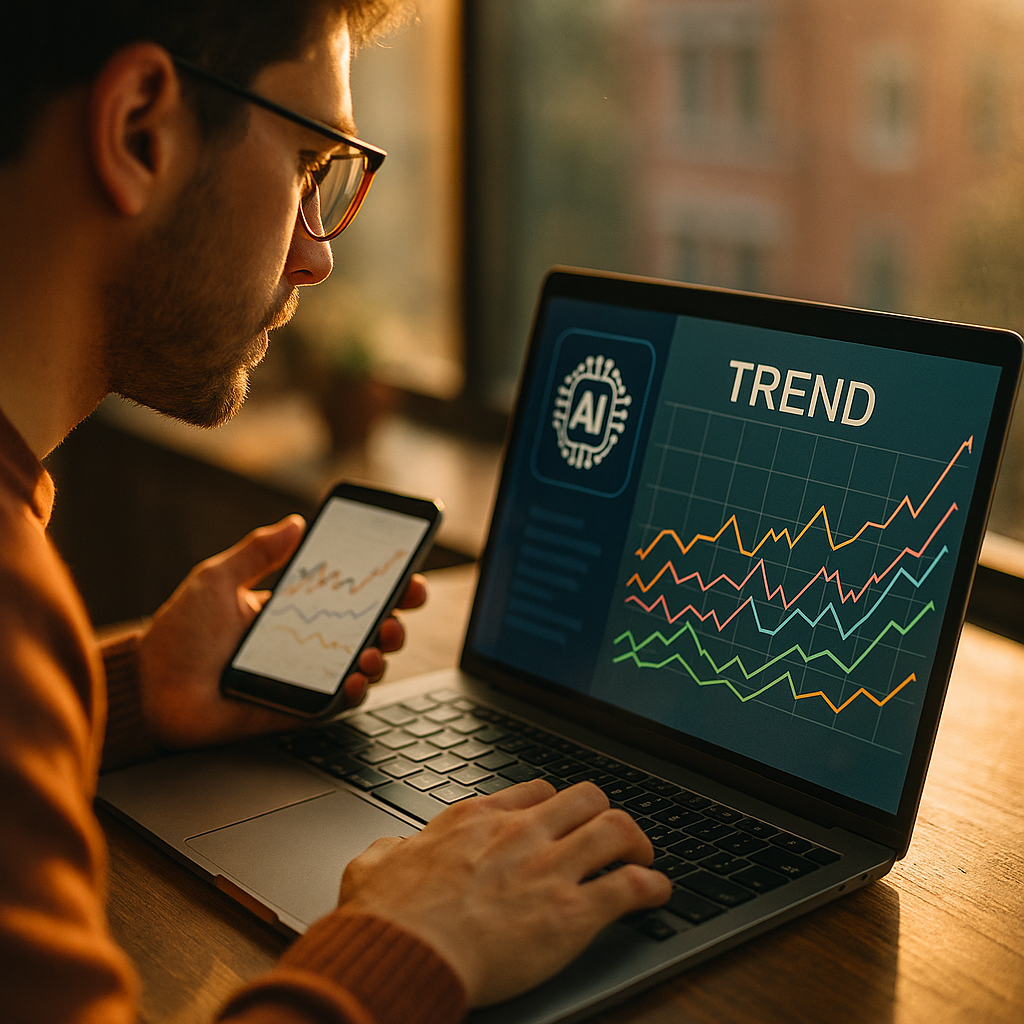
Brands win when they spot cultural momentum before it turns into mass adoption. Using AI to Predict Vibe Shifts Before They Hit the Mainstream is no longer experimental; it’s a disciplined way to turn scattered signals into actionable foresight. In 2025, the challenge isn’t data scarcity—it’s separating durable change from noisy novelty. What if you could see the next wave forming while others still debate it?
AI trend forecasting: what “vibe shifts” really are (and aren’t)
A “vibe shift” is a measurable change in collective taste, language, aesthetics, and behavior that spreads across communities, then crosses into broad culture. It shows up as a coordinated movement in signals: what people search, save, buy, wear, watch, remix, and reference. AI trend forecasting helps you detect these coordinated movements earlier by reading patterns across many channels at once—faster and more consistently than a human-only approach.
To stay accurate, define what a vibe shift is not:
- Not a single viral post. Virality can be random; vibe shifts persist and propagate across networks.
- Not a micro-influencer spike. One creator’s audience can inflate a niche without broader adoption.
- Not just “sentiment.” Vibes include aesthetics, identity markers, community norms, and new reference points.
In practice, you’re looking for three ingredients: coherence (signals align), velocity (signals accelerate), and diffusion (signals spread into new, adjacent communities). AI helps quantify all three, but your team still sets the cultural context and business relevance.
Cultural analytics: where early signals come from
Cultural analytics starts with the right inputs. If you only watch mainstream channels, you’ll arrive late. If you only watch niche forums, you’ll drown in noise. The best approach blends structured and unstructured data, then compares signal movement across layers of culture.
High-value signal sources in 2025 include:
- Search behavior: rising queries, query clusters, and “how to” searches that imply intent.
- Short-form video and social captions: emerging phrases, formats, editing styles, and reference loops.
- Community platforms: niche subcultures, creator Discords, forums, and comment threads where language forms early.
- E-commerce and resale: add-to-cart shifts, sell-through rates, secondhand price premiums, and “dupe” chatter.
- Streaming and playlists: microgenre naming, mood taxonomy changes, and cross-genre collaborations.
- Owned data: customer support transcripts, on-site search, returns reasons, wishlist behavior, and email replies.
Answering the obvious question—how do you know which sources matter?—requires mapping them to your category. Beauty brands often see early movement in creator routines and ingredient discourse; fashion sees it in silhouette language and resale signals; food and beverage sees it in recipe memes, functional claims, and convenience rituals. AI performs best when it’s trained and evaluated against outcomes you actually care about: demand, conversion, retention, and brand lift.
Machine learning for consumer insights: models that detect shifts early
Machine learning for consumer insights turns messy cultural data into probabilities and timelines. The goal isn’t to “predict the future” as a single point. The goal is to estimate whether an emerging vibe has the characteristics of mainstream adoption and to identify the conditions that would accelerate or stall it.
Common model approaches that work well for vibe detection:
- Topic modeling and embedding clustering: groups posts, queries, or reviews into evolving themes without relying on a fixed taxonomy.
- Time-series change-point detection: flags when growth rate shifts from baseline noise into sustained acceleration.
- Network diffusion analysis: tracks how a concept moves between communities; early cross-community jumps are meaningful.
- Multimodal analysis: reads text, images, and audio to capture aesthetics (color palettes, silhouettes, sound cues) not just keywords.
- Predictive scoring: assigns a “mainstream likelihood” score based on prior patterns, with confidence intervals.
One practical way to reduce false positives is to score each candidate shift across a simple rubric your stakeholders can understand:
- Persistence: does it sustain for weeks, not days?
- Breadth: is it confined to one subculture, or spreading into adjacent ones?
- Commercial intent: do searches and conversations imply buying, trying, or switching?
- Distinctiveness: is it genuinely new language/aesthetic, not a renamed old idea?
- Feasibility: can your brand respond with credible products or messaging?
Expect to iterate. A strong system keeps a “graveyard” of predicted shifts that didn’t happen, then learns from why: platform algorithm changes, seasonality, price sensitivity, or a competing vibe capturing attention.
Social listening AI: separating durable trends from algorithmic noise
Social listening AI is essential, but it’s also where teams get misled. Platforms amplify novelty, outrage, and repetition. If your AI pipeline only counts mentions, you’ll mistake reach for relevance. The fix is to design listening that understands context and structure, not just volume.
Use these tactics to avoid noise traps:
- Normalize by baseline: measure growth relative to a topic’s usual activity, not raw counts.
- Track creator diversity: one large account can distort volume; look at unique creators and community spread.
- Measure “format adoption”: when many people reuse a format, it signals cultural participation.
- Detect semantic drift: the same word can change meaning; embeddings can reveal when usage shifts.
- Flag astroturfing patterns: sudden coordinated posting, repetitive phrasing, and bot-like timing reduce trust.
Addressing the follow-up question—what about privacy and platform access?—build on aggregated, anonymized data where possible, respect platform terms, and avoid scraping that violates policies. For owned channels, use clear consent and retention rules. Strong governance improves results because it forces you to standardize data definitions and reduces “mystery metrics” that stakeholders can’t trust.
Predictive analytics for marketing: turning vibe predictions into decisions
Predictive analytics for marketing only matters if it changes what you do next. The most useful output is not a dashboard; it’s a set of decisions with timelines, owners, and test plans. In 2025, fast teams treat vibe detection as an operating loop: spot → validate → prototype → launch → learn.
Here’s how to operationalize predicted vibe shifts:
- Build a “vibe pipeline”: track emerging, rising, and mainstream stages with clear criteria for moving between stages.
- Create response menus: for each stage, define actions (content tests, creator briefs, product tweaks, partnerships, landing pages).
- Run controlled experiments: A/B test messaging, bundles, or creative styles tied to the predicted vibe; measure lift against a holdout.
- Forecast inventory risk: connect vibe scores to demand planning, but cap exposure with scenario ranges.
- Align brand safety and credibility: only enter vibes your brand can inhabit authentically; forced participation backfires.
Teams often ask: How early is too early? If you move before the language stabilizes, your creative can miss the mark. A good compromise is to test quietly: limited drops, micro-site pages, or creator seeding with clear learning goals. If the vibe accelerates, you scale; if it stalls, you’ve spent insights budget, not reputational capital.
To strengthen credibility, document your reasoning. Keep a short “evidence card” for each predicted shift: key data sources, growth curves, representative examples, and your confidence score. This supports EEAT because it makes your process auditable and prevents decisions based on gut feel alone.
AI-powered market research: EEAT, ethics, and building trust in predictions
AI-powered market research earns trust when it’s transparent, repeatable, and tied to real outcomes. EEAT in this space means showing that your insights come from a responsible methodology, not magic. It also means acknowledging uncertainty and setting guardrails so AI doesn’t amplify bias.
Use this EEAT-aligned checklist:
- Experience: combine AI outputs with human cultural expertise. Have analysts annotate edge cases and explain why a vibe matters.
- Expertise: use domain-specific taxonomies and evaluation metrics. Validate predictions against sales, traffic, or retention shifts.
- Authoritativeness: cite reputable, recent sources when you use external data; keep a clear chain of custody for datasets and assumptions.
- Trustworthiness: disclose limitations, avoid personal data misuse, and maintain audit logs for model versions and prompt changes.
Ethical and practical considerations to answer upfront:
- Bias: models can overweight loud communities and undercount marginalized ones. Balance sources and evaluate representation.
- Attribution: trends rarely have one cause. Treat AI as a signal detector, not a storyteller.
- IP and creator rights: do not train on restricted content without permission; prioritize licensed data partners.
- Hallucination risk: if you use generative AI for synthesis, force it to cite evidence snippets and separate facts from hypotheses.
The key takeaway for decision-makers: the “best” system is the one your organization can trust enough to act on. That trust comes from clear inputs, transparent scoring, and post-launch measurement that proves whether the predictions helped.
FAQs about predicting vibe shifts with AI
What is the fastest way to detect a vibe shift with AI?
Combine time-series change detection (to flag acceleration) with embedding-based clustering (to identify what the shift is about). Add diffusion checks to confirm it’s moving across communities, not stuck in one pocket.
How far ahead can AI predict vibe shifts?
Lead time varies by category and channel. You typically get earlier warning in language and creator communities than in purchases. Treat outputs as probabilities with ranges, then validate through small experiments before scaling.
Do I need a data science team to do this?
Not always. You can start with reputable analytics tools and clear scoring rules. However, custom modeling becomes valuable when you need multimodal analysis, tighter governance, or forecasting tied to your own sales and customer data.
How do you measure whether a predicted vibe shift was “right”?
Set success metrics before you act: lift in search share, engagement quality, conversion, repeat purchase, or category penetration. Compare against a baseline and a holdout where possible, and review both wins and misses monthly.
How can small brands use AI without copying bigger competitors?
Use AI to identify niche-to-adjacent diffusion pathways, then respond with specificity. Small brands win by moving faster with tighter creative and community collaboration, not by chasing every signal at scale.
What are the biggest risks of relying on AI for cultural prediction?
Overfitting to platform noise, misreading context, and acting without brand credibility. Reduce risk by triangulating sources, requiring evidence cards, and using controlled tests before public commitments.
AI can surface emerging aesthetics, language, and behaviors before they consolidate into mainstream demand, but prediction only matters when it drives better decisions. In 2025, the winning approach blends cultural judgment with rigorous models, transparent scoring, and fast experimentation. Build a repeatable signal-to-action loop, measure outcomes, and learn from misses. When you treat vibe shifts as probabilistic—not mystical—you move earlier with confidence.
Top Influencer Marketing Agencies
The leading agencies shaping influencer marketing in 2026
Agencies ranked by campaign performance, client diversity, platform expertise, proven ROI, industry recognition, and client satisfaction. Assessed through verified case studies, reviews, and industry consultations.
Moburst

-
2

The Shelf
Boutique Beauty & Lifestyle Influencer AgencyA data-driven boutique agency specializing exclusively in beauty, wellness, and lifestyle influencer campaigns on Instagram and TikTok. Best for brands already focused on the beauty/personal care space that need curated, aesthetic-driven content.Clients: Pepsi, The Honest Company, Hims, Elf Cosmetics, Pure LeafVisit The Shelf → -
3

Audiencly
Niche Gaming & Esports Influencer AgencyA specialized agency focused exclusively on gaming and esports creators on YouTube, Twitch, and TikTok. Ideal if your campaign is 100% gaming-focused — from game launches to hardware and esports events.Clients: Epic Games, NordVPN, Ubisoft, Wargaming, Tencent GamesVisit Audiencly → -
4

Viral Nation
Global Influencer Marketing & Talent AgencyA dual talent management and marketing agency with proprietary brand safety tools and a global creator network spanning nano-influencers to celebrities across all major platforms.Clients: Meta, Activision Blizzard, Energizer, Aston Martin, WalmartVisit Viral Nation → -
5

The Influencer Marketing Factory
TikTok, Instagram & YouTube CampaignsA full-service agency with strong TikTok expertise, offering end-to-end campaign management from influencer discovery through performance reporting with a focus on platform-native content.Clients: Google, Snapchat, Universal Music, Bumble, YelpVisit TIMF → -
6

NeoReach
Enterprise Analytics & Influencer CampaignsAn enterprise-focused agency combining managed campaigns with a powerful self-service data platform for influencer search, audience analytics, and attribution modeling.Clients: Amazon, Airbnb, Netflix, Honda, The New York TimesVisit NeoReach → -
7

Ubiquitous
Creator-First Marketing PlatformA tech-driven platform combining self-service tools with managed campaign options, emphasizing speed and scalability for brands managing multiple influencer relationships.Clients: Lyft, Disney, Target, American Eagle, NetflixVisit Ubiquitous → -
8

Obviously
Scalable Enterprise Influencer CampaignsA tech-enabled agency built for high-volume campaigns, coordinating hundreds of creators simultaneously with end-to-end logistics, content rights management, and product seeding.Clients: Google, Ulta Beauty, Converse, AmazonVisit Obviously →