


Most shoppers decide whether to keep watching a shop ad almost immediately. Most creator-led product demonstration videos spend those seconds on a greeting. This guide covers a demo format built for shop ads, from the hook to the disclosure.
Why demos beat most other formats in shop ads
A shop ad has one job: remove the last doubt before a tap. Storytelling builds affinity. Testimonials build trust. A demo answers “will this actually work for me?” faster than either.
TikTok Shop’s own seller academy describes the format plainly. Product demonstration videos keep the item front and center, show it in real use, and make benefits and ease of use obvious to drive Shop Now conversions. The same page notes the format works especially well for electronics, DIY/crafts, and fashion.
That category note matters for budget. If your product is a low-consideration commodity with nothing to show, a demo may be wasted spend. If the product has a “how does it work” question, a demo is likely your highest-leverage asset.
The anatomy of a demo that converts
Think of the video in four beats. Brief creators on the beats, not on a script. Scripts produce stiff reads, and stiff reads get scrolled past.
- The hook (0-3 seconds). Show the product doing the thing, or state the problem it solves. Common hook types include problem statements, surprising visuals, urgency, and bold claims. For demos, the surprising visual usually wins because the product is the proof.
- The setup (3-7 seconds). Show who this is for and what is in frame. One sentence, one visual.
- The proof (the middle). Run the product in real conditions, uncut where possible. Show the result, not just the process.
- The close. Name the offer or next step and point to the product anchor. Do not trail off.
What about length? There is no magic number. A demo should run as long as the proof takes and not one second longer. If a blender smoothie takes 20 seconds, do not pad it to 45.
The demo is the claim. Whatever the creator shows on screen, the brand is effectively asserting in an ad, so brief the proof before you brief the personality.
Production choices that quietly move conversion
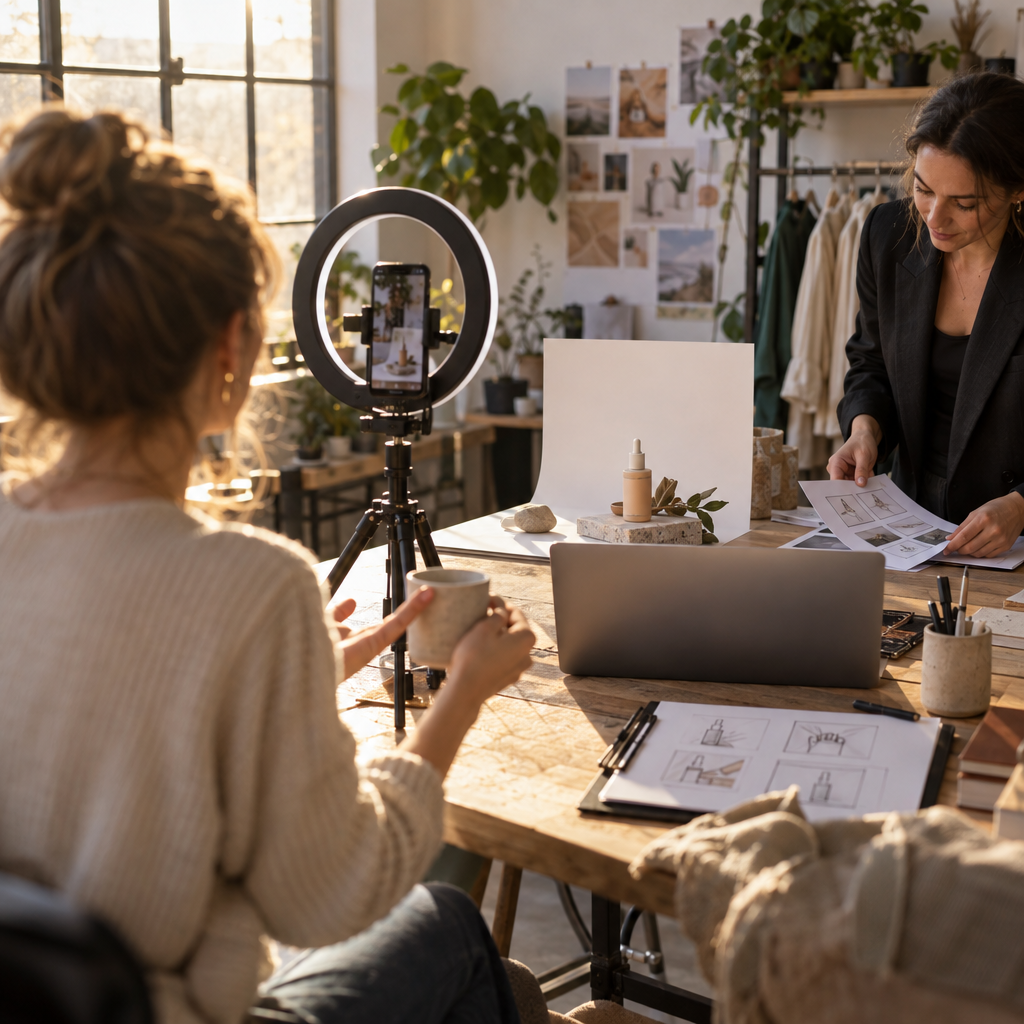
TikTok’s academy guidance is refreshingly unglamorous. It recommends that you prepare the product and props, film in a clean well-lit setting, use edits and text overlays to stress key features, and add relevant hashtags and keywords for discovery. That is a checklist your creators can follow without a production crew.
From experience, four additions help most:
- Hands and product in the same frame. It signals authenticity and shows scale.
- On-screen text for the sound-off viewer. One feature per overlay, not a paragraph.
- A creator face early. Showing a real person using the product within the first moments humanizes the ad.
- Real-use settings. A kitchen demo beats a studio demo for a kitchen product.
Resist the urge to over-edit. Fast cuts can imply the product works faster or better than it does, which brings us to the part many brand teams skip.
Claims and disclosure: where demos get brands in trouble
A demo is visual evidence. If a creator pours coffee through a “5-second” brewer after a hidden pre-heat, you have a problem. Quietly speeding up footage or skipping steps can turn a demo into a misleading claim.
Build a claims check into the brief. Our guide on demo claims that survive legal goes deeper. At minimum:
- Require that the on-screen result is typical or labeled as not typical.
- Ban time-lapses and cuts that hide steps affecting the outcome.
- Match the product shown to the listing. Rend’s shop video guide, for instance, warns that the product on screen must match the listing.
- Pre-approve any performance language, such as “lasts all day.”
Disclosure is the second leg. The FTC states that if there’s a connection between an endorser and the marketer that a significant minority of consumers wouldn’t expect, it should be disclosed clearly and conspicuously. In its words, the same is usually true if the endorser has been paid or given something of value. Read the full FTC endorsement guidance and build its disclosure principle into your brief template.
Practical implication: the disclosure should sit in the video itself, in the first seconds, and not just in the caption. Free product counts. So does an affiliate commission.
Turning one demo into a testing system
One hero demo is a bet. Five variants are a test. TikTok’s guidance for Product GMV Max supports this approach. It recommends auto-select videos, which explores all existing and future videos with no cap, and says that affiliate videos often perform better and improve incremental GMV. The more usable creator videos in the library, the more the system can learn from.
Vary one thing at a time:
- The hook (problem statement versus visual payoff).
- The creator (different age, setting, or niche).
- The proof moment (before the close versus after).
- The offer framing (bundle versus discount).
Mind your campaign settings so the test is clean. TikTok’s Product GMV Max best practices give a recommended budget formula of 2 × historical non-LIVE GMV ÷ ROI target, and advise keeping each ROI setting for at least three full days before making adjustments. Changing ROI targets mid-test muddies your creative read. Once results stabilize, raise budgets gradually rather than doubling them overnight.
Make sure your rights cover this. Paid use of creator content needs usage terms that include Spark Ads or partnership authorization, plus a window long enough to learn and scale. Negotiate that up front, not after a winner appears.
Pairing demos with adjacent formats
A demo rarely works alone. Use it as the anchor and surround it with formats that handle other objections:
- When shoppers ask “how does it compare?”, a versus video handles it.
- When comments fill with doubts, a comment reply video turns objections into content.
- When the product changes how something looks, a transformation reveal adds the outcome.
- When you want tap-through on specific features, shoppable hotspots make the demo interactive.
Each one reuses footage and creator relationships you already paid for. That is the operational efficiency play: shoot once, cut four ways, test everywhere.
A brief template you can steal
Keep the creator brief to one page. Include the product’s three provable benefits, the one claim you cannot make, the required disclosure wording, the hook options, the usage window, and the link or anchor instructions. Then give creators room to demonstrate in their own kitchen, garage, or desk.
Next step: pick your best-selling product with a visible “how does it work” question, brief three creators on the four-beat structure, and run the three demos against each other for at least three full days before you touch the ROI target.
FAQs
What is a creator-led product demonstration video?
It is a video in which a creator shows a product being used in real conditions, highlights its benefits, and points viewers to a purchase action. TikTok Shop’s academy lists it as one of several shoppable video types and recommends keeping the product front and center.
How long should a product demo for a shop ad be?
Long enough to show the proof, and no longer. Put the product or problem in the first three seconds, then let the real-use moment run. Test a short and a longer cut of the same demo rather than guessing.
Do creators have to disclose partnerships in demo videos?
Yes, when a material connection exists. The FTC says a connection that a significant minority of consumers would not expect should be disclosed clearly and conspicuously, and that payment or free product usually qualifies. Put the disclosure in the video itself, not only the caption.
Which products suit demonstration videos best?
TikTok Shop’s academy says the format works especially well for electronics, DIY and crafts, and fashion. In general, products with a visible function, a learning curve, or a “does it really work” question are the strongest fit.
How many demo variants should we test?
Start with three to five, changing one variable at a time, such as the hook or the creator. Keep your ROI target stable for at least three full days so results reflect the creative and not the settings.
Should we use creator videos or brand-made videos in shop ads?
Use both, but weight toward creators. TikTok’s Product GMV Max guidance says affiliate videos often perform better and improve incremental GMV. Brand-made videos still help fill gaps in your creative library.
Top Influencer Marketing Agencies
The leading agencies shaping influencer marketing in 2026
Agencies ranked by campaign performance, client diversity, platform expertise, proven ROI, industry recognition, and client satisfaction. Assessed through verified case studies, reviews, and industry consultations.
Moburst

-
2

The Shelf
Boutique Beauty & Lifestyle Influencer AgencyA data-driven boutique agency specializing exclusively in beauty, wellness, and lifestyle influencer campaigns on Instagram and TikTok. Best for brands already focused on the beauty/personal care space that need curated, aesthetic-driven content.Clients: Pepsi, The Honest Company, Hims, Elf Cosmetics, Pure LeafVisit The Shelf → -
3

Audiencly
Niche Gaming & Esports Influencer AgencyA specialized agency focused exclusively on gaming and esports creators on YouTube, Twitch, and TikTok. Ideal if your campaign is 100% gaming-focused — from game launches to hardware and esports events.Clients: Epic Games, NordVPN, Ubisoft, Wargaming, Tencent GamesVisit Audiencly → -
4

Viral Nation
Global Influencer Marketing & Talent AgencyA dual talent management and marketing agency with proprietary brand safety tools and a global creator network spanning nano-influencers to celebrities across all major platforms.Clients: Meta, Activision Blizzard, Energizer, Aston Martin, WalmartVisit Viral Nation → -
5

The Influencer Marketing Factory
TikTok, Instagram & YouTube CampaignsA full-service agency with strong TikTok expertise, offering end-to-end campaign management from influencer discovery through performance reporting with a focus on platform-native content.Clients: Google, Snapchat, Universal Music, Bumble, YelpVisit TIMF → -
6

NeoReach
Enterprise Analytics & Influencer CampaignsAn enterprise-focused agency combining managed campaigns with a powerful self-service data platform for influencer search, audience analytics, and attribution modeling.Clients: Amazon, Airbnb, Netflix, Honda, The New York TimesVisit NeoReach → -
7

Ubiquitous
Creator-First Marketing PlatformA tech-driven platform combining self-service tools with managed campaign options, emphasizing speed and scalability for brands managing multiple influencer relationships.Clients: Lyft, Disney, Target, American Eagle, NetflixVisit Ubiquitous → -
8

Obviously
Scalable Enterprise Influencer CampaignsA tech-enabled agency built for high-volume campaigns, coordinating hundreds of creators simultaneously with end-to-end logistics, content rights management, and product seeding.Clients: Google, Ulta Beauty, Converse, AmazonVisit Obviously →