


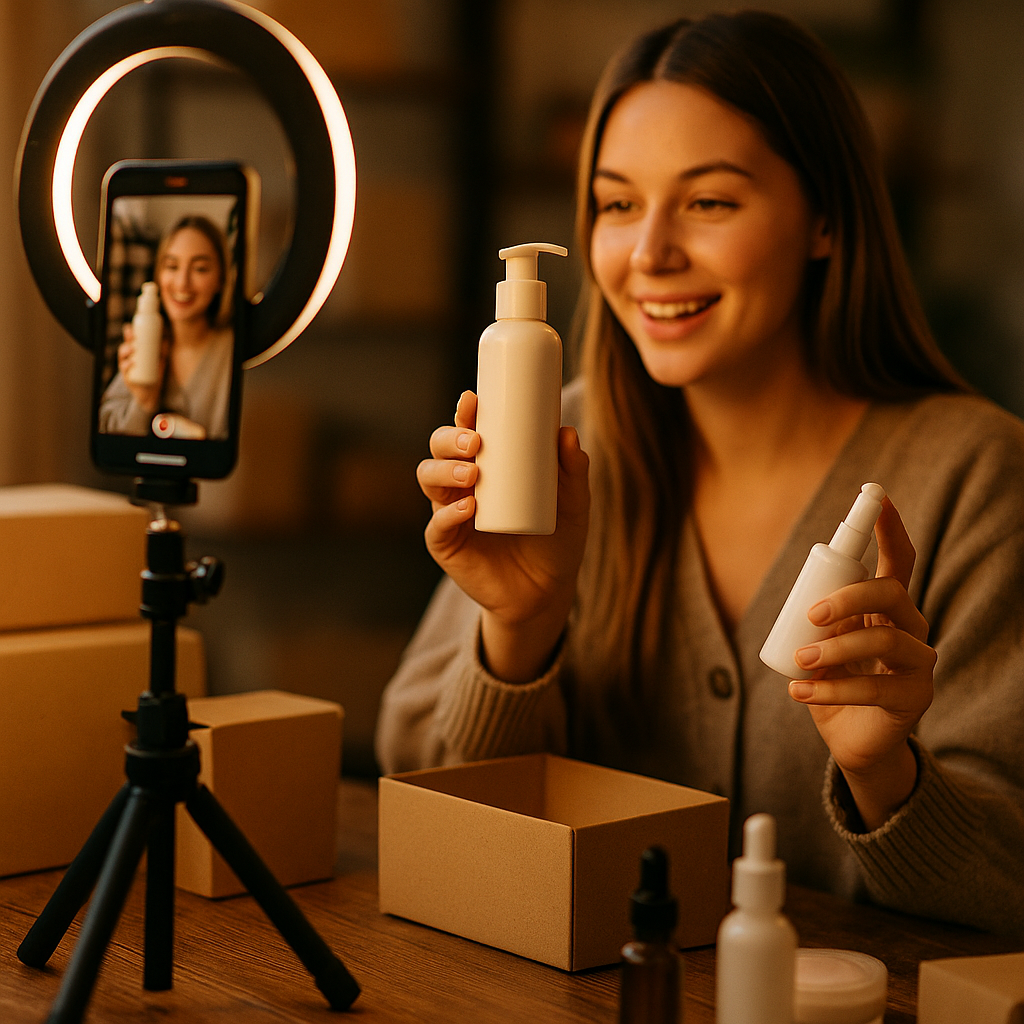
Many D2C teams assume profitable growth requires big creators and bigger budgets. This case study: a D2C brand that scaled profitably using only nano-influencers shows the opposite: small, trusted voices can outperform celebrity reach when the system is engineered for measurement, repeatability, and conversion. You’ll see the exact operating model, numbers, and templates behind the scale—and why most brands miss the compounding effect.
Background & goals for a profitable D2C growth strategy
Brand: LumenLeaf, a D2C skincare line focused on barrier-repair moisturizers and gentle actives. The founders had credible product expertise (a cosmetic chemist and an operator from a subscription commerce brand), but limited paid media appetite after rising CPM volatility.
Starting point (January 2025):
- Monthly revenue: ~$120,000
- Blended gross margin: 71%
- Paid media spend: $18,000/month with inconsistent CAC
- Influencer activity: ad hoc seeding, no tracking discipline
Goal: Reach $500,000+ monthly revenue while maintaining profitable unit economics: a first-order contribution margin above 20% and a 60-day payback period. The team decided to build an influencer engine that behaved like a performance channel, not a branding experiment.
Why nano-influencers only: LumenLeaf’s best customers asked detailed ingredient questions and trusted peer-like creators. The team hypothesized that small creators would deliver higher conversion rates and more durable content usage rights per dollar than larger talent.
Operational constraint: One influencer manager, one part-time analyst, and a fixed monthly budget cap of $35,000 for influencer-related costs (product, fees, shipping, software).
Creator selection & nano-influencer marketing strategy
Definition used: Nano-influencers were creators with ~1,000–10,000 followers on TikTok/Instagram, plus a “proof of community” requirement: visible comment conversations and non-recycled content formats.
Secondary keyword focus: nano-influencer marketing strategy means choosing creators like you’d choose sales reps—based on fit, credibility, and repeatable performance—not follower count.
The sourcing system (repeatable weekly loop):
- Build a “customer-lookalike” feed: The team searched terms like “barrier repair,” “perioral dermatitis,” “retinol sandwich,” and “eczema-friendly routine,” then saved creators whose audience asked technical questions.
- Score creators in 3 minutes: Each creator received a 0–5 score in four categories: authenticity, skincare relevance, comment quality, and on-camera clarity. Only creators with 16/20+ advanced to outreach.
- Prioritize under-monetized creators: Preference for creators with low sponsorship density (few “#ad” posts). These creators typically negotiated simpler deals and produced more candid testimonials.
Outreach message framework (kept plain on purpose):
- Why them: one sentence referencing a specific video and what the team learned from it
- Offer: free product + fixed fee option, or product-only trial with performance bonus
- Clarity: deliverable count, key claims to avoid, usage-rights request
- Tracking: unique code + link, and permission to whitelist top posts as ads
Compliance and trust: LumenLeaf required clear disclosure, avoided medical claims, and provided a one-page “claims guardrail” sheet reviewed by the founder-formulator. This reduced takedowns and kept creators comfortable answering audience questions.
Campaign design & micro-influencer content system
Even with nano creators, the team borrowed best practices from larger creator programs: strong briefs, fast feedback, and rigorous creative testing. The difference was that the brand avoided over-scripting. The goal was credible peer education, not polished commercials.
Secondary keyword focus: A micro-influencer content system can be engineered to produce dozens of variation-rich assets without sacrificing authenticity.
The content architecture (3 pillars):
- Problem-first stories: “My skin barrier was wrecked—here’s what changed.” These drove the highest saves and long-tail comments, signaling buyer intent.
- Routine integration: “Where this fits in my AM/PM routine.” This reduced return risk and increased AOV via bundles.
- Ingredient explanation: Short, practical ingredient callouts (ceramides, panthenol, colloidal oats) with founder-provided accuracy notes.
Brief structure (one page):
- Non-negotiables: disclose partnership; avoid “heals” language; show texture; mention who it’s for
- Creative freedom: hook, filming style, and personal story left to creator
- CTA options: code on screen; “comment ‘routine’ for my steps”; link in bio
Posting cadence: Each creator delivered 2 posts in 14 days. The brand asked for one “raw” talk-to-camera video and one routine/in-use clip. This doubled testing speed while keeping workload manageable.
Repurposing plan (built-in): Every deal included 90-day usage rights for brand reposting. Top posts were cut into paid social ads (whitelisting) only after they proved conversion organically, keeping creative spend efficient.
Measurement framework & influencer ROI tracking
Nano-influencers only work as a scalable channel when measurement is strict. LumenLeaf treated each creator like a campaign cell with standardized inputs and outputs.
Secondary keyword focus: influencer ROI tracking requires triangulation—because no single attribution method is perfect.
The tracking stack (simple, enforceable):
- Unique discount code per creator (10% baseline; 15% for launch windows)
- Unique UTM link per creator driving to a dedicated landing page variant
- Post-level logging (date/time, hook type, format, product shown, claim angle)
- Holdout baseline using a “no-influencer” week each month to estimate organic lift
What the team measured weekly:
- Creator CPA: total cost (fees + product + shipping) divided by tracked new customers
- Contribution margin per creator: first-order gross profit minus creator costs and incremental fulfillment costs
- Lift signals: branded search, direct traffic, and “Add to Cart” rate changes during post windows
Decision rules (non-negotiable):
- Scale: creators with CPA below the brand’s target and strong comment intent (“Does this work for…?”) received a second month contract
- Fix: creators with good engagement but weak conversion were re-briefed with different landing pages or CTAs
- Cut: creators with poor content clarity or audience mismatch were removed quickly—no sunk-cost bias
How they answered the most common follow-up question—“What about dark social?” They assumed some sales would never track to codes. That’s why they compared post windows against holdout weeks and watched branded search changes. The goal wasn’t perfect attribution; it was reliable decision-making.
Profitability levers & D2C influencer seeding at scale
Seeding can quietly destroy margin if it’s treated like gifting without performance expectations. LumenLeaf kept seeding, but tightened it into a measurable pipeline.
Secondary keyword focus: D2C influencer seeding scales profitably when product cost, shipping, and follow-up are engineered like a sales funnel.
Two-track model:
- Track A: Performance trials (product-only + bonus) for creators with strong audience fit but unknown conversion. Bonus paid only after a minimum number of tracked first-time customers.
- Track B: Paid partnerships for creators who already proved they can sell or whose content quality was consistently high.
Cost controls that protected margin:
- Seeding cap: 120 seeding kits/month, each with a defined maximum landed cost
- Bundle-first merchandising: creators pushed a “Barrier Reset Bundle” (higher AOV, better shipping economics)
- Post-purchase survey discipline: “Where did you hear about us?” choices included top creators, catching some dark social conversions
Landing page optimization for nano traffic: The team used a creator-specific landing page template with:
- the creator’s video embedded above the fold (with permission)
- a “who it’s for” checklist to reduce hesitation
- a simple routine diagram and ingredient FAQ
- subscription option shown after add-to-cart (not before), to avoid friction
Retention tie-in: To keep CAC payback short, customers acquired via creators received a “Day 7 routine check-in” email and a “How to avoid irritation” guide written by the founder-formulator. This reduced returns and increased second purchase rates—an EEAT-friendly move because it prioritized safe, accurate usage.
Results & scaling playbook for profitable influencer growth
By mid-2025, LumenLeaf had turned nano-influencers into its primary growth engine without sacrificing contribution margin.
Core results (after 6 months of execution):
- Monthly revenue grew from ~$120,000 to ~$540,000
- Influencer-driven new customers averaged ~3,200/month (tracked + modeled lift)
- Blended CAC decreased by ~38% versus the starting baseline
- First-order contribution margin stayed above the 20% target due to tighter seeding controls and higher AOV bundles
- Top-performing creators delivered repeatable performance across 3+ months, enabling planning rather than guesswork
What actually scaled: Not one viral video. The compounding came from a stable roster of ~80 active nano creators per month, with clear briefs, predictable posting windows, and ruthless measurement.
The playbook (what you can copy):
- Build a creator scorecard and only scale creators who hit both conversion and comment-intent thresholds.
- Use a two-post structure (story + routine) to test both emotion and usability.
- Standardize landing pages so creator traffic converts consistently.
- Lock in usage rights and turn proven organic posts into ads, avoiding expensive “ad-first” creative.
- Create a compliance guardrail sheet to protect trust and reduce risk in regulated categories.
Common follow-up: “When should we graduate to bigger influencers?” Only after you have (1) a reliable CPA benchmark from nanos, (2) a clear content format that consistently converts, and (3) fulfillment and support capacity to handle spikes. Otherwise, larger creators amplify inefficiencies.
FAQs: Nano-influencers, scaling, and profitability
-
What qualifies as a nano-influencer in 2025?
Most brands treat nano-influencers as creators with roughly 1,000–10,000 followers. More important than follower count is proof of trust: real comment conversations, consistent posting, and content that matches your customer’s problem and language.
-
How many nano-influencers do you need to scale a D2C brand?
It depends on your AOV, margins, and conversion rate, but scaling usually requires volume. LumenLeaf reached meaningful growth with a stable roster of dozens of active creators per month, not a handful. Plan for churn and build a pipeline that continuously replaces and upgrades creators.
-
Do nano-influencers work without paying fees?
Sometimes, but relying only on gifting makes performance unpredictable. A hybrid model works best: product-only trials with performance bonuses for testing, and fixed fees for proven creators. This aligns incentives while protecting margins.
-
How do you track ROI if people don’t use discount codes?
Use multiple signals: unique links, post-purchase surveys, and holdout weeks to estimate baseline sales. Your goal is consistent decision-making—identifying which creators and formats produce incremental customers—rather than perfect attribution.
-
What content formats convert best for nano-influencers?
Problem-first stories and routine integration typically convert well because they address both motivation and usage. Ingredient explainers can boost trust if they stay accurate and avoid exaggerated claims.
-
What’s the biggest mistake brands make with nano-influencer programs?
Treating them like a branding tactic instead of an operational channel. Without standardized briefs, tracking, landing pages, and decision rules, results look random and margins erode through uncontrolled seeding and inconsistent offers.
LumenLeaf’s experience shows that profitable scale doesn’t require celebrity influencers—it requires a system. By recruiting nano creators for audience fit, shipping a simple two-post brief, tracking ROI with disciplined rules, and turning proven posts into reusable assets, the brand grew revenue while protecting contribution margin. The clear takeaway: build a measurable nano-influencer engine, then let volume and consistency do the scaling.
Top Influencer Marketing Agencies
The leading agencies shaping influencer marketing in 2026
Agencies ranked by campaign performance, client diversity, platform expertise, proven ROI, industry recognition, and client satisfaction. Assessed through verified case studies, reviews, and industry consultations.
Moburst

-
2

The Shelf
Boutique Beauty & Lifestyle Influencer AgencyA data-driven boutique agency specializing exclusively in beauty, wellness, and lifestyle influencer campaigns on Instagram and TikTok. Best for brands already focused on the beauty/personal care space that need curated, aesthetic-driven content.Clients: Pepsi, The Honest Company, Hims, Elf Cosmetics, Pure LeafVisit The Shelf → -
3

Audiencly
Niche Gaming & Esports Influencer AgencyA specialized agency focused exclusively on gaming and esports creators on YouTube, Twitch, and TikTok. Ideal if your campaign is 100% gaming-focused — from game launches to hardware and esports events.Clients: Epic Games, NordVPN, Ubisoft, Wargaming, Tencent GamesVisit Audiencly → -
4

Viral Nation
Global Influencer Marketing & Talent AgencyA dual talent management and marketing agency with proprietary brand safety tools and a global creator network spanning nano-influencers to celebrities across all major platforms.Clients: Meta, Activision Blizzard, Energizer, Aston Martin, WalmartVisit Viral Nation → -
5

The Influencer Marketing Factory
TikTok, Instagram & YouTube CampaignsA full-service agency with strong TikTok expertise, offering end-to-end campaign management from influencer discovery through performance reporting with a focus on platform-native content.Clients: Google, Snapchat, Universal Music, Bumble, YelpVisit TIMF → -
6

NeoReach
Enterprise Analytics & Influencer CampaignsAn enterprise-focused agency combining managed campaigns with a powerful self-service data platform for influencer search, audience analytics, and attribution modeling.Clients: Amazon, Airbnb, Netflix, Honda, The New York TimesVisit NeoReach → -
7

Ubiquitous
Creator-First Marketing PlatformA tech-driven platform combining self-service tools with managed campaign options, emphasizing speed and scalability for brands managing multiple influencer relationships.Clients: Lyft, Disney, Target, American Eagle, NetflixVisit Ubiquitous → -
8

Obviously
Scalable Enterprise Influencer CampaignsA tech-enabled agency built for high-volume campaigns, coordinating hundreds of creators simultaneously with end-to-end logistics, content rights management, and product seeding.Clients: Google, Ulta Beauty, Converse, AmazonVisit Obviously →